
Simple soil tests are not enough to satisfy Singapore’s regulatory requirements for major construction projects, and many project teams learn this only after costly delays. Geotechnical investigation (SI) is a structured, multi-stage process that goes far beyond collecting a few samples from shallow depths. For buildings on challenging ground or those exceeding 30 storeys, incomplete SI can result in failed BCA submissions, expensive redesigns, and serious structural risk. This guide breaks down what proper SI involves, what Singapore’s regulations actually demand, and how developers and construction firms can use ground data to make better, faster project decisions.
Table of Contents
- What is a geotechnical investigation?
- Regulatory requirements for geotechnical works in Singapore
- Geotechnical investigation methods and best practices
- Challenges of limestone geology and mitigation strategies
- Turning site data into actionable project decisions
- What most project teams miss about geotechnical investigation
- Need support with Singapore geotechnical reports and submissions?
- Frequently asked questions
Key Takeaways
| Point | Details |
|---|---|
| SI goes beyond basic tests | Proper geotechnical investigation is much more comprehensive than simple soil sampling and is mandatory for large and complex projects. |
| Singapore enforces strict compliance | Regulatory approval depends on site-specific investigation, detailed reporting, and professional engineer endorsement. |
| Limestone zones require special care | Western Singapore sites face unique foundation risks that demand phased, risk-based site investigation and remediation. |
| Good SI informs sound design | Quality investigation data helps teams avoid costly failures and enables safe, cost-effective foundation choices. |
What is a geotechnical investigation?
Geotechnical investigation is the systematic process of characterizing subsurface conditions to support safe and compliant structural design. It is not the same as a simple soil test. A standard soil test might confirm the bearing capacity at a single point, but a full SI program maps soil layering, groundwater levels, rock profiles, and potential hazards across the entire site footprint.
The distinction matters because foundation design and safety in Singapore depend on accurate subsurface data. A geotechnical engineer uses SI findings to assess whether the ground can support the intended loads, identify risks such as soft clay layers, perched water tables, or underground cavities, and recommend appropriate foundation systems.
SI is typically needed at three project stages:
- Feasibility stage: Preliminary investigation to confirm whether the site is buildable and flag major risks early.
- Design stage: Detailed investigation to generate the data needed for structural and foundation design.
- Construction stage: Verification testing and monitoring to confirm that actual ground conditions match design assumptions.
The key deliverables from a full SI program include a factual site investigation report, a geotechnical evaluation report, foundation design recommendations, and a risk register identifying residual hazards. These documents are not optional extras. They form the technical backbone of any authority submission.
Understanding how soil interacts with structural elements is equally important. The soil-structure interaction guide provides useful context on how ground behavior directly influences structural performance and long-term building safety.
A geotechnical engineer does not just collect data. They interpret it, identify what it means for your specific structure, and translate findings into actionable design and risk management recommendations.
Regulatory requirements for geotechnical works in Singapore
Singapore’s Building Control Act and its subsidiary regulations define Geotechnical Building Works (GBW) as a distinct category of regulated construction activity. Under these rules, foundation works for buildings ≥30 storeys require a formal geotechnical report prepared and endorsed by an accredited geotechnical engineer.
The report must contain three core components:
- Site investigation results: Borehole logs, laboratory test data, in-situ test results, and groundwater records.
- Geotechnical evaluation: Interpreted soil and rock profiles, bearing capacity assessments, and settlement analysis.
- Design recommendations: Foundation type selection, pile specifications, monitoring requirements, and risk mitigation measures.
Beyond the 30-storey threshold, GBW status also applies to projects on sites with known challenging ground conditions, including reclaimed land, soft marine clay deposits, and limestone geology. Developers should not assume that a modest building height exempts them from SI obligations if the ground conditions are complex.
| Trigger condition | GBW status | Geotechnical report required |
|---|---|---|
| Building ≥30 storeys | Yes | Yes |
| Reclaimed land or soft clay | Yes | Yes |
| Limestone geology (western SG) | Yes | Yes |
| Standard ground, <30 storeys | Depends | Possibly |
Common submission pitfalls include incomplete borehole coverage, SI data that does not extend deep enough below the proposed pile toe, and reports that present raw data without adequate engineering interpretation. BCA reviewers expect clear evaluation and specific recommendations, not just data tables. Engaging BCA periodic inspection requirements knowledge early helps teams understand the full compliance picture before submission.
Key statistic: Projects that submit incomplete geotechnical reports face mandatory resubmission cycles that can add weeks or months to the approval timeline, directly impacting construction start dates and financing schedules.
Geotechnical investigation methods and best practices
Choosing the right investigation method is as important as conducting the investigation itself. Each method has specific capabilities and limitations, and best-in-class teams select a combination based on site geology, project scale, and identified risk zones.
| Method | Best use case | Limitation |
|---|---|---|
| Rotary boreholes | Deep soil and rock profiling | Point data only, no lateral continuity |
| Cone penetration test (CPT) | Continuous soil profiling, soft ground | Cannot penetrate hard rock or boulders |
| Trial pits | Shallow inspection, sampling | Limited to 3 to 5 meters depth |
| Geophysical survey | Cavity detection, lateral profiling | Requires calibration with boreholes |
For most Singapore projects, a combination of rotary boreholes and CPT provides the most reliable subsurface picture. Boreholes allow direct sampling and laboratory testing, while CPT delivers continuous resistance profiles that help interpolate conditions between borehole locations.
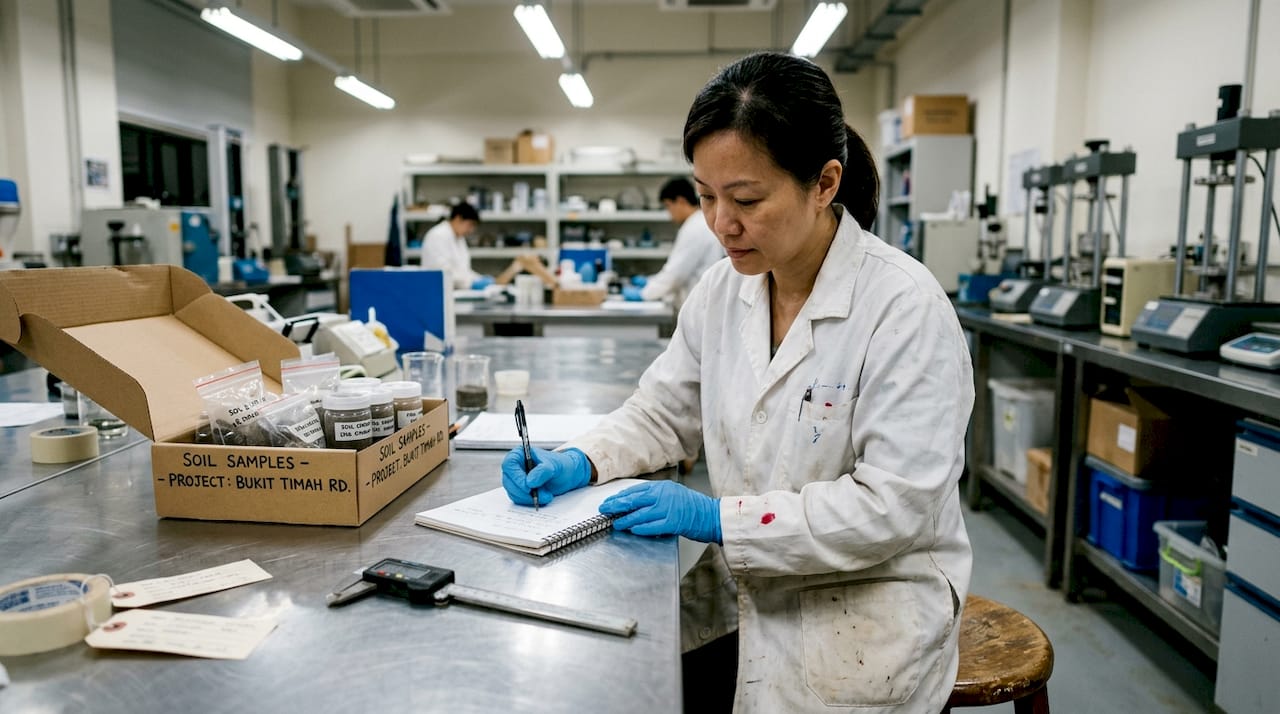
In limestone areas in western Singapore, the requirements are more demanding. Risk-based SI is required: boreholes and probe holes must extend to the influence zone below the pile toe, defined as the greater of 5 meters or three times the pile diameter. Where 25% or more of boreholes encounter limestone with cavities or slump zones, a geophysical survey becomes mandatory.
Pro Tip: Do not treat the SI program as a fixed scope item. Phase your investigation so that early findings from preliminary boreholes can inform where additional testing is most needed. This adaptive approach reduces total cost while improving data quality in high-risk zones.
Documentation standards matter as much as the testing itself. All borehole logs, test records, and laboratory certificates must be retained and submitted as part of the factual SI report. Engaging professional civil engineering expertise from the outset ensures that sampling protocols, testing frequencies, and documentation meet BCA expectations.
Challenges of limestone geology and mitigation strategies
Limestone geology in western Singapore presents risks that have no parallel in standard ground conditions. The rock mass is not uniform. It contains cavities, slump zones, and highly variable weathering profiles that can change dramatically over short horizontal distances. A borehole that finds solid rock at 20 meters may be just 5 meters away from a cavity that extends through the entire pile bearing zone.
The primary risks include:
- Cavity collapse: Voids within the limestone can collapse under pile installation loads, causing sudden and unpredictable pile displacement.
- Reduced pile capacity: Cavities reduce pile capacity, making standard pile design assumptions unreliable without verification.
- Slump zones: Weathered, disaggregated material within the limestone profile behaves more like soil than rock, undermining assumed end-bearing conditions.
Verification requires a phased approach. Initial boreholes establish the general rock profile. Probe holes then target specific pile locations to verify conditions at the exact founding level. Where cavities or slump zones are identified, grouting is required before piling proceeds.
Skipping verification probes to save time is a false economy. A single undetected cavity can trigger pile failure, triggering redesign, re-piling, and regulatory scrutiny that costs far more than the original investigation.
Pro Tip: For sites in Jurong or Bukit Timah limestone zones, engage your geotechnical engineer before site acquisition if possible. Early SI data can inform purchase price negotiations and prevent costly surprises during detailed design.
Remediation strategies include pre-treatment grouting to fill cavities before piling, phased construction monitoring to detect anomalies during installation, and ongoing instrumentation to track any post-construction settlement. Selecting appropriate low-impact foundation systems can also reduce the load demands placed on uncertain ground, lowering overall risk exposure.
Turning site data into actionable project decisions
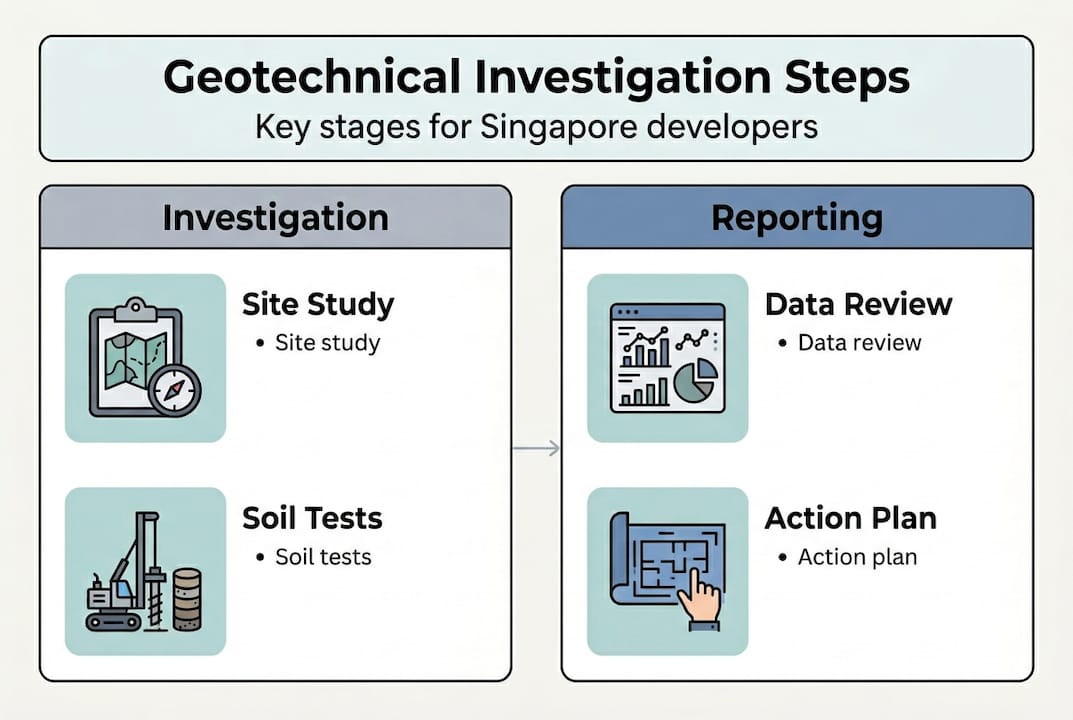
Geotechnical data has direct commercial and regulatory value when it is properly interpreted and applied. The transition from raw SI results to project decisions follows a clear sequence.
- Foundation system selection: SI data determines whether spread footings, raft foundations, driven piles, or bored piles are appropriate. This choice affects both structural performance and construction cost.
- Risk mitigation planning: Identified hazards, such as soft clay layers or cavities, require specific mitigation measures that must be documented in the geotechnical report and reflected in the construction method statement.
- Project cost estimation: Accurate SI reduces pricing uncertainty. Contractors can price foundation works more precisely when ground conditions are well characterized, reducing contingency allowances.
- Regulatory submission preparation: Geotechnical reports must include SI results, evaluation, and design recommendations before BCA will approve foundation works.
| SI finding | Recommended action | Regulatory implication |
|---|---|---|
| Soft clay layer >3m thick | Raft or pile foundation, settlement monitoring | Must be documented in GBW report |
| Limestone cavity detected | Grouting, verification probes | Phased approval required |
| High groundwater table | Dewatering plan, waterproof basement design | PUB and BCA coordination |
| Rock at shallow depth | Consider socketed piles or rock anchors | Adjust pile schedule in submission |
When reviewing a geotechnical report before submission, check that every identified risk has a corresponding recommendation, that the SI coverage is sufficient for the building footprint, and that the geotechnical engineer’s endorsement is current. Gaps at this stage invite BCA queries that delay approval. Using the data to optimize minimizing foundation material choices can also reduce cost without compromising structural integrity.
What most project teams miss about geotechnical investigation
The most persistent problem we observe is the checkbox mindset: teams commission the minimum SI required to satisfy a submission checklist, then move on. This approach meets the letter of the regulation but consistently exposes projects to avoidable risk. Ground conditions do not respect minimum standards.
Phased, site-responsive investigation is a fundamentally different approach. It treats early findings as intelligence that shapes subsequent investigation decisions. When a preliminary borehole reveals unexpected soft layers, a responsive team expands coverage in that zone rather than proceeding with the original fixed scope. This reduces rework, prevents redesign during construction, and produces geotechnical reports that BCA reviewers approve with fewer queries.
The deeper point is that SI is an asset, not a cost line item. The data it generates informs foundation design, construction methodology, risk allocation in contracts, and long-term monitoring requirements. Teams that treat ground investigation as a genuine investment consistently build safer, more resilient structures and navigate regulatory approval more efficiently. Incorporating erosion control insights alongside SI planning also strengthens the overall site risk management framework, particularly on sloped or disturbed sites.
Need support with Singapore geotechnical reports and submissions?
Navigating BCA’s geotechnical requirements demands both technical depth and regulatory familiarity. Getting the scope right, the report structure correct, and the professional endorsements in order requires experience across many project types and ground conditions.

AEC Technical Advisory Singapore provides specialist support across the full geotechnical workflow, from SI program design and field supervision through to report preparation and PE endorsement submissions for authority review. Whether you are managing a high-rise development on limestone geology or a mid-scale project on reclaimed land, our civil engineering services team can help you secure approvals efficiently and with confidence. Contact us for site-specific guidance or direct submission assistance tailored to your project’s ground conditions and regulatory obligations.
Frequently asked questions
When is geotechnical investigation compulsory in Singapore?
Geotechnical investigation is compulsory for all major construction works, particularly buildings ≥30 storeys or projects on challenging ground such as reclaimed land or limestone zones, as defined under BCA’s Geotechnical Building Works regulations.
What are the risks of skipping proper geotechnical investigation?
Incomplete SI can result in foundation failures, expensive redesigns, and failed regulatory approval. In limestone zones specifically, incomplete investigation increases risk to structural safety and compliance, particularly where undetected cavities reduce pile capacity.
How do developers address limestone risk zones?
Developers must carry out risk-based SI using boreholes, probe holes, and geophysical surveys, then implement grouting where cavities are found. Phased SI and grouting before piling is the standard requirement for western Singapore limestone areas.
What does a standard geotechnical report include?
A compliant report contains SI results, soil and rock evaluation, risk assessment, and foundation design recommendations. Under BCA regulations, SI results, evaluation, and recommendations must all be prepared and endorsed by an accredited geotechnical engineer.
Recommended
- Performance-Based Seismic Design for Tall Buildings SG
- Erosion Control Measures in Singapore: A Comprehensive Guide by Qualified Erosion Control Professionals (QECP) – AEC Technical Advisory Singapore Engineering Consultancy
- Civil Engineer’s Definitive Guide to Sustainable Drainage Systems
- SS EN 1992-1-1:2024: Singapore PE’s Guide to Eurocode 2