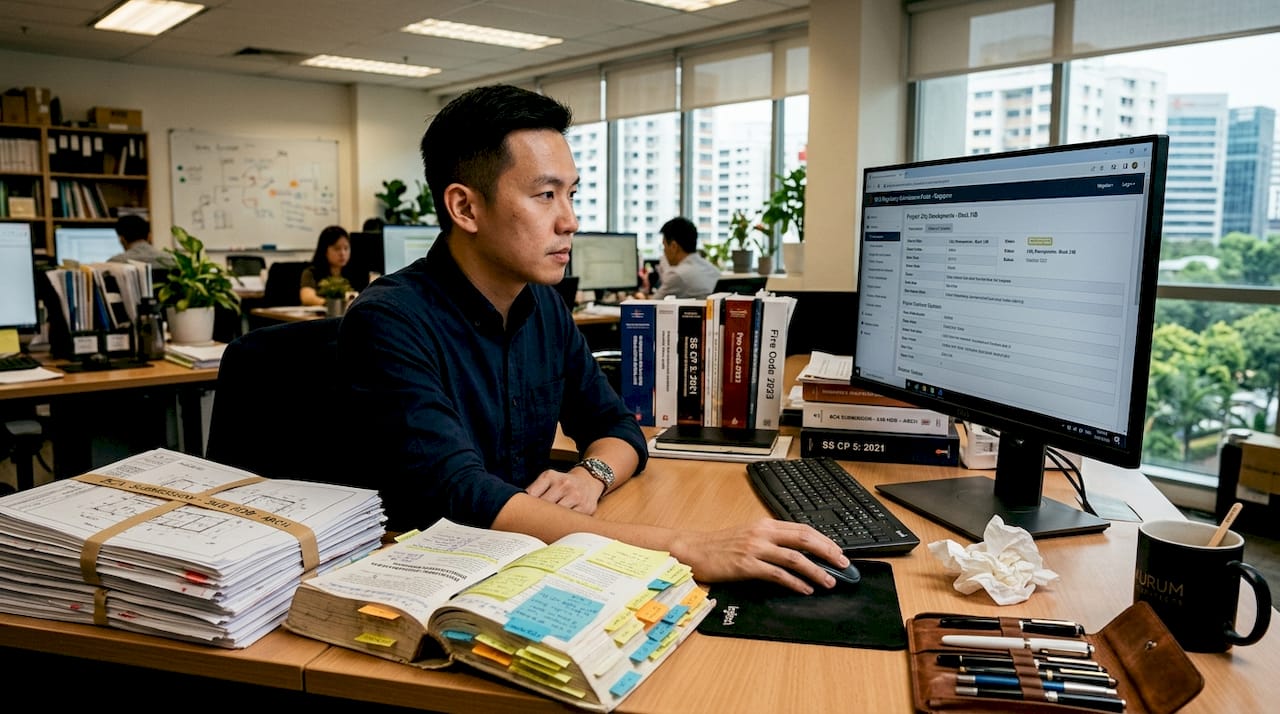
Project developers and construction firms in Singapore frequently underestimate how much a single regulatory misstep can cost. A rejected Building and Construction Authority submission, an incomplete fire safety plan, or a geotechnical report that fails to meet specifications can halt a project for months and trigger significant financial penalties. Consultancy firms are often the decisive factor separating projects that proceed smoothly from those that stall at critical approval stages. This guide examines what consultancy firms genuinely do, how they navigate Singapore’s layered regulatory environment, and how they drive quality, innovation, and sustainability across the full project lifecycle.
Table of Contents
- What do consultancy firms really do?
- Navigating Singapore’s complex regulatory environment
- Driving quality, innovation, and standards in project delivery
- Championing sustainability and future-ready construction
- A new perspective on the value of consultancy firms
- Connect with leading consultancy expertise in Singapore
- Frequently asked questions
Key Takeaways
| Point | Details |
|---|---|
| Consultants streamline compliance | Consultancy firms eliminate regulatory guesswork and help secure timely project approvals in Singapore. |
| Early involvement reduces risk | Bringing consultants on board from the start prevents costly errors and redesigns. |
| Expertise boosts innovation | Consultancy firms introduce new methods, materials, and technologies to elevate construction outcomes. |
| Sustainability guidance included | Consultants help integrate low-carbon and smart solutions to meet modern building standards. |
| Value for any project size | Projects of all scales benefit from expert consultancy input, not just large or complex developments. |
What do consultancy firms really do?
The most common misconception among project developers is that consultancy firms function primarily as regulatory intermediaries, submitting paperwork on behalf of clients and collecting fees for the privilege. This view misses the substantive technical value that qualified consultants bring to every phase of a construction project, from concept design through to final inspection and handover.
At their core, consultancy firms provide a structured combination of engineering design, technical validation, authority submissions, and compliance documentation. These services are not administrative tasks. They require deep knowledge of structural behavior, geotechnical conditions, material specifications, fire safety engineering, and the specific requirements of each Singapore regulatory authority. Consultancy firms offer essential support in regulatory submissions, technical assessments, and complex engineering solutions that protect both the project timeline and the developer’s investment.
Consider a scenario where a developer proceeds with a structural design without engaging a qualified consultant early. The design team may select a foundation system that appears cost-effective on paper but requires extensive modification once geotechnical investigations reveal unexpected soil conditions. By the time the issue surfaces during the Building and Construction Authority plan check, the project has already committed to procurement timelines and contractor mobilization. The redesign cost, combined with the approval delay, can easily exceed the total consultancy fee many times over.
The core services that reputable consultancy firms deliver include:
- Structural and geotechnical engineering design, including foundation selection, load analysis, and site-specific assessments
- Mechanical and electrical (M&E) engineering, covering HVAC, plumbing, electrical systems, and fire protection
- Authority submissions to BCA, SCDF, NEA, URA, JTC, LTA, and PUB, with full documentation packages
- Technical peer reviews, where independent engineers validate design assumptions and specifications
- Site inspection and quality assurance, ensuring construction work conforms to approved drawings and specifications
- Professional Engineer (PE) endorsement, a statutory requirement for structural, geotechnical, and certain M&E works in Singapore
Understanding professional engineers’ roles is critical for any developer, because PE endorsement is not optional. It is a legal requirement under the Building Control Act, and the PE bears statutory responsibility for the safety and compliance of endorsed works.
Pro Tip: Involve your consultants during the concept design phase, not after the schematic design is locked. Early engagement allows consultants to optimize structural systems, flag regulatory constraints, and align the design with authority requirements before costly commitments are made.
Navigating Singapore’s complex regulatory environment
Singapore’s construction regulatory framework is one of the most structured in the Asia-Pacific region. Multiple agencies govern different aspects of a single project, and each agency has its own submission format, technical standards, and review timeline. Managing this environment without specialist support is a significant operational risk.
The primary authorities that construction projects typically engage with include:
- Building and Construction Authority (BCA): Governs structural plans, building plan submissions, and construction quality under the Building Control Act. BCA requires PE-endorsed structural drawings, geotechnical reports, and detailed specifications before granting approval to commence structural works.
- Singapore Civil Defence Force (SCDF) and Fire Safety and Shelter Department (FSSD): Oversees fire safety provisions, including fire compartmentation, means of escape, sprinkler systems, and fire alarm installations. Fire safety plan submissions must comply with the Fire Safety Act and the relevant Singapore Standards.
- National Environment Agency (NEA): Regulates environmental compliance, including air quality, water discharge, and noise control. Consultancy firms facilitate PE endorsement, SCDF/FSSD, NEA, and environmental submissions, ensuring proper compliance with all Singapore agency requirements across the full project scope.
- Urban Redevelopment Authority (URA): Controls land use, plot ratio, building height, and urban design guidelines. Deviations from the Master Plan require formal applications, and consultants prepare the technical justifications needed to support these requests.
- Public Utilities Board (PUB): Manages drainage, sewerage, and water supply connections. Drainage impact assessments and sewerage capacity studies are standard requirements for most development projects.
Projects that engage qualified consultancy firms from the pre-submission stage report significantly shorter approval timelines and lower rates of resubmission compared to those relying solely on in-house teams. Industry data consistently shows that incomplete or non-compliant submissions are among the leading causes of project delays in Singapore’s construction sector.
Understanding Singapore building codes is not simply a matter of reading the relevant legislation. Each code references multiple subsidiary standards, agency-specific practice notes, and technical circulars that are updated periodically. Consultancy firms maintain current knowledge of these requirements and track regulatory changes that could affect ongoing projects.
The following table illustrates the practical difference between in-house submission efforts and consultancy-led submissions:
| Submission factor | In-house team | Consultancy firm |
|---|---|---|
| Knowledge of current requirements | Partial, often outdated | Comprehensive and current |
| Submission completeness rate | Moderate | High |
| Average resubmission cycles | 2 to 3 cycles | 0 to 1 cycles |
| Authority liaison experience | Limited | Established relationships |
| Risk of non-compliance | Higher | Significantly lower |
| Approval timeline | Longer, variable | Shorter, more predictable |
Common PE submission problems include incomplete geotechnical data, missing load calculations, and drawings that do not conform to the current edition of the relevant Singapore Standard. Each rejection triggers a resubmission cycle that adds weeks to the approval timeline and may require additional investigation or redesign work.
The cost implications of non-compliance extend beyond submission fees. Regulatory penalties, stop-work orders, and the reputational damage associated with a failed inspection can affect a developer’s ability to secure future project approvals and financing. Consultancy firms provide a structured risk management function that protects the project from these outcomes.
Driving quality, innovation, and standards in project delivery
Beyond regulatory compliance, consultancy firms serve as technical anchors for project quality. Their involvement in peer reviews, specification development, and site inspections creates a layer of independent verification that internal project teams cannot objectively provide.
Technical peer reviews conducted by consultants examine structural assumptions, load combinations, connection details, and material specifications against both the design intent and the applicable code requirements. This process regularly identifies errors or optimization opportunities that would otherwise remain undetected until construction or, in the worst case, post-occupancy. Consultancy firms leverage cutting-edge engineering tools and expertise to deliver robust, innovative, and sustainable infrastructure projects that meet the highest technical standards.
Innovations introduced by consultancy firms in Singapore construction projects include:
- Advanced formwork systems: Consultants specializing in formwork quality and efficiency introduce climbing formwork, jump form, and table form systems that reduce construction cycle times and improve concrete surface quality
- High-performance concrete mixes: Specification of self-compacting concrete, ultra-high-performance concrete, and fiber-reinforced mixes for applications where standard concrete would require significantly thicker or more heavily reinforced sections
- Building Information Modeling (BIM) coordination: Consultants use BIM to identify clashes between structural, architectural, and M&E elements before construction, eliminating costly on-site modifications
- Prefabrication and Prefabricated Prefinished Volumetric Construction (PPVC): Consultancy firms with experience in advanced concrete technology guide developers through the structural design and regulatory requirements for modular construction systems that BCA actively promotes
The following table shows typical quality metrics observed before and after consultancy engagement on comparable Singapore construction projects:
| Quality metric | Without consultancy | With consultancy |
|---|---|---|
| Structural defect rate (per 100 elements) | 8 to 12 | 1 to 3 |
| Specification non-conformance incidents | Frequent | Rare |
| Rework cost as % of contract value | 3% to 6% | 0.5% to 1.5% |
| Final inspection pass rate (first attempt) | 60% to 70% | 85% to 95% |
| Project completion within original schedule | 45% | 75% to 85% |
Pro Tip: When evaluating consultancy firms, request case studies from projects of comparable scale and complexity. Ask specifically about instances where their technical input prevented a defect or redesign, and quantify the cost avoidance. This gives you a concrete basis for assessing the return on consultancy investment.
Championing sustainability and future-ready construction
Singapore’s construction sector operates under an increasingly demanding sustainability framework. The Building and Construction Authority’s Green Mark scheme sets minimum environmental performance standards for new buildings, and the Singapore Green Plan 2030 establishes national targets for carbon reduction, energy efficiency, and resource conservation. Consultancy firms are central to helping developers meet these requirements without compromising project viability.
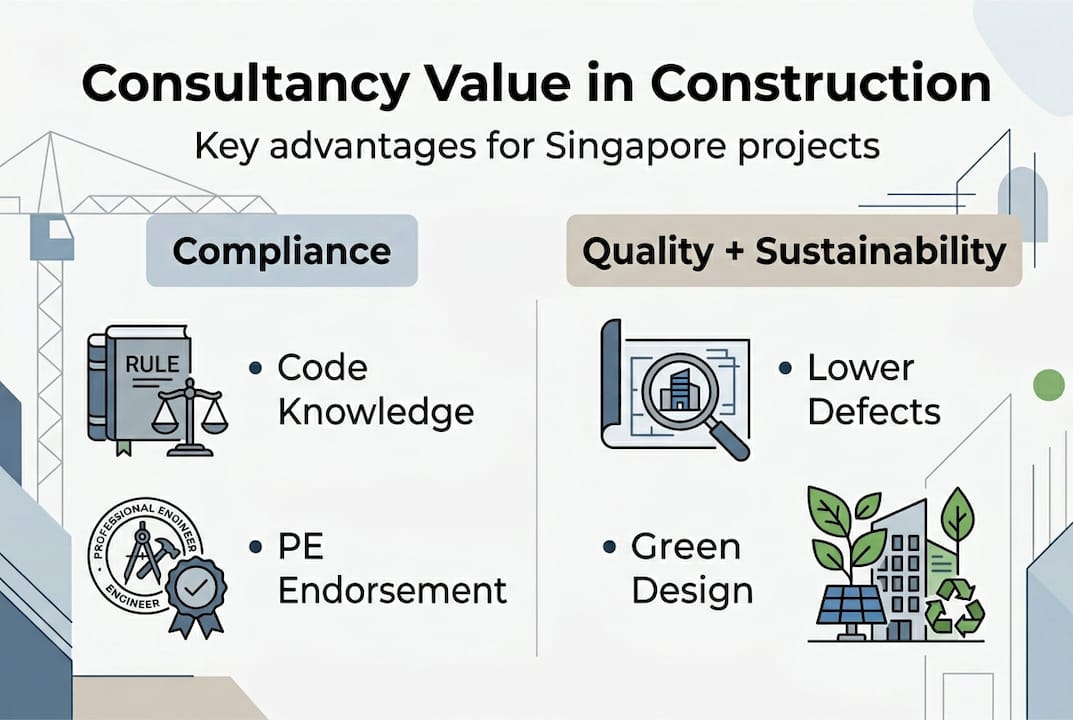
Consultancy firms play a key role in implementing sustainable construction practices, from low-carbon materials to renewable energy integration, across all project types and scales. This expertise is particularly valuable as Green Mark certification becomes a prerequisite for certain categories of government land sales and public sector projects.
Key sustainable services that qualified consultancy firms provide include:
- Low-carbon concrete specification: Replacing a proportion of ordinary Portland cement with supplementary cementitious materials such as ground granulated blast-furnace slag (GGBS) or fly ash, reducing the embodied carbon of structural elements by 20% to 40%
- Renewable energy system integration: Designing and specifying solar photovoltaic systems, including structural assessments for rooftop loading and renewable energy integration with the building’s electrical infrastructure
- Waste reduction strategies: Implementing construction waste management plans that comply with NEA requirements and identify opportunities for material reuse and recycling on-site
- Energy modeling and simulation: Using software tools to optimize building envelope performance, HVAC system selection, and lighting design to minimize operational energy consumption
- Water efficiency design: Specifying low-flow fixtures, rainwater harvesting systems, and greywater recycling installations that contribute to Green Mark water efficiency credits
Statistical callout: Singapore’s BCA reports that the proportion of new building projects achieving Green Mark certification has grown substantially over the past decade, with the industry targeting 80% of all buildings meeting Green Mark standards by 2030. Consultancy firms with dedicated sustainability practices are positioned to help developers meet this target efficiently and cost-effectively.
When selecting a sustainability-focused consultancy for your next project, look for the following capabilities:
- Demonstrated experience with BCA Green Mark submissions across multiple certification tiers
- In-house or partnered expertise in energy modeling, carbon accounting, and life cycle assessment
- Knowledge of NEA environmental submission requirements for air quality, water discharge, and waste management
- Familiarity with JTC and LTA sustainability requirements for industrial and infrastructure projects
- A track record of integrating sustainability measures without exceeding the project budget or timeline
A new perspective on the value of consultancy firms
Most developers approach consultancy engagement as a compliance exercise, something required by regulation and best minimized in cost and scope. This perspective consistently produces worse outcomes than a strategic partnership model, where consultants are integrated into the project team from the earliest planning stages.
The projects that deliver the strongest outcomes, measured by schedule adherence, cost control, quality metrics, and regulatory approval speed, are those where the developer treats the consultancy firm as a technical co-owner of the project’s success. This means sharing project objectives, budget constraints, and risk tolerances openly, and giving consultants the authority to raise technical concerns without bureaucratic friction.
The compounding benefits of this approach are significant. Early consultancy involvement reduces the probability of costly redesigns. Established relationships with regulatory authorities accelerate approval timelines. Independent technical oversight reduces defect rates and rework costs. Over the lifecycle of multiple projects, developers who build strategic partnerships with engineering consultancy expertise consistently outperform those who treat consultancy as a transactional service.
The uncomfortable truth is that the developers who resist investing in quality consultancy support are often the same ones who absorb the largest cost overruns and schedule delays. The consultancy fee is not an overhead. It is risk capital deployed at the front end of the project to protect a far larger investment.
Connect with leading consultancy expertise in Singapore
Ready to make your next project more streamlined and future-proof? Here’s how we can help.
AECTechnicalSG provides end-to-end engineering consultancy services for construction and infrastructure projects across Singapore. From structural and geotechnical design to M&E engineering and authority submissions, our team brings the technical depth and regulatory knowledge your project requires.
Whether you need civil engineering consultancy for a complex structural challenge or PE submission support to navigate BCA, SCDF, NEA, or URA requirements, our consultants are ready to engage from the earliest project phase. Contact us to discuss your project scope, review our portfolio of completed submissions, and identify the consultancy services that will deliver the greatest value for your specific development.
Frequently asked questions
How do consultancy firms support regulatory submissions in Singapore?
Consultancy firms prepare all required submission documents, coordinate with regulatory agencies, and manage the review process to ensure projects achieve compliance with BCA, SCDF, NEA, URA, and other authority requirements. Submission and liaison services for environmental and construction compliance are a core function of established consultancy practices.
What’s the advantage of hiring a consultancy firm early in the project phase?
Early engagement allows consultants to shape the design in line with regulatory requirements, identify technical risks before they become costly problems, and establish submission timelines that align with the overall project program. Engaging consultants streamlines the entire engineering and approval process from the outset.
Can consultancies help with sustainable construction in Singapore?
Yes. Consultancy firms introduce low-carbon concrete mixes, design renewable energy systems, and provide the technical documentation required for BCA Green Mark certification. Consultancies advance sustainable construction through low-carbon solutions that reduce embodied and operational carbon without compromising structural performance.
How do I select a consultancy firm for my construction project?
Prioritize firms with demonstrated experience in the specific regulatory submissions your project requires, a transparent project management process, and a verifiable track record of delivering similar projects on schedule and within budget. Request references from comparable developments and review their submission success rates before making a final decision.
Do consultancy firms only assist with large projects?
No. Consultancy firms add measurable value across projects of all scales, from single-story industrial units to large-scale mixed-use developments. Smaller projects often benefit most from consultancy support because in-house teams at smaller firms typically have less regulatory experience and fewer resources to manage complex approval processes independently.
Recommended
- Professional Civil Engineering Services in Singapore – AEC Technical Advisory Singapore Engineering Consultancy
- 3D-Printed Structural Components in Singapore’s Construction Sector
- Advanced Concrete Technology for Durable and Sustainable High-Rise Construction in Singapore
- PPVC Structural Design, High-Rise Challenges, Singapore