
Design and build is frequently misunderstood in Singapore, even among developers and construction firms with years of project experience. Many assume it is simply a procurement style, when in reality it operates within a tightly layered regulatory environment shaped by BCA frameworks, CORENET submissions, and national productivity mandates. The consequences of misunderstanding this distinction are real: delayed approvals, failed tenders, and costly redesigns. This guide clarifies the concept, maps the full project workflow, and equips project teams with the compliance knowledge needed to deliver efficient, regulation-ready construction outcomes in Singapore.
Table of Contents
- What is design and build? Breaking down the concept
- Project workflow: From design to submission and approvals
- Regulatory compliance: BCA, plans submission, and grading
- Driving efficiency with digital tools and green building benchmarks
- A closer look: Why Singapore’s design and build approach sets a global example
- Take the next step with expert guidance
- Frequently asked questions
Key Takeaways
| Point | Details |
|---|---|
| Integrated project delivery | Design and build streamlines construction by uniting design and execution under one accountable entity. |
| Strict compliance is essential | Successful projects require BCA-licensed firms, proper grading, and specific regulatory submissions through platforms like CORENET. |
| Efficiency through technology | Leveraging digital tools and meeting Green Mark or Buildable Design Scores boosts both compliance and project outcomes. |
| Early expert engagement | Involving experienced consultants early helps avoid costly compliance pitfalls and accelerates approvals. |
What is design and build? Breaking down the concept
Design and build (D&B) places a single contracting entity in charge of both the design and construction phases of a project. This is fundamentally different from the traditional Design-Bid-Build model, where the developer first engages an architect or engineer to complete a design, then separately procures a contractor through competitive tender. With D&B, the contractor assumes responsibility for the entire delivery chain, from concept drawings through to physical completion.
In Singapore, understanding the building codes in Singapore that govern this arrangement is essential before any project mobilization. The approach is not mandated across all project types, but it is deeply embedded in public sector procurement and productivity frameworks. As the BCA CRS Registration Guidelines confirm, there is no single BCA directive that universally mandates D&B, but the model is embedded within the Contractors Registration System for public works and aligned with national productivity tools. Private projects adopt D&B voluntarily, though the incentives for doing so are significant.
Key differences between Design and Build vs. Design-Bid-Build:
| Factor | Design and Build | Design-Bid-Build |
|---|---|---|
| Accountability | Single entity | Split between designer and contractor |
| Workflow | Overlapping design and construction | Sequential phases |
| Regulatory touchpoints | Consolidated submissions | Multiple separate submissions |
| Risk allocation | Contractor holds design risk | Developer holds design risk |
| Speed to completion | Generally faster | Typically slower |
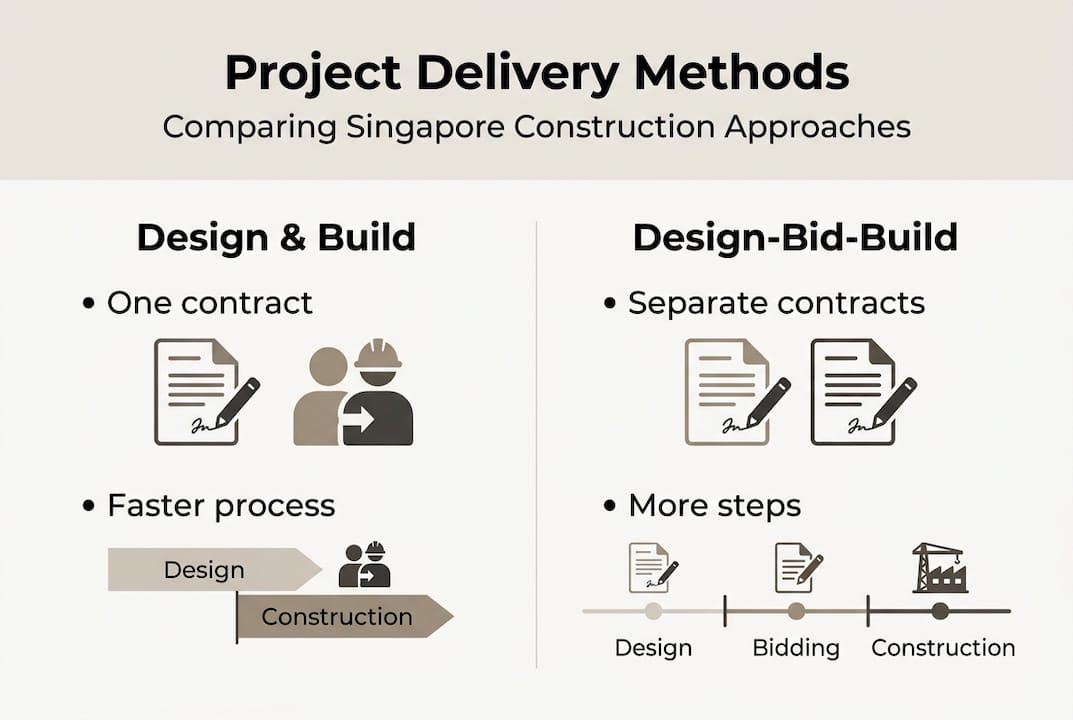
The benefits of the D&B model are well established: faster project delivery, single-point accountability, and more streamlined regulatory compliance. When one entity controls both design and construction, coordination errors between the architect and contractor are reduced, and compliance gaps are easier to identify early.
However, misconceptions persist. One of the most common:
“Is design and build always mandatory for public works in Singapore?” No. While D&B is the preferred delivery model for many public tenders and is tied to CRS registration requirements, it is not universally mandated. The model’s adoption depends on the project type, the procuring agency’s requirements, and the contractor’s CRS grading. For private developments, D&B remains voluntary but is increasingly favored for its efficiency advantages.
Proper construction fastening best practices and construction sequencing are also more effectively managed under D&B because the same entity that designs the structure is responsible for executing it, reducing coordination failures during the build phase.
Project workflow: From design to submission and approvals
Having defined design and build, let’s lay out the actual project workflow and spotlight the compliance gates unique to Singapore.
A well-executed D&B project in Singapore moves through four distinct stages, each with specific regulatory obligations and documentation requirements.
-
Developer brief and conceptual design. The developer issues a project brief covering scope, budget, and performance requirements. The D&B contractor begins conceptual design, engaging structural, architectural, and M&E engineers from the outset. Early integration of all disciplines prevents costly design changes later.
-
Integrated design finalization. The design team consolidates all drawings and calculations. At this stage, the structural design approval process begins in parallel with architectural finalization. Structural plans, geotechnical reports, and M&E schematics are coordinated into a single submission package.
-
CORENET submission. All plans, including structural (ST), architectural (Arch), and mechanical and electrical (M&E), are submitted through CORENET, Singapore’s electronic plan submission platform. BCA-licensed firms with appropriate grading are required to submit these plans, and compliance with Buildable Design Scores is mandatory for projects exceeding 5,000m² gross floor area (GFA). Green Mark scoring is assessed at this stage for applicable projects.
-
Approvals and regulatory clearances. After submission, agencies including BCA, URA, SCDF, and PUB review the plans. Approval timelines vary by project complexity and submission quality.
Typical submission milestones:
| Milestone | Documents Required | Responsible Party |
|---|---|---|
| Structural plan submission | ST drawings, PE endorsement | Licensed structural engineer |
| Architectural plan submission | Arch drawings, URA compliance | Qualified person (architect) |
| M&E plan submission | Mechanical, electrical schematics | Licensed M&E engineer |
| Buildable Design Score | BDS calculation report | D&B contractor or QP |
| Green Mark application | Sustainability documentation | Green Mark accredited professional |
Understanding PE endorsement requirements is non-negotiable at the submission stage. All structural plans must carry the endorsement of a licensed Professional Engineer registered with PEB Singapore, and any deficiency in this documentation triggers immediate rejection by BCA.
Pro Tip: Engage your structural and M&E consultants during the conceptual design phase, not after architectural drawings are finalized. CORENET rejections most frequently occur because structural and M&E inputs were retrofitted onto an architectural design rather than integrated from the start. Early consultant engagement reduces revision cycles and accelerates approval timelines by weeks.
Regulatory compliance: BCA, plans submission, and grading
With the general workflow clear, it’s crucial to zoom in on compliance, the make-or-break element for Singapore projects.
CRS registration is the first compliance gate for any firm seeking public sector D&B contracts. The Contractors Registration System, administered by BCA, classifies contractors by workhead and financial grade. CRS registration is mandatory for firms tendering for public works and for those employing foreign construction workers. Without the appropriate CRS registration, a firm cannot legally bid on government projects or access the foreign workforce quotas required for most large-scale construction.
The role of professional engineers in maintaining CRS compliance is significant. BCA grading is partly determined by the technical personnel a firm can demonstrate, including registered PEs and qualified persons on staff or retainer.
BCA grading determines the financial and project scope ceiling for each contractor. A firm graded at L4 in the CW01 workhead (general building) can tender for projects up to S$13 million, while an L6 firm has no financial ceiling. Grading is assessed based on paid-up capital, track record, and technical personnel qualifications. Firms that allow their grading to lapse or fail to renew CRS registration risk disqualification from active tenders, often at the worst possible moment in a project cycle.
Projects requiring Buildable Design Score and Green Mark compliance:
- All new building works with GFA exceeding 5,000m²
- Additions and alterations projects that increase GFA beyond the 5,000m² threshold
- Industrial, commercial, and residential developments subject to BCA sustainability requirements
- Projects seeking Green Mark certification (mandatory for certain building types under BCA’s Green Building Masterplan)
The design for safety standards framework also intersects with BCA compliance. All projects above a defined threshold must appoint a Design for Safety Professional (DfSP) to review and endorse the design from a workplace safety perspective, adding another layer of documentation to the CORENET submission package.
Regulatory signage requirements on construction sites are a parallel compliance obligation that D&B contractors must address, ensuring that safety and regulatory notices are correctly displayed throughout the project lifecycle.
Pro Tip: Pre-qualify for tenders by auditing your CRS registration, BCA grading, and PE personnel records at least three months before a tender closes. Many firms lose eligibility because a PE’s registration lapses or a CRS workhead is not renewed in time. A proactive compliance calendar prevents these avoidable disqualifications.
Driving efficiency with digital tools and green building benchmarks
Beyond compliance, Singapore’s push for digitalization and sustainability is transforming the way design and build projects are delivered.
Building Information Modeling (BIM) has become the backbone of efficient D&B project delivery in Singapore. BIM platforms allow structural, architectural, and M&E engineers to work within a shared digital model, identifying clashes and coordination errors before they become physical problems on site. For CORENET submissions, BIM-generated drawings carry a higher degree of accuracy and are less likely to trigger revision requests from reviewing authorities.
Singapore’s BIM compliance mandates require BIM submissions for projects above defined GFA thresholds, making early BIM adoption not just a productivity choice but a regulatory necessity. Firms that build BIM capability into their D&B workflow from the project outset gain measurable advantages: faster plan approval, fewer change orders during construction, and better cost predictability.
Key green building frameworks and their compliance impact:
- Green Mark certification: BCA’s green building rating system assesses energy efficiency, water conservation, indoor environment quality, and sustainable materials. Mandatory for new buildings above 5,000m² GFA and for major retrofits. Achieving higher Green Mark tiers (Gold Plus or Platinum) can accelerate BCA approval processing and may qualify projects for government incentives.
- Buildable Design Score (BDS): Measures how efficiently a building can be constructed using prefabricated or standardized components. A higher BDS score reflects greater use of Prefabricated Prefinished Volumetric Construction (PPVC) or Design for Manufacturing and Assembly (DfMA) methods. As confirmed by BCA submission requirements, projects over 5,000m² GFA must meet minimum BDS thresholds before plans are approved.
- Constructability Score: Related to BDS, this metric rewards designs that reduce labor intensity and improve site safety, both priorities under Singapore’s construction productivity agenda.
Use cases from recent Singapore projects illustrate the value clearly. D&B contractors who integrated BIM and DfMA from design stage reported significant reductions in on-site labor hours and faster regulatory approvals compared to traditionally delivered projects. The eco-friendly construction practices adopted in these projects also contributed to Green Mark scoring, creating a compounding compliance benefit.
Pro Tip: Integrate BIM, Green Mark planning, and BDS calculations from the first design workshop, not as separate workstreams added later. When these tools are aligned from day one, they reinforce each other, reducing the total documentation burden at submission and improving scores across all regulatory metrics simultaneously.
A closer look: Why Singapore’s design and build approach sets a global example
Singapore’s D&B ecosystem is frequently mischaracterized as overly bureaucratic by international practitioners unfamiliar with its structure. That characterization misses the point entirely. The regulatory architecture surrounding D&B in Singapore is not a barrier to innovation; it is the mechanism through which innovation is standardized and scaled.
Consider how the Buildable Design Score requirement effectively incentivized the construction industry to adopt prefabrication and DfMA methods at a pace that voluntary adoption never would have achieved. Firms that engaged early with these requirements did not simply comply; they built competitive advantages that now differentiate them in both public and private tender markets.
The same logic applies to Green Mark. What began as a sustainability certification has evolved into a project delivery framework that connects design decisions directly to operational cost outcomes for building owners. Developers who understand this connection treat Green Mark not as a compliance checkbox but as a value creation tool.
The hard-won lesson from years of working within this framework is that success belongs to firms that engage Singapore construction codes as a design input, not a post-design filter. Compliance experts brought in at the brief stage shape better projects. Those brought in at submission stage fix problems. The difference in project outcomes, timelines, and costs between these two approaches is substantial and measurable.
Take the next step with expert guidance
Navigating Singapore’s design and build landscape requires more than project management capability. It demands precise regulatory knowledge, licensed professional support, and a clear understanding of how BCA, CORENET, and sustainability frameworks interact across every project phase.
AECTechnicalSG provides specialized consultancy across the full D&B compliance spectrum, from design for safety consultancy and CRS pre-qualification support to Green Mark documentation and CORENET plan submissions. Whether your project requires professional engineering compliance help or a full service compliance review before tender submission, our licensed engineers and qualified persons are ready to support your team from concept through approval.
Frequently asked questions
Is design and build mandatory for all construction projects in Singapore?
No, design and build is not mandatory for all projects. As the BCA CRS Registration Guidelines confirm, D&B is embedded in public works procurement and CRS frameworks, but private projects adopt it voluntarily based on efficiency and accountability benefits.
What is the role of CORENET in the design and build process?
CORENET is Singapore’s mandatory digital platform for submitting architectural and structural plans to BCA and other authorities for regulatory approval. Submission via CORENET is required for all licensed firms handling plan approvals, and incomplete or non-compliant submissions result in rejection and project delays.
How does BCA grading affect firm eligibility for tenders?
A firm’s BCA grading directly determines the financial ceiling and project scope it can legally undertake, with BCA-licensed firms required to hold appropriate grading for each workhead. Firms without the correct grade are disqualified from tendering, regardless of technical capability.
What is the Buildable Design Score, and why is it important?
The Buildable Design Score measures how efficiently a building design can be constructed, with a focus on prefabrication and standardized components. Projects exceeding 5,000m² GFA must meet minimum BDS thresholds as a condition of plan approval, making it a critical compliance metric for most commercial and residential developments.
Recommended
- Streamline Singapore’s structural design process for fast approval
- Streamline M&E engineering workflow in Singapore: full guide
- Professional Civil Engineering Services in Singapore – AEC Technical Advisory Singapore Engineering Consultancy
- 3D-Printed Structural Components in Singapore’s Construction Sector