
A single missed limestone cavity in western Singapore can halt a bored pile installation for weeks, triggering contract penalties and emergency redesign costs that dwarf the original investigation budget. Project developers and construction firms operating under Singapore’s regulatory framework face a compounding challenge: ground conditions here are among the most variable in Southeast Asia, and the Building and Construction Authority (BCA) demands rigorous documentation at every stage. This guide provides a structured, step-by-step framework for geotechnical analysis that addresses Singapore-specific subsurface risks, satisfies BCA and GeoSS compliance requirements, and protects project timelines from the outset.
Table of Contents
- Understanding geotechnical risks in Singapore
- Essential preparations: Site investigation and data collection
- Step-by-step geotechnical analysis process
- Verification, compliance, and troubleshooting
- Our perspective: Why robust geotechnical analysis pays off in Singapore
- Get expert support for your next project
- Frequently asked questions
Key Takeaways
| Point | Details |
|---|---|
| Anticipate project risks | Unmanaged geotechnical risks in Singapore, like limestone cavities and marine clay, can threaten project success and compliance. |
| Prioritize targeted investigations | Use risk-based site investigations for cost-effective and regulation-ready project execution. |
| Follow local standards | Always align investigations, analysis, and documentation with BCA and GeoSS guidelines to ensure authority approval. |
| Use advanced analysis tools | Leveraging 3D and SSI modeling optimizes designs and supports defensible submission packages. |
Understanding geotechnical risks in Singapore
Singapore’s geology is deceptively complex beneath its urban surface. Two hazard categories dominate the risk landscape for foundation and excavation works: limestone cavities in the western region and soft marine clay deposits associated with the Kallang Formation across coastal and reclaimed areas. Both conditions demand distinct investigation strategies and design responses, and neither can be addressed adequately with a generic site investigation approach.
According to BCA guidelines, limestone cavities and slump zones pose direct risks to pile capacity and construction progress, with undetected cavities causing significant project delays and cost escalation. A cavity encountered mid-installation can require complete pile abandonment, cavity grouting, and re-drilling, which adds substantial time and expense to any program. The same guidelines confirm that marine clay in the Kallang Formation presents undrained shear strengths as low as 10 to 30 kPa in upper layers, creating basal heave risks during excavation and long-term settlement concerns for shallow and deep foundations alike.
These are not edge-case scenarios. They are routine conditions that experienced geotechnical engineers in Singapore encounter on a significant proportion of projects, particularly in Jurong, Buona Vista, and the reclaimed coastal belt.
| Soil type | Typical test required | Primary risk |
|---|---|---|
| Limestone (Bukit Timah) | Boreholes, probe holes, geophysical survey | Cavity collapse, pile capacity loss |
| Marine clay (Kallang) | Vane shear, triaxial, consolidation tests | Basal heave, settlement, slope instability |
| Old alluvium | SPT, CPT, permeability tests | Variable stiffness, groundwater ingress |
| Residual soils | SPT, index tests | Weathering variability, slope erosion |
Top three compliance pain points for developers:
- Insufficient borehole depth and spacing in limestone zones, resulting in BCA rejection of foundation design submissions
- Incomplete groundwater monitoring data, which undermines effective excavation support design
- Missing risk category documentation required under EC7 implementation guidelines for authority submissions
Critical note: Industry experience shows that undetected cavities in limestone areas can increase total foundation costs by 20 to 40 percent when discovered during construction rather than investigation. Early cavity detection through targeted geophysical surveys is not an optional enhancement; it is a cost-control measure.
Understanding these risks positions your team to engage site investigation essentials with the right scope and budget from day one. Equally, foundation selection strategies must account for subsurface variability before any structural design is finalized. Proper building safety fixings and structural connections also depend on accurate load transfer assumptions, which trace back directly to geotechnical data quality.
Essential preparations: Site investigation and data collection
A solid grasp of the challenges lets you prepare targeted site investigations. Effective site investigation in Singapore is not simply a matter of drilling boreholes to a standard depth and submitting a report. It requires a risk-based framework that calibrates investigation intensity to the specific hazards present, the foundation type proposed, and the consequence class of the structure.
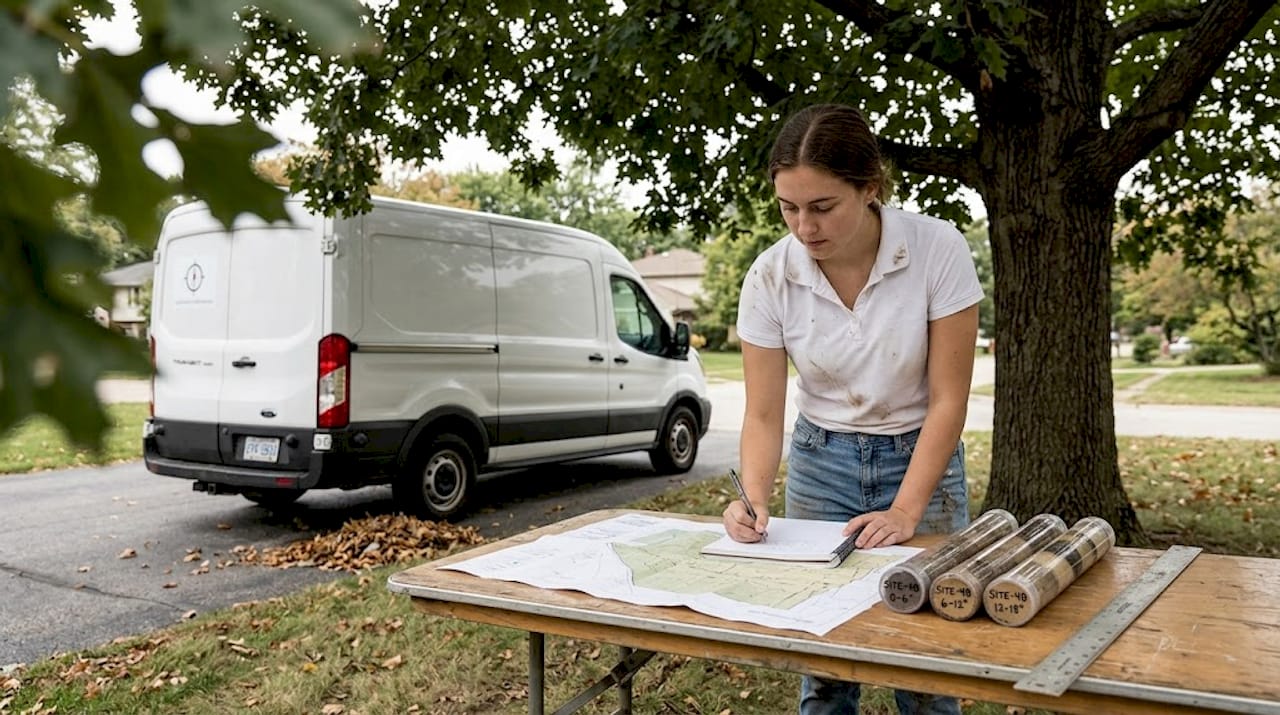
Per BCA requirements, site investigation for bored piles in limestone areas must include boreholes or probe holes extending to pile toe depth and the influence zone below, supplemented by geophysical surveys to map cavity distribution. This is a materially higher standard than what applies to sites on old alluvium or residual soils, and it reflects the genuine hazard that undetected voids present.
Data collection checklist for a compliant site investigation:
- Desk study: geological maps, historical land use records, previous investigation reports, utility records
- Borehole program: minimum depth to founding stratum plus influence zone, with appropriate spacing per risk category
- Probe holes: used to verify pile toe conditions in limestone zones between primary boreholes
- Geophysical survey: seismic refraction, resistivity, or ground-penetrating radar to identify cavity zones
- Groundwater monitoring: standpipe piezometers installed during investigation to establish seasonal fluctuation range
- Laboratory testing: index tests, shear strength, consolidation parameters, and chemical analysis where contamination is suspected
Comparison of investigation methods by risk scenario:
| Investigation method | Best application | Limitation |
|---|---|---|
| Rotary boreholes | Deep stratification, sampling, SPT | Point data only; misses cavities between holes |
| Probe holes | Limestone cavity confirmation at pile toe | Not suitable for soft clay characterization |
| Geophysical survey | Cavity mapping, bedrock profiling | Requires calibration with borehole data |
| CPT (cone penetration test) | Soft clay profiling, liquefaction assessment | Cannot penetrate hard rock or gravel |
Structured workflow for risk-based site investigation:
- Complete a preliminary desk study to identify geological zones, historical hazards, and any previous investigations on or adjacent to the site.
- Classify the site into a risk category based on foundation type, structure consequence class, and known geological hazards.
- Design the borehole and probe hole program with spacing and depth calibrated to the risk category and proposed foundation system.
- Commission geophysical surveys in parallel with borehole drilling to maximize spatial coverage within budget.
- Install groundwater monitoring instruments during fieldwork rather than as a separate mobilization.
- Compile all field data and laboratory results into a unified factual report before interpretation begins.
Pro Tip: Engaging a qualified person (QP) with geotechnical competency at the desk study stage, rather than after fieldwork, consistently reduces the number of BCA queries and supplementary investigation requests. Early QP involvement shapes the investigation scope to match submission requirements from the start.
Skipping deep investigation in limestone zones is the single most common and costly mistake on western Singapore projects. Sites in Jurong and Clementi have recorded cavities at depths exceeding 40 meters, well below standard investigation depths. For 3D geotechnical analysis to be meaningful, the subsurface model must be built on data that actually captures the hazard zone. Developers with access to civil engineering expertise early in the project lifecycle consistently avoid this category of error. Reliable site preparation at ground level also depends on understanding what lies beneath, particularly for temporary works design.
Step-by-step geotechnical analysis process
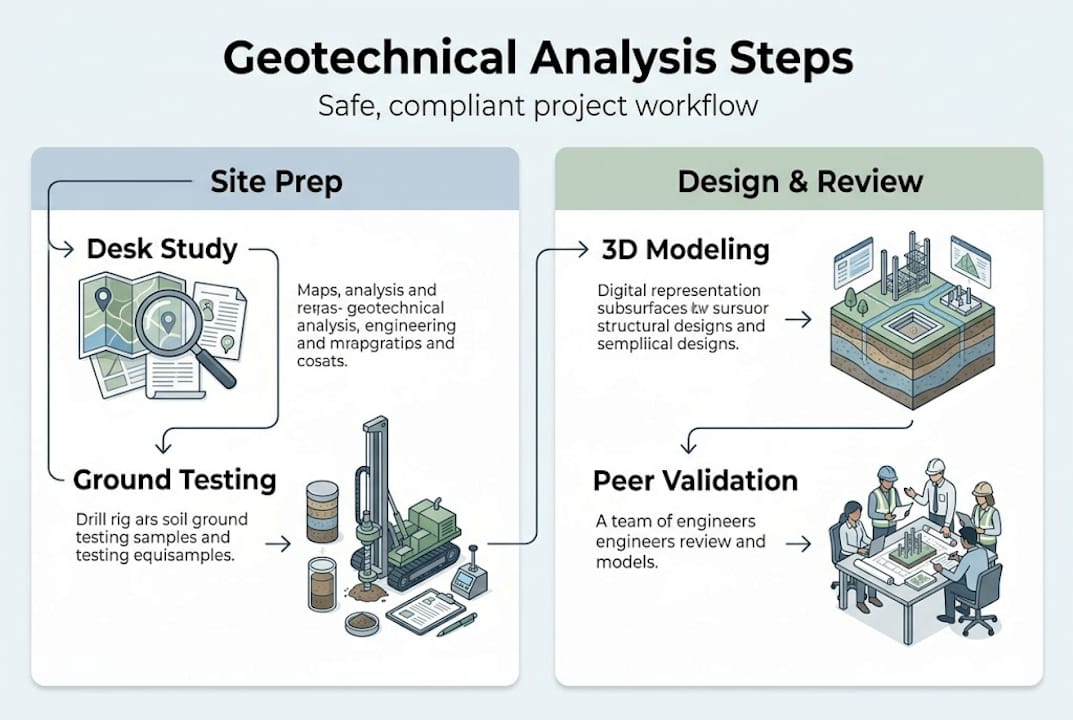
Armed with comprehensive site data, the next steps are rigorous analysis and interpretation in compliance with local standards. The analytical workflow transforms raw field and laboratory data into actionable design recommendations, and each step must be traceable for BCA submission purposes.
Core geotechnical analysis workflow:
- Data review and validation: Check borehole logs, laboratory reports, and geophysical outputs for consistency. Identify anomalies, such as unexplained SPT refusals or resistivity lows, that may indicate cavities or soft inclusions.
- Geotechnical model development: Construct a representative subsurface model defining soil and rock units, groundwater levels, and hazard zones. In limestone areas, this model must explicitly map cavity probability zones.
- Risk assessment: Assign risk categories to foundation elements based on proximity to identified hazards, consequence class, and uncertainty in the subsurface model.
- Design parameter derivation: Apply EC7 principles using characteristic values derived from statistical analysis of test data, not simply the most conservative single test result.
- Numerical modeling: For deep excavations, complex pile groups, or sites with soft clay, use finite element analysis to verify deformation predictions and support system adequacy.
- Design checks and documentation: Confirm that all limit states (ultimate and serviceability) are satisfied, and prepare a geotechnical design report that maps directly to BCA submission requirements.
- Cavity treatment plan (where applicable): For limestone sites, develop a grouting or void-filling strategy with trigger criteria for additional investigation during construction.
Statistic callout: Projects that proceed to pile installation without completing steps 1 through 4 above face a significantly elevated risk of encountering conditions that diverge from design assumptions. Industry data from Singapore construction projects indicates that foundation-related cost overruns are disproportionately concentrated in projects where the geotechnical model was developed from inadequate or misinterpreted data.
BCA and GeoSS guidelines explicitly require integration of 3D analysis for complex excavations, with designs optimized against EC7 implementation standards. PLAXIS 3D and similar finite element platforms allow engineers to model staged excavation, wall deflection, and ground settlement simultaneously, providing outputs that support both design optimization and regulatory submission. For SSI analysis best practices, the quality of soil-structure interaction modeling depends entirely on the accuracy of the geotechnical model developed in steps 1 and 2.
Pro Tip: Cross-validation of analysis outputs by an independent QP or peer reviewer is not a bureaucratic formality. It routinely identifies parameter selection errors or modeling assumptions that, if uncorrected, would result in BCA submission rejection or, worse, construction-phase failures.
For cavity treatment plan development, the most effective approach combines pre-construction grouting in identified high-risk zones with a defined protocol for additional probe holes when pile installation encounters unexpected resistance or loss of drilling fluid. Practical construction examples from infrastructure projects illustrate how pre-planned contingency measures reduce the cost and schedule impact of unexpected ground conditions.
Verification, compliance, and troubleshooting
Once the analysis is complete, regulatory due diligence and troubleshooting secure project success. Verification is not a single event at project completion; it is an ongoing process that runs from design submission through construction monitoring to final acceptance.
Verification checklist for regulatory compliance:
- Pile load testing program (static or dynamic) calibrated to risk category and pile type
- Instrumented monitoring for deep excavations: inclinometers, settlement markers, piezometers
- EC7 compliance documentation: design report with characteristic values, partial factors, and limit state checks
- Cavity treatment verification: post-grouting probe holes or geophysical re-survey to confirm void filling
- Construction monitoring records: pile installation logs, concrete volume checks, anomaly reports
Common errors that trigger BCA non-compliance:
- Underestimating cavity size or extent based on insufficient probe hole data
- Failing to identify soft zones within the influence zone below pile toe
- Poor documentation of design assumptions and parameter derivation, making the submission untraceable
- Omitting groundwater drawdown effects from excavation support design
- Using design parameters from adjacent projects rather than site-specific investigation data
BCA escalation protocol: Where pile test results diverge significantly from design predictions, the qualified person is required to notify BCA and submit a revised design with supporting analysis before construction resumes. Attempting to proceed without notification constitutes a serious regulatory breach with potential legal consequences for the QP and developer.
Risk categories under BCA guidelines directly dictate the scope of pile testing and compliance documentation required, with higher-risk categories demanding more extensive verification programs.
| Risk category | Pile testing requirement | Monitoring requirement |
|---|---|---|
| Low | Routine dynamic testing on selected piles | Standard settlement monitoring |
| Medium | Dynamic testing plus static load test on at least one pile | Inclinometers and piezometers required |
| High | Full static load test program, integrity testing on all piles | Comprehensive real-time monitoring system |
When test results diverge from predictions, the troubleshooting sequence should begin with a review of the geotechnical model, not an immediate redesign. Discrepancies often trace back to a single borehole that misrepresented a soil boundary or a laboratory test conducted on a disturbed sample. Revisiting more on site investigation protocols at this stage can identify data gaps that explain the divergence. Infrastructure protection measures for adjacent structures may also need reassessment if monitoring data indicates greater-than-predicted ground movement.
Our perspective: Why robust geotechnical analysis pays off in Singapore
The most commercially astute developers in Singapore treat geotechnical investigation not as a regulatory cost but as a project optimization tool. This perspective runs counter to the instinct to minimize upfront investigation spending, but the data consistently supports it.
A thorough risk-based investigation completed before design finalization allows the engineering team to select foundation types and excavation support systems with confidence, rather than building in excessive conservatism to compensate for uncertainty. That conservatism has a direct cost in concrete, steel, and program duration. Developers who invest in comprehensive early investigation frequently find that they can justify a less conservative design, recovering the investigation cost several times over in material savings alone.
The regulatory dimension reinforces this logic. BCA submission queries and supplementary investigation requests are not just administrative inconveniences; they extend the approval timeline by weeks or months and can push a project past a critical contractual milestone. Firms that engage engineering partner value at the investigation stage rather than the submission stage consistently achieve faster approvals and fewer construction-phase surprises. In Singapore’s regulatory climate, upfront geotechnical rigor is the most reliable schedule protection available.
Get expert support for your next project
Ready to put comprehensive geotechnical analysis into practice? AEC Technical provides specialized geotechnical and civil engineering support for projects across Singapore, from initial site investigation planning through to BCA and authority submissions.
Our team manages the full technical workflow, including risk-based investigation design, numerical analysis, EC7-compliant design reports, and PE endorsement and authority submissions to BCA, LTA, JTC, and other relevant authorities. For developers working on challenging sites with limestone or soft clay conditions, early engagement with our civil engineering services ensures that your investigation scope is calibrated to submission requirements from the outset, reducing delays and protecting your project program. Contact AEC Technical to discuss your project’s geotechnical requirements.
Frequently asked questions
What is a risk-based geotechnical site investigation?
A risk-based site investigation tailors the type and intensity of testing to the project’s specific subsurface hazards and consequence class, as required under BCA’s framework for foundation types in Singapore, including boreholes, probe holes, and geophysical surveys scaled to the assigned risk category.
How does Singapore regulate geotechnical reports for authority submission?
Singapore requires geotechnical analysis to comply with BCA and GeoSS guidelines, including EC7 implementation standards, with submissions demonstrating comprehensive investigation, risk categorization, characteristic parameter derivation, and limit state compliance documentation.
What are the most common geotechnical risks in Singapore?
The most common risks are undetected limestone cavities and marine clay in the Kallang Formation, each requiring distinct investigation methods, design parameters, and mitigation strategies tailored to their specific failure mechanisms.
Are there special requirements for bored pile foundations in limestone?
Yes, bored piles in limestone areas require boreholes or probe holes extending to pile toe and influence zone depth, supplemented by geophysical surveys, with the investigation scope and pile testing program determined by the assigned risk category.
Recommended
- Geotechnical investigation guide for Singapore developers
- Low-impact foundation systems : A Technical Guide to Minimizing Concrete and Steel Below Grade
- Impact Assessment PLAXIS analysis for engineering solutions – AEC Technical Advisory Singapore Engineering Consultancy
- Soil-Structure Interaction (SSI) Guide