
Singapore’s construction sector operates under some of the world’s most demanding regulatory and productivity requirements, where project delivery timelines, safety standards, and authority submission protocols leave no room for guesswork. Structural engineering sits at the center of every successful development, influencing everything from design feasibility to BCA compliance and long-term operational safety. For project developers and construction firms navigating Singapore’s competitive landscape, understanding the full range of structural engineering advantages is not merely academic — it is a practical necessity that directly affects project outcomes, cost control, and regulatory approvals.
Table of Contents
- Improving productivity with advanced design and modular methods
- Enhancing safety and durability for long-term reliability
- Delivering cost savings and resource efficiency
- Ensuring regulatory compliance and smoother authority submissions
- Supporting sustainability in the Singapore construction industry
- Why prioritizing structural engineering is the smartest decision for Singapore projects
- Partner with the experts in Singapore structural engineering
- Frequently asked questions
Key Takeaways
| Point | Details |
|---|---|
| Faster project delivery | Advanced structural engineering techniques like modular and DfMA dramatically reduce construction timelines and labor needs. |
| Enhanced safety and reliability | Expert design and modern materials ensure safer sites and more durable structures that meet Singapore compliance standards. |
| Lower costs and waste | Innovative solutions such as 3D concrete printing cut both manpower and material expenses, making projects more sustainable and profitable. |
| Streamlined regulatory approvals | Robust engineering documentation and compliance know-how speed up BCA and authority submissions, minimizing costly reworks. |
| Supporting green goals | Resource-efficient engineering aligns with Singapore’s push for environmentally responsible construction. |
Improving productivity with advanced design and modular methods
With the stakes high, the first benefit to examine is how modern structural engineering supercharges project productivity. The construction industry in Singapore has shifted decisively toward prefabrication and off-site manufacturing to address chronic labor shortages and timeline pressures. Structural engineering is the enabling discipline that makes this transition possible and profitable.
DfMA, which stands for Design for Manufacture and Assembly, is an engineering methodology that coordinates structural design with factory-based fabrication and on-site assembly. Rather than treating design and construction as sequential phases, DfMA integrates them from the outset, reducing incompatibilities, minimizing on-site errors, and accelerating installation. When applied systematically, DfMA and PPVC modular strategies can deliver up to 40% productivity gains across the project lifecycle, according to data from Singapore construction initiatives.
Real-world results reinforce the scale of this impact. A modular link bridge installation at a new HDB BTO project at Kempas Residences demonstrated that modular installation cut time from 7 days down to just 12 hours. This represents a productivity gain of more than 173% and illustrates the kind of schedule compression that investors and project managers rarely achieve through conventional methods. Effective use of concrete formwork efficiency planning and structural demountability design further extends these gains to other project elements.
The core productivity wins from this approach include:
- Reduced on-site errors through factory-controlled fabrication tolerances
- Faster assembly sequences due to pre-engineered connections and component sequencing
- Streamlined quality control with standardized inspection protocols applied off-site
- Shorter site occupation periods, reducing exposure to weather, access constraints, and safety risks
- Lower coordination overhead when structural engineers align with M&E and architectural teams early
| Metric | Conventional method | Modular/DfMA method |
|---|---|---|
| Link bridge installation | 7 days | 12 hours |
| Productivity improvement | Baseline | Up to 40% |
| On-site labor dependency | High | Significantly reduced |
| Rework frequency | Higher | Lower |
Pro Tip: Engage your structural engineer during the concept design phase, not after architectural drawings are finalized. Early integration maximizes the prefabrication potential of the design and prevents costly late-stage revisions.
Enhancing safety and durability for long-term reliability
While productivity is vital, safety and lifespan are non-negotiable in Singapore’s regulatory-heavy environment. Structural engineering directly governs the physical integrity of a building over its entire operational life, and this is where professional rigor translates into measurable risk reduction.
Modern structural engineering draws on advanced material science, load analysis, and connection detailing to build structures that perform safely under Singapore’s tropical loading conditions, including wind, humidity, seismic-equivalent forces, and live loads. When engineers specify high-performance concrete grades, reinforcement detailing per code, and robust moment-resisting frames, they are building in redundancy that protects occupants and reduces long-term maintenance liability.
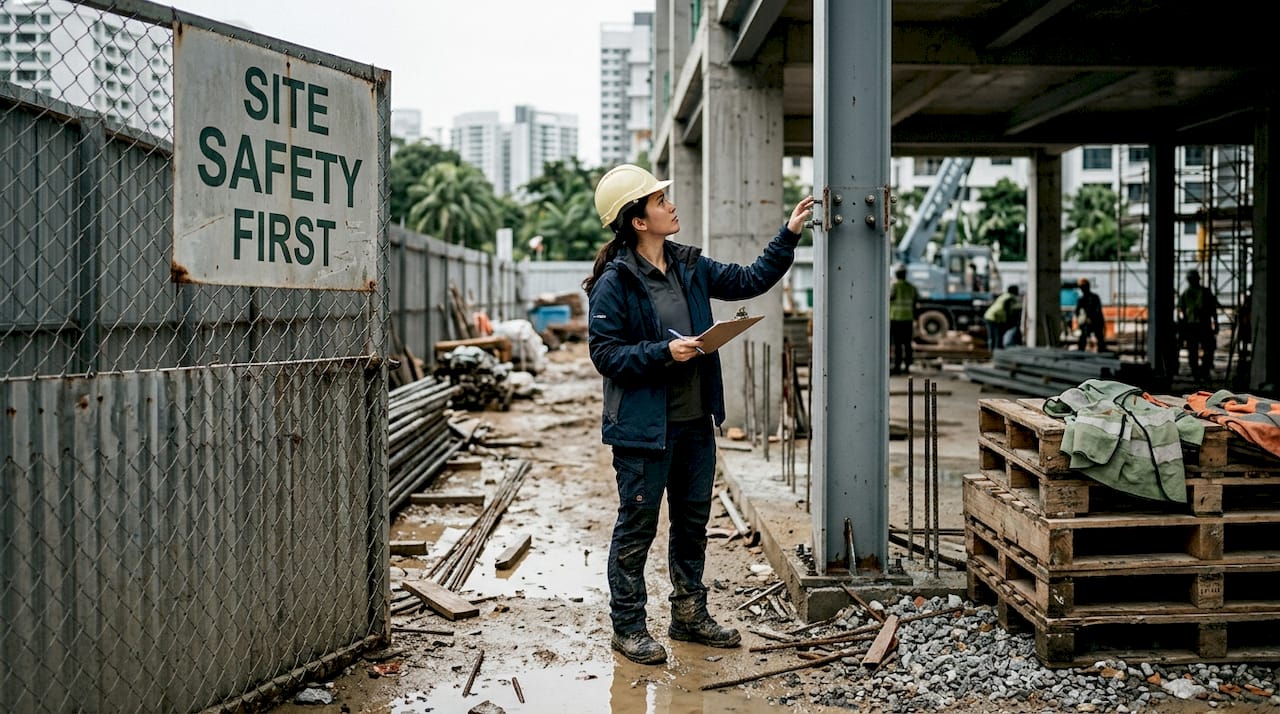
Modular and off-site construction methods further enhance safety records. Factory conditions eliminate many of the hazards associated with working at height or in confined site spaces. 3D concrete printing saves 40% manpower, which directly reduces the number of workers exposed to site-related accident risks at any given time. Fewer workers on site means statistically fewer opportunities for injury.
Specific safety features that advanced structural engineering enables include:
- Framed structural systems with clearly defined load paths, reducing the risk of progressive collapse
- Fire-rated construction details compliant with SCDF requirements, including intumescent coatings and structural compartmentation
- Material standard compliance with BCA-approved specifications for reinforced concrete and steel
- Resilient connection design that accounts for dynamic loads, foundation settlement, and long-term creep
- Early hazard analysis integrated into the structural design phase, reducing risk before mobilization
For aging structures, the benefit is equally pronounced. Applying modern strengthening for aging concrete through fiber-reinforced polymer (FRP) wrapping or section enlargement can restore or even improve the original structural capacity. This extends building life by decades and defers the cost of demolition and reconstruction. Similarly, fire safety in steel structures is an area where performance-based design can optimize the protection strategy without overspecifying materials.
Structural engineering is not just about making buildings stand. It is about making them stand safely, for the right duration, under the actual conditions they will face — and doing so in a way that satisfies regulators, insurers, and end users alike.
Delivering cost savings and resource efficiency
Beyond safety and compliance, one core driver for Singapore developers is the bottom line — where efficiency and savings stand out. Structural engineering directly influences the most significant cost drivers in any construction project: labor, materials, and rework.
The financial case for advanced methods is well supported. 3D-printed concrete advances represent one of the most compelling examples, with data showing that 3D concrete printing saves 40% manpower and reduces material consumption by 30%. In a market where construction labor costs in Singapore are among the highest in the Asia-Pacific region, a 40% manpower reduction translates into direct and significant savings on any project of meaningful scale.
The comparison between conventional and advanced structural engineering approaches makes the financial logic clear:
| Cost category | Conventional construction | Advanced structural engineering |
|---|---|---|
| Labor intensity | High, dependent on site labor | Reduced via prefab and automation |
| Material waste | 10 to 20% wastage typical | Reduced through precision fabrication |
| Rework frequency | Common due to tolerances | Minimized through factory QC |
| Project overrun risk | Higher | Lower with coordinated design |
| Long-term maintenance | Higher for under-engineered structures | Lower with durable design |
Direct and indirect cost-saving levers that structural engineering activates include:
- Prefabrication reduces formwork, scaffolding, and wet trade requirements on site
- Optimized structural sizing avoids over-specification of steel or concrete, reducing material bills
- Clash-free design through BIM-integrated structural coordination prevents costly on-site conflicts
- Reduced rework from precise detailing and shop drawing approval processes
- Lifecycle cost reduction through durable material selection that reduces long-term repair frequency
Projects adopting these technologies in Singapore typically see return on investment within the first or second project cycle, particularly when procurement savings from prefabrication suppliers are factored in alongside labor cost reductions.
Ensuring regulatory compliance and smoother authority submissions
Finally, for every successful Singapore build, regulatory compliance is the gatekeeper — where engineering expertise proves invaluable. Structural engineering documentation is the foundation of every authority submission, and its quality directly determines whether a project sails through or stalls at the BCA, FSSD, or Urban Redevelopment Authority review stages.
DfMA and modular approaches help achieve regulatory requirements more efficiently because the design clarity and documentation standards inherent in off-site fabrication naturally align with what Singapore authorities expect. Factory production records, quality assurance certifications, and pre-approved structural systems reduce the volume of supporting documentation that must be generated afresh for each submission.
The steps for achieving smooth compliance through structural engineering are as follows:
- Early coordination with authorities: Identify which agencies, such as BCA, SCDF, JTC, LTA, or PUB, require input and map submission workflows at the project outset.
- Adopt recognized standards: Design to Eurocode 2 compliance requirements as adopted in Singapore’s SS EN 1992, ensuring that calculations meet current code expectations.
- Prepare thorough PE-endorsed documentation: Structural drawings, calculations, and method statements must be endorsed by a Qualified Person (QP) and, where required, a Professional Engineer (PE) registered under the PE Act.
- Conduct peer review where required: For complex or high-risk structures, independent peer review of structural calculations reduces the likelihood of BCA raising technical queries.
- Integrate M&E and structural submissions: Misalignment between mechanical, electrical, and structural submissions is a leading cause of resubmission requests. Joint coordination meetings and federated BIM models resolve this before submission.
- Track submission status proactively: Assign responsibility for monitoring agency responses and preparing rebuttal reports where technical clarifications are requested.
Pro Tip: For projects involving PPVC or DfMA systems, engage the structural engineer to prepare a system-specific structural design brief early. This document streamlines BCA’s review by clearly articulating how the prefabricated system meets the relevant structural performance requirements, reducing the back-and-forth that delays approval.
Supporting sustainability in the Singapore construction industry
As compliance locks in quality, sustainability is now a non-negotiable success criterion in Singapore development. The Building and Construction Authority’s Green Mark scheme sets the benchmark for environmentally responsible construction, and structural engineering is a primary contributor to achieving favorable ratings.
DfMA and advanced methods save energy and materials, directly supporting the carbon reduction and resource efficiency goals that Green Mark evaluates. Off-site manufacturing produces less construction waste than conventional site-based methods, generates lower noise and dust pollution, and enables tighter quality controls that reduce material rejection and wastage. Structural design choices such as lighter steel frames, high-performance concrete, and optimized section sizes all reduce the embodied carbon of a structure.
The connection between resource-efficient structural design and Singapore’s broader climate goals is direct. The renewable integration for sustainability potential of a building depends significantly on how the roof structure and facade are engineered to accommodate solar panels, green roofs, and future retrofit loads. Structural engineers who account for these future loading scenarios from the start enable developers to pursue sustainability upgrades without expensive structural interventions later.
The green benefits of structural engineering include:
- Reduced carbon footprint through lower embodied carbon in material selection and optimized structural forms
- Less site waste from prefabrication processes that use precise cutting and assembly methods
- Easier future upgrades when structures are designed with adaptability and additional load capacity in mind
- Reduced site disruption resulting in lower noise, dust, and community impact during construction
- Green Mark alignment through documentation of material efficiency, waste reduction, and energy-conscious design choices
Why prioritizing structural engineering is the smartest decision for Singapore projects
The data and case studies outlined above point to a single, unavoidable conclusion: structural engineering is not a cost center to be minimized. It is a value multiplier that shapes every dimension of project performance, from the first design iteration to the final authority clearance.
The most frequent source of budget overruns and program delays in Singapore construction is not contractor error or material price escalation. It is under-investment in rigorous structural engineering at the front end of the project. When structural design is treated as a compliance formality rather than a strategic function, the downstream consequences accumulate rapidly: clashes that require site rework, submission queries that stall approvals, and durability shortfalls that generate early lifecycle repair costs.
The true value of consultancy in structural engineering is realized when the engineer is embedded in project decisions from feasibility through design development, not brought in at the last minute to endorse drawings that have already been locked. Singapore’s most innovative developers understand this. Projects like the Kempas Residences link bridge demonstrate what happens when structural thinking leads the design process rather than follows it.
The uncomfortable reality is that a “minimum compliance” attitude costs more than it saves. Meeting only the bare standard for submission approval may get a project through the door, but it rarely produces a building that performs optimally over decades, adapts to future use changes, or earns recognition for innovation and sustainability. The firms that consistently deliver successful projects in Singapore treat structural engineering as a strategic investment, not an administrative step.
Partner with the experts in Singapore structural engineering
Capturing all five of these benefits, productivity, safety, cost efficiency, regulatory compliance, and sustainability, requires more than technical knowledge. It requires experienced professionals who understand Singapore’s specific authority requirements, know the most current code expectations, and can coordinate across structural, geotechnical, M&E, and architectural disciplines with confidence.
AECTechnicalSG provides precisely this kind of integrated support for Singapore developers and construction firms. From authority submissions to BCA, SCDF, JTC, LTA, and PUB, to structural design under the latest Singapore standards, the team brings the regulatory fluency and technical depth that complex projects demand. Understanding the engineering consultancy types available and choosing the right partner for your scope is the first practical step. Whether you need full civil engineering services or targeted structural advisory, engaging experienced Singapore-based engineers early is the single most effective way to protect your project investment.
Frequently asked questions
How does modular structural engineering reduce project timelines?
By assembling major components off-site under controlled factory conditions, modular methods can cut site installation dramatically. Singapore’s HDB link bridge project demonstrated a reduction from 7 days to just 12 hours using this approach.
What is DfMA and why is it important for Singapore construction?
DfMA, Design for Manufacture and Assembly, integrates structural design with factory-based fabrication from the start, enabling coordinated off-site assembly that reduces rework and improves scheduling predictability. Singapore projects applying DfMA have recorded up to 40% productivity gains compared to conventional delivery methods.
Can advanced structural engineering lower project costs long-term?
Yes, significantly. Technologies like 3D concrete printing have demonstrated savings of 40% manpower and 30% material usage, and the combined effect of reduced rework, optimized material sizing, and lower lifecycle maintenance substantially reduces total project cost.
How does structural engineering contribute to green construction in Singapore?
Advanced structural engineering supports Singapore’s Green Mark scheme by reducing material waste, lowering embodied carbon through optimized design, and enabling future-proofing for renewable energy integration and adaptive reuse. DfMA methods further reduce site pollution and resource consumption, directly supporting sustainability certification goals.