
The ground beneath a construction site holds more variables than any structural blueprint can capture. In Singapore, where marine clay deposits, soft alluvial soils, and decades of land reclamation define much of the island’s subsurface profile, those variables carry real consequences for project timelines, structural integrity, and regulatory approval. Developers and construction firms that underestimate what lies below grade often discover the true cost only after delays, redesigns, or authority rejections have already eroded their margins. Expert geotechnical consultancy is not a line item to be minimized. It is a foundational investment that shapes every phase of a well-executed Singapore build.
Table of Contents
- What does geotechnical consultancy involve?
- The stakes: Why the ground beneath matters in Singapore
- How expert consultancy ensures compliance and prevents failure
- Choosing the right consultancy: Key factors for project success
- What most developers miss about geotechnical consultancy in Singapore
- Partner with proven geotechnical consultants for your next Singapore project
- Frequently asked questions
Key Takeaways
| Point | Details |
|---|---|
| Mitigate ground risk | Geotechnical consultants help you identify and resolve ground problems before they escalate, saving time and money. |
| Ensure compliance | Expert guidance smooths authority approvals and keeps you in line with Singapore’s rigorous regulations. |
| Boost project performance | Evidence-based methods validated by consultants improve foundational stability and long-term outcomes. |
| Maximize value | Early input from specialists leads to smarter engineering choices and better project economics. |
What does geotechnical consultancy involve?
Geotechnical consultancy is a specialized branch of civil and structural engineering that focuses on understanding and managing soil, rock, groundwater, and their interactions with built structures. It goes well beyond ordering a standard soil test. A qualified geotechnical consultant designs the investigation scope, interprets subsurface data, identifies risk conditions, recommends ground improvement strategies, and validates that those strategies have performed as designed.
The main activities a geotechnical consultant delivers on a Singapore project include:
- Site investigation planning: Determining borehole locations, depths, and sampling methods based on the project footprint and expected subsurface conditions
- Laboratory and in-situ testing: Running consolidation tests, triaxial shear strength tests, cone penetration tests (CPT), and piezometer readings to characterize soil behavior
- Risk assessment and geohazard mapping: Identifying zones of high settlement potential, liquefaction risk, or lateral soil movement that could affect adjacent structures
- Ground improvement specification: Recommending techniques such as prefabricated vertical drains (PVD), dynamic compaction, or surcharging, and setting performance targets
- Instrumentation and monitoring: Installing settlement plates, inclinometers, and piezometers, then interpreting the data to confirm real-world ground performance
As confirmed in published research on Singapore’s ground improvement practice, geotechnical consultants specify and interpret investigation and monitoring methodologies, and validate design assumptions throughout the project lifecycle. This validation role is what separates specialist geotechnical consultancy from general structural or civil engineering. Understanding the full geotechnical analysis process is essential before committing to a project program in Singapore.
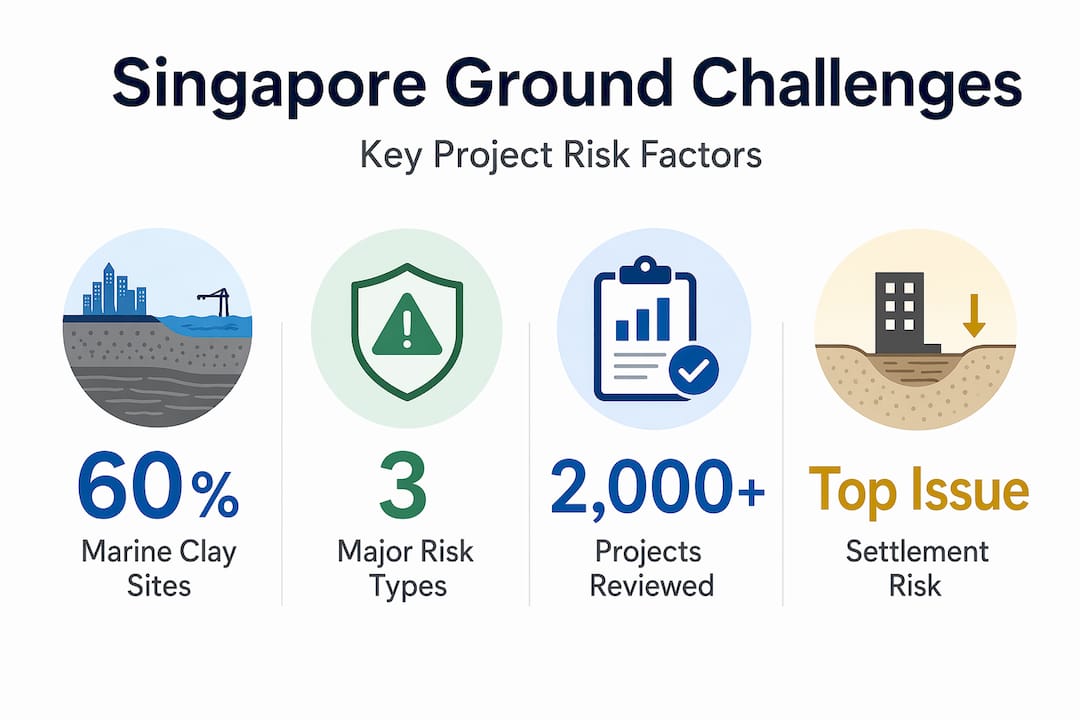
Singapore’s ground presents unique challenges that amplify the need for this specialization. The island’s marine clay, known locally as the Kallang Formation, is highly compressible and sensitive to disturbance. Reclaimed land, which now accounts for a significant portion of Singapore’s total area, introduces heterogeneous fill materials that behave unpredictably under load. The soil investigation essentials that apply in other regional markets simply do not account for these local conditions without expert local interpretation.
Pro Tip: Do not rely solely on previous site investigation reports from adjacent lots. Soil conditions in Singapore can vary significantly within short horizontal distances, particularly near former coastlines and reclamation boundaries.
The stakes: Why the ground beneath matters in Singapore
With the scope of geotechnical consultancy established, the next question is: what actually happens when ground conditions are misread or ignored? The answer is both technically and financially significant.
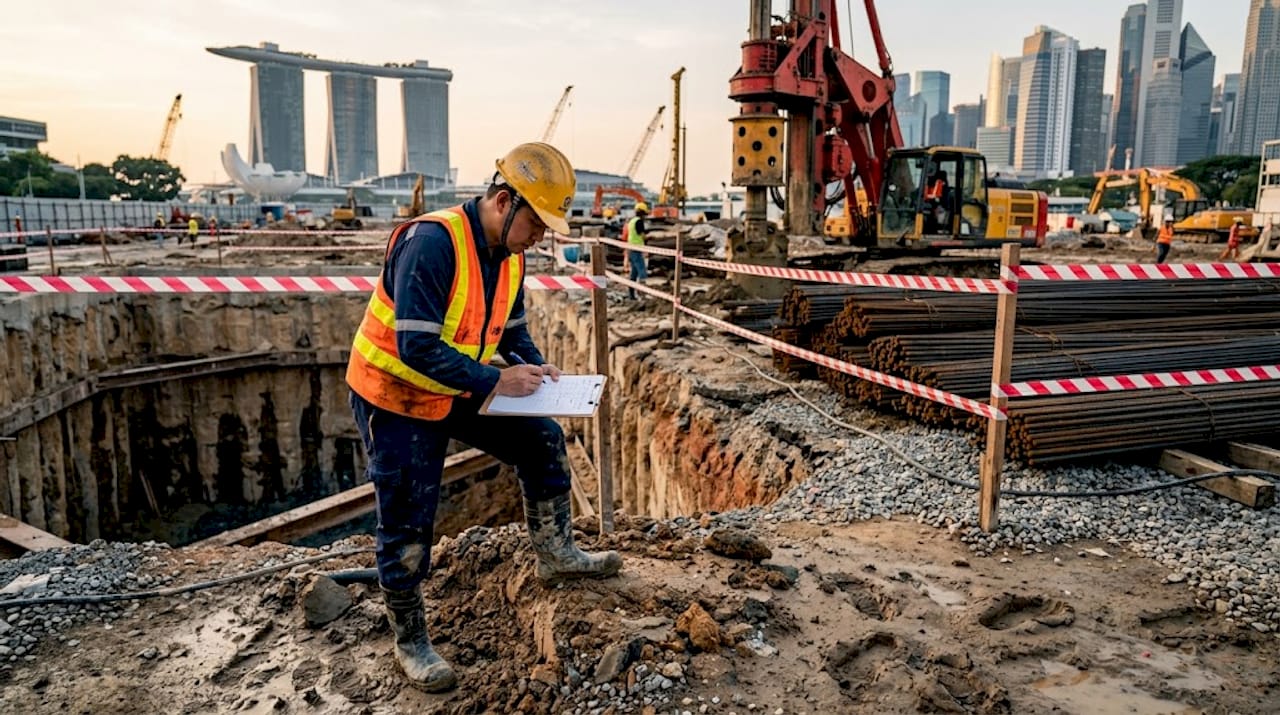
Singapore’s most prevalent ground risks fall into three categories. First, excessive consolidation settlement in marine clay can cause differential movement between structural elements, leading to cracking, misalignment of services, and long-term maintenance liabilities. Second, lateral ground displacement during excavation or embankment construction can damage adjacent utilities, retaining structures, or even neighboring buildings. Third, inadequate bearing capacity in reclaimed land can lead to foundation failure or unacceptable post-construction settlements.
The following table illustrates how project outcomes differ based on whether qualified geotechnical consultancy was applied:
| Project scenario | Without geotechnical consultancy | With geotechnical consultancy |
|---|---|---|
| Ground settlement on reclaimed land | Unexpected post-construction settlement causing rework | Monitored, controlled settlement within design tolerance |
| Marine clay excavation adjacent to MRT corridor | Risk of authority stop-work order, potential structural damage | Pre-approved monitoring scheme, continuous compliance |
| Soft ground below industrial slab | Costly slab heave or subsidence after completion | Ground improvement validated before handover |
| Regulatory submission to LTA or BCA | Incomplete geotechnical data triggers repeated resubmissions | Properly documented findings support faster approval |
| Change order frequency | High: unforeseen ground conditions drive redesign | Low: risks identified and designed around from the start |
The Changi East development program offers a particularly instructive local example. Ground improvement at large reclamation sites in that region required the installation of PVD arrays across vast areas of soft seabed clay. The success of that work depended entirely on instrumented monitoring, with settlement plates and piezometers providing the evidence base that ground performance targets had been achieved. As documented in the case study literature, instrumented, evidence-based verification is crucial in Singapore’s ground-improvement projects.
“The financial cost of skipping geotechnical consultancy is rarely the consultant’s fee. It is the unplanned redesign, the authority rejection, the rectification of a failed ground improvement scheme, and the reputational exposure that follows a project overrun.”
Developers who have worked on Singapore’s reclaimed western and eastern coastal zones consistently report that the consultancy value in Singapore only becomes apparent when something goes wrong on a project that did not invest in it. The smarter approach is to recognize that value before the first borehole is sunk.
How expert consultancy ensures compliance and prevents failure
Singapore’s regulatory environment for geotechnical works is among the most rigorous in Southeast Asia. The Building and Construction Authority (BCA), Land Transport Authority (LTA), and Public Utilities Board (PUB) each have specific technical requirements that govern ground investigation, foundation design, and excavation support for developments falling within their respective purviews. Any submission to these authorities that lacks properly documented geotechnical findings is highly likely to be returned for further technical input, adding weeks or months to a project program.
The steps a qualified geotechnical consultant follows to support compliance and prevent construction failure are structured and methodical:
- Pre-design investigation: Conducting a site-specific investigation program calibrated to the project’s structural loads, footprint, and proximity to sensitive infrastructure
- Design assumption validation: Confirming that soil parameters used in foundation and earthworks design reflect actual measured conditions, not conservative assumptions from generic tables
- Ground improvement oversight: Specifying improvement methods, setting measurable performance criteria (e.g., target degree of consolidation), and monitoring progress against those criteria
- Authority documentation: Preparing the geotechnical interpretive reports, monitoring plans, and compliance declarations required by BCA, LTA, or other relevant authorities
- Construction-phase verification: Reviewing contractor submittals, attending key construction milestones, and certifying that works have been executed in accordance with the approved design
Published technical evidence confirms that verification and interpretation by geotechnical consultants validates performance and compliance with authorities. On monitored reclamation projects, this verification step is what allows authorities to grant practical completion sign-off with confidence. Without it, the regulatory process stalls.
Understanding how the different consultancy types interface with each other on a typical Singapore project helps developers structure their professional team correctly from the outset. Geotechnical consultants work alongside structural engineers, architects, and M&E consultants, but their findings carry upstream authority: a structural engineer cannot finalize pile design until geotechnical parameters are confirmed.
The foundation code guide is another resource that clarifies how foundation system choices are directly constrained by subsurface conditions, reinforcing the point that geotechnical input must precede, not follow, structural decision-making.
Pro Tip: Request that your geotechnical consultant prepare a monitoring and instrumentation plan before excavation commences. Having this plan pre-approved by the relevant authority avoids stop-work notices mid-construction and demonstrates proactive technical governance to regulators.
Choosing the right consultancy: Key factors for project success
Selecting the right geotechnical consultant is as consequential as selecting the right contractor. The selection of methodologies and validation by consultancy dictates project outcomes in Singapore’s reclamation cases. A poor choice at this stage can produce underpowered site investigation, misapplied improvement techniques, and documentation that fails to satisfy BCA or LTA requirements.
The following comparison table helps developers weigh the relative merits of in-house versus external geotechnical consultancy arrangements:
| Factor | In-house geotechnical team | External specialist consultancy |
|---|---|---|
| Local regulatory expertise | Variable, depends on team’s Singapore experience | Typically deep, built through repeated authority submissions |
| Objectivity in risk reporting | May face internal pressure to minimize risk findings | Independent, reports risks without organizational bias |
| Access to specialist equipment | Limited to owned or leased instruments | Access to a wider range of investigation tools and lab services |
| Scalability for large or complex projects | Constrained by team headcount | Scalable, able to mobilize larger teams for peak investigation phases |
| Documentation for authority submissions | May lack familiarity with local submission formats | Format-compliant, authority-tested documentation |
| Cost structure | Fixed overhead regardless of project pipeline | Variable, aligned to project-specific scope |
Beyond this structural comparison, developers should scrutinize prospective consultants against the following criteria before appointment:
- Track record on projects with similar ground conditions (marine clay, reclaimed land, deep excavation)
- Familiarity with Singapore’s specific authority submission formats for BCA, LTA, and PUB
- In-house capability for instrumentation installation and real-time monitoring data management
- Evidence of peer review processes for geotechnical interpretive reports
- Clear articulation of the validation methodology they use to confirm ground improvement performance
Questions worth asking during the selection process include: What is your firm’s experience with PVD-assisted consolidation in Kallang Formation clay? Can you demonstrate a recent successful LTA submission for a project of comparable scale? How do you manage monitoring data in real time, and what triggers your escalation protocol?
Red flags to watch for include consultants who propose fixed investigation scopes before reviewing any preliminary site data, firms that lack direct Singapore authority submission experience, and those who offer ground improvement recommendations without specifying measurable performance criteria. These are signals of a practice that is applying generic methods to a highly context-specific environment.
Understanding the full range of consultant benefits available to Singapore developers helps frame this selection decision in its broader commercial context.
What most developers miss about geotechnical consultancy in Singapore
The most persistent and costly mistake in Singapore’s development sector is not failing to appoint a geotechnical consultant. It is appointing one too late. Developers who bring geotechnical expertise into the team only at the submission stage are paying for compliance documentation, not for the genuine risk management that makes a project more buildable, more durable, and less expensive.
When geotechnical consultancy is integrated from the concept design stage, its value extends far beyond regulatory sign-off. Early subsurface insight allows structural engineers to optimize pile depths and eliminate overdesign that adds concrete and steel without adding structural benefit. It gives the project team the data to select a foundation system matched to actual soil behavior rather than worst-case assumptions. It also allows ground improvement programs, when required, to be properly scheduled within the overall program without creating critical path delays.
The true consultancy value in Singapore’s context is not in the report that gets submitted to BCA. It is in the design decisions made six months earlier that reduced the pile count, avoided a ground improvement scheme on a portion of the site, or justified a less conservative excavation support system because the actual soil parameters were measured rather than assumed.
There is also a reputational dimension that experienced project leads recognize. Developers who consistently engage rigorous geotechnical consultancy build productive, trust-based relationships with Singapore’s technical authorities. Their submissions are reviewed more efficiently. Their monitoring plans are accepted with fewer queries. Their applications for construction clearances move faster through the system. These are not intangible benefits. In a market where construction program delays carry real holding costs, a smoother authority relationship translates directly to improved project economics.
The developers who extract the most value from geotechnical consultancy treat their consultants as early-stage project partners, not late-stage documentation services.
Partner with proven geotechnical consultants for your next Singapore project
Singapore’s ground conditions demand more than a checkbox geotechnical report. They demand a consultancy relationship built on local expertise, methodological rigor, and a deep understanding of what Singapore’s authorities require at every project stage.
AECTechnicalSG provides geotechnical and structural engineering consultancy services specifically calibrated to Singapore’s regulatory environment and subsurface conditions. From initial site investigation planning through ground improvement validation and authority submission, the firm’s technical team supports developers and construction firms in delivering compliant, well-founded projects. Explore the available engineering consultancy options to understand how the right combination of services can be structured for your project, and review the project safety guide to see how a rigorous geotechnical approach translates into practical risk reduction from the first day of investigation.
Frequently asked questions
Is geotechnical consultancy mandatory for all projects in Singapore?
While not always mandatory, large or complex projects, especially those on reclaimed land or near sensitive infrastructure, typically require geotechnical consultancy for compliance and safety, as Singapore’s ground-improvement practice relies on expert consultancy for specifying and validating methodologies in complex conditions.
What makes ground conditions in Singapore especially challenging?
Singapore’s abundance of marine clay and extensive reclaimed land require advanced investigation and ground improvement techniques, as marine-clay and reclamation dominate the island’s subsurface profile and demand instrumented, evidence-based ground improvement approaches that general engineering practice rarely addresses with adequate depth.
How early should a geotechnical consultant be involved in a project?
Geotechnical consultants should be engaged from the earliest planning stages to anticipate ground risks, optimize foundation design, and ensure that the project program includes adequate time for investigation, ground improvement, and compliance verification before construction commences.
How does geotechnical consultancy reduce project risk?
Consultants identify ground hazards early, validate ground improvement performance, and ensure regulatory compliance, all of which lower cost and approval risks. As confirmed in research on Singapore’s reclamation projects, geotechnical consultants monitor, validate, and document ground performance, directly mitigating the technical and financial risks that undefined subsurface conditions introduce to any development project.