
Geotechnical engineering is frequently misunderstood as nothing more than soil testing before construction begins. In reality, it is the technical discipline that determines whether a building can stand safely on a given plot of land, how deep foundations must go, what retaining walls must withstand, and which regulatory submissions are required before a single pile is driven. For project developers in Singapore, where dense urban development overlays complex and sometimes unpredictable subsurface conditions, geotechnical engineering is not an optional add-on. It is a core requirement that directly shapes project safety, cost, and compliance outcomes.
Table of Contents
- What is geotechnical engineering?
- Core processes: Investigation, analysis, and design
- Singapore’s risk-based regulatory framework
- From theory to practice: Impact on project outcomes
- Why “one size fits all” doesn’t work: Lessons from Singapore
- Connect with expert geotechnical support in Singapore
- Frequently asked questions
Key Takeaways
| Point | Details |
|---|---|
| Geotechnical is foundational | Understanding ground conditions is essential for safe, compliant construction in Singapore. |
| Risk-based regulations matter | Singapore mandates specific geotechnical guidelines to address subsurface hazards like limestone cavities. |
| Early investigation saves cost | Investing in site analysis upfront prevents delays and budget overruns. |
| Adaptation outperforms generic | Tailoring engineering to site-specific risks delivers better long-term outcomes than one-size-fits-all approaches. |
| Expert support is available | Consulting engineering specialists empowers developers to make informed, compliant decisions. |
What is geotechnical engineering?
Geotechnical engineering is the civil engineering discipline focused on understanding earth material behavior and applying that understanding to the design, construction, and performance of structures supported by or interacting with the ground. It draws on soil mechanics, rock mechanics, geology, and structural engineering to answer one fundamental question: will this ground safely support what we intend to build?
In Singapore’s context, that question is never straightforward. The island’s subsurface profile ranges from soft marine clay in reclaimed areas to granite bedrock in central districts, and from weathered sedimentary formations in the Jurong area to the fragmented limestone deposits of Bukit Timah. Each ground condition demands a different engineering response, and misidentifying that condition at the start of a project can trigger cascading failures in design, cost, and regulatory approval.
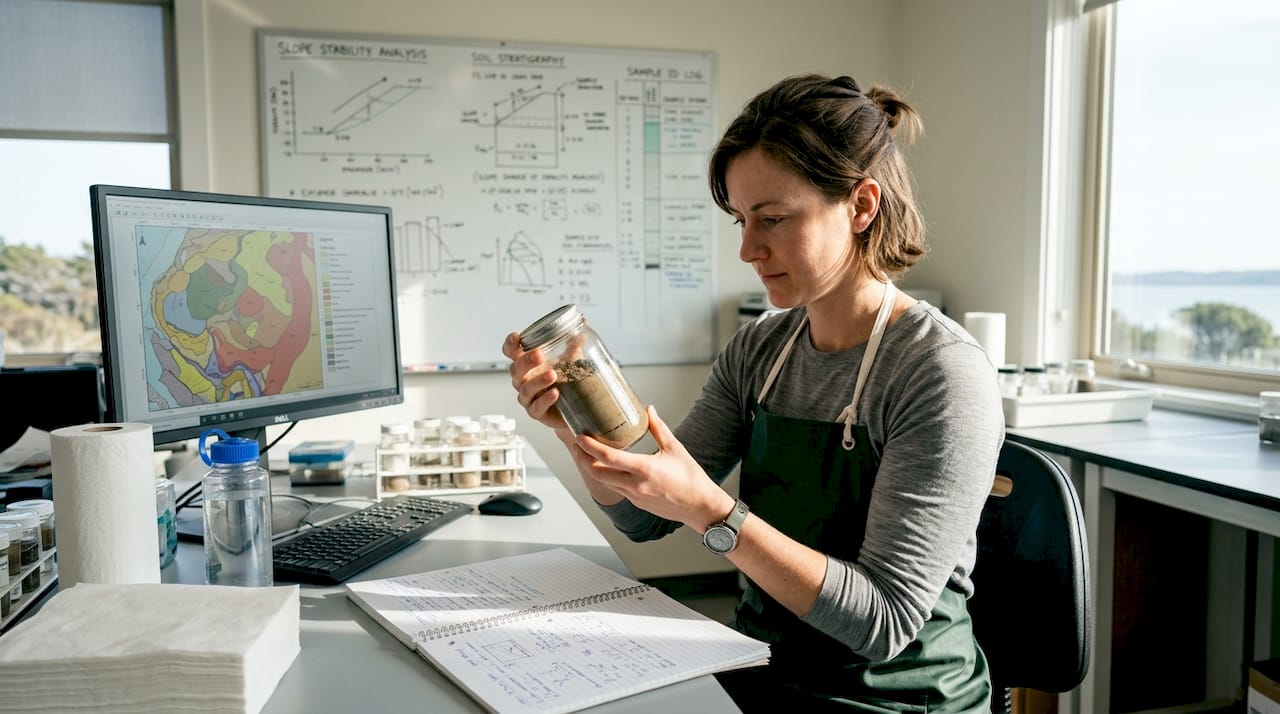
The application areas for geotechnical engineering, as recognized by international technical authorities, include the following:
| Application Area | Typical Singapore Context |
|---|---|
| Foundations | High-rise residential and commercial towers |
| Earth-retaining structures | MRT station excavations, basement construction |
| Tunnels | Underground MRT lines, utility corridors |
| Slopes | Hillside developments, embankments |
| Excavations and braced walls | Deep basement carparks, civil works |
| Other underground works | Cable tunnels, service reservoirs |
Geotechnical engineering applies to foundations, earth-retaining structures, excavations and braced walls, tunnels, slopes, and other underground works, making it relevant at virtually every stage of a development project. Before committing to a design scheme, developers benefit from reviewing a detailed geotechnical investigation guide that outlines investigation scope and regulatory obligations specific to local conditions.
Key areas where geotechnical engineering drives decisions in Singapore include:
- Foundation type selection: Bored piles, driven piles, or raft foundations each carry different cost and performance implications depending on subsurface profiles.
- Excavation safety planning: Soft ground and high water tables demand robust bracing systems to prevent settlement in adjacent structures.
- Slope stability assessments: Hillside developments require quantitative analysis to prevent soil movement that could damage neighboring properties.
- Bearing capacity analysis: Determining the load that a given soil or rock stratum can support without excessive settlement or shear failure.
The choice between a bored pile and a driven pile system, for example, is not merely a cost question. It reflects the actual ground profile, the presence of boulders or cavities, the sensitivity of surrounding structures, and the regulatory requirements imposed by the Building and Construction Authority of Singapore (BCA). Developers who treat this as a purely commercial decision typically encounter expensive redesigns later. Understanding the foundation systems guide helps project teams evaluate these options before committing resources.
Core processes: Investigation, analysis, and design
Once you know what geotechnical engineering is, understanding its step-by-step processes matters most for managing risk and compliance. Geotechnical engineering uses investigation and design analysis to ensure stability and safety, and each phase of that process has direct consequences for project decisions.
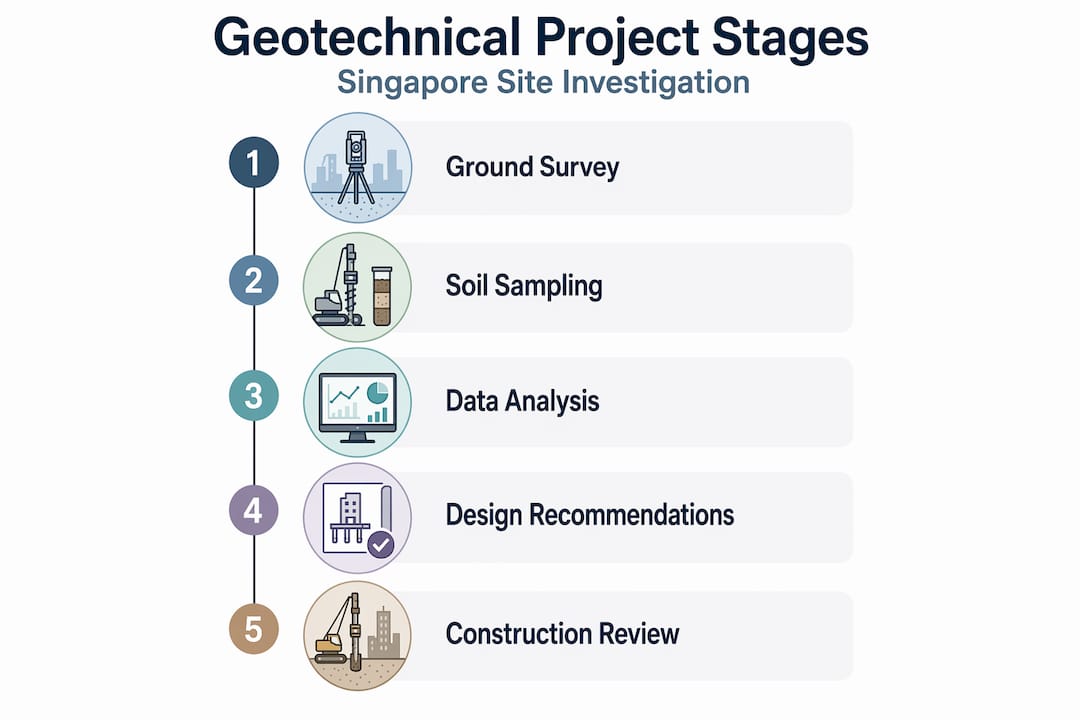
The typical geotechnical process for a Singapore development follows this sequence:
- Desk study and geological mapping: Review of geological maps, historical borehole records from the Singapore Geotechnical Information System (SGIS), and records of previous developments on adjacent plots. This step costs relatively little but can flag high-risk ground conditions before any fieldwork begins.
- Site investigation (SI) fieldwork: Boreholes are sunk to retrieve soil and rock samples at depth. Standard Penetration Tests (SPT) are conducted at regular intervals to measure soil resistance. Field vane shear tests may be used in soft clay areas to assess undrained shear strength.
- Laboratory testing: Recovered samples undergo classification tests (grading, Atterberg limits), consolidation tests, triaxial shear tests, and chemical analysis where corrosive ground conditions are suspected.
- Interpretive reporting: A qualified Geotechnical Engineer (GE) interprets SI data, develops a ground model, and identifies subsurface risks including variable rock heads, groundwater levels, and problematic strata.
- Geotechnical design analysis: Foundation options are evaluated, settlement predictions are made, retaining wall designs are analyzed for stability, and pile designs are verified against calculated bearing capacities.
- Design documentation and authority submission: Final geotechnical reports and design calculations are compiled for submission to BCA or other relevant authorities such as LTA for works near expressways or rail infrastructure.
Common pitfalls during this process include conducting inadequate boreholes for the site area, spacing boreholes too far apart to detect variable features, and commissioning SI fieldwork too late in the design timeline. When SI is completed only after schematic design is finalized, developers often face the uncomfortable situation of a preferred foundation scheme being technically unworkable on actual ground conditions.
Pro Tip: Commission your site investigation before schematic design is finalized, not after. Ground conditions revealed in the SI should inform the structural scheme, not the other way around. Engaging a geotechnical consultant during the pre-design stage typically saves more in redesign costs than the early investigation budget amounts to.
For a detailed breakdown of each analytical step, refer to the geotechnical analysis steps guide, which outlines both the technical methodology and the authority submission process in Singapore.
Singapore’s risk-based regulatory framework
To make informed decisions in Singapore, you need to understand how regulation adapts to subsurface complexity rather than applying uniform standards across all sites. Singapore takes a distinctly risk-based, location-sensitive approach to geotechnical regulation, which reflects the island’s significant subsurface diversity.
Singapore issues risk-based, ground-condition-specific geotechnical requirements for complex subsurface hazards, meaning that the depth of investigation, the type of testing required, and the design verification procedures all vary depending on where a project is located and what ground hazards are present.
Comparison: Generic vs. risk-based regulatory approach
| Feature | Generic Approach | Singapore Risk-Based Approach |
|---|---|---|
| Investigation scope | Fixed minimum boreholes | Scaled to site-specific hazard level |
| Design standard | Single design code applied uniformly | Ground-condition-specific requirements |
| Pile verification | Standard load testing | Enhanced testing in limestone or cavity zones |
| Regulatory submissions | General SI report | Detailed GE-certified reports per hazard type |
| Treatment of anomalies | Not explicitly required | Mandatory cavity investigation and treatment |
The most technically significant subsurface hazards in Singapore include:
- Limestone cavities and voids: Bukit Timah limestone is known for dissolution cavities that can cause sudden loss of pile bearing capacity or even structural collapse if not properly identified and treated.
- Slump zones and pinnacled rock heads: Where limestone has undergone karst dissolution, the rock surface is highly irregular, creating zones where pile toes may bear on projecting rock pinnacles rather than a uniform surface.
- Old Alluvium and residual soils: Found extensively in eastern Singapore, these soils can exhibit variable strength and compressibility that requires careful characterization before foundation design.
- Soft marine clay: Prevalent in reclaimed land areas, soft clay consolidates under load over time, creating settlement risks for structures that are not designed accordingly.
- High groundwater tables: Common across Singapore, high groundwater affects excavation stability, pile construction quality, and the choice of permanent retaining wall system.
These conditions directly affect safe project compliance outcomes and require developers to engage geotechnical specialists with local experience rather than relying on generic international standards alone. The interaction between Singapore’s geotechnical requirements and structural design frameworks, including evolving compliance expectations under Eurocode 2 guidance, means that structural design in Singapore cannot be responsibly separated from the geotechnical input it depends on.
From theory to practice: Impact on project outcomes
Understanding regulation is only meaningful when you see its effect on actual project outcomes. For Singapore developers, geotechnical decisions ripple through every phase of a project, from feasibility through construction completion.
Consider a commercial tower project in an area underlain by limestone. The SI reveals cavities at depths between 20 and 35 meters below ground level. The following consequences follow directly from that finding:
- The standard bored pile design must be modified to account for the risk of cavity breakthrough during installation.
- Enhanced socket lengths into sound rock below the cavity zone are required.
- Each pile may require cavity probing before and during installation to confirm the pile toe bearing stratum is intact.
- Additional load testing, including high-strain dynamic testing and static maintained load tests, is mandated to verify pile capacity.
- Cavity grouting may be required before or during piling to stabilize voids that pose a risk to adjacent structures or pile installation.
Guidelines are meant to minimize risks in such ground conditions, and while compliance may add time and cost to the construction program, non-compliance introduces risks that are financially and legally far more severe, including structural failure, regulatory enforcement, and project suspension.
Key actions that protect project outcomes include:
- Early ground investigation: Reduces unforeseen conditions during construction, which are invariably more expensive to manage reactively.
- Geotechnically informed procurement: Foundation and substructure contract specifications that reflect actual ground conditions prevent disputes and claims between developers and contractors.
- Staged construction monitoring: Inclinometer readings, settlement markers, and piezometer data during excavation and piling provide early warning of ground movement that allows corrective action before damage occurs.
- Integrated design team coordination: Structural engineers, geotechnical consultants, and contractors working from a unified ground model produce coordinated designs that avoid conflicts discovered only on site.
Pro Tip: Ensure the geotechnical consultant is involved in reviewing contractor method statements before piling or deep excavation work begins. A technically sound design can still be compromised by a construction method that does not account for actual ground behavior at the time of works.
For a broader view of how geotechnical input connects to overall project delivery, see the practical engineering guide and the advanced concrete technology resource, which cover how material choices interact with foundation and substructure performance.
Why “one size fits all” doesn’t work: Lessons from Singapore
Here is a perspective that challenges conventional thinking in project development: many developers still approach geotechnical engineering as a compliance formality rather than a project management tool. They commission a minimum site investigation, obtain the geotechnical report needed for BCA submission, and then treat the findings as background information rather than decision-driving intelligence.
This approach fails on Singapore’s ground. Consistently, the projects that encounter the most expensive and disruptive geotechnical surprises are those where the investigation scope was compressed to save early-stage costs and where the geotechnical findings were not integrated into design and procurement decisions.
Regulators in Singapore use specific, risk-based guidance for deep foundation works rather than a single generic approach, and this reflects a technical reality: the ground beneath Singapore’s cities is not uniform, and engineering responses cannot be uniform either. The regulatory framework is not bureaucratic excess. It encodes lessons from real failures on real sites.
The contrarian insight for developers is this: a more thorough geotechnical investment at the investigation and design stage consistently costs less than managing a geotechnical problem discovered during construction. Cavity grouting a pile location before piling costs far less than extracting a failed pile and redesigning three adjacent foundations under time pressure. Early site-specific analysis is, in effect, a form of project insurance with a calculable return.
Proactive geotechnical strategy also creates a more competitive project. Developers who understand their ground conditions before tender can write more accurate substructure specifications, attract more competitive bids from contractors who can price accurately, and maintain program certainty that supports downstream construction and sales milestones. Ground uncertainty is not just a safety risk. It is a commercial risk with quantifiable consequences for project viability.
Connect with expert geotechnical support in Singapore
Geotechnical knowledge is most powerful when it is applied by experienced consultants who understand both the technical requirements and the regulatory environment unique to Singapore projects.
AECTechnicalSG provides geotechnical and structural engineering consultancy services for developers navigating Singapore’s complex subsurface conditions and regulatory framework. Whether your project involves deep basement excavations, bored pile design in limestone areas, or comprehensive site investigation for BCA submission, expert support is available at every stage. Explore the engineering consultancy types available for Singapore developments, review the full geotechnical analysis guide to understand what a compliant investigation involves, and assess the consultancy value that specialist input delivers for risk-managed, authority-compliant projects.
Frequently asked questions
What are common geotechnical hazards in Singapore developments?
Limestone cavities and slump zones are frequent subsurface hazards that can critically affect deep foundation designs, and risk-based geotechnical requirements are specifically issued to address these ground-condition-specific risks across Singapore.
How does the geotechnical process impact project timelines?
Comprehensive investigation and design analysis conducted early in a project lifecycle allows design teams to anticipate subsurface risks and avoid costly construction-phase delays caused by unforeseen ground conditions.
Are Singapore’s geotechnical guidelines mandatory for all projects?
Yes, risk-based guidelines are required for all projects encountering complex subsurface conditions and are enforced by BCA and other authorities to minimize safety and project risks.
What is the role of geotechnical consultants?
Geotechnical consultants analyze earth material behavior specific to each site, recommend appropriate foundation solutions, prepare technical reports for authority submission, and guide construction monitoring to ensure design assumptions are met on the ground.