
Getting structural design right in Singapore is not simply a matter of technical competence. It requires aligning architectural intent, site-specific conditions, load analysis, and a tightly regulated approval process through agencies like BCA and URA, all simultaneously. When any of these elements falls out of coordination, the consequences range from costly redesigns and submission failures to structural deficiencies that compromise safety. This guide provides a structured, expert-level walkthrough of the structural design how to process, covering prerequisites, step-by-step execution, modeling validation, and regulatory compliance, so project developers and construction firms can approach every project with clarity and confidence.
Table of Contents
- Preparing for structural design: understanding prerequisites and site considerations
- Step-by-step execution of structural design
- Best practices for structural modeling and validation
- Navigating Singapore’s structural design regulatory standards and compliance
- Why mastering structural design fundamentals beats flashy software
- How AEC Technical Advisory supports your Singapore structural design projects
- Frequently asked questions
Key Takeaways
| Point | Details |
|---|---|
| Structural design workflow | Structural design follows a clear, iterative sequence from conceptual plans to construction administration. |
| Modeling accuracy | Accurate models rely on physics-based assumptions validated through hand sketches and incremental building. |
| Regulatory compliance | Singapore mandates strict adherence to either Singapore/British standards or Eurocodes, not both. |
| Preparation essentials | Thorough site and load assessment at project start ensures feasible and safe structure designs. |
| Expert guidance | Specialized consultancy can streamline design, compliance, and construction support in Singapore projects. |
Preparing for structural design: understanding prerequisites and site considerations
Before a single calculation is performed or software model opened, a project’s structural viability is shaped by decisions made at the preparation stage. Conceptual design begins with translating the architect’s vision into structurally feasible geometry, accounting for site conditions including soil profiles and environmental exposure. Skipping this alignment step is one of the most common causes of expensive rework later.
For Singapore projects specifically, site conditions carry significant weight. Reclaimed land along the southern and western coastlines often presents weak marine clay profiles, while developments near Bukit Timah or Mandai may encounter weathered granite. These conditions directly influence foundation type selection, whether driven piles, bored piles, or raft foundations are appropriate, and they affect material specifications for long-term durability.
A well-prepared structural brief at this stage should address the following considerations:
- Architectural coordination: Review floor plans, section cuts, and elevation drawings to identify structural spans, transfer levels, and cantilever zones before any layout is finalized.
- Soil investigation reports: Obtain geotechnical data from boreholes and cone penetration tests to understand bearing capacity, settlement risk, and groundwater levels.
- Preliminary structural layout: Establish column grid spacings, beam span directions, and slab system configurations that suit both architectural intent and structural efficiency.
- Load identification: Classify loads into dead loads (self-weight of structural and non-structural elements), live loads (occupancy-based as per SS EN 1991), and environmental loads (wind and seismic per Singapore’s national annexes).
- Regulatory pre-checks: Identify whether the project triggers specific BCA requirements such as Design for Safety (DfS) submissions, ERSS approvals, or deviation approvals under the Building Control Act.
Understanding how architectural planning intersects with structural feasibility at this early stage prevents costly conflicts between design disciplines downstream.
Step-by-step execution of structural design
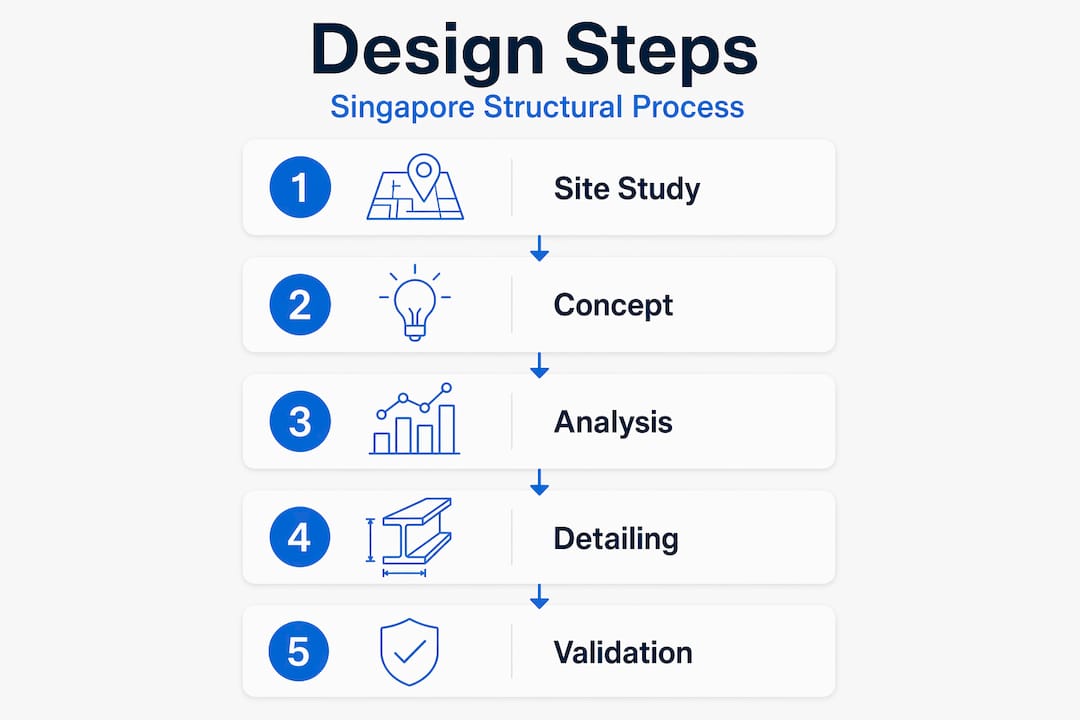
With preparation complete, execution follows a defined and iterative workflow. Structural design workflow involves conceptual design, load analysis, structural analysis, system design, element detailing, iterative reviews, and construction administration. Each phase has specific deliverables, and the design frequently loops back for revision when analysis reveals misalignments or coordination conflicts.
The following numbered sequence outlines the structural engineering design workflow as it should be managed on Singapore building projects:
- Conceptual structural design: Translate architectural drawings into a proposed structural system. Define material choices (reinforced concrete, structural steel, or composite), vertical and lateral load-resisting systems, and key connections.
- Load analysis: Quantify all load combinations per the applicable design standard. Generate a load schedule that documents dead loads, superimposed dead loads, live loads, and wind loads at each floor level.
- Structural analysis: Input the load schedule into an analysis model. Determine member forces, moments, shears, and deflections across the entire structural frame.
- Structural system design: Select member sizes, connection types, and foundation configurations based on analysis outputs. This phase produces a preliminary design that satisfies strength and serviceability criteria.
- Element detailing: Produce detailed reinforcement drawings for RC elements or connection details for steel members. Detailing must comply with the applicable code’s minimum cover, bar spacing, lap length, and anchorage requirements.
- Iterative review and drafting: Coordinate with architectural, M&E, and geotechnical consultants to resolve clashes, verify penetration locations, and confirm slab openings do not compromise structural performance. Update drawings and calculations accordingly.
- Construction administration: Issue Requests for Information responses, review shop drawings submitted by contractors, and conduct site inspections to verify that construction follows the approved design intent.
The table below summarizes the key deliverables and responsibilities at each phase:
| Design phase | Primary deliverable | Responsible party |
|---|---|---|
| Conceptual design | Structural scheme report | Structural engineer |
| Load analysis | Load schedule and combination matrix | Structural engineer |
| Structural analysis | Analysis model and result summaries | Structural engineer |
| System design | Preliminary sizing drawings | Structural engineer |
| Element detailing | Reinforcement and connection drawings | Structural engineer / draftsperson |
| Iterative review | Coordinated BIM model or drawing set | Multidisciplinary team |
| Construction administration | Site observation reports, RFI responses | Structural engineer |
Pro Tip: Build revision cycles into your project program explicitly. On BCA plan-check submissions, structural drawings and calculations are reviewed together. Any mismatch between the two, even a minor inconsistency in a load value, triggers a query that can delay approval by weeks.
To further streamline the structural design process from plan check to permit issuance, maintaining a single coordinated set of calculations and drawings that updates in parallel is essential. Treating them as separate documents is a common and avoidable mistake.
Best practices for structural modeling and validation
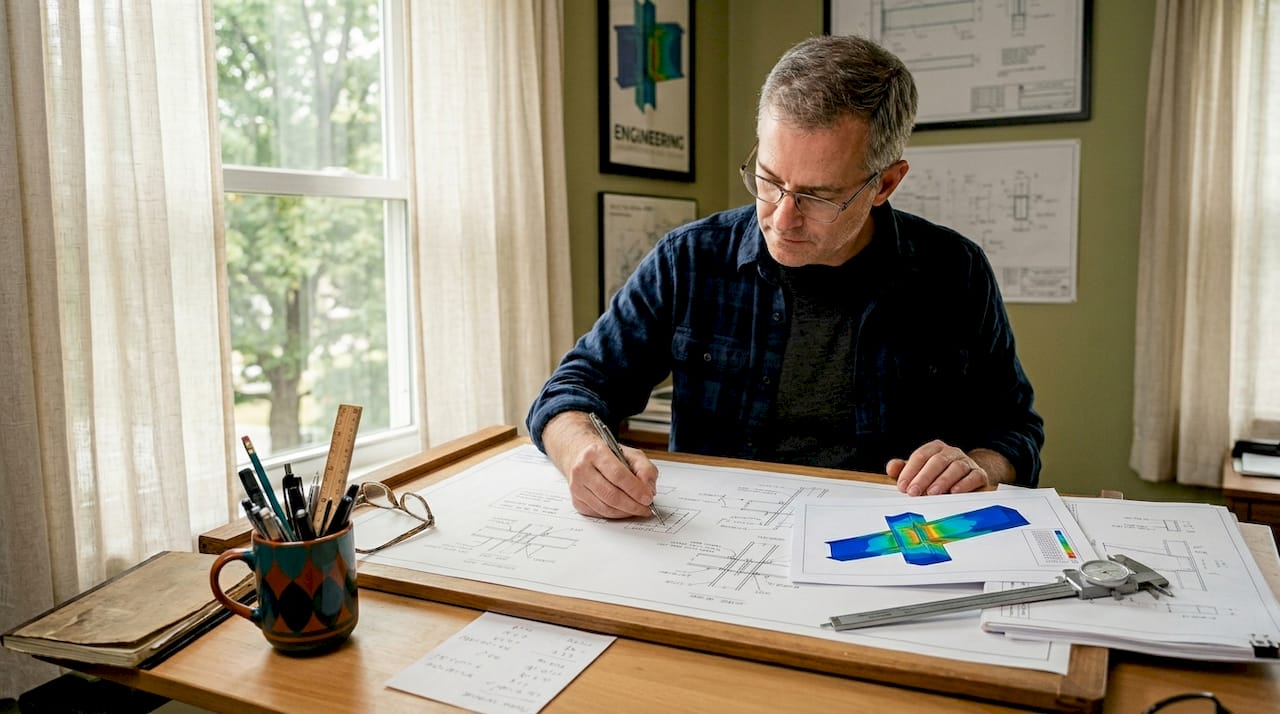
An accurate structural model is not defined by its visual presentation. Correctness in structural modeling comes from physics and assumptions, validated by hand sketches and incremental model building, not from polished 3D renders alone. This distinction matters enormously when models are submitted as part of BCA regulatory packages.
The following practices distinguish models that hold up under scrutiny from those that unravel at the submission stage:
- Start with hand sketches: Before opening any software, sketch the anticipated load path from the point of application to the foundation. This confirms the model topology is logical before any numbers are input.
- Validate boundary conditions: Every support condition in the model, whether pinned, fixed, or spring-supported, has a direct and significant influence on member forces. Incorrect boundary conditions are among the most common sources of unconservative results.
- Build incrementally: Begin with a simplified version of the model, perhaps a single frame or a representative bay, and validate results manually before expanding to the full structure.
- Conduct sensitivity studies: Vary key assumptions such as fixity at column bases, slab-to-beam stiffness ratios, and soil spring stiffness. If small changes in an assumption produce large changes in the result, that assumption demands closer attention.
- Document assumptions explicitly: Every modeling assumption must be recorded in the calculation package. BCA plan checkers expect to trace design decisions through the calculations, and undocumented assumptions are treated as deficiencies.
“A structural model that produces visually impressive outputs but rests on unvalidated assumptions is a liability, not an asset. The engineer’s understanding of structural behavior must always precede the software’s output.”
Pro Tip: When submitting calculations for BCA review, include a one-page modeling assumption summary at the front of the calculation package. This single addition reduces back-and-forth queries significantly, because reviewers immediately understand the design intent and scope without having to interrogate every formula.
For projects involving complex steel connections or high-rise frames, advanced FEM validation provides an additional layer of confidence that cannot be obtained from conventional frame analysis alone.
Navigating Singapore’s structural design regulatory standards and compliance
Singapore’s regulatory framework for structural design is precise, and it demands precision in return. Mixing superseded Singapore/British standards with Eurocodes within the same building design is unacceptable; every project must lock its design standard set at the outset and enforce that selection through internal quality assurance. This requirement is not advisory. Submissions that combine, for example, CP65 for RC design with EN 1993 for steel design will fail BCA plan check.
The table below provides a practical comparison for quick reference:
| Criterion | Singapore/British standards | Eurocodes (with Singapore national annex) |
|---|---|---|
| RC design basis | CP65 (limit state) | SS EN 1992 |
| Steel design basis | BS 5950 | SS EN 1993 |
| Loading standard | BS 6399 | SS EN 1991 |
| Wind loading | CP3 Chapter V | SS EN 1991-1-4 |
| Foundation design | BS 8004 | SS EN 1997 |
| Current BCA status | Accepted for existing projects | Preferred for new submissions under Corenet X |
Beyond standard selection, several compliance-specific considerations deserve attention from project teams:
- Lock the design standard set at project inception: Document the chosen standard set in the project’s structural design basis report and obtain client and QP acknowledgment before design commences.
- Monitor BCA circulars actively: Singapore’s regulatory environment updates regularly. The revised SS EN 13791:2024 standard introduces updated procedures for assessing in-situ concrete compressive strength, affecting both new build quality assurance and structural assessment of existing buildings.
- Understand Corenet X implications: New projects submitted through Corenet X face additional data requirements, including structured BIM data and updated submission templates that differ from legacy Corenet workflows.
- Engage QP (Structural) early: Singapore’s Building Control Act requires a Qualified Person for structural work. Early engagement allows the QP to shape the design basis, not merely sign off on an already-completed design.
Staying current with building codes and regulations in Singapore’s construction sector is not optional. For developers and construction firms, a delayed submission due to a standards conflict represents both a cost and a reputational risk that proper upfront compliance management eliminates entirely.
Why mastering structural design fundamentals beats flashy software
There is a recurring pattern in Singapore’s construction sector that deserves direct attention. Firms invest heavily in the latest structural analysis and BIM software platforms, train teams on the interface, and proceed to produce outputs that do not stand up to a basic hand-check. The software is not the problem. The problem is that the outputs are trusted without the engineer developing an independent sense of whether the results are physically plausible.
Load path understanding is the foundation of every sound structural design. When an engineer can trace gravity load from a roof slab through beams, columns, and pile caps by instinct, that engineer will immediately recognize when a model assigns load in a direction that defies gravity. Software cannot provide that instinct. It can only compute what it is given.
Singapore’s regulatory environment, particularly BCA’s technical review process, actually rewards firms that demonstrate conceptual clarity. A submission that leads with a clear structural design basis report, a well-documented modeling assumption summary, and logical calculation flow will clear plan check faster than a dense 400-page printout of raw software output with no narrative. Reviewers are engineers too, and they respond to evidence of engineering judgment.
The practical structural engineering guide perspective consistently shows that incremental model validation and manual cross-checks are not inefficiencies; they are the mechanism by which firms avoid costly revisions at the worst possible moment in a project program. Investment in fundamental competency compounds across every project that follows.
For multidisciplinary project teams, an engineer who understands structural behavior at a fundamental level communicates more effectively with architects, geotechnical consultants, and contractors. That communication quality reduces coordination errors, shortens RFI response times, and ultimately protects both the project schedule and the developer’s investment.
How AEC Technical Advisory supports your Singapore structural design projects
Navigating the full structural design process, from site investigation through BCA submission and construction administration, demands both technical depth and regulatory fluency. AEC Technical Advisory provides both.

Our structural engineering team works directly with project developers and construction firms across Singapore, offering expert input at every project phase. Whether you need support establishing a compliant design standard set under Corenet X, conducting design for safety reviews, or coordinating design and build workflows to compress your program, our consultants bring project-specific experience and current regulatory knowledge to every engagement. We also support firms in aligning with the latest building codes and regulations, reducing the risk of submission failures and approval delays that affect project viability. Contact AEC Technical Advisory to discuss how we can support your next structural design project in Singapore.
Frequently asked questions
What are the main steps involved in structural design for buildings?
The main steps include conceptual design, load analysis, structural analysis, system selection, element detailing, iterative design reviews, and construction administration, each producing specific deliverables that feed into the next phase.
Why is it important to avoid mixing Singapore/British standards with Eurocodes in one project?
Mixing design standards within the same project causes compliance failures at BCA submission; Singapore requires projects to commit to either Singapore/British standards or Eurocodes from inception, and this selection must be enforced consistently across all structural disciplines.
How can hand sketches improve the accuracy of structural modeling?
Hand sketches force the engineer to establish logical load paths and validate boundary conditions before software is involved, which reduces the likelihood of errors being introduced and unchallenged in the computational model.
What recent updates are there to concrete strength assessment standards in Singapore?
The revised SS EN 13791:2024 standard provides updated procedures for assessing in-situ compressive strength of concrete, covering test location selection, accepted methods, and interpretation guidance applicable to both new construction quality assurance and existing building assessments.