
Construction remains one of the world’s most hazardous industries, yet most preventable fatalities trace back not to site management failures but to decisions made at the drafting stage. 21% of all industrial fatalities in the U.S. are construction-related, with millions more suffering nonfatal injuries each year. Understanding what is design for safety means recognizing that the architect’s drawing, the engineer’s specification, and the project planner’s workflow decisions carry as much weight as any site safety officer’s directive. This article breaks down the principles, practical applications, and cultural dynamics of design for safety for construction professionals and project stakeholders who want to move beyond reactive safety management.
Table of Contents
- Key takeaways
- What is design for safety and its core principles
- How design decisions affect construction safety
- Implementing design for safety in practice
- Barriers to adoption and how to address them
- My perspective on design for safety in construction
- How Aectechnicalsg supports safe design integration
- FAQ
Key takeaways
| Point | Details |
|---|---|
| Design is the first line of defense | Safety hazards eliminated at the design stage cost far less to resolve than fixes made during construction or operation. |
| Hierarchy of controls applies early | Designers should prioritize elimination and substitution of hazards before defaulting to administrative controls or PPE. |
| Documentation prevents safety drift | A design risk register formally logs every safety decision and keeps risk management accountable across project phases. |
| Collaboration is non-negotiable | Engaging end users, contractors, and regulators during design prevents overlooked hazards and improves constructability. |
| Culture drives sustained outcomes | A just culture that encourages reporting near misses supports continuous improvement beyond any single design cycle. |
What is design for safety and its core principles
Design for Safety, often framed under the broader term Prevention through Design (PtD), is a methodology that integrates hazard identification and risk elimination into the design and planning phases of a construction project rather than addressing hazards reactively once construction begins. NIOSH promotes Prevention through Design as a program specifically focused on worker safety starting from the design phase, recognizing that designers hold significant influence over how construction methods unfold on site.
The distinction between traditional safety management and safety focused design is foundational. Traditional safety measures respond to hazards as they appear. Design for Safety anticipates them before the first worker steps onto the site, making it a fundamentally different mindset rather than simply an additional checklist item.
Five core safety design principles structure this approach:
- Lifecycle consideration: Safety must be evaluated across the full building lifecycle, from construction through operation, maintenance, and eventual demolition.
- Systematic risk management: Hazards are identified, assessed, and controlled through a formal, repeatable process rather than ad hoc judgment.
- Engagement of all persons with control: Clients, designers, engineers, and project managers each carry responsibility for safety outcomes within their sphere of influence.
- Hierarchy of controls application: The preferred sequence is to eliminate the hazard entirely, then substitute with a safer alternative, then isolate workers from the hazard, then apply engineering controls, administrative controls, and finally personal protective equipment (PPE) as a last resort.
- Communication of residual risks: Any hazard that cannot be designed out must be formally documented and communicated to those who will encounter it during later project phases.
Pro Tip: When starting a new design, task your engineering team with identifying the top five fall, crush, and struck-by hazards before the schematic design is finalized. Addressing these at concept stage costs a fraction of what retrofitting controls later will require.
The difference between designing safe environments and applying safety rules on-site is not merely procedural. It is the difference between a building whose layout actively reduces injury risk and one that simply complies with minimum code requirements. Safety design guidelines embedded from project inception shape everything from loading dock placement to rooftop access strategy.
How design decisions affect construction safety
The connection between a design decision and a worker’s safety outcome is often more direct than project stakeholders realize. Consider three straightforward examples. A structural engineer who specifies permanent fall arrest anchor points in the roofing design eliminates the need for temporary systems that workers frequently misuse or bypass. A mechanical designer who locates plant rooms with adequate turning radius for maintenance equipment removes the manual handling hazard before it exists. A civil engineer who routes the site access path away from crane swing zones eliminates a collision risk without a single safety sign.
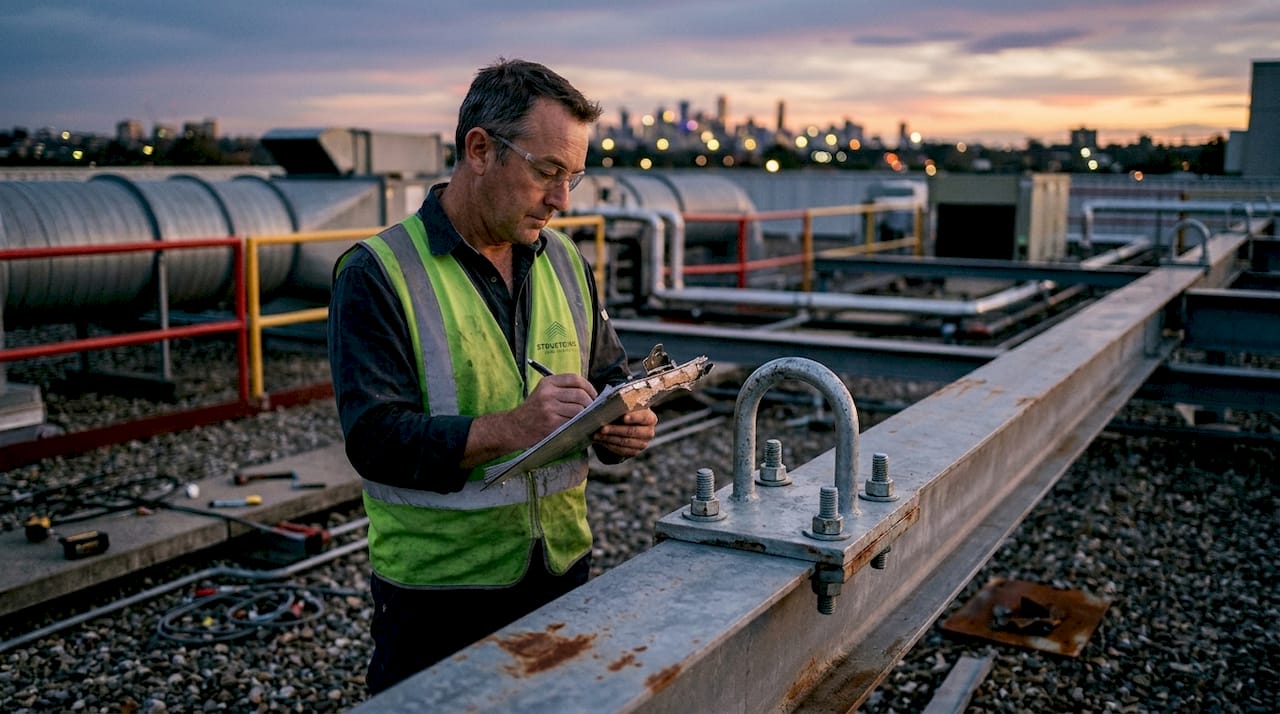
Integrating permanent safety features like fixed anchorage points can reduce fall hazards by over 80% in commercial projects. That figure illustrates the gap between what reactive site controls achieve and what thoughtful design can deliver.
The table below compares reactive safety controls against integrated safety design across key project parameters.
| Parameter | Reactive safety controls | Integrated safety design |
|---|---|---|
| When applied | After design is finalized | During schematic and detail design phases |
| Cost of implementation | Higher due to redesign or retrofitting | Lower when embedded from concept stage |
| Effectiveness | Dependent on worker compliance | Built into the physical environment |
| Documentation | Often informal or incomplete | Formally logged in design risk register |
| Lifecycle coverage | Typically construction phase only | Covers construction, operation, and maintenance |
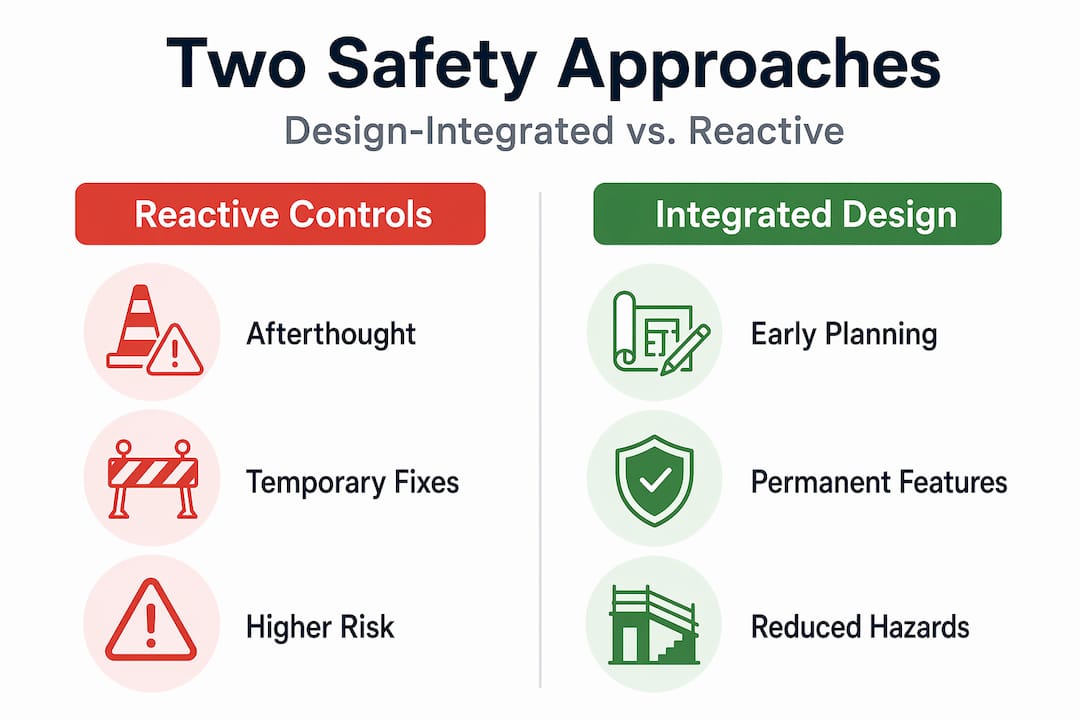
Changes to improve safety cost much less when made during design than during construction or operation. This economic reality is often the most persuasive argument for clients who push back on investing additional design hours in safety analysis.
Human factors also play a substantial role that is frequently underestimated. Poor workspace organization causes cumulative strain and injury risk more than isolated incidents. When a design forces workers into awkward postures, requires repeated overhead reaching, or creates congestion at critical workflow junctions, injuries accumulate over time rather than appearing as single dramatic events. Safety focused design accounts for these ergonomic and behavioral factors from the outset, shaping the physical environment so that the safest path is also the most natural one.
“Safety, efficiency, and cost-effectiveness are complementary outcomes that result from well-considered design that works with human behavior rather than imposing unrealistic demands.” — Safety in Design
Designing for maintainability extends this logic across the full building lifecycle. Permanent anchors, clear equipment access corridors, and labeled isolation points reduce risks not only during construction but for every maintenance team that will service the building over its operational life. The importance of safety in design, therefore, is not a construction-phase concern alone. It is a commitment that compounds in value over decades.
Implementing design for safety in practice
Translating design for safety principles into project delivery requires a structured process, not good intentions. The Safety in Design (SiD) methodology provides that structure. Here is how it operates in practice across a typical construction project.
-
Initiate a design safety review at concept stage. Before layouts and structural systems are determined, the project team documents known hazards associated with the project type, site conditions, and construction methodology. This is the cheapest point at which design strategies for safety can be applied.
-
Establish and maintain a Design Risk Register. Systematic documentation of safety risks via tools like Design Risk Registers ensures accountability and prevents safety drift. Every identified hazard, its associated control measure, and the responsible design discipline are logged. The register is a live document, not a one-time submission.
-
Conduct formal Safety in Design workshops. Structured workshops bring designers, structural and M&E engineers, contractors, and client representatives to the same table. Engaging end users and daily workers early in design prevents overlooked hazards and increases usability. Workers who will operate and maintain the completed facility often identify hazards that office-based designers miss entirely.
-
Apply the hierarchy of controls systematically. For each registered hazard, the team works through the control hierarchy in sequence, documenting why each level was or was not feasible before moving to the next.
-
Communicate residual risks formally. Any hazard that remains after design controls have been applied is documented in a Residual Risk Report and transferred to the construction contractor and, subsequently, to the building owner. Logging every safety decision in this way ensures continuous risk review and prevents safety from being deprioritized during complex project phases.
Pro Tip: Require your design team to include a Safety in Design statement as a standard deliverable alongside construction drawings. This creates a formal handover of safety knowledge between designers and contractors that cannot be lost in verbal briefings.
Regulatory context adds further weight to this process. In Singapore, the Building and Construction Authority (BCA) and the Ministry of Manpower (MOM) have progressively tightened design accountability requirements. What is safety engineering in this regulatory context involves not just technical analysis but formal compliance submissions that demonstrate how hazards have been addressed at source.
Barriers to adoption and how to address them
Recognizing the barriers to design for safety adoption is as important as understanding the methodology itself. Three categories of resistance appear repeatedly across construction projects in Singapore and beyond.
-
Cost concerns from clients and developers: The argument that safety in design adds design hours and increases fees is common. The counter-argument, supported by cost data, is that hazard elimination during design prevents expensive variations, delays, and litigation costs during construction. Safety programs embedded into blueprints from day one outperform those enforced reactively on every measurable metric.
-
Safety drift during project execution: Even when safety design principles are established early, they erode under schedule pressure. Design changes made under tight deadlines rarely receive the same safety scrutiny as original design decisions. A maintained Design Risk Register, with mandatory review at each design stage gate, is the primary defense against this pattern.
-
Capability gaps among designers and project managers: Many design professionals receive limited formal training in hazard identification and risk assessment. Building capability through structured training programs and mentoring under experienced safety engineers accelerates adoption and improves the quality of design safety reviews.
-
Fragmented accountability: On projects with multiple consultants, responsibility for safety in design can fall between disciplines. Assigning a lead Safety in Design coordinator who has authority across all design packages resolves this ambiguity.
-
Cultural reluctance to report issues: A just culture where near misses and unsafe conditions are reported without punishment is fundamental for continuous safety improvement. Real safety challenges are often system failures rather than individual errors, and a project culture that treats reporting as a threat rather than an asset misses critical early warnings.
Addressing these barriers requires deliberate effort from project leadership, not only design teams. When clients, developers, and project managers signal that safety in design is a non-negotiable project standard, the downstream culture responds accordingly.
My perspective on design for safety in construction
I have reviewed enough post-incident investigation reports to know that the phrase “unforeseeable hazard” appears far more often than it should. In most cases, the hazard was foreseeable. It simply was not considered during design, because safety was treated as the contractor’s problem rather than the designer’s responsibility.
What I have learned from observing projects where design for safety was genuinely embedded from concept stage is that the benefits extend well beyond injury prevention. Sites run more efficiently when workflow paths are logical, access is clear, and workers are not improvising around design oversights. The relationship between safety and productivity is not a trade-off. It is a reinforcing cycle.
The professionals who advocate most effectively for safety in design are not the ones who cite regulations first. They are the ones who translate safety decisions into cost and schedule language that clients and developers understand. If a design change eliminates a hazard that would otherwise require a temporary edge protection system for twelve months of construction, that is a quantifiable saving. Make that argument, and the conversation shifts.
My honest view is that safety focused design is not yet standard practice across the industry in Singapore, despite regulatory progress. It remains the exception on projects where an engaged engineer or safety professional insists on it. That needs to change at the industry level, and it starts with professionals who understand both the technical requirements and the business case being willing to advocate clearly for them.
— Aman
How Aectechnicalsg supports safe design integration
At Aectechnicalsg, design for safety is not treated as an add-on service. It is embedded in the consultancy process from the first project briefing through to regulatory submission. For developers and construction firms working within Singapore’s regulatory framework, that means every structural, geotechnical, and M&E design engagement includes formal hazard review and documentation aligned with BCA and MOM requirements.
Whether a project requires engineering consultancy services scoped specifically around safety in design, or broader support covering authority submissions to BCA, URA, and SCDF, the Aectechnicalsg team brings the technical depth to deliver compliant, construction-ready designs. Understanding design for safety in Singapore and translating that understanding into submission-ready documentation is a core capability of the firm. Project teams that want to move from reactive safety management to genuine design accountability are encouraged to contact Aectechnicalsg for a project-specific consultation.
FAQ
What is design for safety in construction?
Design for Safety (DfS) is a methodology that integrates hazard identification and risk elimination into the design and planning phases of a construction project. It addresses risks before construction begins rather than managing them reactively on site.
How does design for safety differ from traditional site safety management?
Traditional site safety management responds to hazards after design is finalized, relying on administrative controls and PPE. Design for Safety eliminates or reduces hazards through design decisions, making safety a physical condition of the built environment rather than a procedural requirement.
What is a Design Risk Register and why does it matter?
A Design Risk Register is a formal document that logs every identified hazard, its control measure, and the responsible design discipline throughout the project. It prevents safety drift by maintaining accountability across all design stages and project handovers.
What role do designers play in construction safety?
Designers hold significant influence over construction safety because their decisions determine the physical conditions workers encounter on site. Specifying permanent fall arrest anchors, clear maintenance access, and logical workflow layouts directly reduces injury risk across the full building lifecycle.
Is design for safety a legal requirement in Singapore?
Singapore’s regulatory framework, administered by BCA and MOM, increasingly requires designers and developers to demonstrate formal hazard management as part of the design process. While specific requirements vary by project type, safety accountability at the design stage is a recognized and enforced standard.