
Singapore’s construction approval workflow has always been one of the most demanding regulatory processes in the region. Fragmented submissions, multi-agency coordination, and version control errors have historically pushed project timelines past their targets and driven up costs. The introduction of CORENET X has fundamentally changed how construction professionals manage the construction approval workflow in Singapore, consolidating approvals across seven agencies into a single digital platform. This guide provides a practical, step-by-step breakdown of the current process, covering prerequisites, submission stages, common mistakes, and post-approval compliance requirements.
Table of Contents
- Key takeaways
- Construction approval workflow Singapore: what you need before you start
- The step-by-step submission process on CORENET X
- Leveraging Kit-of-Parts and DSP submissions
- Common mistakes that delay construction permits in Singapore
- Post-approval compliance and ongoing verification
- Expert perspective: what the digital transition has actually changed
- How Aectechnicalsg supports your approval workflow
- FAQ
Key takeaways
| Point | Details |
|---|---|
| CORENET X is now the central platform | All major project submissions must pass through CORENET X, consolidating seven agency approvals in one place. |
| BIM compliance is non-negotiable | Submissions require a federated BIM model built to the IFC+SG standard before any review begins. |
| Kit-of-Parts saves time and money | Projects using the KoP approach with a single DSP submission save at least 10% in manufacturing costs. |
| Early coordination prevents costly delays | Thrice-weekly team meetings and centralized tracking logs are proven practices from high-performing project teams. |
| Post-approval compliance is ongoing | Permit conditions, inspection coordination, and supplementary submissions continue well past plan approval. |
Construction approval workflow Singapore: what you need before you start
Before a single drawing enters the CORENET X portal, your project team must clear several administrative and technical prerequisites. Skipping any of these steps at the beginning creates delays that compound fast once the formal review clock starts.
Registration and licensing requirements
- Register all participating firms on the CORENET X portal under the relevant project roles (Qualified Person, Developer, Main Contractor)
- Verify that your main contractor holds a valid CRS (Contractors Registration System) grade appropriate to the project scope
- Confirm that all Nominated Sub-Contractors (NSCs) and specialist contractors are registered with the National Construction Authority (NCA) under the correct work categories
- Confirm that your Qualified Person (QP) for structural and architectural submissions has updated eSales and BCA licensing details
Technical and document preparation
| Requirement | Detail |
|---|---|
| BIM standard | IFC+SG federated model covering architectural, structural, and MEP disciplines |
| Submission platform | CORENET X portal with project created and roles assigned |
| Design Standardisation Plan (DSP) | Required for projects using Kit-of-Parts modular components |
| Coordinated drawings | Clash-detected, discipline-coordinated set before submission |
| IT setup | Compatible BIM authoring software and IFC export capability verified |
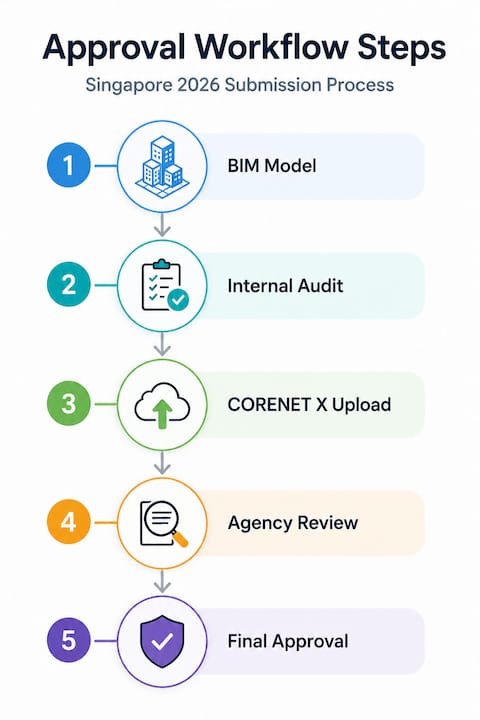
Mandatory BIM use under the IFC+SG standard requires the federated model to integrate architecture, structural, and MEP data in a format all reviewing agencies can access concurrently. This is not a documentation formality. Agencies will reject submissions that do not conform to the modeling standard, resetting your timeline entirely.
Pro Tip: Run a pre-submission BIM audit internally at least two weeks before your planned portal upload. Cross-check IFC export settings against BCA’s published model checking criteria to catch non-conformances before they reach the agency queue.
Note also that CORENET X is mandatory for projects exceeding 30,000 sq m GFA. Over 100 projects and 180 firms have adopted the platform since 2023, so the learning curve among peers is real and documented.
The step-by-step submission process on CORENET X
With prerequisites in place, the actual building approval process in Singapore follows a defined sequence. Understanding where each stage sits and what it demands keeps the project team coordinated and prevents revision loops.
-
Create the project record on CORENET X. The developer or their appointed QP establishes the project, assigns roles, and uploads the base project information. Errors in project categorization at this stage affect which agencies are triggered for review.
-
Submit coordinated BIM models for preliminary design review. The QP uploads the federated model and associated drawings. CORENET X routes the submission automatically to the relevant agencies, which currently include BCA, URA, LTA, SCDF, NParks, PUB, and NEA.
-
Receive concurrent agency feedback. This is where CORENET X delivers its most significant advantage. Unlike the older sequential review process, concurrent multi-agency reviews allow all agencies to comment simultaneously, reducing revision cycles and cutting overall approval time by up to 20%.
-
Respond to agency comments with coordinated amendments. Each comment set must be addressed in the BIM model and drawings. Amendments require resubmission of the affected model elements, not just marked-up PDFs. This is a common point of failure for teams not maintaining strict version control.
-
Obtain formal approvals from all relevant agencies. Once all agencies have cleared their respective review items, the formal plan approval is issued. This is the trigger for the building permit process to proceed to site commencement activities.
-
Manage supplementary submissions for design changes. Any deviation from the approved model during construction requires a supplementary submission through CORENET X before the change is implemented on site.
Pro Tip: Assign a dedicated CORENET X submission coordinator within your project team. This person owns the submission tracking list, monitors agency comment status, and ensures no item is left unanswered beyond the prescribed response period.
“The Springleaf Residence project team held three meetings per week specifically to track CORENET X submission items. The result was faster agency responses and fewer escalated comments.”
Milestone tracking is also worth formalizing. Map each submission stage to a project Gantt chart and flag dependencies. Agency review periods are not fixed, but BCA publishes target processing times. Build buffer where agency comments are expected to be substantial.
Leveraging Kit-of-Parts and DSP submissions

The Kit-of-Parts (KoP) approach is one of the most significant regulatory developments in Singapore’s building approval process in recent years. It allows project teams to catalog standard modular components and obtain regulatory pre-validation through a single Design Standardisation Plan, rather than submitting full approvals for each project that uses the same components.
| Traditional approach | Kit-of-Parts approach |
|---|---|
| Full structural submission per project | Single DSP accepted for multiple projects |
| Repetitive agency review cycles | Pre-validated component library used |
| Higher per-project consultant hours | Estimated 320 man-hours saved per large project |
| Standard precast unit costs | At least 10% reduction in manufacturing costs |
Developers using KoP can save at least 10% in manufacturing costs and 20% in manpower per project, with consultants saving approximately 320 man-hours per typical large project through the single DSP pathway.
The practical requirements for adopting KoP include:
- Preparing a component catalog with full structural calculations and specifications for each standard element
- Submitting the DSP to BCA for acceptance under the new buildability type approval framework
- Maintaining the approved catalog with version control as components are updated
- Applying the accepted DSP reference in subsequent project submissions to bypass repeated reviews
For developers planning multiple projects on similar typologies, for example, residential blocks with standardized unit layouts, the long-term productivity gains from this approach are substantial. The adoption of standardized prefabricated components also directly addresses Singapore’s construction sector manpower constraints, making it both a regulatory and operational priority.
For more on how the design and build model supports DSP submissions, Aectechnicalsg’s resource on project standardization covers the workflow integration in detail.
Common mistakes that delay construction permits in Singapore
The construction permit process in Singapore has clear standards, but certain failure patterns appear repeatedly across project teams, particularly those new to CORENET X.
-
BIM non-conformance on first submission. Teams that carry over old drafting habits produce IFC files that fail model checking. BIM submissions under IFC+SG require strict adherence to modeling standards so all agencies can review the federated model concurrently. One rejected model resets the review clock entirely.
-
Inadequate discipline coordination before upload. Structural elements clashing with MEP runs, or architectural setbacks inconsistent with structural grids, generate comments from multiple agencies simultaneously. Resolving clashes internally before submission is far cheaper than resolving them under live agency review.
-
Ignoring concurrent feedback from all agencies. Some teams focus on the BCA or URA comments and treat SCDF or PUB items as secondary. All agency conditions must be cleared before plan approval is issued. Selective response strategies extend the total review cycle.
-
Poor version control on amended drawings. When amendments are made in response to comments, the wrong drawing version being resubmitted is a documented cause of re-reviews and lost approvals.
-
Late involvement of builders and specialist subcontractors. Early and frequent coordination among all project stakeholders is the single most consistently cited factor in successful submissions. Bringing the main contractor into the BIM coordination process at design stage, rather than post-approval, prevents buildability conflicts that would otherwise surface as change requests.
Pro Tip: Review Aectechnicalsg’s analysis of common PE submission rejections before your first CORENET X upload. The rejection patterns documented there overlap significantly with model-checking failures at the BCA review stage.
Construction workflow management at this level demands a formal internal checklist. Before any submission, your QP should sign off on BIM conformance, discipline coordination, document version tagging, and the completeness of supporting calculations.
Post-approval compliance and ongoing verification
Plan approval is not the end of the regulatory process. It is the beginning of a construction compliance phase that carries its own obligations, monitoring requirements, and documentation standards.
-
Read and record all permit conditions. Agency approvals frequently carry conditions, such as noise control periods, traffic management plans, or specific inspection milestones. These must be documented, assigned to responsible parties, and tracked throughout the construction program.
-
Coordinate with agencies during phased construction. Certain works trigger mandatory inspections before proceeding. SCDF, for instance, requires that fire protection installations be inspected and certified progressively, not just at project completion. The SCDF FSSD submission process for fire safety compliance runs parallel to construction, requiring separate coordination. Aectechnicalsg provides dedicated support for SCDF and FSSD submissions to keep this track aligned with the main build program.
-
Maintain a QA documentation register. Record inspection dates, agency attendees, outcomes, and any conditions imposed during site visits. This register supports the Certificate of Statutory Completion (CSC) application and provides evidence of compliance in the event of an audit.
-
Submit supplementary applications for design deviations promptly. Any deviation from approved plans must be submitted through CORENET X before the change is made on site. Proceeding without approval exposes the developer and QP to enforcement action under the Building Control Act.
-
Prepare for the TOP/CSC process in parallel. The Temporary Occupation Permit (TOP) and CSC applications require compiled documentation from all agencies. Starting this compilation at least three months before practical completion prevents last-minute gaps.
Pro Tip: Assign a compliance officer or dedicated site QP specifically to manage post-approval obligations. This person’s sole focus should be tracking permit conditions, scheduling inspections, and maintaining the documentation register. Merging this role with the construction manager’s workload is a common source of missed compliance steps.
For a structured reference on how professional engineers maintain regulatory compliance through this phase, the structural design approval guide on Aectechnicalsg’s platform provides detailed procedural context.
Expert perspective: what the digital transition has actually changed
I’ve spent years working on regulatory submissions across multiple Singapore construction project types, and the shift to CORENET X represents a genuine structural change in how project approvals are managed, not simply a digital version of the old paper process.
What I’ve found most telling is that the teams struggling most with CORENET X are not the ones with weaker technical knowledge. They are the ones that treat the platform as a document submission system rather than a coordination infrastructure. The concurrent review model requires that your design be further developed before submission than the old sequential process ever demanded. You cannot rely on BCA approving the structure before SCDF or NParks even looks at the drawings. Every discipline needs to be coordinated before the first upload.
In my experience, projects that invest in a dedicated CORENET X coordinator, hold structured weekly reviews with all consultants, and run internal BIM audits ahead of submission consistently outperform those that do not. The time pressure is real. Singapore’s construction sector already contends with manpower constraints and tight delivery schedules. Losing two or three weeks to a rejected model submission or an unresolved agency comment is a cost that ripples through the entire program.
On the horizon, AI and digital tools in construction will eventually accelerate model checking and comment resolution, but data governance and inter-agency data sharing frameworks still need to mature before that potential is realized. For now, the competitive advantage belongs to teams that master the current system thoroughly and engage proactively with the authorities.
— Aman
How Aectechnicalsg supports your approval workflow
Navigating Singapore’s construction approval workflow demands technical precision, regulatory knowledge, and coordination across multiple disciplines and agencies. Aectechnicalsg provides engineering consultancy services specifically structured for this environment.
From BIM-compliant structural submissions to DSP preparation for Kit-of-Parts projects, the team at Aectechnicalsg manages the full regulatory submission cycle on behalf of developers, contractors, and architectural firms. Services cover CORENET X project setup, coordinated BIM model preparation, multi-agency liaison, and post-approval compliance tracking. For project teams who need to maintain momentum without allocating internal resources to regulatory management, Aectechnicalsg offers a proven design for safety and compliance framework that keeps projects on schedule and within regulatory requirements. Contact Aectechnicalsg for a project-specific consultation before your next submission cycle begins.
FAQ
What is CORENET X and is it mandatory?
CORENET X is Singapore’s digital regulatory submission platform that consolidates building approvals across seven government agencies. It is mandatory for projects exceeding 30,000 sq m GFA, with over 180 firms already using it.
How long does the building approval process take in Singapore?
Approval timelines vary by project complexity, but CORENET X reduces overall approval time by up to 20% through concurrent multi-agency reviews compared to the previous sequential process.
What BIM standard is required for Singapore construction submissions?
All CORENET X submissions require a federated BIM model built to the IFC+SG standard, integrating architectural, structural, and MEP disciplines in a format accessible to all reviewing agencies simultaneously.
What is the Kit-of-Parts approach and who should use it?
The Kit-of-Parts (KoP) approach allows project teams to pre-validate standard modular components through a single Design Standardisation Plan (DSP), saving approximately 320 man-hours and at least 10% in manufacturing costs per project. It is most beneficial for developers delivering multiple projects with similar typologies.
What happens if construction deviates from the approved plans?
Any on-site deviation from approved plans requires a supplementary submission through CORENET X before the work proceeds. Proceeding without this approval constitutes a breach under the Building Control Act and may expose both the developer and Qualified Person to regulatory enforcement.