
The Building and Construction Authority (BCA) is far more than a permit-issuing body. For project managers, contractors, and regulatory specialists working in Singapore, the role of BCA in Singapore construction spans building control, workmanship quality certification, digital regulatory transformation, and contractor registration. Missing any one of these layers creates compliance gaps that can delay approvals, affect tender eligibility, and expose projects to safety liability. This article breaks down each function systematically so you can engage with BCA’s systems with full situational awareness.
Table of Contents
- Key Takeaways
- The role of BCA in Singapore construction: core functions
- Quality assurance frameworks: CONQUAS and Quality Mark
- BCA’s role in construction innovation and digital transformation
- BCA and MOM: understanding regulatory coordination
- Practical implications across the project lifecycle
- My perspective on BCA’s evolving regulatory identity
- How Aectechnicalsg supports BCA compliance and project delivery
- FAQ
Key Takeaways
| Point | Details |
|---|---|
| BCA governs more than permits | BCA’s authority covers contractor registration, workmanship standards, and digital approval workflows across the full project lifecycle. |
| CONQUAS sets the quality benchmark | Introduced in 1989, CONQUAS® is Singapore’s national standard for construction workmanship and directly shapes tender evaluations. |
| CORENET X cuts approval time | The digital multi-agency platform reduces approval time by up to 20%, with concurrent review by seven agencies. |
| MOM’s SDQ framework runs parallel | Tender eligibility for public projects above $1 million requires meeting MOM’s safety standards alongside BCA compliance. |
| Integrated regulatory strategy is required | Relying on BCA knowledge alone is insufficient. Coordinating BCA, MOM, and contract conditions is critical for project success. |
The role of BCA in Singapore construction: core functions
BCA develops and regulates Singapore’s building and construction sector through two foundational mechanisms: the building control pathway and the contractor registration system. Every practitioner interacts with both, often repeatedly across a single project lifespan.
The building control pathway is what most professionals recognize first. It governs structural plan submissions, qualified person (QP) appointments, building plan approvals, and the issuance of temporary occupation permits (TOPs) and certificates of statutory completion (CSCs). These are non-negotiable checkpoints that apply to all regulated works in Singapore. What is less commonly understood is that BCA’s influence on construction industry regulations extends well beyond these formal gateways.
Here are the core regulatory functions BCA exercises across a typical project:
- Contractor registration via eBACS: All contractors performing regulated works must be registered under BCA’s eBACS directory. Registration is categorized by work head type, financial grading, and capacity, directly determining which projects a firm can legally tender for.
- Structural safety enforcement: BCA enforces compliance with the Building Control Act, including mandatory independent checking of structural plans for high-risk buildings and critical infrastructure.
- Buildability and constructability standards: BCA’s buildability framework mandates minimum buildability scores, promoting designs that reduce reliance on manual labor through off-site fabrication and prefabrication.
- Environmental sustainability: BCA’s Green Mark scheme sets minimum sustainability standards for new buildings and major retrofits, with certification tiers that affect planning approvals.
- Accreditation and testing oversight: BCA oversees accreditation of testing laboratories and product certification schemes, which feed directly into materials compliance on site.
Understanding these BCA compliance standards at the outset of project planning prevents costly late-stage redesigns and registration gaps that could disqualify a contractor from specific scopes of work.
Quality assurance frameworks: CONQUAS and Quality Mark
CONQUAS® was introduced in 1989 as Singapore’s national standard for assessing construction workmanship quality. It functions as a scoring system applied to structural works, architectural finishes, and mechanical and electrical (M&E) installations. Scores are recorded, benchmarked, and tracked over time, creating a verifiable quality record tied to the contractor.

The significance of CONQUAS extends beyond internal benchmarking. BCA’s construction quality regime shapes tender evaluation criteria for public projects, meaning a poor CONQUAS score history can directly affect a contractor’s competitiveness in government procurement. The BCA Quality Mark, launched in 2002, operates alongside CONQUAS to provide a consumer-facing certification for residential projects, assuring buyers of a consistent standard in workmanship delivery.
How these frameworks embed into project practice:
- Pre-qualification: Before submitting tenders for public housing or institutional projects, check whether CONQUAS scoring is a mandatory component of the quality plan submission. Government agencies frequently weight quality credentials in evaluation matrices.
- Workmanship targets: Set internal workmanship targets that exceed the minimum CONQUAS threshold. Projects consistently achieving high scores build a track record that supports future tendering.
- Trade supervision: CONQUAS assessors evaluate specific trade items, including wall finishes, jointings, and M&E installation quality. Supervisors must understand exactly which inspection criteria apply to each work category.
- Bonus Scheme for Construction Quality (BSCQ): BCA’s incentive program rewards contractors with bonuses for exceeding quality benchmarks and penalizes those who fall below. The financial implications are real and should be factored into project contingency planning.
- Quality Mark for residential projects: If the project scope includes private residential units, Quality Mark certification signals commitment to a recognized BCA standard and strengthens market positioning.
Pro Tip: Align your internal defect management system directly with CONQUAS assessment categories from the pre-construction phase. Retrofitting quality control processes after construction begins is significantly less effective and more costly.
BCA’s role in construction innovation and digital transformation
BCA’s impact on construction in Singapore is perhaps most consequential in how it handles emerging technologies. Rather than waiting for new methods to fit existing prescriptive codes, BCA operates an outcome-based regulatory approach that supports trial validation for novel construction methods. This is a structural shift in how construction industry regulations Singapore can accommodate innovation without sacrificing safety.
The most concrete example of this approach is on-site 3D concrete printing (3DCP). A BCA-supported 3DCP project cut manhours by 50%, with verification completed in August 2025 and a second project commencing in January 2026. BCA’s endorsement was not based on prescriptive compliance. It was based on evidence gathered from site trials, structural testing, and outcome verification. For project teams considering advanced construction methods, this signals a path forward through engagement rather than avoidance of the regulator.
On the digital front, CORENET X was launched in 2018 as a one-stop digital regulatory approval platform. The impact on project schedules is measurable.
| Feature | Traditional Workflow | CORENET X Workflow |
|---|---|---|
| Agency review process | Sequential, agency by agency | Concurrent review by 7 agencies |
| Approval time reduction | Baseline | Up to 20% faster |
| Rework from coordination gaps | Higher risk | Reduced through early clash detection |
| BIM integration | Limited or manual | Centralized digital model submission |
| Mandatory applicability | N/A | Projects over 30,000 m² GFA |
CORENET X enables consolidated responses and prevents buildability clashes from surfacing late in the design process. For large-scale projects, the platform reduces the coordination overhead that typically consumes weeks of QP and project management time. You can explore how digital approval workflows operate in practice to plan your submission process more effectively.
BCA and MOM: understanding regulatory coordination
One of the most consequential misunderstandings in Singapore construction practice is treating BCA as the sole regulatory reference point for project compliance. Tender eligibility risks frequently originate not from BCA gaps but from the Ministry of Manpower’s (MOM) Workplace Safety and Health (WSH) frameworks.
MOM’s Safety Disqualification (SDQ) framework, which applies from April 2024 to public sector construction tenders, introduces safety weightage requirements that directly affect tender scoring. The key parameters are:
- Project threshold: SDQ applies to public sector projects with a contract value above $1 million.
- Safety weightage minimum: Tenders must allocate at least 5% of evaluation criteria to safety and health performance metrics.
- Scope of impact: The SDQ framework applies to both main contractors and subcontractors, meaning supply chain management must account for WSH standing throughout.
- Disqualification consequences: Contractors with poor WSH incident records can be disqualified from tendering, regardless of strong BCA compliance standing.
Even with strong BCA compliance, meeting MOM’s WSH standards is separately required for tender eligibility, indicating the need for an integrated regulatory strategy. BCA’s Singapore construction safety standards address structural and workmanship concerns, while MOM’s framework governs worker safety and incident management. Both must be satisfied concurrently. The Aectechnicalsg team frequently encounters projects where BCA submissions are well-prepared but MOM obligations have been underweighted in planning. Reviewing design for safety requirements as part of the design phase addresses both regulatory streams simultaneously.
Pro Tip: Conduct a dual compliance audit at the tender preparation stage. Map BCA registration and quality requirements against MOM’s WSH records in parallel, not sequentially. This prevents last-minute eligibility issues before submission deadlines.
Practical implications across the project lifecycle
Practitioners who understand BCA’s touchpoints across the full project lifecycle are better positioned to manage regulatory risk and schedule certainty. The table below maps key BCA interactions against project stages.
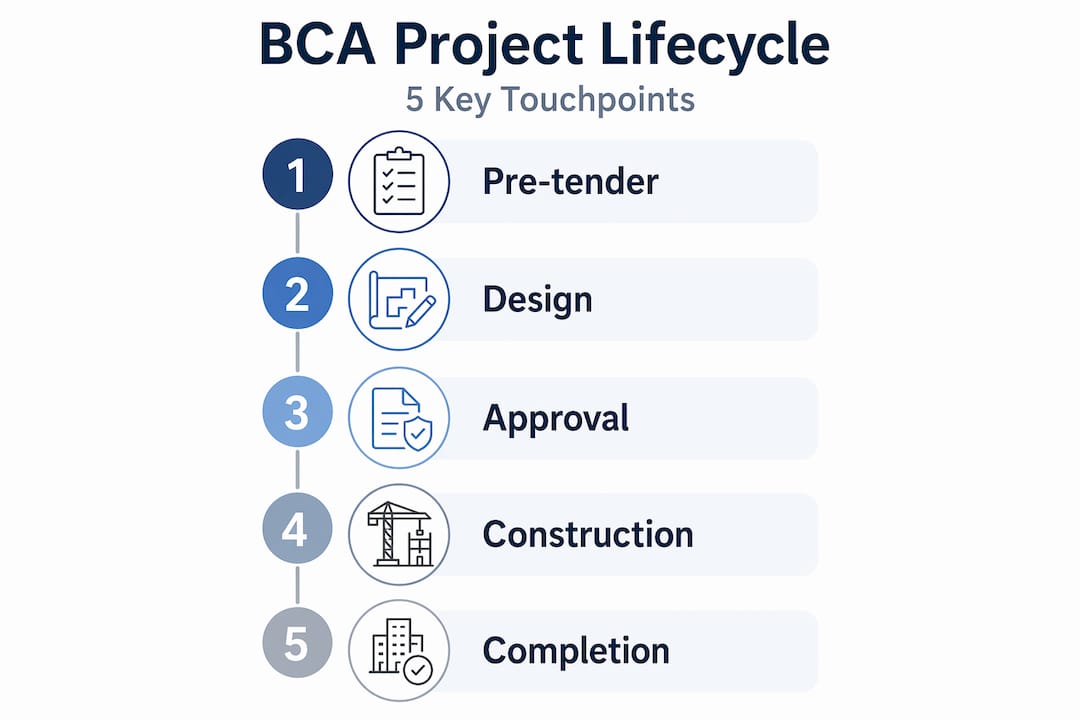
| Project Stage | BCA Touchpoint | Practical Action Required |
|---|---|---|
| Pre-tender | eBACS contractor registration and grading | Verify work head classification matches project scope |
| Design development | Structural plan submission and QP appointment | Appoint QP early; use CORENET X for large-floor-area projects |
| Tender evaluation | CONQUAS score history and Quality Mark certification | Compile quality performance records for submission |
| Construction | CONQUAS assessments and buildability compliance | Schedule CONQUAS inspections aligned with trade completion |
| Completion | TOP and CSC applications | Prepare as-built documentation and final inspections |
Beyond the table, three practical considerations deserve attention. First, BCA’s eBACS registrar is the starting reference for work classification and grading confirmation. Misjudging a firm’s registered capacity for a specific work head creates procurement problems that surface at contract award. Second, for projects requiring professional engineer (PE) input, understanding the BCA ST submission process for structural plans is critical to managing submission timelines accurately. Third, CONQUAS metrics are not a project closeout formality. They are live quality indicators that affect future commercial opportunities and should be integrated into ongoing site supervision protocols.
My perspective on BCA’s evolving regulatory identity
I’ve worked on enough Singapore construction projects to recognize a consistent pattern. Teams that treat BCA as a procedural checkpoint to clear at fixed project stages consistently carry more regulatory risk than those who treat it as a recurring technical collaborator. The 3DCP example makes this concrete. BCA did not simply wait to approve a finished product. It co-developed a validation framework alongside the research team, enabling a 50% reduction in manhours on a live construction site. That kind of outcome is only possible when project teams engage regulators early rather than submit for approval at the end.
What I’ve found equally important is recognizing what BCA does not cover. MOM’s SDQ framework caught several experienced contractors off guard in 2024 precisely because their regulatory planning was BCA-centric. An integrated view, one that maps BCA, MOM, and contract-level safety requirements simultaneously, is not optional for public sector work. It is the minimum standard for competent project management in Singapore today. The professionals who will navigate this most successfully are those who treat building codes and regulations not as static reference documents but as active inputs to project strategy.
— Aman
How Aectechnicalsg supports BCA compliance and project delivery
Aectechnicalsg works directly with developers, contractors, and architectural firms across Singapore to manage the full spectrum of BCA regulatory requirements, from early-stage structural plan submissions to CONQUAS quality program alignment and CORENET X digital submissions. The complexity of Singapore’s multi-agency approval environment means that regulatory preparation cannot be treated as a back-end task.
The team at Aectechnicalsg provides engineering consultancy services tailored to BCA compliance pathways, including structural and geotechnical engineering, M&E design, and authority submissions spanning BCA, URA, SCDF, and LTA. For projects requiring PE endorsements and authority submissions, Aectechnicalsg manages the technical documentation and submission workflow to reduce approval risk. Whether you are managing a large-scale development or a targeted structural upgrade, Aectechnicalsg provides the technical depth and regulatory experience to keep approvals on schedule and compliance obligations fully met.
FAQ
What does BCA regulate in Singapore construction?
BCA regulates building control pathways, contractor registration via eBACS, structural safety compliance, workmanship quality through CONQUAS, and digital approvals via CORENET X. Its authority covers the full project lifecycle from design submission to certificate of statutory completion.
How does CONQUAS affect public sector tenders?
CONQUAS scores form part of tender evaluation criteria for public projects in Singapore, with BCA’s quality regime directly influencing contractor selection. Contractors with consistently high scores gain a measurable advantage in government procurement.
What is CORENET X and who must use it?
CORENET X is BCA’s digital regulatory approval platform that enables concurrent review by seven agencies and reduces approval times by up to 20%. It is mandatory for new projects exceeding 30,000 square meters of gross floor area.
How does MOM’s SDQ framework interact with BCA compliance?
MOM’s Safety Disqualification framework applies independently of BCA compliance, affecting public sector tenders above $1 million with a minimum 5% safety weightage requirement. Contractors must satisfy both BCA and MOM standards to maintain full tender eligibility.
What is BCA’s approach to novel construction methods?
BCA supports innovative methods like 3D concrete printing through an outcome-based regulatory approach, requiring evidence from site trials rather than prescriptive code compliance. This enables validation and endorsement of methods that demonstrably improve productivity and safety.
Recommended
- Building Codes And Regulations In Singapore Construction Industry – AEC Technical Advisory Singapore Engineering Consultancy
- The real value of consultancy firms in Singapore construction
- Design and Build in Singapore: Streamline Your Projects
- BCA ST Submission for Structural Plans in Singapore – AEC Technical Advisory Singapore Engineering Consultancy