
Building regulations Singapore 2026 define the mandatory compliance framework for all construction projects, incorporating updated environmental sustainability standards, digital submission protocols via CORENET-X, and stricter developer accountability measures. The Building Control (Amendment) Regulations 2026 took effect on 1 April 2026, with specific provisions phased across the year. Responsible agencies including BCA, URA, NParks, SCDF, LTA, PUB, and NEA each enforce distinct requirements that construction professionals must track simultaneously. Understanding the precise regulatory trigger dates, digital modeling standards, and penalty frameworks is not optional. It is the foundation of project delivery in Singapore’s 2026 construction environment.
What are the 2026 building regulations professionals must follow?
The singapore construction laws 2026 framework rests on three major pillars: Environmental Sustainability (ES) requirements, the CORENET-X digital submission mandate, and new developer penalty frameworks. Each pillar carries distinct applicability thresholds, trigger dates, and compliance obligations. Professionals who treat these as separate concerns rather than an integrated compliance system will encounter costly rework and approval delays.
The building codes Singapore 2026 framework does not apply uniformly across all project types. Gross Floor Area (GFA) thresholds, project classification, and the specific date of the first URA planning permission submission all determine which version of a regulation governs a given project. This version-control dynamic is the most misunderstood aspect of the current regulatory environment, and it is where most compliance failures originate.

Practitioners who begin compliance planning only at the construction documentation stage consistently discover that earlier design decisions, made under a different regulatory version, now require revision. The regulatory trigger date governs compliance, not the construction start date. This distinction has material consequences for project budgets and timelines.
What are the environmental sustainability requirements for 2026 building projects?
Environmental Sustainability regulations under the Building Control (Environmental Sustainability) Regulations apply to new buildings and major additions based on GFA thresholds. Specifically, ES requirements apply to new buildings with GFA of 5,000 m² or more, as well as major additions and alterations of equivalent scale. This threshold means that a significant portion of commercial, institutional, and large residential projects fall within scope.
The critical compliance trigger is the date of the first URA planning permission submission, not the date construction begins. This means a project submitted to URA in late 2025 is governed by the ES code version current at that submission date, even if construction extends well into 2026 or beyond. Design teams that revise scope or add GFA after the initial submission must carefully assess whether a new submission is triggered, which could invoke the 2026 ES code version with its higher performance benchmarks.
Key applicability criteria include:
- New buildings with GFA ≥ 5,000 m² require mandatory ES compliance and Green Mark certification submission to BCA.
- Major additions and alterations (A&A) that increase GFA to meet or exceed the threshold are subject to the same ES requirements as new buildings.
- Government Land Sales (GLS) sites carry a higher Green Mark standard, typically Green Mark Platinum, as a condition of the land sale tender.
- Mandatory declaration by the Qualified Person (QP) is required at the time of building plan submission, confirming ES compliance.
- Phased projects must track which ES code version applies to each phase based on its individual URA submission date.
Pro Tip: Create a regulatory version log at project inception. Record the first URA submission date, the ES code version in force on that date, and any subsequent submissions that may trigger a version change. This log becomes the single source of truth for compliance decisions across the entire design and construction lifecycle.
Integrating renewable energy solutions early in the design phase, such as photovoltaic systems and passive cooling strategies, directly improves Green Mark scoring and reduces the risk of late-stage redesign to meet ES thresholds.
How does CORENET-X impact regulatory workflows in 2026?
CORENET-X is Singapore’s multi-agency digital regulatory submission platform, replacing the legacy CORENET system with a concurrent review model that routes building plan submissions simultaneously to BCA, URA, SCDF, LTA, PUB, and other agencies. The platform’s concurrent review process reduces approval time by up to 20% compared to sequential agency reviews. That efficiency gain is only realized when submitted BIM models meet the required data standards.
The mandatory adoption timeline is structured as follows:
- October 2025: CORENET-X became mandatory for all new building projects with GFA exceeding 30,000 m².
- 1 October 2026: CORENET-X mandatory for all new projects regardless of size, eliminating the GFA threshold entirely.
- IFC/IFC+SG compliance: All submitted BIM models must conform to IFC or the Singapore-specific IFC+SG standard, with correct object classification and property mapping.
- Multi-agency data requirements: Each agency within CORENET-X has distinct data requirements embedded in the model review. A model that satisfies BCA’s structural review may still fail SCDF’s fire safety review if object classifications are incomplete.
- Rework risk: Inadequate BIM data causes review failures and extended approval timelines, negating the platform’s efficiency benefits.
“The shift to CORENET-X is not simply a change in submission format. It is a fundamental restructuring of how regulatory information is embedded in design models from the earliest project stages.”
Pro Tip: Conduct a CORENET-X BIM readiness audit at the schematic design stage, not at building plan submission. Verify that all structural elements, fire compartments, and M&E systems are modeled with IFC+SG compliant object classifications before the first submission. Errors discovered at submission stage require full model rework and delay the entire approval chain.
Aectechnicalsg’s guidance on BIM mandates and compliance provides a detailed breakdown of the object classification requirements and common modeling errors that trigger review failures under CORENET-X.
What developer penalties affect building regulations compliance in 2026?
The Land Sales Disqualification Framework and the Sales Suspension Framework, both effective from 22 May 2026, represent the most significant expansion of developer accountability in Singapore’s recent regulatory history. These frameworks impose bans of up to five years on developers who deliver defect-ridden or unsafe projects, covering both participation in Government Land Sales and the launch of new residential developments.
The penalty triggers and their implications are summarized below:
| Trigger | Framework | Maximum Penalty Duration |
|---|---|---|
| Severe structural or safety defects | Land Sales Disqualification | Up to 5 years ban from GLS participation |
| Repeated defect non-compliance | Sales Suspension Framework | Suspension of new project launches |
| Safety breaches during construction | Both frameworks | Combined disqualification and suspension |
| Failure to rectify notified defects | Sales Suspension Framework | Extended suspension until rectification |
Key features of the penalty frameworks include:
- Related parties are affected. Directors, shareholders, and associated entities of a penalized developer may also face disqualification, preventing restructuring as a workaround.
- Early warning mechanism. Developers receive formal notification and an opportunity for representation before penalties are imposed, providing a structured due process.
- Licence conditions. Penalties may be imposed as conditions on the developer’s Housing Developer’s Licence rather than outright revocation, allowing graduated enforcement.
- Deterrent signal. The frameworks send a clear signal that construction quality standards are now directly tied to a developer’s ability to operate, not merely to financial penalties.
The practical implication for construction professionals is that defect prevention, not just defect rectification, becomes a commercial imperative. Contractors and consultants working with developers subject to these frameworks carry heightened responsibility for quality assurance documentation throughout the project lifecycle.
What are the compliance triggers and reporting requirements for professionals in 2026?
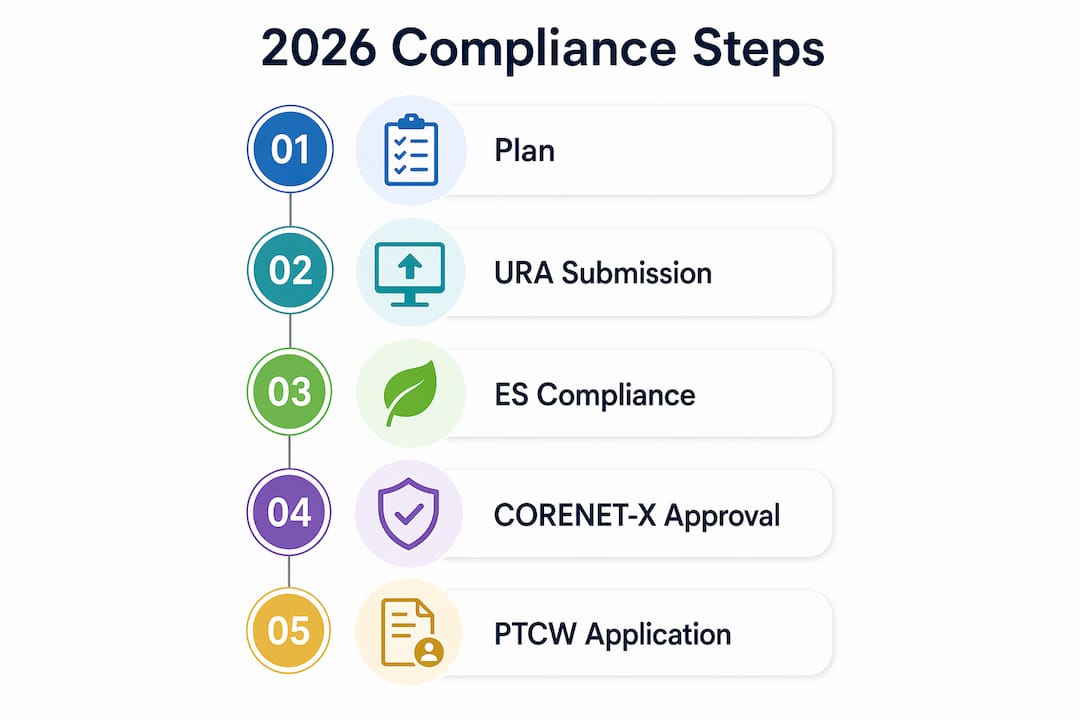
The Permit to Commence Work (PTCW) application date is the regulatory trigger for automated Continuous Professional Development (CPD) submissions under the latest building regulations in Singapore. Mandatory automated CPD submissions apply to all PTCW applications made on or after 1 May 2026, with a specific exception for HDB Build-To-Order (BTO) projects, which operate under a separate timeline. This distinction matters because professionals managing mixed portfolios of private and public housing projects must track different compliance calendars simultaneously.
The reporting requirements extend beyond CPD submissions. The Biometric Authentication System (BAS) for site worker attendance and the SGBuildex integration for construction workforce data both carry live reporting obligations that are activated by the PTCW application date, not the physical start of site work. Misalignment between regulatory trigger dates and actual project timelines is a documented source of compliance failures, particularly for projects where PTCW applications are submitted in advance of mobilization.
Compliance requirements activated by the PTCW application date include:
- Automated CPD submission for all Qualified Persons and Key Personnel named in the PTCW application.
- Biometric Authentication System activation for all site workers, with live data feeds to MOM’s workforce tracking systems.
- SGBuildex integration confirming that all construction personnel meet the relevant trade certification and safety training requirements.
- Version-controlled ES compliance confirmation, cross-referenced against the original URA submission date to verify which ES code version governs the project.
Pro Tip: Build a compliance trigger matrix for every project at the pre-construction planning stage. Map each regulatory obligation to its specific trigger date, whether that is the URA submission date, the PTCW application date, or the construction start date. A single spreadsheet tracking these dates across all active projects prevents the version-control errors that generate the most expensive rework in Singapore’s 2026 regulatory environment.
The construction approval workflow for Singapore projects in 2026 requires professionals to manage at least four distinct trigger dates across the project lifecycle, each activating a different set of compliance obligations.
Key takeaways
Singapore’s 2026 building regulations require professionals to manage environmental sustainability thresholds, CORENET-X digital submissions, developer penalty frameworks, and PTCW-triggered reporting obligations as an integrated compliance system, not as separate workstreams.
| Point | Details |
|---|---|
| Regulatory trigger dates govern compliance | The URA submission date and PTCW application date, not construction start, determine which code version applies. |
| CORENET-X is mandatory for all projects by October 2026 | IFC+SG compliant BIM models must be prepared from schematic design stage to avoid rework at submission. |
| ES requirements apply from 5,000 m² GFA | GLS sites carry higher Green Mark standards; version control across phased submissions is mandatory. |
| Developer penalties extend to related parties | Five-year bans under the Land Sales Disqualification Framework apply to directors and associated entities, not only the developer entity. |
| Automated CPD submissions start 1 May 2026 | PTCW applications on or after this date trigger mandatory automated reporting, with HDB BTO projects as the primary exception. |
Why the 2026 regulatory shift demands a different compliance mindset
From my experience working across Singapore’s construction regulatory environment, the 2026 updates represent a structural change in how compliance is managed, not simply a set of new rules to add to an existing checklist. The introduction of CORENET-X as a mandatory platform for all projects by October 2026 means that BIM quality is now a regulatory deliverable, not a design tool preference. Projects where BIM was treated as a visualization aid rather than a data-rich regulatory submission vehicle are already encountering significant rework costs.
The version-control challenge around ES regulations is the issue I see causing the most friction in practice. Design teams frequently proceed through detailed design under the assumption that the ES code version applicable at URA submission is fixed for the project’s life. It is, until a scope change triggers a new submission. At that point, the project may be governed by a more demanding ES code version, requiring redesign of building envelope specifications, mechanical systems, or renewable energy provisions that were already coordinated and costed.
The developer penalty frameworks are, in my view, the most consequential long-term change. They shift the accountability calculus for the entire project team. When a developer faces a five-year ban from GLS participation for delivering a defect-ridden project, the pressure on contractors and consultants to maintain rigorous quality assurance documentation intensifies considerably. This is not a negative development. It aligns financial incentives with construction quality in a way that previous penalty structures did not.
The professionals who will navigate 2026 most effectively are those who treat regulatory trigger date management as a core project management discipline, not an administrative afterthought. Early coordination among QPs, contractors, and developers, structured around a shared compliance trigger matrix, is the single most effective risk mitigation strategy available.
— Aman
How Aectechnicalsg supports your 2026 compliance obligations
Aectechnicalsg provides engineering consultancy services specifically structured to address the regulatory requirements that Singapore’s 2026 building codes impose on developers, contractors, and architectural firms. From PE endorsements and CORENET-X BIM submission preparation to Environmental Sustainability compliance guidance and multi-agency authority submissions to BCA, URA, SCDF, and LTA, the firm’s services cover the full compliance lifecycle.
For developers managing GLS sites with Green Mark Platinum requirements, or contractors navigating PTCW-triggered automated CPD reporting, expert consultancy support reduces the risk of approval delays and penalty exposure. Explore the full range of engineering consultancy services available for Singapore developers, or review Aectechnicalsg’s PE endorsement and authority submission capabilities to understand how professional support integrates with your project’s regulatory workflow.
FAQ
What date did the Building Control (Amendment) Regulations 2026 take effect?
The Building Control (Amendment) Regulations 2026 came into operation on 1 April 2026, with specific provisions under regulations 7, 8, 9, and 11 subject to separate commencement dates.
When does CORENET-X become mandatory for all building projects?
CORENET-X becomes mandatory for all new building projects in Singapore regardless of size from 1 October 2026, following an earlier mandate for projects exceeding 30,000 m² GFA from October 2025.
What GFA threshold triggers Environmental Sustainability compliance in 2026?
ES requirements apply to new buildings with GFA of 5,000 m² or more, with compliance governed by the date of the first URA planning permission submission, not the construction start date.
How long can developers be banned under the new penalty frameworks?
Under the Land Sales Disqualification Framework and Sales Suspension Framework effective 22 May 2026, developers who deliver defect-ridden or unsafe projects face bans of up to five years from GLS participation and new project launches.
What triggers automated CPD submission requirements in 2026?
Automated CPD submissions are triggered by PTCW applications made on or after 1 May 2026, with HDB BTO projects operating under a separate compliance timeline as the primary exception to this mandate.
Recommended
- Understanding Building Codes in Singapore: 2026 Guide
- Understanding The Role Of Professional Engineers In Ensuring Building Safety And Compliance In Singapore – AEC Technical Advisory Singapore Engineering Consultancy
- PE compliance in Singapore: what developers must know
- Essential structural design guide for Singapore building owners