
An infrastructure project workflow is the structured sequence of coordinated processes spanning engineering, procurement, construction, and operations that governs how infrastructure assets are planned, built, and handed over. Construction managers who treat this sequence as a rigid checklist consistently underperform those who treat it as a living system of decision gates, data flows, and phase overlaps. Modern delivery methods like the EPC model, platforms like Autodesk’s Common Data Environment, and technologies like BIM and digital twins have fundamentally changed what an optimized workflow looks like in 2026. Understanding these shifts is not optional for project stakeholders. It is the baseline for competitive, compliant, and cost-predictable infrastructure delivery.
What are the core phases of an infrastructure project workflow?
A typical infrastructure project workflow moves through six distinct phases, each with defined inputs, outputs, and decision gates. Skipping or compressing a phase without deliberate planning is the most common cause of costly rework later in the project lifecycle.
-
Feasibility and options analysis. This phase establishes technical viability, regulatory constraints, and preliminary cost ranges. Outputs include a project brief, site investigations, and authority pre-consultation records. In Singapore, this often involves early engagement with agencies such as URA, LTA, and PUB before any design commitment is made.
-
Front-End Engineering Design (FEED). FEED translates the feasibility brief into a defined scope with sufficient engineering detail to support procurement decisions and budget locking. This phase produces the basis of design, preliminary drawings, and a project execution plan.
-
Procurement initiation. Procurement accounts for 50 to 60% of EPC contract value, which means long-lead equipment orders must begin before detailed engineering is complete. Waiting for full design sign-off before issuing purchase orders is a schedule risk that compounds across the entire project.
-
Detailed engineering and design. This phase produces construction-ready drawings, specifications, and shop drawing packages. Coordination between structural, M&E, and civil disciplines is most intensive here. Errors introduced at this stage propagate directly into construction.
-
Construction and commissioning. Site activities proceed against a master schedule that integrates design milestones, procurement delivery dates, and construction sequences. Commissioning begins before construction is fully complete on large projects, with systems tested in defined sequences.
-
Handover and operational readiness. Infrastructure assets require lifecycle planning spanning 50 to 100 years, which means handover documentation, as-built records, and maintenance manuals are not administrative afterthoughts. They are the foundation of the asset’s operational value.
The critical difference between high-performing and average project teams is not the phases themselves. It is the rigor applied to phase gate reviews, where a formal decision is made to proceed, revise, or stop before committing resources to the next phase.
How does digital project delivery transform infrastructure workflows?

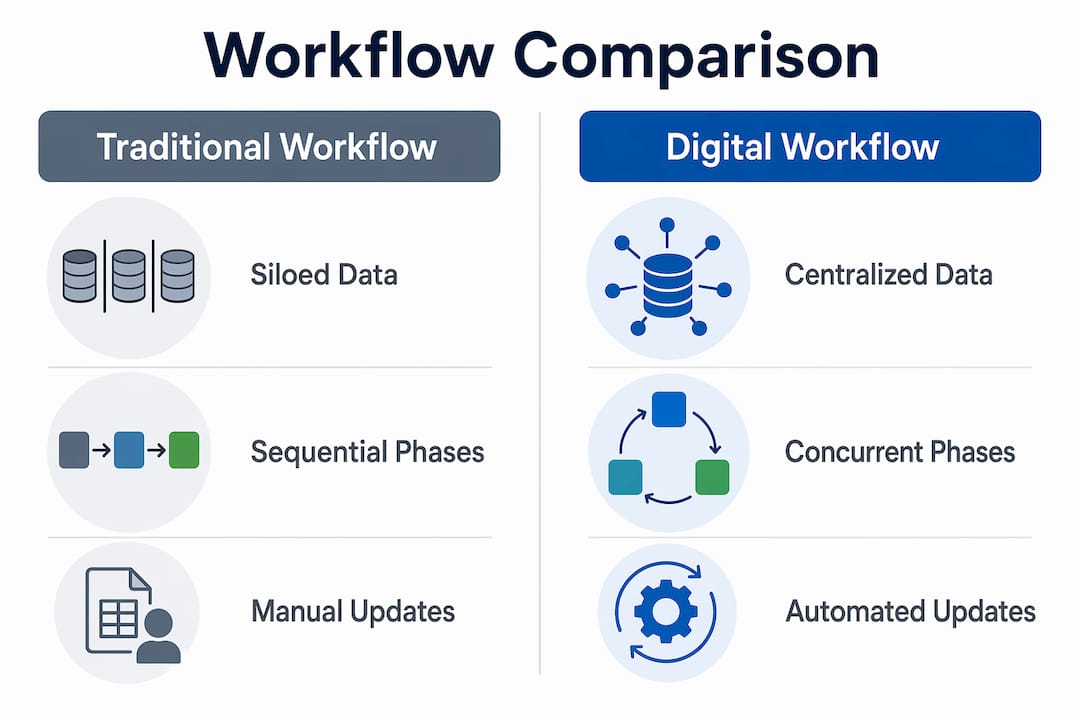
Digital Project Delivery (DPD) is defined as the practice of centralizing data and workflows in a cloud-based Common Data Environment (CDE) to enable real-time collaboration across all project disciplines and phases. This is not a technology upgrade. It is an operational shift that changes how decisions are made, how errors are caught, and how teams communicate across organizational boundaries.
The table below illustrates the practical differences between traditional and digital workflow approaches:
| Dimension | Traditional workflow | Digital workflow (DPD) |
|---|---|---|
| Data storage | Siloed by discipline or contractor | Centralized CDE accessible to all parties |
| Drawing revisions | Email-distributed, version conflicts common | Single-source model with controlled issue registers |
| Schedule updates | Manual, weekly or monthly cycles | Automated triggers from field data and procurement systems |
| Risk identification | Reactive, post-incident reporting | Predictive, using IoT sensors and BIM analytics |
| Stakeholder coordination | Meeting-dependent, slow feedback loops | Live dashboards with role-based access and comment threads |
The practical impact of this shift is measurable. BIM and digital twin integration enables real-time optimization and automatic resource reallocation when activities lag behind the critical path. This means a delay in concrete delivery on Level 3 can trigger an automatic rescheduling of the crane crew to Level 5 without a project manager manually intervening. High-performing infrastructure teams advance beyond visual dashboards to predictive intelligence using IoT sensors and BIM models for proactive risk mitigation.
GIS integration with BIM adds spatial context to project data, which is particularly valuable for linear infrastructure such as roads, rail, and utilities. When a design change affects a corridor that crosses multiple land parcels or authority jurisdictions, a GIS-linked BIM model surfaces those conflicts before they reach the field. Aectechnicalsg’s work on Singapore’s digital twin applications reflects how this integration is being applied in practice across the region.
Pro Tip: Before selecting a CDE platform, map your project’s data exchange requirements by discipline and phase. A platform that works well for structural coordination may create friction for M&E workflows if it lacks the right IFC schema support.
What are best practices to optimize construction workflow efficiency?
Construction workflow optimization depends on three structural decisions made early in the project: how information flows between parties, who owns the master schedule, and how regulatory compliance is embedded into the workflow rather than treated as a separate track.
The most direct way to improve project workflow is to establish a unified master schedule that integrates design milestones, procurement delivery windows, and construction sequences into a single document with explicit dependencies. Fragmented delivery between utilities, EPCs, and contractors causes broken handoffs and increased risk. A unified master schedule with named decision gates reduces rework and increases schedule predictability across the full project team.
Key practices that construction managers should apply:
- Embed regulatory milestones into the master schedule. Authority submission windows for BCA, LTA, or PUB approvals are not external events. They are schedule-critical activities with lead times that must be planned from the outset. Missing a submission window can delay construction commencement by months.
- Use middleware integration to automate schedule updates. Middleware solutions that automate triggers and update dependent schedules reduce manual delays and errors. When a procurement system confirms a delivery date, that date should automatically update the construction schedule without manual re-entry.
- Assign a single workflow owner per phase. Ambiguity about who controls the schedule during the transition from design to construction is a leading cause of coordination failures. One accountable party per phase gate prevents decisions from stalling.
- Specialize by project type. Specialization in project type such as telecom versus roadway infrastructure enhances planning, problem solving, and technical understanding. A team experienced in MRT civil works brings a different workflow discipline than one experienced in industrial plant construction. Matching team expertise to project type reduces the learning curve that otherwise consumes the first 20% of a project.
Pro Tip: Run a workflow audit at the end of FEED, before detailed engineering begins. Identify which data handoffs between disciplines are manual, which approvals are on the critical path, and which contractor interfaces have no defined communication protocol. Fixing these gaps at FEED costs a fraction of what they cost during construction.
For teams managing M&E engineering coordination, the workflow audit is especially valuable because M&E interfaces with every other discipline and is the most common source of coordination clashes.
How does the EPC model compress infrastructure project schedules?
The Engineering, Procurement, and Construction (EPC) delivery model consolidates accountability for all three workstreams under a single contracting entity, which fundamentally changes how the infrastructure development process is sequenced. Under traditional sequential delivery, design must be substantially complete before procurement begins, and procurement must be substantially complete before construction starts. EPC eliminates these hard boundaries.
The schedule impact is significant. EPC delivery can compress overall project schedules by 20 to 30% compared to traditional sequential delivery by overlapping design, procurement, and construction workstreams. For a project with a traditional 48-month schedule, that compression represents 10 to 14 months of recovered time, which translates directly into earlier revenue generation or earlier public service delivery.
The workflow mechanics that enable this compression include:
- Fast-track procurement on long-lead items. Transformers, switchgear, and specialized mechanical equipment are ordered based on preliminary specifications before detailed engineering is finalized. The EPC contractor accepts the risk of minor specification changes against the benefit of schedule certainty.
- Construction mobilization during design. Site preparation, temporary works, and foundation construction begin while detailed engineering of superstructure elements is still in progress. This requires tight coordination between the engineering and construction teams within the EPC entity.
- Phase gate enforcement. Compressing schedules by 20 to 30% demands strict enforcement of phase gates to avoid expensive rework. If construction proceeds on a foundation design that has not been formally approved, a subsequent design change can require demolition and reconstruction at multiples of the original cost.
The EPC model is not universally appropriate. It transfers significant design risk to the contractor and requires the owner to define scope with precision at contract award. Projects where scope is likely to evolve, such as urban regeneration schemes with complex stakeholder requirements, are better suited to design-and-build or traditional procurement with stronger owner-side design control. Aectechnicalsg’s design and build guidance for Singapore projects addresses how to structure these delivery decisions within the local regulatory context.
Key takeaways
A well-governed infrastructure project workflow, supported by digital tools and a unified master schedule, is the single most reliable predictor of on-time, on-budget infrastructure delivery.
| Point | Details |
|---|---|
| Phase gate discipline | Formal decision reviews between phases prevent costly rework and scope drift. |
| EPC schedule compression | Overlapping design, procurement, and construction can reduce schedules by 20 to 30%. |
| Digital Project Delivery | A Common Data Environment breaks down silos and enables real-time collaboration across disciplines. |
| Unified master schedule | Integrating design, procurement, and construction milestones into one schedule reduces fragmentation risk. |
| Regulatory integration | Authority submission milestones must be embedded in the project schedule from the outset, not managed separately. |
Why workflow governance matters more than workflow technology
From my experience working across infrastructure projects in Singapore and the broader Asia-Pacific region, the most persistent failure mode is not a lack of technology. It is a lack of workflow governance. Teams adopt BIM, deploy CDEs, and purchase project management platforms, then continue to manage decisions through email chains and informal conversations that never get recorded in the system.
Digital tools create the conditions for better workflows. They do not create the workflows themselves. The projects I have seen deliver on schedule and within budget share one characteristic: a project director who treats the master schedule as a governance document, not a reporting artifact. Every decision, every change, and every approval is reflected in the schedule within 24 hours. That discipline is harder to build than any technology implementation.
The other pattern worth noting is the underestimation of regulatory workflow complexity in Singapore. Submissions to BCA, LTA, SCDF, and PUB each have their own documentation standards, review timelines, and resubmission protocols. Teams that treat these as administrative tasks rather than critical path activities consistently experience avoidable delays. Embedding regulatory milestones into the master schedule, with named responsible parties and defined lead times, is the single most underutilized workflow improvement available to Singapore-based project teams.
The future of infrastructure project management will be shaped by predictive intelligence, not just real-time visibility. IoT sensors feeding BIM models, automated procurement triggers, and AI-assisted schedule risk analysis are moving from pilot projects to standard practice. But the teams that will benefit most are those that have already built the governance discipline to act on what those tools tell them.
— Aman
How Aectechnicalsg supports your infrastructure project workflow

Aectechnicalsg provides engineering consultancy services specifically structured to support construction managers and developers at every phase of the infrastructure project workflow, from FEED through authority submissions and construction completion. The team’s expertise spans structural and geotechnical engineering, M&E coordination, and regulatory submissions to BCA, URA, LTA, SCDF, PUB, JTC, and NEA. For project teams managing engineering consultancy requirements across multiple disciplines, Aectechnicalsg provides integrated technical advisory that keeps design, compliance, and construction workflows aligned. Teams requiring PE endorsement and authority submissions can engage Aectechnicalsg to manage the submission process as a defined workflow activity, reducing the risk of approval delays on the critical path.
FAQ
What is an infrastructure project workflow?
An infrastructure project workflow is the structured sequence of phases, decision gates, and data handoffs that coordinate engineering, procurement, construction, and operations to deliver an infrastructure asset. It defines who does what, in what order, and with what information at each stage of the project lifecycle.
How does the EPC model improve project workflow efficiency?
The EPC model consolidates engineering, procurement, and construction under one contract, enabling phase overlaps that compress schedules by 20 to 30% compared to traditional sequential delivery. This requires strict phase gate enforcement to prevent rework from design changes that affect already-constructed elements.
What tools are used to manage infrastructure project workflows?
Common project workflow tools for infrastructure include BIM platforms such as Autodesk Revit, Common Data Environments such as Autodesk Construction Cloud, GIS integration tools, and middleware solutions that automate schedule updates between procurement and construction systems. The right combination depends on project type, team size, and regulatory requirements.
How do you reduce workflow bottlenecks in infrastructure projects?
The most direct method is middleware integration that automates data triggers between procurement, design, and construction systems, eliminating manual re-entry delays. Pairing this with a unified master schedule that assigns a single owner per phase gate removes the decision ambiguity that causes most coordination failures.
Why does regulatory compliance affect infrastructure workflow planning?
In Singapore, authority submissions to agencies such as BCA, LTA, and SCDF each carry defined review timelines and documentation requirements that sit on or near the critical path. Teams that treat these submissions as administrative tasks rather than schedule activities consistently experience delays that could have been avoided with earlier planning and proper submission preparation.