
PUB submission is the mandatory regulatory process by which developers and Qualified Persons obtain approval from Singapore’s national water agency for drainage, sewerage, and sanitary works before construction proceeds. Understanding pub submission Singapore is non-negotiable for any project requiring a BCA Temporary Occupation Permit or Certificate of Statutory Completion. Submissions are processed through two primary digital channels: PUB’s Business and Professional (B&P) Portal and CORENET X, Singapore’s integrated multi-agency building approval platform. Failure to comply triggers project delays, resubmission cycles, and potential fines that compound as construction milestones slip.
What is PUB submission and which forms apply to your project?
PUB submission is fundamentally work-type driven, meaning the first decision any project team makes is classifying the scope of works to the correct form family. PUB provides distinct application forms including Form B, Form B1, Form E, Form F, and Form H, each covering a specific category of sewerage or sanitary works. Selecting the wrong form does not simply cause a minor administrative correction. It triggers a full resubmission cycle that can cost a project several weeks at a critical approval gateway.
Here is how the primary forms map to project scenarios:
- Form B: Covers new sewer connections and major sewerage infrastructure works for new developments.
- Form B1: Applies to additions and alterations to existing sewer connections, common in A&A projects and building extensions.
- Form E: Governs sanitary plumbing and drainage works within the building boundary, typically submitted by a Licensed Plumber.
- Form F: Addresses water service pipe protection works, particularly relevant when excavation or construction activity occurs near existing PUB water mains.
- Form H: Used for the reinstatement of roads and surfaces disturbed during sewerage or drainage works.
The practical implication is that a single development project may require multiple concurrent form submissions. A new mixed-use development, for example, will likely require Form B for the sewer connection, Form E for internal sanitary works, and potentially Form F if the site boundary sits near a water main corridor. Mapping submission scope to PUB forms must occur before design freeze. Late corrections cause multi-week project delays due to gateway resubmission requirements.
Pro Tip: Conduct a PUB form mapping exercise during the schematic design stage, not at construction document stage. Engage your Licensed Plumber and Qualified Person together at this point to align scope boundaries and avoid split-responsibility gaps that generate resubmission.

How do PUB digital submission platforms work?
The pub submission process Singapore now operates through two distinct but interconnected digital environments. Understanding how each platform functions, and when to use which, is a core operational competency for any project team.
-
PUB B&P Portal access and setup. The PUB B&P Portal is a secured channel for industry stakeholders to submit and manage PUB-related applications online. Access requires SingPass or CorpPass authentication. Project teams must assign authorized users with the correct role permissions before any submission activity begins. Inadequate portal access is a documented cause of submission delays reported by Qualified Persons and contractors.
-
CORENET X integration for drainage approvals. CORENET X is the integrated digital platform for multi-agency building approvals, including PUB drainage review. It requires BIM submissions in IFC+SG format, which is Singapore’s localized extension of the international IFC standard. This coordination reduces late-stage design rework and consolidates reviews from BCA, URA, SCDF, PUB, and other agencies within a single submission gateway.
-
IFC+SG BIM model preparation. PUB-related drainage parameters must be correctly embedded in the IFC+SG model before export. Missing or incorrectly mapped properties are the primary cause of CORENET X submission failures, not fundamental design non-compliance.
-
Submission gateway selection. Not all PUB forms route through CORENET X. Form E submissions for internal sanitary works, for instance, are typically submitted directly through the B&P Portal by the Licensed Plumber. Form B sewer connection submissions for larger developments are increasingly processed via CORENET X as part of the integrated building permit application.
-
Tracking and query management. Both platforms provide submission status tracking. CORENET X displays agency-specific review statuses, allowing project teams to identify which agency has raised a query without waiting for consolidated feedback. Prompt responses to PUB queries within the portal prevent the submission from lapsing into an inactive status.
Pro Tip: Assign a dedicated portal administrator for each project at the pre-construction stage. This person manages user roles, monitors submission statuses daily, and coordinates query responses. Treating portal administration as an afterthought is one of the most preventable causes of approval delays.
What are common pitfalls in the PUB submission process?
Operational challenges dominate PUB submission delays more than technical non-compliance. Managing user roles and digital access is as important as design correctness, a reality that many project teams underestimate until they encounter a blocked submission at a critical milestone.
The most frequently encountered failure points include:
- Incomplete IFC+SG parameters. Missing IFC+SG properties cause delays and resubmissions. Teams that implement validation checklists pre-export consistently achieve higher first-pass acceptance rates than those relying on post-export correction.
- Misalignment between disciplines. Architectural and structural models that do not align with drainage and sanitary design create clashes that PUB reviewers flag during the CORENET X multi-agency review. These clashes require design coordination meetings and model revisions before resubmission.
- Incorrect submission gateway. Submitting a Form B sewer connection application through the B&P Portal when the project requires CORENET X integration, or vice versa, results in rejection at the intake stage. The project team then loses the processing time already elapsed.
- Unauthenticated or unauthorized submissions. Submissions made by users without the correct CorpPass authorization or without the Qualified Person’s digital signature are rejected outright. This is a procedural failure, not a technical one, and it is entirely avoidable.
- Late engagement of Licensed Plumbers. PUB submissions require coordination of multiple specialist consultants including Licensed Plumbers, Qualified Persons, engineers, and project managers. Engaging the Licensed Plumber after the design is finalized creates scope gaps and form selection errors.
The solution framework is straightforward: implement a pre-submission validation checklist that covers form selection, IFC+SG parameter completeness, portal access rights, and digital authorization before any submission is initiated. Teams that treat this checklist as a formal project deliverable, rather than an informal review, reduce resubmission rates significantly. For additional context on common rejection causes, reviewing documented PE submission failure patterns provides a useful parallel reference.
How to navigate the PUB submission workflow step by step
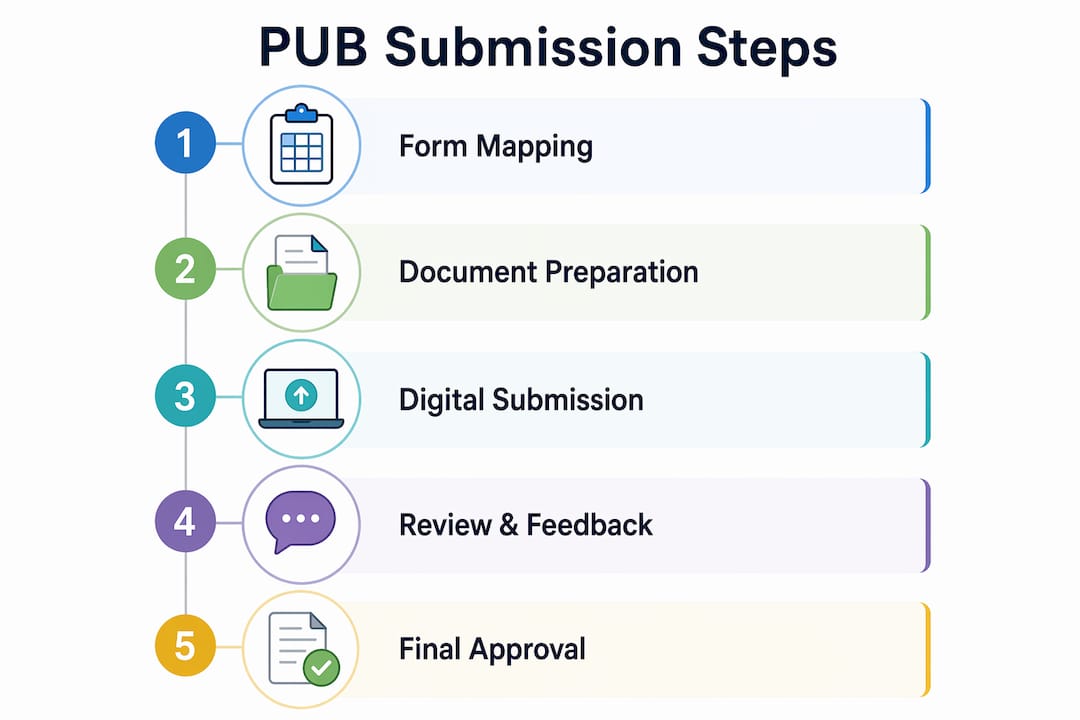
A structured sequential approach to the pub submission process Singapore eliminates the ad hoc decision-making that generates most delays. The following workflow reflects current 2026 requirements under CORENET X and the B&P Portal.
-
Scope mapping and form selection. Identify all drainage, sewerage, and sanitary works within the project boundary. Map each work category to the applicable PUB form. Confirm with the Licensed Plumber and Qualified Person that the form selection covers all scope elements before design development begins.
-
BIM model preparation with IFC+SG parameters. Prepare the drainage and sanitary design in a BIM-compliant environment. Embed all required IFC+SG parameters for PUB-specific drainage elements. Run internal validation using tools such as the BIM Execution Plan validator before export to CORENET X.
-
Portal setup and credential verification. Register or verify CorpPass access for all authorized submitters on both the B&P Portal and CORENET X. Assign user roles including Qualified Person, Licensed Plumber, and project administrator. Confirm digital certificate validity before the submission date.
-
Submission through the correct gateway. Submit Form B and integrated drainage approvals through CORENET X as part of the building permit application. Submit Form E and other standalone sanitary works through the B&P Portal. Retain submission reference numbers for all applications.
-
Query response and approval tracking. Monitor submission status on both platforms daily during the review period. Respond to PUB queries within the stipulated timeframe to prevent submission lapse. Document all query responses and approvals for the project record.
The table below summarizes the submission stage, the applicable platform, and the responsible party for each step.
| Submission stage | Platform | Responsible party |
|---|---|---|
| Sewer connection (Form B) | CORENET X | Qualified Person |
| Internal sanitary works (Form E) | B&P Portal | Licensed Plumber |
| Water pipe protection (Form F) | B&P Portal | Qualified Person |
| Road reinstatement (Form H) | B&P Portal | Contractor |
| Multi-agency drainage review | CORENET X | Project team |
Legacy versus digital PUB submission: what has changed for developers
The transition from paper-based to CORENET X digital submissions has centralized and fundamentally restructured how PUB reviews drainage and sewerage applications. This shift has improved transparency, shortened approval times, and increased data accuracy across the board.
| Feature | Legacy paper-based process | Current digital workflow |
|---|---|---|
| Submission method | Physical document lodgment | Online via B&P Portal or CORENET X |
| Agency coordination | Sequential, fragmented | Concurrent multi-agency review |
| BIM requirement | Not applicable | IFC+SG format mandatory |
| Status tracking | Manual follow-up calls | Real-time portal dashboard |
| Query management | Written correspondence | In-portal query and response system |
| Approval documentation | Physical stamps and letters | Digital approval records |
The practical impact for developers is significant. CORENET X’s integrated model submission reduces fragmented review and promotes earlier clash detection among building, drainage, and other regulatory parameters. A project that previously required sequential approvals from BCA, PUB, and SCDF over separate timelines now progresses through concurrent review within a single submission event. This compression of the approval timeline directly reduces pre-construction holding costs for developers. The challenge during transition is that teams accustomed to paper workflows must rebuild their internal processes around digital credential management, BIM data discipline, and portal administration. Teams that invest in this capability early gain a measurable competitive advantage in project delivery speed. For a broader view of multi-agency submission workflows, the construction approval process in Singapore provides useful context on how PUB fits within the full regulatory sequence.
Key takeaways
PUB submission in Singapore is a form-driven, digitally regulated process where correct form selection, IFC+SG BIM compliance, and portal access management determine whether approvals proceed on schedule or stall at critical project milestones.
| Point | Details |
|---|---|
| Form selection is foundational | Map all works to the correct PUB form before design freeze to prevent multi-week resubmission delays. |
| Digital portals require early setup | Register CorpPass credentials and assign user roles on B&P Portal and CORENET X before submission deadlines approach. |
| IFC+SG validation prevents rejections | Run internal BIM parameter checklists pre-export to catch missing properties before CORENET X submission. |
| Multi-disciplinary coordination is mandatory | Engage Licensed Plumbers and Qualified Persons together at schematic design stage, not at construction document stage. |
| Digital workflows compress approval timelines | CORENET X concurrent multi-agency review reduces sequential approval delays compared to legacy paper-based processes. |
Why early coordination defines PUB submission outcomes
From my experience working across multiple large-scale development submissions in Singapore, the single most consistent predictor of a smooth PUB approval is not the quality of the engineering design. It is the quality of the coordination that happens before a single drawing is finalized.
Projects that treat PUB submission as a downstream administrative task, something to be handled after the design is complete, consistently encounter the same sequence of problems: wrong form selection discovered at submission stage, IFC+SG parameters missing from a model that has already been issued for construction, and portal access not set up for the Licensed Plumber who needs to submit Form E. Each of these failures is entirely preventable. Each one costs real time and real money.
The teams that perform best are those that run a PUB submission planning session at the start of design development, not at the end. They map the form requirements, assign portal roles, and build IFC+SG parameter compliance into the BIM execution plan from day one. They also engage PUB officials proactively when scope edge cases arise, rather than waiting for a formal query response that may take days. The regulatory environment in Singapore is moving decisively toward digital-first, integrated submissions. Teams that build this capability into their standard operating procedures now will find the process increasingly manageable. Those that continue to treat it as a last-minute compliance task will find the penalties for that approach growing more severe as CORENET X adoption deepens.
— Aman
How Aectechnicalsg supports your PUB submission in Singapore
Aectechnicalsg provides end-to-end engineering consultancy support for developers and construction professionals navigating the PUB submission process in Singapore. The team manages form selection, IFC+SG BIM validation, CORENET X coordination, and B&P Portal administration across drainage, sewerage, and sanitary works submissions. For developers managing multiple concurrent authority submissions, Aectechnicalsg’s engineering consultancy services cover the full regulatory scope including PUB, BCA, URA, SCDF, and NEA. The firm’s track record in resolving submission bottlenecks and expediting approvals makes it a practical partner for projects where timeline certainty is a priority. Visit Aectechnicalsg to discuss your project’s PE endorsement and authority submissions requirements with a specialist.
FAQ
What is PUB submission in Singapore?
PUB submission is the formal regulatory process for obtaining approval from Singapore’s Public Utilities Board for drainage, sewerage, and sanitary works. It is mandatory for projects requiring BCA Temporary Occupation Permit or Certificate of Statutory Completion.
Which PUB form applies to internal sanitary works?
Form E governs internal sanitary plumbing and drainage works within the building boundary and is submitted through the B&P Portal by a Licensed Plumber. Form B covers new external sewer connections and is increasingly submitted via CORENET X.
What causes most PUB submission rejections?
Missing or incorrect IFC+SG properties in BIM models are the primary cause of CORENET X submission failures, along with unauthenticated submissions and incorrect portal access assignments.
Is CORENET X mandatory for all PUB submissions?
CORENET X is mandatory for integrated building permit applications that include drainage approvals as part of the multi-agency review. Standalone sanitary works submissions such as Form E are still processed through the B&P Portal directly.
How early should PUB form mapping occur in a project?
PUB form mapping must occur before design freeze. Late identification of the correct form family causes gateway resubmission requirements that generate multi-week delays at critical project milestones.