
Design for safety in 2026 is defined as the proactive integration of updated engineering standards, digital hazard detection tools, and Inherently Safer Design principles into construction projects before physical work begins. The formal industry term is Prevention through Design, or PtD, and it sits at the core of how Singapore’s construction and engineering sector approaches risk in 2026. Building Information Modelling, AI-powered hazard identification, revised mechanical safety factors, and human-centric usability requirements have all converged to reshape what responsible design looks like. Projects that embed these controls at the concept stage consistently outperform those that rely on administrative controls or PPE as primary safeguards. This guide covers every layer of that approach, from digital tools to documentation governance.
How does design for safety in 2026 use AI and BIM?
Automated hazard identification using BIM and machine learning reaches 84.77% accuracy in detecting design-related construction hazards as of June 2026. That figure, supported by a Kappa coefficient of 0.83, confirms that AI-assisted review is now a reliable first-pass tool rather than an experimental add-on. For construction professionals, this means BIM models can be analyzed algorithmically before a single structural drawing is issued for tender.
The practical deployment workflow places AI screening at the design development stage, where changes are still low-cost. Tools ingest BIM geometry, spatial relationships, and activity sequences to flag collision risks, fall hazards, and confined space exposures. The output is a prioritized hazard register that design teams can act on immediately.
However, AI tools complement but do not replace expert review, particularly for complex or catastrophic hazard scenarios. A 15.23% miss rate at 84.77% accuracy is acceptable for routine hazards but unacceptable for scenarios involving structural collapse or toxic release. Expert engineers must review all high-consequence findings before design sign-off.
| Tool Type | Capability | Limitation |
|---|---|---|
| BIM + ML Hazard Detection | 84.77% accuracy on design hazards | Misses complex, low-frequency catastrophic risks |
| AI Spatial Analysis | Flags fall zones, confined spaces, collision paths | Requires accurate, current BIM geometry as input |
| Expert Manual Review | Covers catastrophic and novel hazard scenarios | Time-intensive; must be scoped to high-risk items |
| Integrated Workflow | Combines speed of AI with depth of expert judgment | Requires clear handoff protocols between tools and reviewers |
Pro Tip: Assign AI hazard outputs a severity tier on receipt. Route Tier 1 (catastrophic potential) items directly to a licensed engineer for manual review within 48 hours. Tier 2 and 3 items can follow standard design review cycles. This prevents AI speed from masking high-consequence gaps.
What are the 2026 safety design principles for structural and mechanical safety?
Mechanical safety design in 2026 requires safety factors between 1.5–2.0 for static loads and 2.0–4.0 for dynamic or impact loads, depending on the applicable code. These ranges are not conservative estimates. They represent the minimum multipliers engineers must apply to account for material variability, load uncertainty, and degradation over a structure’s service life.
For construction professionals working under Singapore’s SS EN 1992-1-1:2024, current safety factor requirements align with the Eurocode 2 framework, which specifies partial factors for both material strength and applied loads. Understanding where your project sits within the 1.5–4.0 range is a prerequisite for any structural submission to BCA.
Beyond numerical factors, Inherently Safer Design principles are now mandated in 2026 EPA Risk Management Program fact sheets. The four ISD categories are minimization, substitution, moderation, and simplification. Each one targets a different mechanism of hazard reduction.
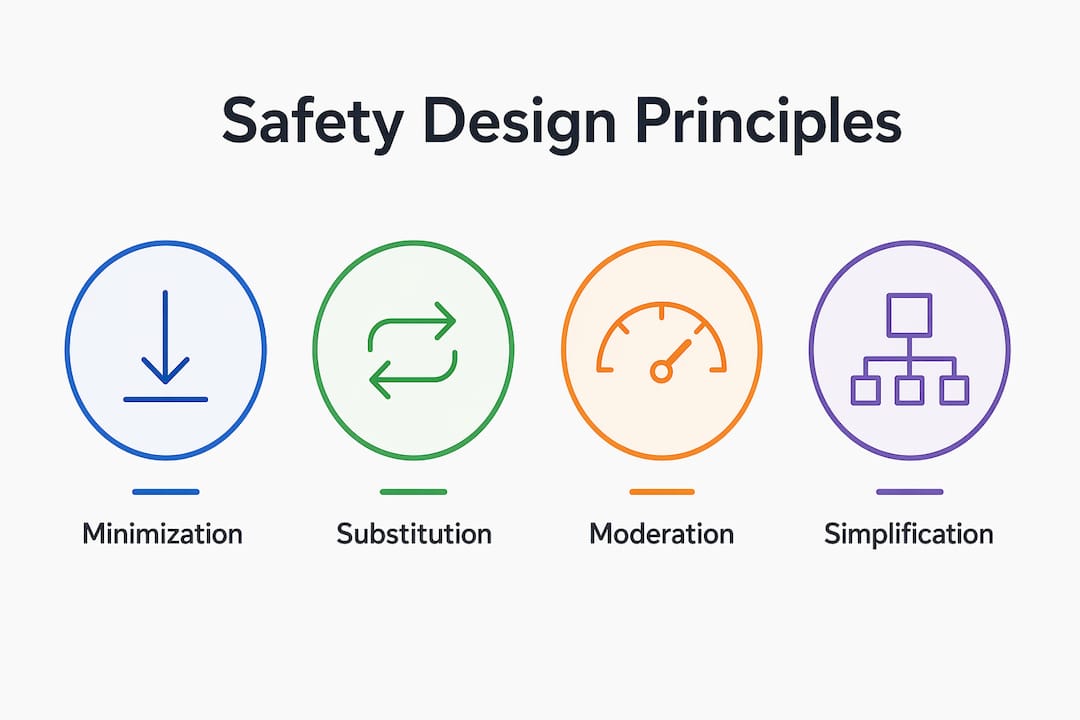
| ISD Principle | Definition | Construction Application |
|---|---|---|
| Minimization | Reduce hazardous quantities or energy at source | Design smaller fuel storage volumes on site; reduce crane lift heights |
| Substitution | Replace hazardous material or process with a safer one | Use low-VOC adhesives; substitute timber formwork with prefabricated steel |
| Moderation | Use hazardous materials under less hazardous conditions | Reduce operating pressures in hydraulic systems; lower cutting speeds |
| Simplification | Eliminate complexity that creates error or failure modes | Standardize connection details; reduce the number of temporary works stages |
The hierarchy is deliberate. Minimization and substitution eliminate hazards at the source. Moderation and simplification reduce the severity of residual hazards. Administrative controls and PPE sit below all four ISD categories in the control hierarchy.
Pro Tip: During design reviews, require the project engineer to state which ISD principle was applied to each significant hazard. If the answer is “PPE” or “site induction,” the design has not yet met the PtD standard. Push back before the drawing is issued.
How does human-centric design reshape construction safety practices?
Human-centric design in construction safety addresses the reality that workers interact with equipment, interfaces, and environments under cognitive load, time pressure, and fatigue. Designing for that reality reduces errors before they become incidents.
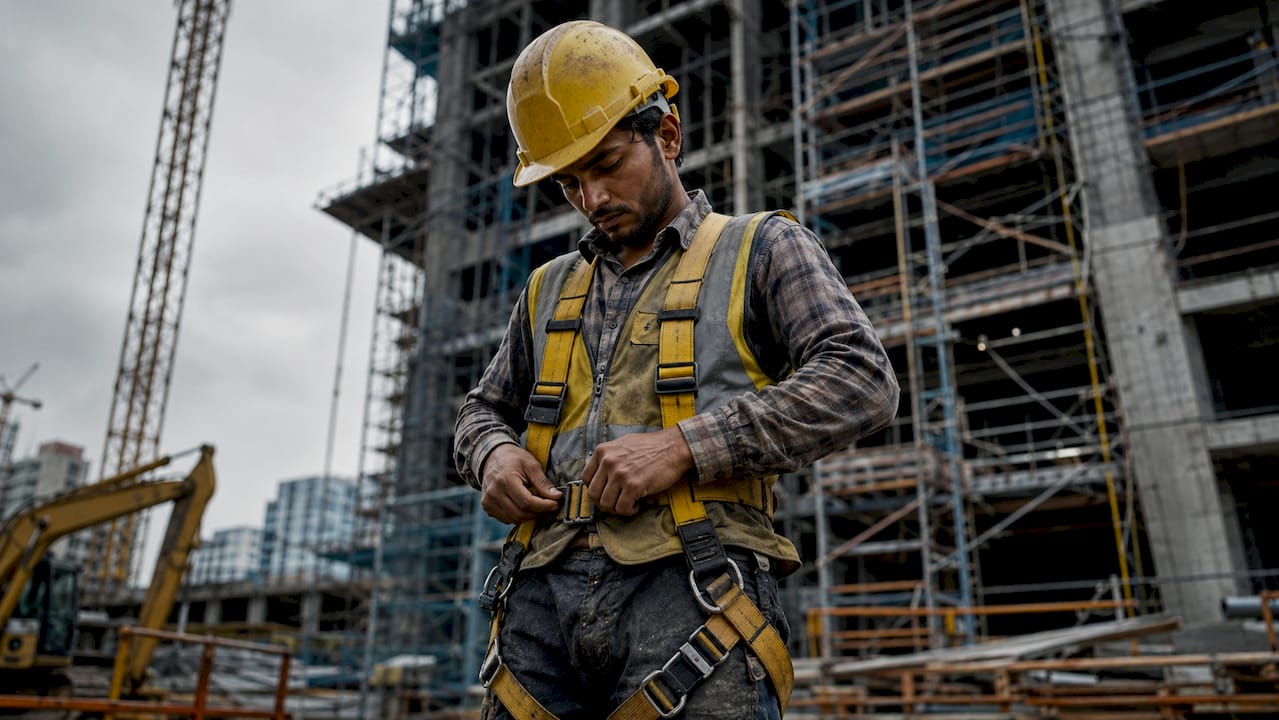
Tactile feedback systems reduce distraction and are becoming compliance requirements in 2026 safety design standards. The principle originates in vehicle interface regulation, where haptic feedback reduces glance time away from primary tasks. The same logic applies directly to construction equipment controls, tower crane cabins, and mobile elevated work platforms.
Key human-centric safety features now being integrated into construction design include:
- Intuitive control layouts on plant and equipment that match operator mental models, reducing the probability of mode errors during high-stress operations
- Tactile and auditory feedback on safety-critical controls, such as load limit warnings on lifting equipment, so operators receive alerts without diverting visual attention
- Reduced cognitive complexity in temporary works sequences, achieved by standardizing connection details and limiting the number of sequential steps that must be performed correctly for structural stability
- Ergonomic access routes for maintenance tasks, designed so that the safest path is also the most convenient path, removing the incentive to bypass fall protection
The critical shift in 2026 is that safety, usability, and compliance are no longer treated as separate design objectives. Projects that design these three elements together from the project brief stage consistently reduce both incident rates and regulatory non-conformances. Aectechnicalsg applies this integrated approach across structural, M&E, and architectural design scopes for Singapore authority submissions.
Why is documentation critical to safety design governance?
A risk register that lists hazards without recording rejected design alternatives fails to achieve genuine safety governance. Effective design for safety requires documenting rejected safer design alternatives, the reasoning behind each rejection, and the decision owner for every high-risk hazard. Without that history, the register is a compliance artifact rather than a governance tool.
The following numbered framework establishes a defensible safety decision log for construction projects:
- Identify the hazard with sufficient specificity to distinguish it from similar hazards. “Fall risk” is insufficient. “Fall risk from leading edge of Level 3 slab during formwork striking” is specific enough to drive a design response.
- List at least two engineering alternatives that would eliminate or reduce the hazard before considering administrative controls or PPE. Engineering alternatives must be documented in writing before PPE is approved as the primary control for high-energy tasks.
- Record the rationale for rejection of each alternative, including cost, program, technical feasibility, and any residual risk introduced by the alternative itself.
- Assign a decision owner by name and role. Anonymous decisions cannot be reviewed, challenged, or learned from.
- Set a procurement gate requiring safety documentation to be approved before purchase orders are raised for materials or plant associated with the hazard. Procurement gates lock in safety requirements before commercial commitments are made, preventing cost pressure from overriding design intent.
- Schedule a review trigger tied to a design milestone, procurement event, or construction stage, so the decision is revisited if project conditions change.
Pro Tip: Attach the safety decision log to the BIM model as a linked document. When the model is updated, the log update becomes a mandatory workflow step. This prevents the common failure where design changes are made without reassessing the associated hazard controls.
What emerging trends are shaping future safety design?
Safety in 2026 is a dynamic target due to digital systems, AI integration, and new environmental conditions creating emerging harm pathways that require continuous monitoring and iterative validation. This is a structural shift in how safety engineering must operate. Static compliance checklists are no longer sufficient when the systems being designed are themselves evolving.
The most significant emerging trends for construction and design professionals include:
- Edge AI in safety-critical systems: Platforms like AMD Versal AI Edge and SAFERTOS now enable real-time AI and safety workloads on a single device. This makes predictive hazard detection practical on construction sites, where cloud connectivity is unreliable.
- Functional safety and cybersecurity convergence: Connected industrial systems require Safety Integrity Level verification, safety lifecycle governance, and cybersecurity integration as a unified discipline. A crane control system with a network interface is now both a mechanical safety problem and a cybersecurity problem.
- Anticipatory safety planning: The World Economic Forum identifies foresight and anticipatory adaptation as core competencies for safety engineers working with digital systems. Hazards that do not yet exist in current codes must be modeled and mitigated before deployment.
- Lifecycle governance requirements: Safety validation is no longer a one-time design-stage activity. Iterative testing, real-world monitoring, and formal re-validation at defined lifecycle stages are becoming standard practice for software-defined construction systems.
- Regulatory adaptation lag: Singapore’s building regulations for 2026 are updating to address digital and AI-related risks, but the pace of technology adoption consistently outpaces formal code revision. Design professionals must apply engineering judgment to fill the gaps.
The practical response is to build safety review cycles into project programs at every major design gate, not just at the final submission stage.
Key takeaways
Effective design for safety in 2026 requires integrating AI-assisted hazard detection, ISD principles, human-centric design, and rigorous documentation governance from the earliest project stage.
| Point | Details |
|---|---|
| AI and BIM accuracy | Automated hazard detection reaches 84.77% accuracy but requires expert review for catastrophic risks. |
| Engineering safety factors | Apply 1.5–2.0 for static loads and 2.0–4.0 for dynamic loads per current mechanical safety codes. |
| ISD hierarchy | Minimization, substitution, moderation, and simplification must precede PPE in every hazard control decision. |
| Documentation governance | Risk registers must record rejected design alternatives, decision owners, and procurement gates to be effective. |
| Emerging risk adaptation | Edge AI, cybersecurity integration, and lifecycle governance are now core components of future-ready safety design. |
Where most safety design programs fall short
From my experience working across construction and engineering projects in Singapore, the single most common failure is treating PPE as the default answer to hazards that engineering design could have eliminated. It happens at every project scale, from small additions to major infrastructure works. The design team closes out a hazard with “workers to wear harnesses” and moves on. The hazard remains built into the structure.
The second failure is documentation that exists only to satisfy an audit. A risk register with no record of what alternatives were considered, who made the decision, and why a safer option was rejected is not a safety tool. It is a liability document that protects no one.
What actually works is early engagement between the design team and the safety engineer, before the structural scheme is fixed. At that stage, changes cost almost nothing. A staircase relocated by two meters can eliminate a permanent fall risk. A plant room ceiling raised by 300 millimeters can make maintenance safe without scaffolding. These decisions are trivial at concept stage and expensive or impossible after tender.
The digital tools available in 2026, particularly BIM-integrated AI hazard detection, make early engagement more productive than it has ever been. But the tools only deliver value when the project culture treats safety as a design constraint, not a post-design checklist. That culture starts with the lead designer and the client brief.
— Aman
How Aectechnicalsg supports design for safety in singapore
Aectechnicalsg provides specialized engineering consultancy for construction and development projects in Singapore, with direct expertise in design for safety implementation across structural, M&E, and architectural scopes. The team supports BCA, SCDF, and URA submissions with safety design documentation that meets 2026 regulatory standards, including ISD principle application, safety factor verification, and risk register governance.
For project developers and design firms requiring authority submission support or hazard mitigation review, Aectechnicalsg offers tailored advisory services from concept through construction. Contact the team directly to discuss your project’s safety design requirements and compliance obligations under Singapore’s current building framework.
FAQ
What is design for safety in construction?
Design for safety, formally called Prevention through Design, is the practice of eliminating or reducing construction hazards through engineering decisions made during the design stage. It prioritizes built-in controls over administrative measures and PPE.
What safety factors apply to structural design in 2026?
Mechanical safety design in 2026 requires factors of 1.5–2.0 for static loads and 2.0–4.0 for dynamic or impact loads, depending on the applicable code. Singapore projects under SS EN 1992-1-1:2024 follow Eurocode 2 partial factor requirements.
How accurate are AI hazard detection tools in 2026?
BIM-integrated machine learning tools reach 84.77% detection accuracy for design-related construction hazards. Expert manual review remains mandatory for high-consequence and catastrophic hazard scenarios.
What are the four ISD principles?
The four Inherently Safer Design principles are minimization, substitution, moderation, and simplification. All four are mandated in 2026 EPA Risk Management Program guidance and apply directly to construction hazard control hierarchies.
Why must risk registers include rejected alternatives?
A risk register without the history of rejected design alternatives cannot demonstrate that safer options were genuinely considered. Documenting rejected alternatives, decision owners, and rationale is required for defensible safety governance and regulatory compliance.
Recommended
- What Is Design for Safety in Construction Projects
- Design for Safety in Engineering Singapore – AEC Technical Advisory Singapore Engineering Consultancy
- Advanced Concrete Formwork Systems: Guide to Quality & Efficiency (2025)
- Advanced Fire Engineering: Performance-Based Design for Exposed Steel Structures