
Construction permits are official authorizations required by Singapore law before any building or renovation work begins, guaranteeing structural safety, legal compliance, and professional oversight. The Planning Act 1998 and Building Control Act 1989 together form the legal backbone that makes these permits mandatory for property owners and developers alike. Understanding why construction permits are required is not optional knowledge for Singapore homeowners. Skipping permits exposes you to fines, criminal liability, and property devaluation that far outweigh any short-term savings from bypassing the process.
Why construction permits are required under singapore law
Singapore’s permit requirements stem from two primary statutes: the Planning Act 1998 and the Building Control Act 1989. These laws exist to protect public safety, enforce zoning compliance, and maintain structural standards across the built environment.

The Urban Redevelopment Authority (URA) administers the Planning Act and issues Written Permission (WP) for development works that affect land use, gross floor area, or building height. The Building and Construction Authority (BCA) enforces the Building Control Act, requiring permits before any structural building works commence. Other authorities, including the Housing and Development Board (HDB), the Land Transport Authority (LTA), the Public Utilities Board (PUB), and the National Environment Agency (NEA), each govern specific aspects of construction depending on the project type and location.
Key permit categories under Singapore’s framework include:
- Written Permission (WP): Required from URA for works that change land use, add gross floor area, or alter a building’s approved use.
- Provisional Permission (PP): An interim URA approval granted before full WP, allowing preliminary planning to proceed.
- Building Plan Approval: Required from BCA before structural works begin, covering foundations, slabs, columns, and load-bearing elements.
- Conservation Permission: Mandatory for any works on URA-gazetted conserved buildings, with strict restoration requirements attached.
- HDB Renovation Permit: Required for works within HDB flats, separate from and in addition to BCA clearance.
Enforcement powers under both acts are substantial. URA and BCA officers can issue stop-work orders, require demolition of unauthorized structures, and initiate criminal proceedings. The construction approval workflow in Singapore is layered by design, because each authority protects a distinct public interest.
How do construction permits ensure safety and structural integrity?
The safety rationale behind building permits is most visible in Singapore’s high-density residential environment. When you hack a wall in an HDB flat or a condominium, you are not just modifying your own unit. You are potentially altering load paths that support floors above and below, affecting dozens of neighboring households.
Professional Engineer (PE) endorsement is the primary technical safeguard built into Singapore’s permit process. A PE conducts load distribution analysis and structural remediation assessments before endorsing any works. Without that endorsement, homeowners carry full legal liability for any resulting structural damage, and that liability extends to neighboring units and common property.
“Without PE endorsement, homeowners risk structural vulnerabilities and legal liabilities under the Building Control Act.” This is not a theoretical risk. Structural failures from unauthorized hacking have caused slab deterioration, water ingress into lower floors, and costly remediation orders.
The insurance dimension compounds the risk further. Home insurance policies typically exclude damages arising from unauthorized structural works. If unpermitted hacking damages your neighbor’s unit or the building’s common areas, you bear the full repair cost out of pocket. No insurer will cover a claim where the root cause is work that was never legally authorized.
Scenarios that always require PE endorsement and permits include:
- Hacking or relocating load-bearing walls or columns
- Cutting or coring through reinforced concrete floor slabs
- Adding heavy features such as water features, stone flooring, or mezzanine levels
- Altering structural beams or modifying the building envelope
- Any works in conserved buildings or heritage structures
Pro Tip: Before engaging any contractor, request a copy of their PE endorsement scope in writing. If a contractor claims structural works do not need a PE, treat that as a red flag and verify directly with BCA.
What are the consequences of not getting a permit?
The financial and legal consequences of skipping permits in Singapore are among the most severe in the region. Unauthorized works on conserved buildings carry fines up to S$500,000, imprisonment, and mandatory restoration at the owner’s expense. A property owner in Little India was fined S$250,000 for illegal renovation of a heritage shophouse. That figure represents a single enforcement case, not an outlier.
Beyond conserved buildings, the impact of not getting a permit reaches into everyday property transactions and ongoing ownership:
- Property sale complications: Buyers, banks, and conveyancing lawyers increasingly check for unauthorized works. Unpermitted additions can block mortgage approvals and force price reductions.
- Insurance voidance: Structural damage claims are rejected when the root cause is unauthorized works, leaving owners fully exposed.
- Reinstatement orders: Authorities can require complete demolition and restoration of unauthorized structures at the owner’s cost, regardless of how long the works have stood.
- Future permit rejections: A history of non-compliance on a property can delay or block future permit applications.
- Developer disqualification: Errant developers face disqualification from government land sales for up to five years. This measure signals that Singapore authorities treat non-compliance as a systemic risk, not just an individual infraction.
The cumulative cost of non-compliance almost always exceeds the cost of obtaining permits correctly from the start. Restoration orders alone can run into hundreds of thousands of dollars for commercial or conserved properties.
How to obtain construction permits in singapore
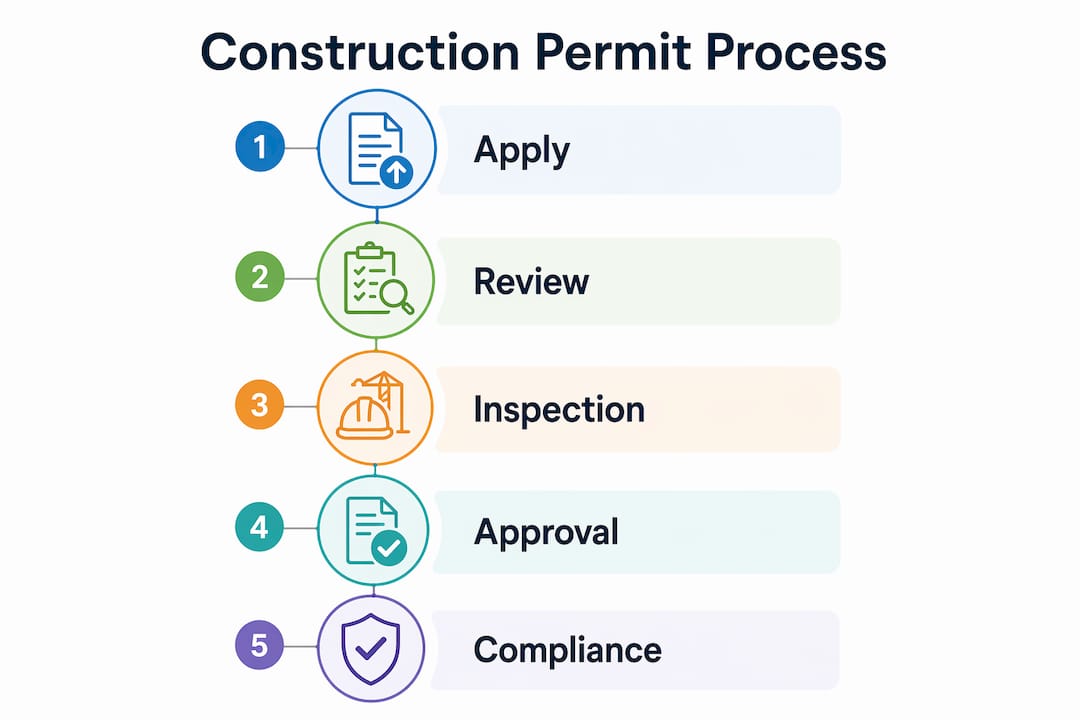
The permit application process varies by property type, scope of works, and the authorities involved. The construction permit process overview below applies to most residential and commercial projects.
Step-by-step permit application process
- Define the scope of works. Determine whether works are structural or non-structural. Internal renovation works that do not affect gross floor area or structural integrity generally do not require URA Written Permission, though BCA approval may still apply.
- Engage a Qualified Person (QP). A registered architect or PE must prepare and submit plans to the relevant authorities. You cannot submit directly to BCA or URA as a property owner.
- Obtain HDB or MCST approval if applicable. HDB Renovation Guidelines prohibit hacking structural walls or altering floor slabs without prior HDB approval and separate BCA clearance. Condominium owners must obtain Management Corporation Strata Title (MCST) approval before submitting to BCA.
- Submit building plans to BCA. Plans must be PE-endorsed and include structural calculations, material specifications, and method statements.
- Await plan approval and commence works. Works may only begin after written approval is received. Commencing before approval constitutes a criminal offense under the Building Control Act.
- Arrange supervision and inspections. The appointed QP must supervise works at key stages. BCA may conduct site inspections during and after construction.
- Obtain Temporary Occupation Permit (TOP) or Certificate of Statutory Completion (CSC). These are required before occupying new or significantly altered buildings.
Common reasons for permit rejection
| Rejection Reason | How to Avoid It |
|---|---|
| Incomplete structural calculations | Engage a PE early and verify submission checklist |
| Non-compliant floor plan drawings | Use a registered architect for plan preparation |
| Missing PE endorsement on structural works | Confirm PE scope covers all structural elements |
| Failure to obtain HDB or MCST pre-approval | Secure estate-level approvals before BCA submission |
| Works exceeding approved gross floor area | Verify GFA limits with URA before design stage |
Pro Tip: Engaging a qualified engineering consultancy at the design stage, before any contractor is appointed, reduces rejection risk significantly. Most rejections stem from documentation gaps that a QP would catch early.
Key takeaways
Construction permits in Singapore are legally mandatory, technically enforced, and financially consequential. Skipping them is never a cost-saving measure.
| Point | Details |
|---|---|
| Legal mandate is dual-layered | Both the Planning Act 1998 and Building Control Act 1989 require permits before structural works begin. |
| PE endorsement is non-negotiable | Structural works without PE endorsement expose owners to criminal liability and uninsured damage claims. |
| Penalties are severe and enforced | Fines reach S$500,000 for conserved buildings, with reinstatement orders adding further costs. |
| Property value is directly affected | Unpermitted works complicate sales, void insurance, and block future permit applications. |
| Early professional engagement prevents rejection | Appointing a QP at the design stage is the most reliable way to avoid costly submission delays. |
The permit process rewards those who plan ahead
Most homeowners who contact Aectechnicalsg after an enforcement notice share one thing in common. They assumed their renovation was minor enough to skip the permit process. That assumption is the single most expensive mistake a Singapore property owner can make.
The permit system is not designed to obstruct renovation. It exists because Singapore’s vertical housing density means one unauthorized structural modification can affect dozens of households simultaneously. The regulatory framework reflects that reality, not bureaucratic excess.
What I have observed consistently is that property owners who engage a PE and a registered architect before signing any contractor agreement move through the approval process faster and with fewer complications. The documentation they accumulate, including PE-endorsed drawings, BCA approvals, and contractor insurance certificates, also provides critical legal protection if compliance is ever questioned during a property sale or dispute.
The misconception that permits are only for large commercial projects is particularly damaging. HDB flat owners undertaking seemingly routine hacking work have faced reinstatement orders because they removed a load-bearing wall without BCA clearance. The Building Control Act does not distinguish between a condominium penthouse and a three-room flat when structural integrity is at stake.
My practical advice: treat permit acquisition as the first phase of your project, not an afterthought. Budget for it, schedule it, and assign it to a qualified professional from day one. The cost of compliance is fixed and predictable. The cost of non-compliance is not.
— Aman
Get expert permit support from Aectechnicalsg
Navigating Singapore’s multi-authority permit process requires more than a checklist. It requires qualified professionals who understand how URA, BCA, HDB, SCDF, and NEA requirements interact across different project types.

Aectechnicalsg provides engineering consultancy services covering structural and geotechnical engineering, architectural planning, and M&E design, all with full authority submission support. The team handles PE endorsement and authority submissions to BCA, URA, and other relevant bodies, reducing your exposure to rejection and enforcement risk. For projects requiring SCDF and FSSD submissions or NEA regulatory compliance, Aectechnicalsg manages the full submission workflow. Contact the team before your project begins, not after a stop-work order arrives.
FAQ
What makes construction permits legally required in singapore?
The Planning Act 1998 and Building Control Act 1989 mandate permits before any structural building works begin. Non-compliance carries criminal penalties, fines, and mandatory restoration orders.
Do all renovations in singapore require a permit?
Not all renovations require URA Written Permission. Internal works that do not affect gross floor area or structural integrity may be exempt from URA approval, but BCA and HDB or MCST approvals may still apply depending on the scope.
What happens if you renovate without a permit in singapore?
Unauthorized works can result in fines up to S$500,000, stop-work orders, reinstatement requirements, and criminal prosecution. Unpermitted works also void home insurance coverage for related damage claims.
When is a professional engineer required for renovation works?
A PE is required whenever works involve structural elements such as load-bearing walls, floor slabs, columns, or beams. PE endorsement is also mandatory for any works on conserved buildings and for HDB flats requiring BCA clearance.
How long does the permit approval process take in singapore?
Approval timelines vary by authority and project complexity. BCA building plan approvals for straightforward residential works typically take four to eight weeks, though complex or conserved building submissions may take significantly longer.
Recommended
- Construction Approval Workflow Singapore: 2026 Guide
- Building Codes And Regulations In Singapore Construction Industry – AEC Technical Advisory Singapore Engineering Consultancy
- When is PE Endorsement Required in Singapore? A Guide for Contractors and Developers
- Construction Compliance Checklist for Singapore Projects