
Construction supervision is defined as the continuous, active oversight of all construction activities throughout a project lifecycle to enforce safety, quality, and contractual compliance. Without it, even the most precisely engineered designs fail at the execution stage. The role of supervision in construction extends far beyond watching workers. It encompasses planning, monitoring, documentation, and on-site leadership that directly determines whether a project meets its safety, budget, and quality targets. Entities such as ISO 9001, non-conformance reports (NCRs), and development finance lenders all depend on credible supervision records to verify project integrity.
What are the key functions and responsibilities of construction supervision?
Construction supervision covers every phase of a project, from site mobilization through the defect liability period. Supervision encompasses everything from mobilization to defect liability periods, including weekly progress meetings and inspections. That scope means a supervisor’s daily responsibilities are broad and technically demanding.
The core functions of a construction supervisor include:
- Work planning and allocation: Assigning tasks to trades and subcontractors based on current site conditions and the master program.
- Quality monitoring: Checking workmanship and materials against approved specifications, shop drawings, and BIM models to catch deviations before they become costly corrections.
- Safety enforcement: Verifying that personal protective equipment is used, exclusion zones are maintained, and OSHA or local Building and Construction Authority (BCA) regulations are followed.
- Trade coordination: Managing interfaces between structural, mechanical, electrical, and finishing contractors to prevent clashes and schedule conflicts.
- Documentation: Issuing inspection reports, recording site instructions, and maintaining daily logs that serve as legal records.
- Cost and schedule control: Tracking progress against the program and flagging variances before they compound into delays or overruns.
- Client representation: Acting as the owner’s eyes and ears on site, reporting objectively on contractor performance.
Supervision acts as a bridge between design teams and builders, translating plans into reality. That translation role requires technical authority, not just administrative presence.
Pro Tip: Establish a standardized weekly inspection checklist aligned to the project’s quality plan from day one. Supervisors who wait until issues surface reactively spend three times more time on corrective documentation than those who inspect proactively.

How does supervision improve safety and prevent accidents on construction sites?
Lack of effective leadership and oversight causes most site accidents. That finding places supervision at the center of any credible site safety program, not as a supporting function but as the primary control measure.
Supervisors enforce safety through several specific mechanisms:
- Pre-task briefings: Reviewing hazards with workers before high-risk activities such as formwork erection, excavation, or working at height.
- Permit-to-work verification: Confirming that confined space entry, hot work, and electrical isolation permits are properly issued and understood.
- Proactive hazard identification: Walking the site daily to spot unsafe conditions before an incident occurs, such as unsecured scaffolding, unmarked excavations, or improperly stored materials.
- Regulatory enforcement: Requiring immediate corrective action when OSHA standards or Singapore’s Workplace Safety and Health Act requirements are not met.
- Safety culture reinforcement: Consistent on-site leadership signals to workers that safety standards are non-negotiable, which reduces normalized risk-taking over time.
On-site leadership is key to continuous safety enforcement and accident prevention. A supervisor who is present, technically credible, and empowered to stop work creates a fundamentally different site culture than one who only reviews paperwork. Reviewing red flags on a jobsite walkthrough before work begins is one practical technique supervisors use to front-load hazard identification rather than respond to incidents after the fact.
How does construction supervision impact project quality and compliance?
Quality assurance in construction is not self-executing. Identifying issues before materials reach the site saves demolition and correction costs later. Supervisors are the gatekeepers who make that early identification possible.
The quality and compliance functions of supervision follow a structured sequence:
- Submittal review: Checking shop drawings, material samples, and BIM coordination models against the contract documents before any fabrication or installation begins.
- In-process inspection: Verifying that reinforcement placement, concrete pours, waterproofing applications, and structural connections conform to approved drawings and specifications.
- Non-conformance reporting: NCRs document deviations, enforce timely corrections, and maintain quality standards. They also create a legal record that protects the client in disputes.
- ISO 9001 compliance: Supervisors verify that the contractor’s quality management system procedures are actually followed on site, not just filed in a binder.
- As-built documentation: Accurate as-built records are critical for long-term maintenance, safety, and legal record keeping. Construction drawings alone do not capture the changes made during execution.
| Supervision activity | Primary benefit |
|---|---|
| Submittal and shop drawing review | Prevents field installation errors and costly rework |
| Non-conformance reports (NCRs) | Creates accountability and legal protection for the client |
| ISO 9001 process verification | Confirms contractor quality systems are applied, not just documented |
| As-built documentation | Preserves project integrity for future maintenance and regulatory audits |
The construction compliance checklist for Singapore projects illustrates how these activities map to specific regulatory requirements under BCA and other authorities.
What is the difference between construction supervision and project management?
Clients regularly confuse construction supervision with project management. Client-side oversight independently checks schedule, budget, and quality, protecting clients through detailed documentation. Project management directs and coordinates the work. Supervision verifies that the work is executed correctly and independently.
The distinction matters for risk management. When the same party manages and supervises a project, conflicts of interest arise. A contractor’s project manager has a financial incentive to report progress favorably. An independent supervisor has no such incentive.
Key differences between the two roles:
- Project management sets the program, manages subcontractor appointments, controls the budget, and drives commercial decisions.
- Construction supervision monitors execution against the approved design, flags non-conformances, and reports objectively to the client.
- Independence: Supervision works best when it is structurally separate from day-to-day management. Client-side oversight must remain independent from contractor project management to avoid conflicts of interest.
- Documentation focus: Supervisors maintain contemporaneous records of instructions, inspections, and approvals that become critical evidence if disputes arise.
- Authority scope: A project manager can instruct changes to scope or program. A supervisor’s authority is to enforce compliance with the existing contract and design.
Understanding this separation is particularly relevant for developers and institutional clients in Singapore, where BCA and other regulatory bodies require documented evidence of independent oversight for permit approvals and authority submissions.
Practical applications and best practices for effective construction supervision
Effective supervision techniques in construction follow the project lifecycle rather than reacting to problems as they emerge. Continuous supervision enables early identification of deviations, assisting in timely corrective actions that reduce risks and delays. That proactive posture is what separates competent oversight from passive observation.
Lifecycle of supervision activities
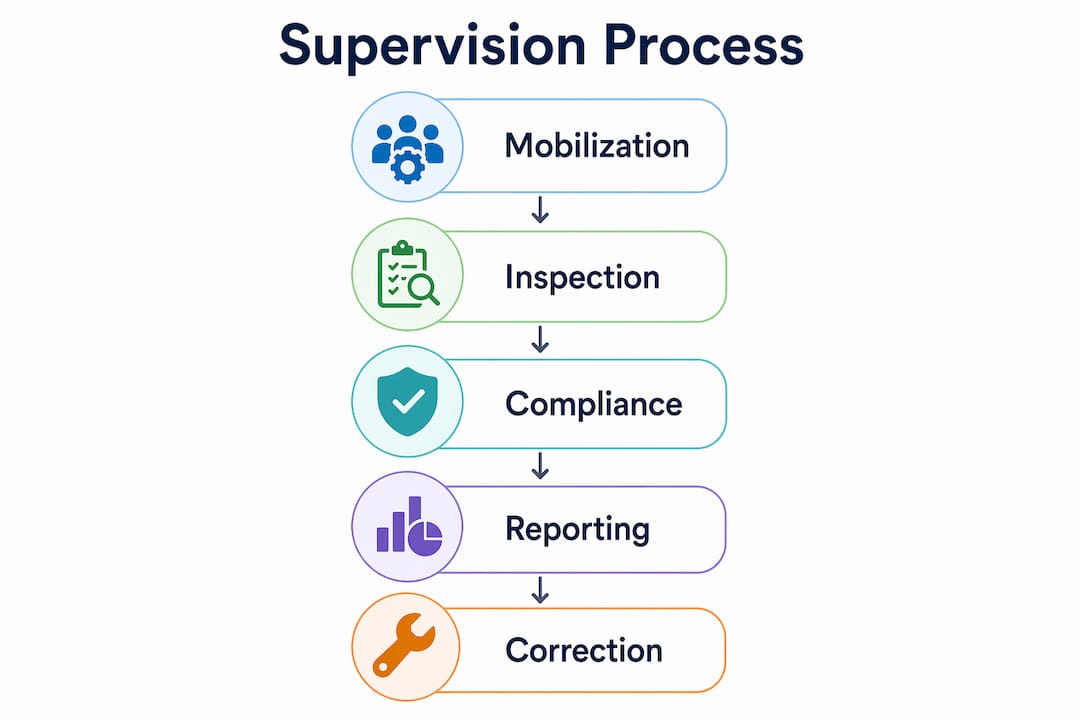
The supervision function begins at mobilization, when the supervisor reviews the contractor’s method statements, quality plan, and safety management system before any physical work starts. During construction, daily site inspections, weekly progress meetings, and formal hold-point inspections at critical stages form the backbone of the oversight program. At practical completion, the supervisor compiles the defect schedule and monitors rectification. During the defect liability period, the supervisor verifies that all outstanding items are closed before the final certificate is issued.
Tools and documentation practices
Progress meeting minutes, site instruction registers, photographic records, and NCR logs are the primary documentation tools. Even the best-designed projects encounter surprises. Consistent supervision is key to adapting plans and maintaining alignment with design intent when those surprises occur. Supervisors who maintain organized, timestamped records give clients a defensible position in any contractual dispute.
Reviewing concrete formwork systems during the inspection phase is one example of how supervisors adapt technical knowledge to actual site conditions, verifying that temporary works match the approved design before concrete is placed.
Common pitfalls to avoid
- Delegating inspection authority to the contractor’s own quality control team without independent verification.
- Failing to issue NCRs promptly, which allows defective work to be covered up by subsequent construction.
- Treating progress meetings as reporting exercises rather than problem-solving sessions.
- Neglecting the defect liability period, which is when many latent defects become visible.
Pro Tip: Require contractors to submit a two-week look-ahead program at every progress meeting. This gives supervisors advance notice of upcoming hold-point inspections and prevents the common scenario where critical work proceeds without the required sign-off.
Key takeaways
Effective construction supervision is the single most direct control measure for achieving safety, quality, and compliance across the full project lifecycle.
| Point | Details |
|---|---|
| Supervision is active, not passive | Supervisors diagnose problems and enforce corrections, not just observe and report. |
| Safety depends on on-site leadership | Lack of effective oversight is the leading cause of site accidents, making supervision the primary safety control. |
| NCRs protect clients legally | Non-conformance reports create accountability and serve as legal records in contractual disputes. |
| Supervision and project management are distinct | Independent oversight must remain separate from contractor management to avoid conflicts of interest. |
| As-built documentation is non-negotiable | Accurate records created during supervision are critical for long-term maintenance, regulatory compliance, and dispute resolution. |
Why independent supervision is the most undervalued investment in construction
From my experience working across complex construction and infrastructure projects, the single most consistent pattern I observe is this: clients who invest in independent, technically competent supervision spend less money overall. The savings do not come from catching every defect. They come from the deterrent effect. Contractors perform differently when they know a qualified, empowered supervisor is present and will issue an NCR without hesitation.
The supervision role has grown more demanding as projects incorporate BIM coordination, prefabricated components, and multi-trade interfaces that require real-time technical judgment on site. A supervisor who only knows how to fill out inspection forms is not equipped for that environment. The supervisors who add genuine value are those who can read a structural drawing, understand a geotechnical report, and recognize when a contractor’s method statement does not match the approved design.
The documentation discipline that good supervision produces also changes the commercial dynamic of a project. When every site instruction is recorded, every NCR is tracked to closure, and every inspection hold point is signed off, the contractor has less room to claim additional costs for rework that was their own fault. That accountability protects the client’s budget as directly as any commercial negotiation.
My recommendation to developers and project owners is straightforward: do not treat supervision as a cost to minimize. Treat it as the technical control that makes every other investment in design and engineering actually deliver its intended value.
— Aman
How Aectechnicalsg supports construction supervision and compliance

Aectechnicalsg provides engineering consultancy services specifically designed to support the oversight, compliance, and technical verification functions that construction projects in Singapore require. From structural and geotechnical engineering to M&E coordination and authority submissions to BCA, URA, SCDF, and LTA, the firm’s services align directly with the supervisory functions described in this article. Developers and construction firms seeking structured technical oversight can explore the full range of engineering consultancy services available for Singapore projects. For projects requiring regulatory submissions and PE endorsement support, Aectechnicalsg offers the technical authority and documentation expertise that credible oversight demands.
FAQ
What is the role of supervision in construction?
Construction supervision is the continuous, active oversight of site activities to enforce safety, quality, and contract compliance throughout the project lifecycle. It includes inspections, non-conformance reporting, trade coordination, and as-built documentation.
How does supervision reduce accidents on construction sites?
Lack of effective oversight causes most site accidents. Supervisors reduce risk by enforcing safety protocols, conducting pre-task briefings, and maintaining a consistent on-site leadership presence that reinforces a safety-first culture.
What is the difference between a supervisor and a project manager in construction?
A project manager directs and coordinates the work commercially and programmatically. A supervisor independently verifies that execution meets the approved design and contract standards, with no financial interest in reporting progress favorably.
Why are non-conformance reports important in construction supervision?
NCRs document deviations from approved standards, enforce timely corrections, and create a legal record that protects the client in disputes. They are a core accountability tool in any quality management system.
When does construction supervision begin and end?
Supervision begins at mobilization, when the contractor’s method statements and quality plan are reviewed before physical work starts. It ends after the defect liability period, once all outstanding defects are rectified and the final certificate is issued.