
Effective building renovation planning in Singapore is defined as the structured process of assessing your property, securing regulatory approvals, setting a realistic budget, and coordinating licensed professionals before any physical work begins. Homeowners and property investors who understand how to plan building renovations in Singapore avoid the two most common outcomes: budget overruns and compliance penalties. Singapore’s regulatory framework, governed by bodies including the Housing & Development Board (HDB), the Building and Construction Authority (BCA), and the Urban Redevelopment Authority (URA), makes early preparation non-negotiable. This guide covers every critical stage, from condition surveys to permit expiry windows, so your renovation stays legal, on schedule, and within budget.
What are the key steps to plan building renovations in Singapore?
Renovation planning in Singapore follows a defined sequence. Skipping any stage creates compounding problems that cost more to fix than to prevent.
1. Conduct a property condition survey
A condition survey documents the existing state of your property before any work starts. Without one, hidden defects discovered mid-renovation force costly redesigns and contractor delays. The survey should cover structural elements, plumbing, electrical systems, and existing finishes.

2. Define your renovation scope and objectives
Decide clearly what you are changing and why. A scope document prevents scope creep, which is the single largest driver of budget overruns. Separate your must-haves from your nice-to-haves before you speak to any contractor.

3. Set your budget with a contingency reserve
Financial experts recommend a contingency fund of 10–15% of total renovation cost to cover unforeseen expenses. That buffer is not optional. It is the financial margin that keeps a project alive when unexpected structural issues or material price changes appear.
4. Understand permit and regulatory requirements
Different works require different permits. Hacking, flooring changes, and bathroom alterations each carry specific approval requirements under HDB rules. Knowing which permits apply before you hire anyone saves weeks of back-and-forth with authorities.
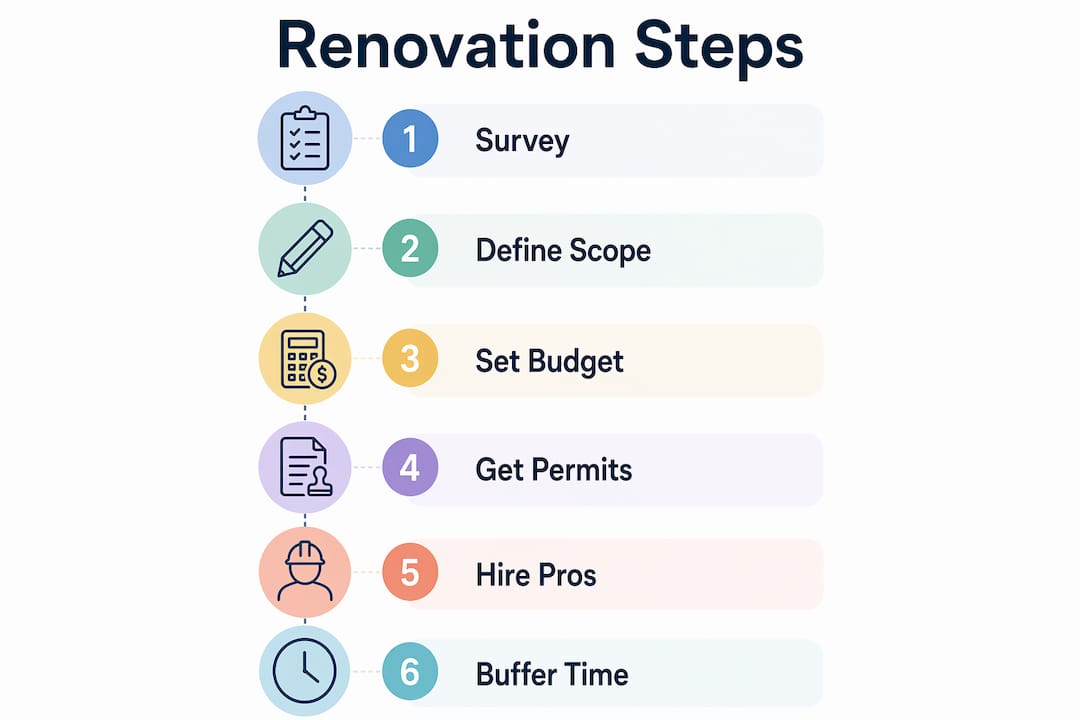
5. Select licensed contractors and design professionals
Only contractors listed in the HDB Directory are legally permitted to carry out permit-required renovation work. Verify contractor registration before signing any agreement.
6. Build in buffer time
Material procurement delays and authority approval timelines regularly push renovations past their original end dates. A realistic schedule accounts for these variables from the start, not after they occur.
How do you prepare an effective budget for a Singapore renovation project?
Budgeting for a Singapore renovation requires more precision than most homeowners expect. The cost structure differs significantly between HDB flats, private condominiums, and resale properties.
Key cost categories to plan for include:
- Hacking and demolition: Resale flats carry higher demolition costs than new BTO units because existing finishes must be removed first.
- Materials and finishes: Flooring, tiles, cabinetry, and fixtures vary widely in price. Fixing a material budget early prevents mid-project substitutions that delay timelines.
- Contractor fees: Labor costs in Singapore reflect a tight skilled trades market. Get at least three quotes before committing.
- Permit fees: Permit application costs are modest but must be factored in. Missing them from your budget is a sign of incomplete planning.
- Professional fees: Structural engineers, interior designers, and Professional Engineers (PEs) charge separately. Their fees are not included in contractor quotes.
A critical financial misconception affects many first-time renovators. CPF funds cannot be used for renovation payments. Homeowners must pay in cash or via a renovation loan, which is typically capped at S$30,000 or six months’ salary. Plan your cash flow accordingly before committing to a scope.
Pro Tip: Track every expense in a shared spreadsheet from day one. Assign a budget line to every item, including small purchases. Renovation costs accumulate in ways that are invisible until the total is alarming.
What design considerations and restrictions apply in Singapore renovations?
Design freedom in Singapore renovations operates within firm legal boundaries. Understanding those boundaries before engaging a designer saves time and prevents abortive work.
The most significant restrictions include:
- BTO wet area finishes: HDB flats cannot remove wall and floor finishes in wet areas within three years of block completion. BTO owners who want to retile bathrooms must wait out this restriction or face non-compliance penalties.
- Load-bearing walls: Removing or modifying a load-bearing wall requires a PE endorsement. No contractor can legally carry out this work without one. Aectechnicalsg provides PE endorsement services for exactly this type of structural alteration.
- Non-load-bearing walls: Even non-load-bearing wall alterations may require a PE endorsement depending on the scope and property type.
- Noise restrictions: The 1 pm to 2 pm quiet hour on working days, introduced in 2026, is mandatory. Contractors who violate this rule expose homeowners to complaints and potential penalties.
- Space optimization: Open-plan layouts, built-in storage, and multi-function furniture are the most effective ways to maximize space within Singapore’s typical unit sizes without triggering structural permit requirements.
Pro Tip: Ask your designer to produce a compliance checklist alongside the design drawings. Every design decision should map to a specific HDB or BCA rule. If it does not, the design needs revision before submission.
How to navigate regulatory compliance and permits for building renovations?
Permit compliance is the area where most Singapore renovation projects encounter delays. The rules are specific, the timelines are tight, and the penalties for non-compliance are real.
The Housing & Development (Renovation Control) Rules 2006 mandate that all permit-required renovation work must be carried out by contractors listed in the HDB Directory. Fines for non-compliance reach up to S$5,000. That figure does not include the cost of rectifying unauthorized works, which can exceed the fine many times over.
| Work Type | Permit Required | Permit Validity |
|---|---|---|
| Hacking of walls | Yes | 3 months (BTO), 1 month (resale) |
| Flooring replacement | Yes (in some cases) | 3 months (BTO), 1 month (resale) |
| Bathroom alterations | Yes | 3 months (BTO), 1 month (resale) |
| Electrical rewiring | Yes (via SP Group/BCA) | Varies by scope |
| Load-bearing wall modification | Yes, with PE endorsement | Subject to BCA approval |
Permit expiry windows are three months for BTO units and just one month for resale units. These are not generous timelines. If your contractor has not completed permit-required work within the validity window, you must reapply. That reapplication adds cost and delay.
Key compliance steps for homeowners:
- Verify your contractor’s HDB Directory listing before signing any contract.
- Apply for permits before work begins, not during or after.
- Retain all permit approval documents throughout the renovation.
- Engage a PE for any structural alteration, including wall removals and loft additions.
For a detailed breakdown of the construction approval workflow applicable to residential renovations, Aectechnicalsg provides structured guidance on authority submissions and approval sequencing.
What are best practices for managing the renovation project timeline and execution?
A full home renovation in Singapore typically runs 8 to 12 weeks. Resale flats often extend beyond that range because demolition adds a full phase before construction work can begin. That baseline assumes no permit delays, no material shortages, and no contractor scheduling conflicts. All three happen regularly.
The most effective timeline management practices are:
- Sequence work correctly. Hacking and structural work come first. Electrical and plumbing rough-in follows. Finishes and fixtures come last. Reversing this sequence creates rework.
- Order materials early. Material lead times for tiles, custom cabinetry, and imported fixtures can run four to eight weeks. Order before work starts, not when you need them.
- Communicate with neighbors. Inform adjacent units of your renovation schedule before work begins. This reduces complaints and protects your relationship with the building management.
- Schedule a snagging inspection. Before final payment, walk through the completed work with your contractor and document every defect. A written snagging list is legally stronger than a verbal agreement.
- Build in a two-week buffer. Add two weeks to any contractor-provided timeline estimate. This accounts for the permit reapplication risk and material delays that affect nearly every project.
Pro Tip: Use a shared project management tool to track contractor milestones, permit dates, and material delivery schedules in one place. A simple spreadsheet works. The goal is visibility, not complexity.
Construction visualization tools, as discussed in real-world case studies, show that pre-renovation 3D modeling reduces on-site errors and change orders significantly. This is particularly valuable for complex layouts or structural alterations.
Key Takeaways
Successful building renovation planning in Singapore requires regulatory compliance, realistic budgeting, and disciplined project sequencing from the first day of planning.
| Point | Details |
|---|---|
| Start with a condition survey | Document existing defects before any work begins to avoid costly mid-project surprises. |
| Budget a 10–15% contingency | Reserve this buffer above your total cost estimate to absorb unforeseen expenses. |
| Verify contractor registration | Only HDB-listed contractors can legally carry out permit-required renovation work. |
| Know your permit expiry window | BTO permits last 3 months; resale permits last only 1 month. Plan your schedule around these dates. |
| Engage a PE for structural work | Wall removals and structural alterations require a Professional Engineer endorsement before work proceeds. |
What I have learned from years of renovation planning in Singapore
The most expensive mistake I see property owners make is treating regulatory compliance as a final step rather than a starting point. By the time a homeowner discovers that their contractor is not HDB-registered, or that their BTO flat is still within the three-year wet area restriction, the project is already in trouble. Reversing unauthorized work costs more than doing it correctly the first time.
Early due diligence changes the entire project dynamic. A condition survey before you engage any designer gives you real data to work with. It tells you what the building actually contains, not what you assume it contains. That information shapes your scope, your budget, and your timeline in ways that no amount of design inspiration can substitute for.
Budgeting is the second area where I see consistent underestimation. The CPF misconception is widespread. Many homeowners assume they can draw on CPF savings for renovation costs and are surprised to learn they cannot. Cash flow planning must happen before scope decisions, not after.
My strongest advice: engage your engineering and compliance professionals at the same time you engage your designer. Structural constraints and permit requirements shape what is physically and legally possible. Finding out late that your open-plan concept requires a PE endorsement and a BCA submission adds weeks to your timeline and stress to your project.
— Aman
How Aectechnicalsg supports your renovation planning in Singapore
Aectechnicalsg provides engineering consultancy and authority submission services for homeowners and property investors navigating Singapore’s renovation regulatory framework.
From structural assessments and PE endorsements to BCA, URA, and HDB permit submissions, Aectechnicalsg covers the technical and compliance requirements that determine whether a renovation proceeds on schedule or stalls at the approval stage. The team handles engineering consultancy services across structural, geotechnical, and M&E disciplines, giving property owners a single point of contact for complex multi-authority projects. For renovations requiring PE endorsement and authority submissions, Aectechnicalsg manages the process from documentation to approval. Contact Aectechnicalsg directly to discuss your project’s specific compliance requirements.
FAQ
What permits are needed for HDB renovation in Singapore?
Permits are required for hacking, flooring changes, bathroom alterations, and structural modifications. All permit-required work must be carried out by contractors listed in the HDB Directory.
How long does a full home renovation take in Singapore?
A full renovation typically takes 8 to 12 weeks. Resale flats often take longer due to the additional demolition phase required before construction begins.
Can CPF funds be used to pay for renovation in Singapore?
CPF funds cannot be used for renovation payments. Homeowners must pay in cash or via a renovation loan, which is typically capped at S$30,000 or six months’ salary.
When is a Professional Engineer required for renovation works?
A PE endorsement is required for any structural alteration, including load-bearing wall removal, loft construction, and certain non-load-bearing wall modifications. Aectechnicalsg provides PE endorsement services for these works.
What happens if renovation work is done without the required permits?
Non-compliant renovation work can result in fines of up to S$5,000 under the Housing & Development (Renovation Control) Rules 2006, plus the cost of rectifying unauthorized works.