
M&E engineering documentation is the structured set of records, drawings, and manuals that detail mechanical and electrical system designs, installation, commissioning, and maintenance for a construction project. For Singapore developers and contractors, this documentation is the primary evidence base for obtaining approvals from the Building and Construction Authority (BCA), the Singapore Civil Defence Force (SCDF), the Public Utilities Board (PUB), and the National Environment Agency (NEA). A complete m&e engineering documentation guide must address what to prepare, when to prepare it, and how to maintain quality across all disciplines. Gaps in this record set trigger submission rejections, project delays, and in some cases, legal liability.
What are the essential components of M&E engineering documentation?
M&E engineering documentation covers four core categories: as-built drawings, operations and maintenance (O&M) manuals, commissioning reports, and technical specifications. Each category serves a distinct compliance function and cannot substitute for another.
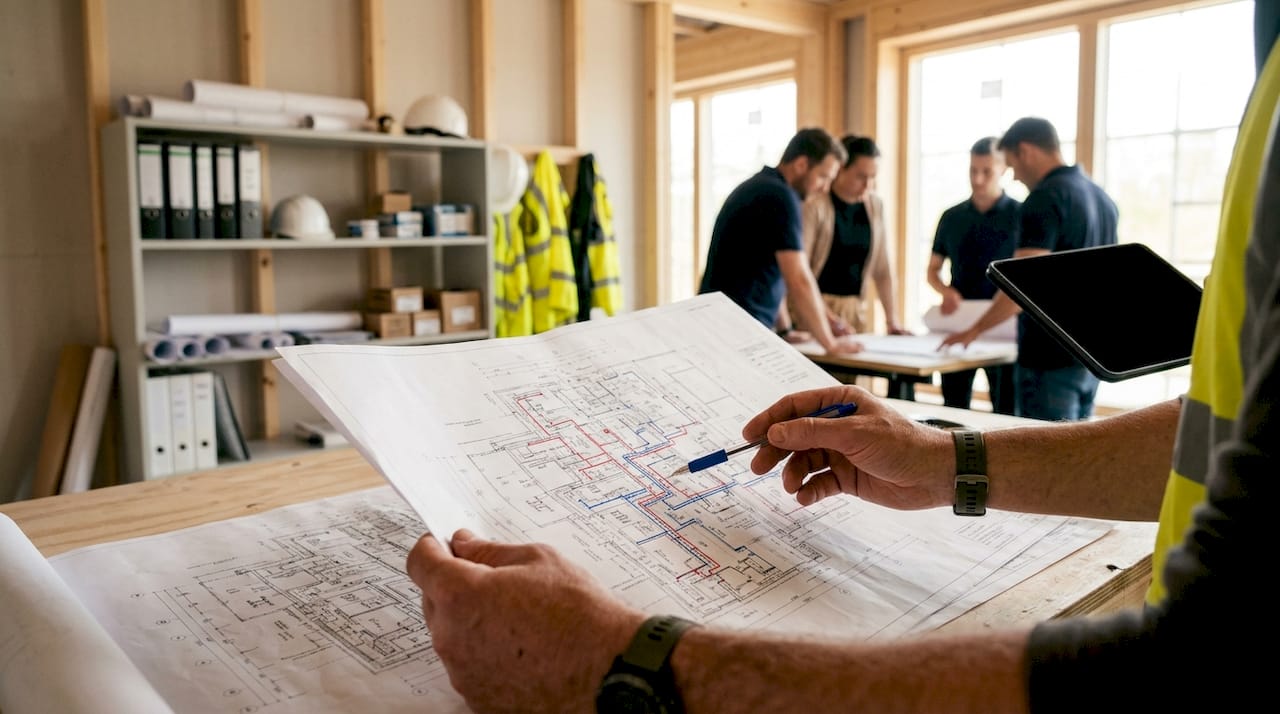
As-built drawings are the most scrutinized documents during authority submissions. MEP as-built quality is measured using Level of Development (LOD) standards, with LOD 300 confirming accurate geometry, locations, and routing, and LOD 350 adding coordination data such as hanger locations. LOD 350 is required for high-coordination zones where mechanical, electrical, and structural systems share confined spaces. Submitting LOD 300 drawings where LOD 350 is required is a common cause of BCA plan rejection.
O&M manuals are not generic equipment brochures. A compliant O&M manual contains as-built settings and setpoints, maintenance schedules, and equipment-specific data tied to the actual installed configuration. This distinction matters because facility managers must verify the manual against the physical installation before project closeout is accepted.
Commissioning reports document that each system has been tested, balanced, and verified against design intent. These reports are required by SCDF for fire protection systems and by BCA for energy-related mechanical systems. Without signed commissioning reports, the temporary occupation permit (TOP) process stalls.
Technical specifications and control diagrams define the performance parameters and sequence of operations for each system. They serve as the reference standard during inspections and defect liability periods.
- As-built drawings at LOD 300 or LOD 350 depending on coordination complexity
- O&M manuals with equipment-specific data, setpoints, and maintenance schedules
- Commissioning plans and final test reports for each system
- Technical specifications, control schematics, and sequence of operations documents
- Submittal review records confirming vendor equipment matches design intent
How to prepare M&E documentation according to 2026 Singapore standards
Preparation follows a sequential process tied to project milestones, not a single closeout activity. The most costly mistake on Singapore projects is treating documentation as a final-stage task. Starting O&M and as-built data capture at project kickoff prevents information gaps, particularly for ceiling-concealed services that become inaccessible after finishes are applied.
-
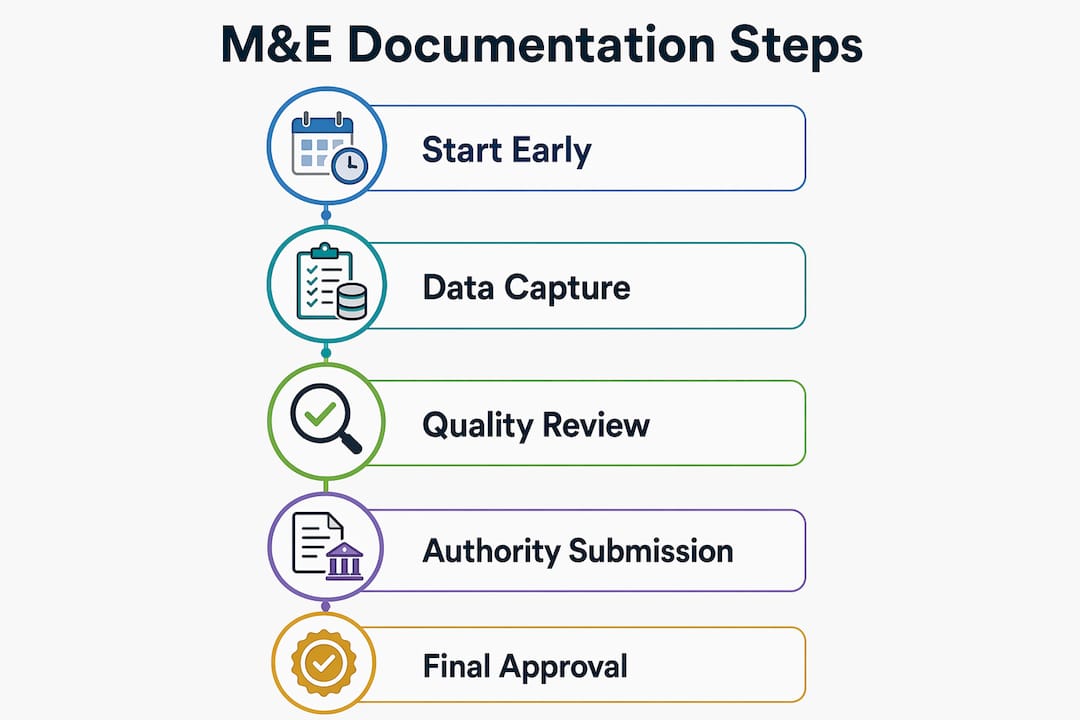
Initiate documentation at project kickoff. Assign a documentation lead from the M&E consultancy team on day one. Create a master document register that lists every required submission, its responsible party, and its target completion date aligned with the project program.
-
Coordinate between mechanical, electrical, and structural teams. Interface consistency across disciplines is more critical than the volume of documentation produced. Schedule monthly interdisciplinary reviews to verify that pipe routing, cable tray paths, and structural penetrations are recorded consistently across all drawing sets.
-
Conduct progressive 3D laser scanning at key milestones. Scanning at slab-pour, above-ceiling, and pre-cladding stages produces reliable as-built records. Traditional red-line markups on paper drawings introduce transcription errors and are increasingly rejected by Singapore authorities in favor of BIM-based as-built submissions. Integrating scan data into a BIM model also satisfies the BIM coordination requirements for larger projects under BCA’s BIM e-Submission protocol.
-
Organize files by system and equipment tag. Each equipment item should have its own documentation sheet linking the as-built drawing reference, the O&M manual section, the commissioning test record, and the submittal approval. This structure allows authority reviewers to trace a single piece of equipment through the entire documentation chain without requesting additional information.
-
Submit O&M manuals 60–90 days before project closeout. O&M manuals must be submitted well ahead of the final inspection to allow facility managers time to verify the content against installed equipment. Late submission is one of the most frequent causes of TOP delays on Singapore commercial and industrial projects.
-
Conduct a pre-submission quality check. Review every document against the authority’s checklist before lodging. Verify that drawing revision numbers match across all sets, that equipment tags are consistent between drawings and O&M manuals, and that all commissioning reports carry the required Professional Engineer (PE) endorsement.
Pro Tip: Create a single-page equipment data sheet for every major plant item at the time of procurement. Populate it with model numbers, serial numbers, and design setpoints while the information is readily available. This sheet becomes the foundation of the O&M manual entry and eliminates the most common data-gap problem at closeout.
What are the common challenges in M&E documentation quality and compliance?
Documentation debt is the single largest risk in M&E project management. It accumulates when teams defer record-keeping to later project stages, then face a backlog of undocumented changes, substituted equipment, and unverified test results. Treating documentation as a Definition of Done item, updated with every technical change, prevents this backlog from forming.
The following pitfalls appear consistently across Singapore M&E projects:
- No assigned ownership. When documentation responsibility is shared informally, critical records fall between teams. Assign a named individual to each document category, not a department.
- Inconsistent interdisciplinary records. A mechanical drawing showing a chiller plant at one elevation while the structural drawing shows a different slab penetration location creates a conflict that reviewers flag immediately. Inconsistent documentation across disciplines is a leading cause of approval failures.
- Mixed document types in a single file. Combining installation instructions, maintenance procedures, and equipment specifications into one unstructured document makes verification slow and error-prone. The Diataxis framework, referenced in modular documentation practice, separates documents by purpose: tutorials, how-to guides, reference material, and explanatory content. Applying this logic to M&E documentation means each file has one clear function.
- Missing version control. Drawings revised after a submittal approval must be resubmitted with a clear revision history. Submitting superseded drawings to SCDF or PUB is a compliance violation that can void an approval.
Pro Tip: Add a documentation checkpoint to every project milestone gate. Before a milestone is signed off, the documentation lead confirms that all records for that phase are complete, filed, and version-controlled. This mirrors the Definition of Done principle used in software engineering and works equally well for construction.
Vendor collaboration also affects documentation quality. Require equipment suppliers to submit O&M data in a specified format at the time of purchase order, not at delivery. Late vendor data is the second most common cause of incomplete O&M manuals at closeout.
What tools and technologies support M&E documentation preparation?
Technology selection determines how efficiently a team can produce, maintain, and submit compliant documentation. The table below summarizes the primary tools and their documentation functions.
| Technology | Primary Documentation Function | Key Benefit for Singapore Projects |
|---|---|---|
| BIM (Building Information Modeling) | Coordination, clash detection, as-built model | Supports BCA BIM e-Submission protocol |
| 3D laser scanning | As-built geometry capture at milestones | Eliminates red-line transcription errors |
| Cloud document management | Centralized file storage and access control | Enables real-time collaboration across teams |
| Version control systems | Revision tracking and audit trails | Prevents submission of superseded drawings |
| Automated O&M assembly tools | Aggregates equipment data into structured manuals | Reduces manual compilation time at closeout |
BIM models are the most impactful single investment for M&E documentation quality. A well-maintained BIM model serves as the master reference for as-built drawings, clash coordination records, and equipment location data. For projects requiring M&E engineering compliance submissions to multiple Singapore authorities, a single BIM model reduces the risk of inconsistencies between separate drawing sets.
Cloud-based document management platforms with role-based access control allow the M&E consultant, main contractor, and authority reviewers to access the same document version simultaneously. This eliminates the version confusion that occurs when teams exchange files by email. Effective document control in construction requires a single source of truth, not multiple copies distributed across individual inboxes.
Key Takeaways
Compliant M&E engineering documentation requires early initiation, disciplinary consistency, modular structure, and technology-supported version control to secure Singapore authority approvals without delays.
| Point | Details |
|---|---|
| Start at project kickoff | Begin O&M and as-built data capture on day one to avoid gaps in concealed system records. |
| LOD standards define quality | Submit as-built drawings at LOD 300 minimum; use LOD 350 for high-coordination zones. |
| Submit O&M manuals early | Lodge O&M manuals 60–90 days before closeout to allow facility manager verification. |
| Assign clear ownership | Name a responsible individual for each document category to prevent records falling through the gaps. |
| Interface consistency is critical | Verify that mechanical, electrical, and structural records align before any authority submission. |
What I have learned about M&E documentation on Singapore projects
The most persistent misconception I encounter is that documentation quality is a closeout problem. Teams invest heavily in design and construction, then treat record-keeping as an administrative task to finish before handover. That sequence produces the documentation debt that delays TOP applications and creates liability exposure during the defect liability period.
The projects that move through BCA, SCDF, and PUB submissions without major queries share one characteristic: documentation was treated as a live engineering product from day one. Every design change triggered a documentation update. Every equipment substitution was captured in the O&M manual before the item was installed. The M&E engineering workflow on those projects was not faster because the teams were more experienced. It was faster because they never accumulated a backlog.
Singapore’s regulatory environment is also becoming less tolerant of incomplete submissions. Authorities now cross-reference BIM models against physical inspections on larger projects. A team that has maintained accurate BIM-based as-built records throughout construction passes those inspections. A team that assembled drawings from memory at closeout does not.
— Aman
How Aectechnicalsg supports M&E documentation and authority submissions
Aectechnicalsg provides M&E engineering consultancy services to Singapore developers, contractors, and property owners who need compliant documentation packages for authority submissions.
The team at Aectechnicalsg prepares and reviews M&E documentation for submissions to BCA, SCDF, PUB, NEA, and JTC, covering as-built drawing sets, O&M manuals, commissioning reports, and PE-endorsed technical specifications. For developers who need a clear picture of their engineering consultancy options, Aectechnicalsg offers structured advisory services tailored to project scale and submission requirements. The firm also handles PE endorsement and authority submissions directly, reducing the coordination burden on project teams and shortening the path to TOP approval.
FAQ
What is M&E engineering documentation?
M&E engineering documentation is the complete set of records covering mechanical and electrical system design, installation, commissioning, and maintenance for a construction project. It includes as-built drawings, O&M manuals, commissioning reports, and technical specifications required for authority approvals.
When should O&M manuals be submitted in Singapore?
O&M manuals should be submitted at least 60–90 days before project closeout. This window allows facility managers to verify the manual content against the installed equipment before the final inspection.
What LOD standard applies to M&E as-built drawings?
LOD 300 is the standard for most M&E as-built drawings, confirming accurate geometry and routing. LOD 350 is required for high-coordination zones where mechanical, electrical, and structural systems share confined spaces.
Why do M&E documentation submissions get rejected?
The most common rejection causes are inconsistent records across mechanical, electrical, and structural disciplines, missing PE endorsements on commissioning reports, and O&M manuals that contain generic brochures rather than equipment-specific data and setpoints.
How does BIM improve M&E documentation quality?
BIM provides a single coordinated model that serves as the master reference for as-built drawings, clash records, and equipment locations. For Singapore projects under BCA’s BIM e-Submission protocol, a maintained BIM model also satisfies construction handover documentation requirements and reduces inconsistencies between separate drawing sets.