
Earthworks failure in Singapore is defined as the uncontrolled collapse, settlement, or instability of excavated ground or retaining structures during construction. The common earthworks failure causes in Singapore consistently trace back to five core breakdowns: unauthorized deviations from approved structural plans, missing or inadequate Earth Retaining or Stabilizing Structures (ERSS), poor soil compaction, ineffective water management, and absent real-time monitoring. The Workplace Safety and Health (Construction) Regulations 2007 sets the legal baseline, yet incidents continue to occur when site teams treat compliance as a ceiling rather than a floor. Understanding each failure mode gives construction professionals the specific knowledge needed to prevent incidents, protect workers, and avoid enforcement action.
1. Common earthworks failure causes in Singapore: regulatory non-compliance and unauthorized deviations
Regulatory non-compliance is the single most documented root cause of major earthworks failures in Singapore. Unauthorized site deviations from approved structural plans, including reduced pile diameters and unapproved openings in caisson rings, directly degrade the Professional Engineer’s design intent. Once field teams alter approved configurations without PE endorsement, the entire structural system operates outside its certified parameters.
The 2025 Tanjong Katong Road South sinkhole illustrates this precisely. The incident on July 26, 2025 resulted in enforcement charges against seven parties by june 2026, covering unauthorized building works and supervisory lapses. The investigation confirmed that jet grout pile diameters were reduced without authorization, compromising the ground support system.
Key regulatory violations that drive these failures include:
- Proceeding with excavation without a PE-certified ERSS design
- Modifying approved structural drawings without formal variation submissions to BCA or relevant authorities
- Failing to maintain adequate supervision by a qualified person during critical excavation phases
- Ignoring PE stop-work directives or trigger-level alerts from monitoring instruments
Pro Tip: Every field change, no matter how minor it appears, requires a formal variation order reviewed and endorsed by the PE of record before work proceeds. Verbal approvals carry no legal weight under Singapore’s regulatory framework.
Reviewing your PE compliance obligations before mobilization is the most direct way to close this gap.
2. Missing or inadequate ERSS: the primary technical cause of excavation collapses
ERSS failures account for a disproportionate share of excavation collapses on Singapore construction sites. Regulation 37 requires adequate structural support for any excavation exceeding 1.5 meters in depth. Placing heavy materials or plant equipment within 1 meter of an unsupported trench edge compounds the risk significantly.
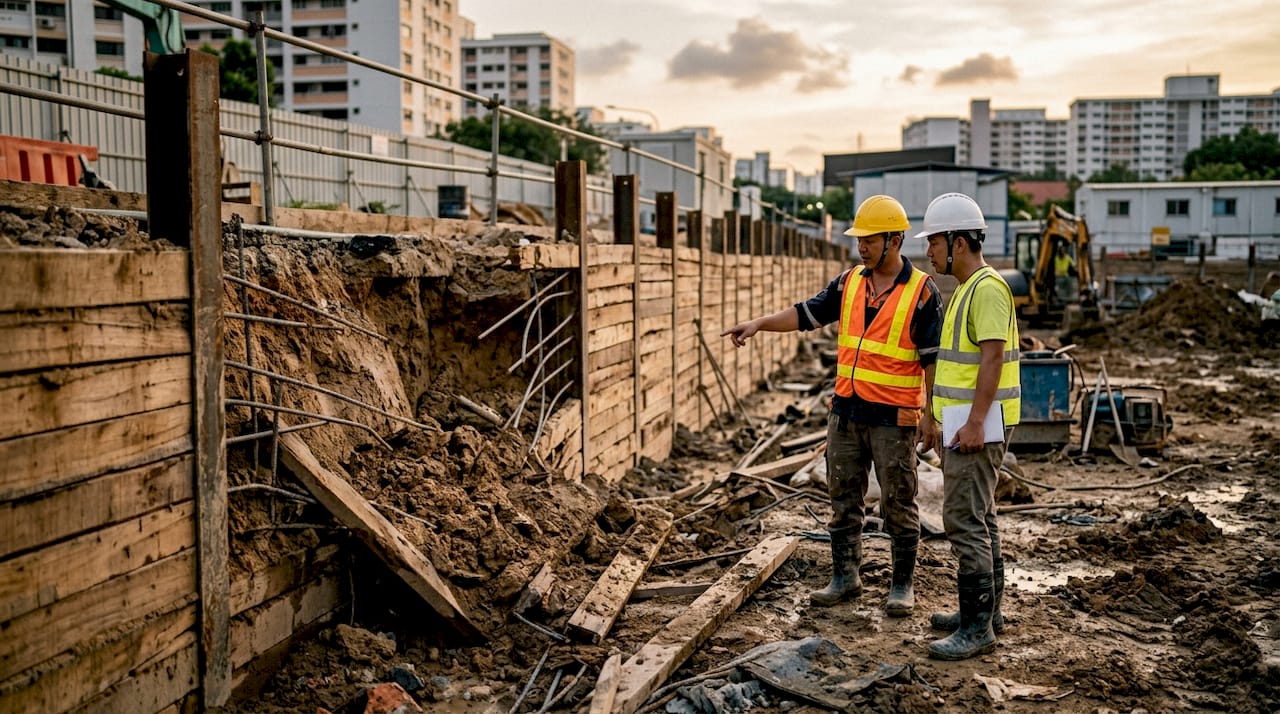
Singapore’s geology presents specific challenges. Marine clay deposits in reclaimed areas and soft alluvial soils in older districts have low shear strength and high compressibility. These conditions demand ERSS designs that account for actual ground behavior, not just textbook parameters.
Common ERSS types used in Singapore excavations include:
- Sheet pile walls with steel walers and struts for deep urban excavations
- Contiguous bored pile walls for sites adjacent to existing structures
- Soldier pile and timber lagging systems for shallower, temporary cuts
- Soil nailing combined with shotcrete for slope stabilization in residual soil profiles
- Jet grouting as a ground improvement measure before excavation commences
Each system requires a PE-stamped design, installation verification, and ongoing monitoring. Regulatory compliance is the baseline, not a guarantee of safety. Site-specific risk assessments must account for buried utilities, adjacent structures, and changing ground conditions that standard code calculations may not capture.
Pro Tip: Commission a geotechnical investigation before finalizing your ERSS design. Soil borings spaced too far apart miss localized weak zones that cause localized wall deflections and progressive collapse.
A thorough geotechnical analysis before excavation design reduces the risk of encountering unexpected ground conditions mid-project.
3. Poor soil compaction and settlement: how inadequate monitoring drives structural damage
Settlement-related failures cause 25–40% of all structural damage claims in construction projects, with rework costs ranging from $500,000 to $2 million per highway embankment section. That cost range reflects what happens when compaction quality is assumed rather than verified. Singapore’s mix of reclaimed land, soft marine clay, and variable fill materials makes compaction monitoring non-negotiable.
Inadequate compaction produces voids beneath structural slabs, differential settlement under footings, and pavement failures along access roads. These outcomes are not immediately visible. They develop over weeks or months, making the connection between poor field practice and structural damage easy to miss until the damage is severe.
| Compaction failure indicator | Likely cause | Recommended action |
|---|---|---|
| Differential settlement at slab edges | Uneven lift thickness during fill placement | Verify lift thickness and recompact to specification |
| Cracking in adjacent pavements | Insufficient compaction of backfill near structures | Conduct nuclear density gauge or dynamic cone penetrometer testing |
| Heave or lateral movement in retaining walls | Excess pore water pressure from poorly drained fill | Install piezometers and review drainage design |
| Sinkholes in completed areas | Collapse of uncompacted voids in fill | Conduct ground-penetrating radar survey and remediate |
Monitoring methods that prevent these outcomes include:
- Nuclear density gauge testing at specified intervals per layer
- Dynamic cone penetrometer (DCP) testing for rapid field verification
- Intelligent compaction systems with GPS-linked real-time data logging
- Settlement plate arrays to track post-construction movement over time
4. Water management failures: drainage problems that trigger slope instability
Water is the single most significant factor in earthworks failure on construction sites, and neglecting integrated drainage planning is the most common mistake teams make. Singapore’s tropical climate delivers intense, short-duration rainfall events that saturate exposed slopes and fill materials rapidly. When surface runoff is not controlled, it infiltrates the soil mass, raises the water table, and reduces shear strength to the point of slope failure.
Slope failure mechanisms triggered by water ingress follow predictable patterns. Excess pore water pressure reduces the effective stress holding soil particles together. Once that pressure exceeds the soil’s shear strength, the slope moves. Circular slip failures in cohesive soils and translational slides in granular materials are both common outcomes on Singapore sites where drainage is treated as an afterthought.
Effective water management during earthworks requires:
- Perimeter cut-off drains installed before bulk excavation begins, sized for a design storm event
- Silt fences and sediment traps at all discharge points to comply with PUB requirements
- Temporary slope protection using geotextile sheeting during periods of heavy rainfall
- Subsoil drainage layers incorporated into fill designs for permanent embankments
- Regular inspection of drainage channels after every significant rainfall event
Integrated drainage planning must be part of the earthworks design package, not a site-level improvisation. The financial exposure from drainage failures extends well beyond remediation costs to include project delays, third-party property damage claims, and regulatory penalties.
5. Absent or ignored monitoring: how missed warning signs accelerate failure
Real-time monitoring is the last line of defense against earthworks failure, yet it is frequently either absent or its outputs are ignored. Intelligent monitoring systems for ground movement and compaction are becoming standard practice in Singapore, providing legally defensible data for safety management and dispute resolution. Sites that rely on periodic manual readings miss the rapid changes that precede collapse.
Standard monitoring instruments for excavation projects include inclinometers to track lateral wall movement, piezometers to measure pore water pressure, settlement markers on adjacent structures, and vibrating wire strain gauges on struts. Each instrument generates data that, when trended over time, reveals whether the excavation is behaving within design assumptions.
Early warning signs such as small pavement cracks, increased water ingress, and unexpected siltation are critical indicators of ground movement. Waiting for official trigger levels delays remedial action and leaves little margin to avoid collapse. Proactive intervention at the first sign of anomalous readings is the professional standard.
The practical steps that prevent monitoring failures include:
- Establishing alert, action, and alarm trigger levels before excavation begins
- Assigning a named responsible person to review instrument readings daily
- Automating data transmission from instruments to a central dashboard for real-time visibility
- Documenting all readings and responses to create an auditable compliance record
- Acting on anomalous readings immediately rather than waiting for the next scheduled review
A construction compliance checklist that incorporates monitoring protocols helps teams maintain this discipline across the full excavation cycle.
Key Takeaways
The most preventable earthworks failures in Singapore share a common thread: the gap between what the approved design requires and what actually happens on site.
| Point | Details |
|---|---|
| Regulatory compliance is the floor | Meeting minimum code requirements does not eliminate risk; site-specific conditions require design factors beyond the baseline. |
| ERSS is legally mandatory at 1.5m depth | Any excavation exceeding 1.5 meters requires a PE-certified ERSS design before work begins. |
| Compaction failures are expensive and preventable | Settlement-related damage costs $500,000–$2 million per embankment section; real-time monitoring prevents this outcome. |
| Water management must be designed, not improvised | Integrated drainage plans sized for tropical rainfall events must be part of the earthworks design package. |
| Early warning signs demand immediate action | Pavement cracks, water ingress, and siltation signal ground movement; acting before trigger levels are reached prevents collapse. |
Why bare-minimum compliance keeps failing Singapore sites
The pattern I see repeatedly in Singapore earthworks incidents is not ignorance of the rules. It is the assumption that meeting the rules is enough. Regulation 37 tells you when ERSS is required. It does not tell you how the wall will behave when the soil profile changes three meters below the design assumption. That gap between code compliance and actual site behavior is where most failures originate.
Field execution consistently degrades engineering design. A PE produces a certified ERSS drawing based on borehole data and design loads. Then a site supervisor decides to reduce pile spacing to save time, or a subcontractor installs walers at the wrong elevation because the approved drawing was not on site. These are not dramatic decisions. They are small, incremental departures that accumulate into a collapse.
The technology exists to close this gap. Real-time inclinometer data, automated piezometer readings, and intelligent compaction systems give site teams the information they need to catch deviations before they become failures. The barrier is not technical. It is the organizational habit of treating monitoring as a paperwork exercise rather than a decision-making tool.
What I advocate for is a shift in professional accountability. The PE of record should be reviewing instrument trends weekly, not just signing off on the initial design. The project manager should understand what the alert trigger levels mean and have a clear escalation protocol. The site supervisor should be empowered to stop work when readings trend toward action levels, without needing approval from three layers of management. That is how earthworks failure prevention actually works in practice.
— Aman
How Aectechnicalsg supports earthworks safety and compliance
Construction professionals managing excavation and earthworks projects in Singapore face a demanding regulatory environment. Aectechnicalsg provides engineering consultancy services covering structural plan endorsement, PE submissions to BCA and other authorities, geotechnical advisory, and monitoring protocol development.

The team at Aectechnicalsg works directly with developers and contractors to align site execution with approved designs, manage PE endorsement submissions, and provide technical guidance on ERSS design, compaction standards, and drainage planning. For projects where regulatory compliance and site safety must work together from day one, Aectechnicalsg offers the technical depth and authority submission experience to deliver that outcome.
FAQ
What are the most common earthworks failure causes in Singapore?
The most common causes are unauthorized deviations from approved structural plans, missing ERSS for excavations deeper than 1.5 meters, inadequate soil compaction, poor drainage management, and absent or ignored ground movement monitoring.
When is an ERSS legally required in Singapore?
Regulation 37 of the Workplace Safety and Health (Construction) Regulations 2007 requires adequate earth retaining or stabilizing structures for any excavation exceeding 1.5 meters in depth.
How do water management failures cause earthworks collapses?
Excess surface runoff and poor subsoil drainage raise pore water pressure within the soil mass, reducing shear strength until the slope or excavation wall fails. Integrated drainage planning sized for tropical rainfall events prevents this outcome.
What monitoring instruments are standard for Singapore excavation projects?
Standard instruments include inclinometers for lateral wall movement, piezometers for pore water pressure, settlement markers on adjacent structures, and vibrating wire strain gauges on ERSS struts.
What should a site team do when monitoring readings approach trigger levels?
The team should immediately notify the PE of record, halt excavation activities in the affected zone, and implement pre-agreed remedial measures. Waiting for alarm-level readings before acting significantly reduces the margin for safe intervention.
Recommended
- Geotechnical analysis guide: Steps for safe, compliant projects
- Geotechnical engineering: Essential knowledge for Singapore developers
- Main types of civil engineering projects in Singapore
- Erosion Control Measures in Singapore: A Comprehensive Guide by Qualified Erosion Control Professionals (QECP) – AEC Technical Advisory Singapore Engineering Consultancy