
Fire safety regulations are mandatory standards that require systematic prevention, detection, and control of fire hazards in buildings and construction projects. Frameworks like OSHA and NFPA codes define the legal baseline for fire life safety, covering everything from sprinkler installation to emergency evacuation procedures. For construction professionals, architects, and engineers, understanding why fire safety regulations exist is not optional. Non-compliance carries criminal liability, financial penalties exceeding $165,000 per incident, and the irreversible cost of preventable deaths. These rules exist because history proved, repeatedly, that voluntary safety measures are not enough.
Why fire safety regulations are non-negotiable in construction
Compliance with fire safety laws protects lives first, then assets, then business continuity. A fire in an occupied building without functioning suppression or detection systems can kill within minutes. Regulations remove the guesswork by mandating specific systems, maintenance schedules, and trained personnel on every project.
The legal exposure from non-compliance is severe. Code violations constitute negligence per se, meaning a plaintiff in a fire injury lawsuit does not need to prove unreasonable conduct. The violation itself is the proof. That shifts the entire burden of litigation onto the building owner or responsible contractor.
Financial risk compounds the legal exposure. OSHA penalties exceed $165,000 per incident, with daily fines of $10,000 for ongoing violations. Those figures do not include civil settlements, increased insurance premiums, or the cost of forced project shutdowns.
The benefits of fire regulations extend beyond avoiding penalties. Compliant buildings sustain lower insurance costs, attract tenants and investors, and maintain operational continuity after minor incidents. A building that meets NFPA standards for suppression and detection is statistically less likely to suffer total loss in a fire event.
- Life safety: Regulations mandate detection and suppression systems that give occupants time to evacuate.
- Legal protection: Compliance eliminates negligence per se exposure in civil litigation.
- Financial stability: Avoiding OSHA fines and insurance surcharges protects project budgets.
- Asset preservation: Fire-resistant construction and active suppression limit structural damage.
- Regulatory approval: Projects cannot receive occupancy permits without demonstrated compliance.
Pro Tip: Embed fire safety compliance checkpoints into your project schedule at design, construction, and pre-occupancy phases. Retrofitting fire systems after construction is significantly more expensive than integrating them from the start.
How historical disasters shaped modern fire codes
Modern fire safety codes did not emerge from theory. They were written in direct response to mass casualty events where the absence of basic protections killed hundreds of people.
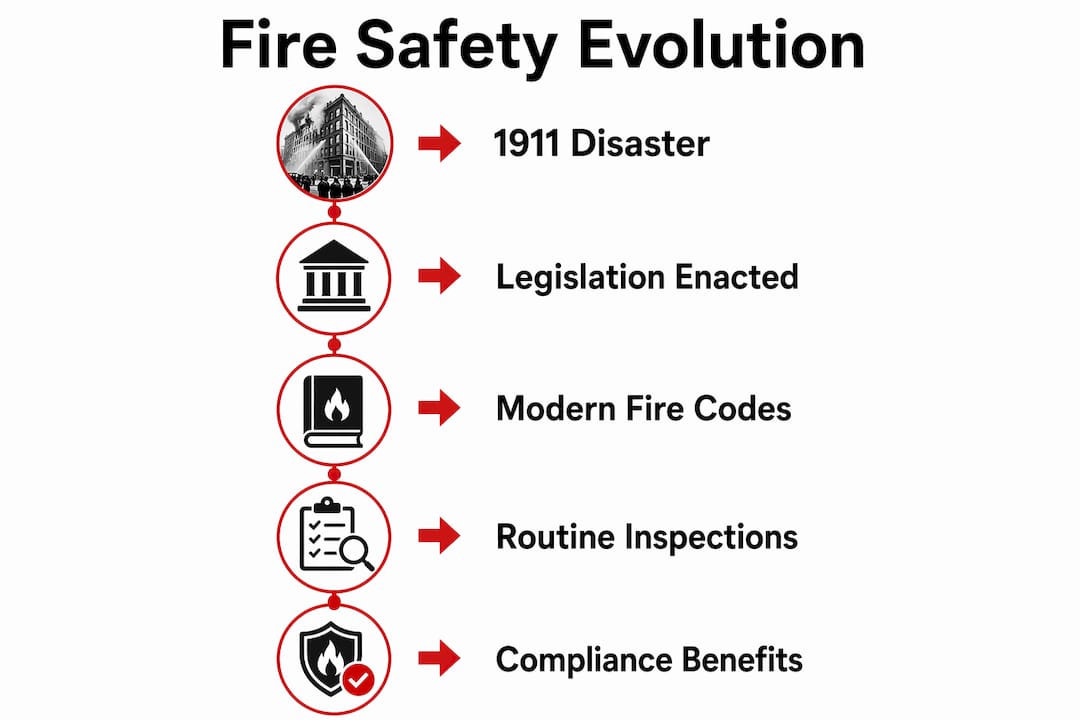
The Triangle Shirtwaist Factory fire of 1911 killed 146 garment workers in New York City. The disaster triggered sweeping reforms mandating fire escapes, unlocked exits, sprinkler systems, and regular fire drills in workplaces. Before that fire, none of those requirements were legally enforceable.
The Cocoanut Grove nightclub fire in Boston in 1942 killed 492 people in a single night. Investigators found revolving doors that trapped occupants, flammable decorations, and exits that were locked or hidden. That disaster directly produced requirements for outward-swinging exit doors, occupancy limits, and non-combustible interior finishes.
The Station Nightclub fire in Rhode Island in 2003 killed 100 people when pyrotechnics ignited foam soundproofing. The building had no sprinkler system. That event accelerated mandatory sprinkler requirements for assembly occupancies across multiple states.
Fire codes are not bureaucratic overhead. They are the accumulated record of what happens when buildings fail their occupants. Every requirement in the code corresponds to a specific failure mode that killed real people.
- Locked exits: Now prohibited under NFPA 101 Life Safety Code, which mandates unobstructed egress at all times.
- Lack of sprinklers: NFPA 13 requires automatic sprinkler systems in most commercial and assembly occupancies.
- Flammable finishes: Building codes restrict interior finish materials based on flame spread ratings.
- Inadequate egress: Codes specify minimum corridor widths, travel distances, and exit quantities based on occupancy load.
Regular fire inspections enforce these lessons by identifying blocked exits, failed protection systems, and unsafe conditions before they become fatal. Inspections are the mechanism that converts written code into physical reality.
What fire safety regulations require in practice
Fire life safety, the recognized industry term for the integrated system of detection, suppression, and evacuation, is defined by codes like NFPA and enforced through inspections by Authorities Having Jurisdiction (AHJs). Fire life safety integrates early detection, controlled response, and safe evacuation into a coordinated system. Each component is mandatory, not optional.
Core technical requirements
| Requirement | Regulatory basis | Frequency |
|---|---|---|
| Fire risk assessment | Fire Safety Order 2005, OSHA | At project start; reviewed on change |
| Fire alarm system inspection | NFPA 72 | Annual minimum |
| Sprinkler system testing | NFPA 25 | Quarterly and annual |
| Emergency lighting check | NFPA 101 | Monthly and annual |
| Fire door inspection | NFPA 80 | Annual |
| Staff fire safety training | OSHA 29 CFR 1910.38 | At hire; annual refresher |
Fire risk assessments must be reviewed whenever building use or occupancy changes. A risk assessment completed at project handover becomes legally insufficient the moment the building’s function or occupant load shifts. Treating the assessment as a living document is a legal requirement, not a best practice.
The concept of the “Responsible Person” formalizes accountability. The Responsible Person must actively manage fire risk assessment reviews and compliance documentation. This is not a passive administrative role. It carries direct legal liability for failures in detection, suppression, or evacuation systems.
- Fire alarms: Must be tested, maintained, and documented under NFPA 72. The fire alarm panel is the system’s brain; a failed panel disables the entire detection network.
- Sprinkler systems: NFPA 13 and NFPA 25 govern installation and maintenance. Blocked or corroded sprinkler heads are a common inspection failure.
- Fire doors: Must self-close, latch fully, and remain free of obstructions. Propped-open fire doors are one of the most cited violations in AHJ inspections.
- Emergency lighting: Must activate automatically on power failure and illuminate egress paths for a minimum duration per NFPA 101.
Pro Tip: Assign the Responsible Person role to a named individual in every project contract, not to a department or company. Diffuse accountability is the most common reason compliance documentation fails during an incident investigation.
For projects in Singapore, SCDF fire safety compliance requirements align with these international principles but include jurisdiction-specific submission and approval processes that must be addressed at the design stage.
What happens when fire safety compliance fails?
Non-compliance with fire safety obligations produces consequences across three categories: legal, financial, and operational. Each category compounds the others.
On the legal side, a code violation alone can prove negligence in civil court without requiring additional evidence of unreasonable conduct. This negligence per se doctrine means that a building owner who failed to maintain a sprinkler system faces near-automatic liability if a fire injures an occupant. The legal defense becomes extremely narrow.
Financially, the numbers are direct. OSHA financial penalties can exceed $165,000 per incident. Daily fines of $10,000 accumulate for every day a violation remains uncorrected. Civil settlements in fire injury cases routinely exceed these regulatory fines by a significant margin.
Neglecting system maintenance or staff training invalidates the safety intent of fire codes and increases legal exposure for building owners. A fire alarm that has not been tested in two years provides no legal protection even if it was originally installed to code.
- Forced closure: AHJs have authority to issue stop-work orders or revoke occupancy certificates for serious violations.
- Insurance consequences: Insurers can void policies or deny claims when violations contributed to a loss.
- Reputational damage: Public fire incidents tied to code violations generate regulatory scrutiny on all projects associated with the responsible firm.
- Criminal exposure: Gross negligence in fire safety failures has resulted in criminal prosecution of building owners and project managers in multiple jurisdictions.
Maintaining construction site safety standards throughout the build phase reduces the risk of fire incidents before occupancy, a period when suppression systems may not yet be fully commissioned.
Key Takeaways
Fire safety regulations are legally enforceable standards that protect lives, limit financial liability, and determine project viability. Compliance is the baseline requirement for every construction and engineering professional.
| Point | Details |
|---|---|
| Negligence per se risk | A code violation alone proves negligence in civil court, removing the need for additional proof. |
| Financial penalty scale | OSHA fines exceed $165,000 per incident, with $10,000 daily fines for ongoing violations. |
| Living risk assessments | Fire risk assessments must be reviewed whenever building use or occupancy changes. |
| Responsible Person accountability | One named individual must own compliance documentation and system maintenance records. |
| Historical code origins | Every NFPA and OSHA fire requirement traces to a specific disaster where its absence caused deaths. |
Fire safety regulations as professional responsibility
The framing of fire safety regulations as a compliance cost is the most dangerous misconception in construction practice. Every requirement in NFPA 101, NFPA 13, or OSHA 29 CFR 1910.38 exists because a specific failure mode killed people. When a project team treats a fire door inspection as a checkbox, they are dismissing the lesson of a real fatality.
What I have seen consistently across complex projects is that the teams with the fewest fire safety incidents are not the ones with the largest compliance budgets. They are the ones where the Responsible Person is a named individual with direct authority, where risk assessments are updated after every significant design change, and where fire drills are treated as operational exercises rather than inconveniences.
The negligence per se doctrine is the clearest signal that regulators have sent to the profession. Regulators are not asking for best efforts. They are setting a defined standard, and falling below it transfers full legal liability to the project team. That is not a bureaucratic position. It is a statement about where accountability sits.
Cutting corners on fire safety is not a financial decision. It is a liability transfer. The cost of a properly maintained fire suppression system is a fraction of a single OSHA penalty, let alone a civil settlement. Professionals who understand the design for safety principles in engineering practice recognize that fire safety integration at the design stage is the most cost-effective point of intervention.
The most important shift a project team can make is treating fire safety compliance as a continuous process embedded in the project workflow, not a final inspection to pass before handover.
— Aman
Aectechnicalsg supports fire safety compliance from design to delivery
Fire safety compliance in construction requires technical expertise at every project phase, from initial risk assessment through authority submission and system commissioning.

Aectechnicalsg provides engineering consultancy services that integrate fire safety requirements into structural, M&E, and architectural design for Singapore projects. The team manages submissions to SCDF and other authorities, ensuring that fire detection, suppression, and evacuation systems meet both local and international code requirements. Professionals working on design safety in construction can consult Aectechnicalsg for technical advisory support that addresses compliance from the earliest design stage through project completion and occupancy approval.
FAQ
What are fire safety regulations?
Fire safety regulations are legally enforceable standards that mandate the prevention, detection, and control of fire hazards in buildings. Key frameworks include OSHA standards, NFPA codes, and jurisdiction-specific laws like Singapore’s SCDF requirements.
Why enforce fire safety regulations in construction projects?
Enforcement protects occupants from preventable deaths and holds project teams legally accountable. Code violations constitute negligence per se in civil litigation, meaning the violation itself proves liability without additional evidence.
What does a fire risk assessment require?
A fire risk assessment must identify hazards, evaluate risks to occupants, and document control measures. It must be reviewed whenever building use or occupancy changes, and the Responsible Person must maintain it as an active compliance document.
What are the financial consequences of fire safety non-compliance?
OSHA penalties exceed $165,000 per incident, with daily fines of $10,000 for ongoing violations. Civil settlements and insurance consequences typically exceed regulatory fines by a significant margin.
How do historical fires explain why fire safety laws exist?
Disasters like the Triangle Shirtwaist Factory fire of 1911 and the Station Nightclub fire of 2003 directly produced specific code requirements, including mandatory sprinklers, unlocked exits, and non-combustible interior finishes. Each code requirement traces to a documented failure that caused deaths.
Recommended
- Building Codes And Regulations In Singapore Construction Industry – AEC Technical Advisory Singapore Engineering Consultancy
- SCDF Fire Safety: A Compliance Guide for Singapore Developers
- Advanced Fire Engineering: Performance-Based Design for Exposed Steel Structures
- Why Risk Assessment in Construction Matters