
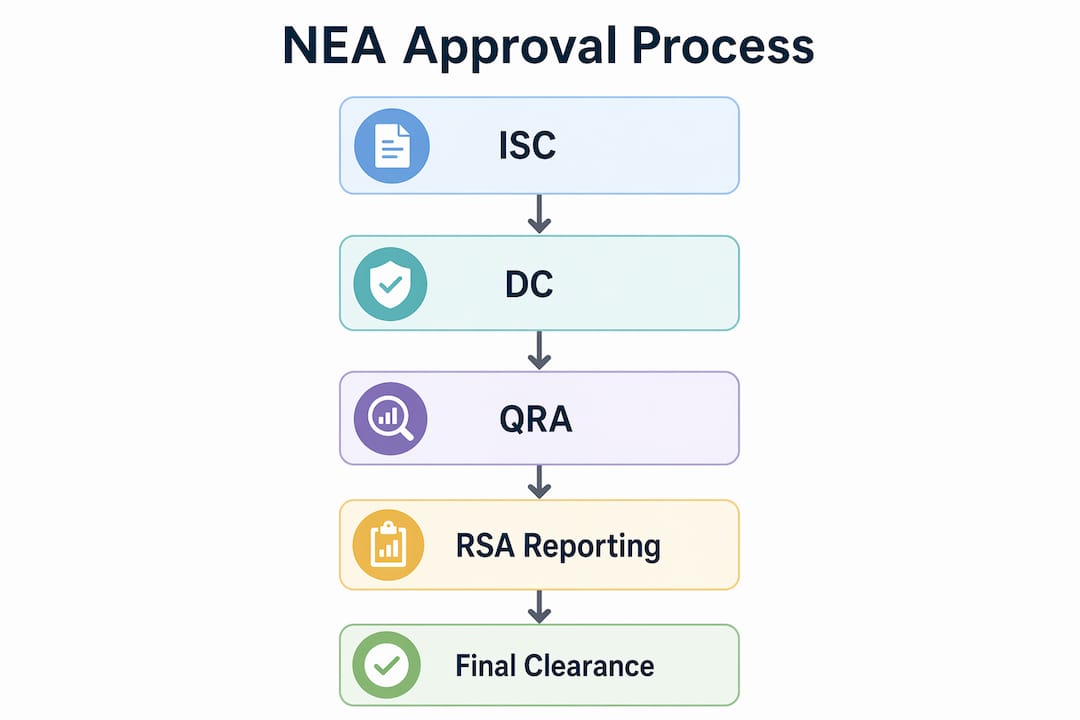
NEA approval is the mandatory clearance process where Singapore’s National Environment Agency evaluates construction and industrial projects for environmental compliance and land-use suitability before work proceeds. The NEA approval process operates through two primary stages: Industrial Siting Consultation (ISC) and Development Control (DC). Both stages are administered by NEA’s Development Control Department and Industrial Siting Department respectively. Construction professionals who miss either stage risk project delays, design revisions, and potential regulatory penalties. The Resource Sustainability Act (RSA) adds a third layer of ongoing compliance through mandatory waste reporting, making NEA clearance a continuous obligation rather than a one-time checkpoint.
What is NEA approval, and why does it matter for construction?
NEA approval is a multi-stage clearance process that confirms a construction or industrial project meets Singapore’s environmental and land-use standards. The process covers pollution control, environmental health, and site suitability. Without it, Qualified Persons (QPs) cannot complete building plan submissions to the Building and Construction Authority (BCA).
The two core clearance milestones are ISC and DC. ISC confirms that a proposed industrial activity is compatible with surrounding land uses and zoning. DC evaluates the building plans themselves, focusing on how the project controls noise, dust, and effluent discharge. Both stages must be satisfied in sequence for most industrial and construction developments.

NEA compliance also intersects with other agencies. Projects near watercourses require PUB coordination. Facilities handling hazardous substances involve the Ministry of Manpower (MOM), the Singapore Civil Defence Force (SCDF), and NEA jointly. Understanding this multi-agency structure is the first step to building a realistic project timeline.
What is Industrial Siting Consultation (ISC), and why is it critical?
ISC is the first formal NEA clearance gate for industrial developments. It determines whether the proposed activity is environmentally compatible with the site’s zoning and neighboring uses. The ISC in-principle approval is a prerequisite for proceeding to the DC stage, but it can be revoked if material project changes occur after approval.
The ISC process follows a defined sequence:
- Determine applicability. ISC applies to new industrial developments, expansions, and changes of use that introduce pollution-generating activities. Purely commercial or residential projects typically do not require ISC.
- Prepare the submission package. This includes site plans, process descriptions, pollution control measures, and details of raw materials and outputs.
- Submit via the Environment Protection Management System (EPMS). NEA processes ISC applications through this portal. Incomplete submissions are the most common cause of delays.
- Await NEA’s evaluation. NEA assesses land-use compatibility, buffer distances from sensitive receptors, and cumulative environmental impact.
- Receive in-principle approval or conditional approval. Conditions may require design changes before DC submission proceeds.
- Maintain approval validity. Any subsequent change in pollution control strategy or site layout may trigger a fresh ISC evaluation.
The last point carries significant project management risk. Project design changes after ISC approval, even minor ones affecting pollution control, can invalidate the clearance and require re-submission. This directly impacts project schedules and budgets.
Pro Tip: Engage NEA’s Industrial Siting Department during the concept design stage, before committing to site layout or process configurations. Early consultation surfaces potential zoning conflicts before they become costly redesigns.
How does the Development Control (DC) stage function in securing NEA clearance?
The DC stage is where NEA evaluates the actual building plans submitted by QPs. NEA’s Development Control Department reviews these plans against pollution control guidelines covering noise, dust, and effluent discharge. Pollution control documentation clarity is the decisive factor in securing timely DC clearance.
Key requirements at the DC stage include:
- Noise mitigation plans. Projects near residential zones must demonstrate compliance with permissible noise levels through acoustic barriers, equipment enclosures, or operational hour restrictions.
- Dust suppression measures. Construction sites must detail water spraying schedules, hoarding specifications, and wheel-wash facilities.
- Effluent treatment systems. Industrial premises must show how process wastewater is treated before discharge to public sewers or watercourses.
- Checklist compliance. NEA publishes specific checklists for QPs. Missing checklist items is the most common reason for DC resubmission.
- Coordination with other agency comments. DC submissions often run in parallel with URA, BCA, and PUB reviews. NEA’s comments must be addressed before the consolidated building plan approval is issued.
Successful DC approval depends on how clearly the submission demonstrates that the project mitigates all identified pollution disamenities. Vague or incomplete mitigation descriptions consistently trigger requests for additional information, adding weeks to the review cycle.
Pro Tip: Use NEA’s published pollution control guidelines as a drafting checklist before submission. Cross-reference every guideline item against your plans and include a compliance matrix in the submission package. This single step reduces back-and-forth queries significantly.
For a broader view of how DC fits within the full approval workflow, the construction approval workflow guide from Aectechnicalsg provides a structured overview of all regulatory milestones.
What is a Quantitative Risk Assessment (QRA), and when is it required?
A Quantitative Risk Assessment is a formal analysis that calculates the probability and consequence of accidents involving hazardous substances at major hazard installations. QRA is not required for standard construction projects. It applies specifically to facilities that store, handle, or process hazardous substances above defined threshold quantities.
The QRA process involves three agencies working in coordination:
- MOM leads the QRA framework under the Workplace Safety and Health Act for major hazard installations.
- SCDF evaluates emergency response implications and land-use separation requirements.
- NEA assesses environmental impact from potential releases of hazardous substances.
QRA submissions receive initial agency comments within 15 working days. The full clearance process, however, takes 4–6 months. That timeline reflects the complexity of multi-agency coordination and the technical depth of the assessment itself.
The most costly QRA mistake is starting the process too late. MOM’s Major Hazard Installations Department (MHD) advises consultation during the concept or pre-Front End Engineering Design (FEED) stage. Projects that initiate QRA after detailed design is complete often face mandatory redesigns that are far more expensive than early-stage adjustments would have been.
Early consultation with MHD during the design stage prevents delays arising from QRA requirements. Construction professionals managing petrochemical, pharmaceutical, or large-scale chemical storage projects should treat QRA initiation as a design-stage task, not a pre-construction formality.
What are the NEA waste reporting requirements under the Resource Sustainability Act?
The Resource Sustainability Act (RSA) mandates that prescribed premises submit annual waste data to NEA. This obligation applies regardless of whether the waste is managed in-house or outsourced to licensed collectors. Waste generators must maintain accurate, auditable records to comply with NEA regulations. Hiring a licensed waste collector does not transfer the legal reporting responsibility.
| Premise Type | GFA or Activity Threshold | Reporting Obligation |
|---|---|---|
| Large commercial buildings | Above 30,000 m² GFA | Annual waste data submission to NEA |
| Large industrial premises | Above 30,000 m² GFA | Annual waste data submission to NEA |
| Food waste producers | Defined by NEA output thresholds | Segregated food waste reporting |
| Hotels | Above defined room count | Annual waste data submission to NEA |
Key compliance requirements under RSA waste reporting include:
- Data accuracy. Reported figures must be traceable to licensed waste collector records. Estimates are not acceptable.
- Record retention. Digital record retention for at least 3 years supports audit readiness and ESG disclosure requirements.
- Submission deadlines. NEA sets annual submission windows. Late or incomplete submissions attract regulatory scrutiny.
- ESG alignment. Accurate waste reporting underpins corporate sustainability disclosures and contributes directly to ESG transparency goals.
Construction professionals managing large development sites should integrate waste tracking into project management systems from day one. Retrofitting a data collection process after operations begin is both inefficient and risky.
How to navigate common challenges and ensure successful NEA approval
The most preventable NEA approval failures share a common cause: late engagement. Projects that treat NEA clearance as a late-stage administrative task consistently encounter delays that compress construction schedules and inflate costs.
Practical steps to protect approval timelines include:
- Initiate ISC during concept design. Waiting until detailed design is complete before seeking ISC creates redesign risk if NEA identifies zoning incompatibilities.
- Maintain a pollution control documentation register. Every design decision affecting noise, dust, or effluent management should be recorded with its regulatory basis. This register becomes the backbone of the DC submission.
- Start QRA early for hazardous substance projects. The 4–6 month QRA timeline must be built into the project program, not treated as a parallel fast-track item.
- Digitize waste tracking from project mobilization. Paper-based waste records are difficult to audit and prone to gaps. Digital systems produce the traceable data NEA requires.
- Notify NEA of material project changes. Any modification affecting pollution control strategies or site layout after ISC approval requires proactive communication with NEA to determine whether re-submission is needed.
Common mistakes that cause rejections include submitting incomplete EPMS applications, omitting pollution control checklists from DC packages, and failing to coordinate NEA comments with concurrent URA and BCA reviews. The construction compliance checklist from Aectechnicalsg consolidates NEA and multi-agency requirements into a single reference.
Pro Tip: Assign a dedicated compliance coordinator for projects requiring both ISC and QRA. These two tracks have different agencies, timelines, and documentation standards. Managing them under a single project manager without dedicated support is the fastest route to a missed milestone.
Key Takeaways
NEA approval requires sequential clearance through ISC and DC stages, with QRA and RSA waste reporting adding mandatory obligations for qualifying projects.
| Point | Details |
|---|---|
| ISC comes first | Secure Industrial Siting Consultation approval before submitting building plans at the DC stage. |
| DC depends on documentation | Pollution control plans covering noise, dust, and effluent must be complete and specific to pass DC review. |
| QRA takes 4–6 months | Initiate Quantitative Risk Assessment at concept or pre-FEED stage for any project involving hazardous substances. |
| RSA reporting is the generator’s duty | Hiring licensed waste collectors does not remove the legal obligation to submit accurate annual waste data to NEA. |
| Early engagement prevents delays | Consulting NEA during design stages is the single most effective way to protect project timelines. |
The NEA approval process is more demanding than most project programs account for
Working across Singapore construction and infrastructure projects, the pattern I see most often is not ignorance of NEA requirements. It is underestimation of their sequencing complexity. Project managers know ISC and DC exist. What they consistently miss is that these are not parallel tracks. ISC must be resolved before DC can proceed, and any design change after ISC approval restarts the clock.
The RSA waste reporting obligation compounds this. Developers who complete ISC and DC successfully sometimes discover mid-construction that their waste management setup does not produce the traceable data NEA requires for annual reporting. Retrofitting a compliant system after mobilization is expensive and disruptive.
The 2026 compliance environment has tightened further. NEA’s scrutiny of waste reporting accuracy has increased as ESG disclosure requirements grow. Auditors now cross-reference NEA submissions against licensed collector records. Projects that relied on estimates in prior years face retroactive exposure.
My practical advice: treat NEA compliance as a design input, not a submission output. The teams that consistently achieve smooth approvals build pollution control documentation, waste tracking protocols, and QRA timelines into their project programs before the first drawing is issued. For projects requiring PE endorsement and authority submissions, integrating NEA requirements with BCA and URA milestones from the outset is the only approach that reliably avoids schedule compression.
— Aman
Aectechnicalsg’s NEA submission services for Singapore developers
Construction professionals managing NEA approval submissions face a process that spans multiple departments, agencies, and documentation standards. Aectechnicalsg provides end-to-end support for NEA BP and DC submissions, covering air quality, water quality, and Qualified Environmental Control Professional (QECP) requirements.

The team handles ISC pre-consultation, DC submission packages, QRA coordination with MOM and SCDF, and RSA waste reporting compliance. For developers managing complex industrial or mixed-use projects, Aectechnicalsg’s regulatory knowledge reduces submission errors and accelerates clearance timelines. The firm also supports engineering consultancy services across structural, geotechnical, and M&E disciplines, providing a single point of coordination for multi-agency approval workflows.
FAQ
What is NEA approval in Singapore construction?
NEA approval is the regulatory clearance issued by Singapore’s National Environment Agency confirming that a construction or industrial project meets environmental and land-use standards. It covers two primary stages: Industrial Siting Consultation (ISC) and Development Control (DC).
What is NEA clearance at the ISC stage?
NEA clearance at the ISC stage is an in-principle approval confirming that the proposed industrial activity is compatible with site zoning and neighboring land uses. This clearance is a prerequisite for the DC building plan submission and can be invalidated by material project changes.
How long does the NEA approval process take for QRA projects?
For projects requiring a Quantitative Risk Assessment, the full NEA approval process takes 4–6 months from submission. Agencies provide initial comments within 15 working days, but multi-agency coordination extends the overall timeline significantly.
Who is responsible for NEA waste reporting under the RSA?
The waste generator is legally responsible for submitting accurate annual waste data to NEA, even when waste collection is outsourced to licensed contractors. Data must be traceable to collector records, not based on estimates.
What triggers a re-submission of the ISC application?
Any material change to the project’s pollution control strategy, site layout, or process configuration after ISC approval triggers the need for re-submission. NEA evaluates whether the change affects the environmental compatibility assessment that underpinned the original approval.