
Understanding LTA regulations is the foundation of any construction or infrastructure project that touches Singapore’s public road network. The Land Transport Authority enforces mandatory compliance under the Street Works Act 1995, covering everything from road occupation permits to Traffic Control Plans and Safety, Health and Environment specifications. Non-compliance carries real consequences: work stoppages, permit revocations, and legal penalties that can derail project timelines and budgets. Project managers who treat the LTA regulatory framework as a procedural checklist rather than a legal obligation consistently face the most costly delays. This guide covers the permit process, personnel qualifications, safety standards, and practical steps to secure approval without resubmission.
What are the key permit requirements under LTA regulations?
Understanding LTA regulations starts with the permit application process. Every application for road occupation, lane closures, excavations, or diversions must be submitted through LTA.PROMPT at least 7 days before work begins. That 7-day window is a hard minimum, not a guideline. Submitting late blocks approval and can force a project to miss its mobilization date entirely.
For major utility proposals or complex infrastructure works, the timeline extends significantly. Pre-consultation with LTA is mandatory at least 6 months before the formal permit application. This step exists because large-scale works often affect multiple road users, utilities, and transit corridors simultaneously. Starting that conversation early gives project teams time to adjust scope, phasing, or access routes before committing to a submission.
The types of permits construction professionals typically need include:
- Road occupation permits for any physical presence on a public road or footway
- Lane closure permits for works that restrict vehicle or pedestrian flow
- Excavation permits for underground utility or foundation works beneath road reserves
- Traffic diversion permits for rerouting vehicles around a work zone
Each permit category carries its own documentation requirements. The most frequently overlooked is the public liability insurance requirement. Insurance must name LTA as principal with a minimum sum assured of $1 million. Generic policies that meet the dollar threshold but omit the LTA principal clause routinely delay approvals, even when all other documentation is complete.
Pro Tip: Confirm with your insurer that the LTA principal clause appears verbatim in the policy schedule before submitting to LTA.PROMPT. A missing clause discovered after submission adds days to the approval cycle.
The LTA.PROMPT portal also performs an automated function that many project managers underestimate. The system blocks overlapping permit submissions from different contractors targeting the same road segment. This protects road safety coordination, but it also means a competitor’s earlier submission can lock your team out of a preferred work window. Early submission is the only reliable defense against scheduling conflicts.
For detailed guidance on the full construction approval workflow, including submission timelines and documentation checklists, the Aectechnicalsg resource library covers the process step by step.
How do traffic control plans and contractor qualifications support LTA compliance?
A Traffic Control Plan, or TCP, is the approved schematic that defines exactly how traffic and pedestrians are managed around a work zone. The TCP must be endorsed by a Professional Engineer before any work begins. That endorsement is not a formality. It certifies that the plan meets the Code of Practice for Traffic Control and that the proposed measures are technically sound for the specific site conditions.

The most common misconception project managers hold is that a PE-endorsed TCP automatically covers onsite execution. It does not. Field implementation must match the approved plan precisely, and LTA inspectors compare site conditions against approved schematics during unannounced visits. Any deviation, whether a missing barrier, a repositioned sign, or an unauthorized lane configuration, can result in immediate permit revocation.
Personnel qualifications are equally non-negotiable. The following roles require specific LTA-aligned training:
- Basic Traffic Control for Workers: Required for any site worker who physically places or adjusts traffic control devices in a live road environment.
- Traffic Control Supervisor course: Required for supervisors overseeing traffic management operations on site.
- Traffic Control Manager course: Required for managers responsible for overall traffic management compliance across a project.
- Security officer authorization: Security officers performing traffic regulation duties must hold specific authorization under LTA requirements, separate from standard security licensing.
Deploying unqualified personnel to manually regulate traffic on a public road is one of the fastest ways to trigger enforcement action. Improper qualifications increase liability for both the contractor and the project owner. LTA inspectors are trained to check credentials on site, and a single unqualified traffic controller can result in a stop-work order for the entire project.
Pro Tip: Maintain a live register of all personnel qualifications on site, including expiry dates. LTA certification courses have validity periods, and an expired certificate carries the same enforcement risk as no certificate at all.
Effective stakeholder communication strategies with regulatory authorities before mobilization also reduce the risk of onsite surprises. Engaging LTA early on complex traffic management scenarios gives inspectors context and reduces the likelihood of a disputed interpretation during an inspection.
What are the safety, health, and environmental specifications enforced by LTA?
LTA’s Safety, Health and Environment Specifications, commonly referred to as SHE Specifications, carry full legal enforceability under the Street Works Act 1995. They are not advisory documents. The SHE framework covers hazard identification, environmental protection measures, and public safety protocols for all LTA-regulated construction works.
The safety stakes are concrete. MOM’s Workplace Safety and Health Report 2025 identified vehicular incidents as the leading cause of workplace fatalities, accounting for 42% of workplace deaths in 2025. That figure reflects precisely the environment construction teams operate in when working adjacent to live traffic. LTA’s SHE Specifications exist to reduce that exposure through structured controls.
Key elements of the SHE compliance framework include:
- Project Safety Review (PSR) certification: Required for rail and major road projects. The PSR process involves systematic civil hazard identification and documented mitigation measures before works commence.
- Inspection protocols: LTA conducts both scheduled and unannounced site inspections. Inspectors assess compliance with approved plans, personnel qualifications, and environmental protection measures simultaneously.
- Environmental protection requirements: Dust suppression, noise management, and drainage controls are embedded within SHE Specifications and are subject to the same enforcement actions as safety requirements.
- Enforcement actions: Non-compliance findings can result in notices to rectify, suspension of permits, or referral to other regulatory agencies including the National Environment Agency.
LTA enforces SHE standards through a certification process that gates project approval. A project that fails PSR certification cannot proceed to the construction phase. Understanding this sequence prevents teams from treating safety documentation as a post-approval task. Aectechnicalsg’s design for safety services address these criteria directly within the engineering design phase, reducing the risk of late-stage compliance failures.
What practical steps ensure smooth LTA permit approval?
Permit approval delays almost always trace back to the same preventable errors: late submissions, incomplete documentation, unresolved scheduling conflicts, and insurance policies with missing clauses. The following steps address each of those failure points systematically.
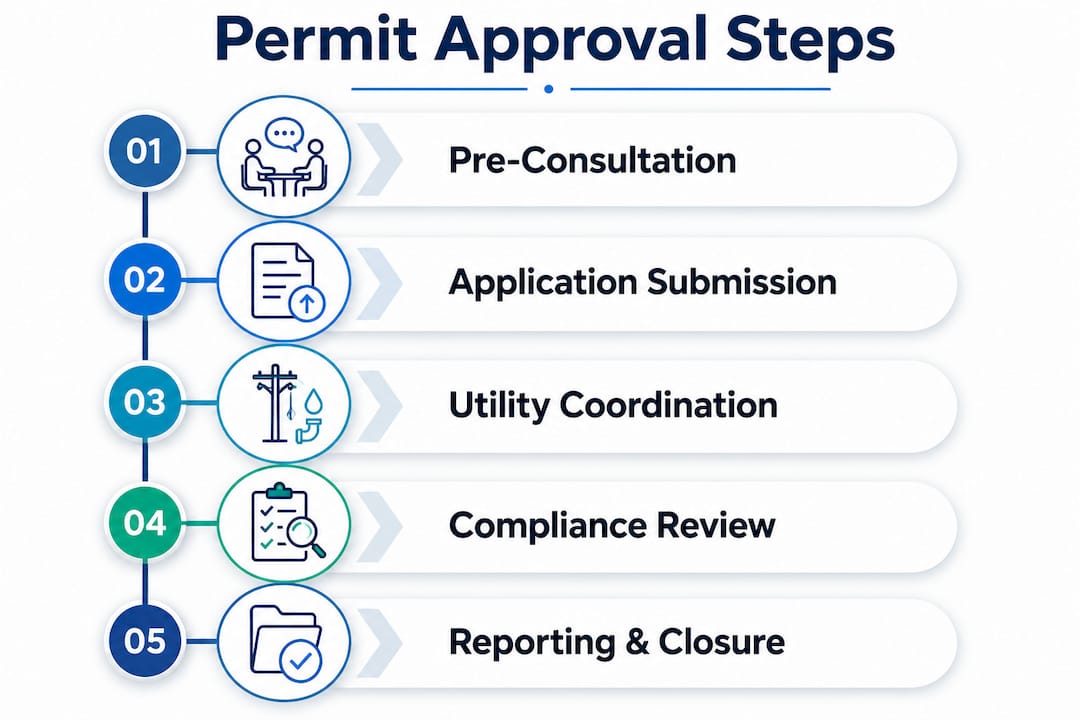
| Action | Timing | Key Requirement |
|---|---|---|
| Pre-consultation with LTA | At least 6 months before application | Mandatory for major utility or complex projects |
| Submit via LTA.PROMPT | At least 7 days before work | All road occupation, closures, and diversions |
| Secure public liability insurance | Before submission | $1M minimum, LTA named as principal |
| Obtain PE endorsement on TCP | Before submission | Must match April 2026 Code of Practice edition |
| Notify commencement and completion | At each project milestone | Legal obligation via LTA.PROMPT |
Early scheduling through LTA.PROMPT is the single most effective step a project manager can take. The portal’s automated conflict-detection system means that a later submission can be blocked by an earlier one from a different contractor on the same road segment. Submitting as early as possible secures the work window before conflicts arise.
Coordinating with utility agencies before submission prevents a separate category of delays. Overlapping permits from different agencies on the same corridor create enforcement complications that LTA.PROMPT cannot resolve automatically. Proactive coordination with SP Group, PUB, and Singtel before submitting avoids permit clashes that require manual resolution.
Filing commencement, completion, and incident reports through LTA.PROMPT is a legal obligation, not an administrative courtesy. Failure to notify triggers enforcement actions and can affect future permit applications. Project managers should assign a named person responsible for portal notifications at each project milestone. The construction compliance checklist published by Aectechnicalsg provides a structured reference for tracking these obligations across a project lifecycle.
Pro Tip: Book a pre-submission compliance review with a qualified engineering consultant before mobilization. A single review session typically catches the documentation gaps that cause resubmission, saving more time than the review costs.
Key Takeaways
LTA compliance for construction projects in Singapore requires early permit submission, PE-endorsed Traffic Control Plans, qualified personnel, and legally correct insurance documentation to avoid stop-work orders and permit revocations.
| Point | Details |
|---|---|
| Submit early via LTA.PROMPT | Submit at least 7 days before work; major projects need pre-consultation 6 months in advance. |
| Insurance must name LTA as principal | A $1M minimum policy without the LTA principal clause will delay approval regardless of coverage amount. |
| TCP endorsement alone is not enough | Field implementation must match the approved schematic exactly or permits risk immediate revocation. |
| Personnel qualifications are legally required | Workers, supervisors, and managers each need role-specific LTA-aligned certification before site deployment. |
| SHE compliance gates project approval | Project Safety Review certification must be completed before construction-phase works can begin. |
Why LTA compliance is harder than most project managers expect
From working across Singapore infrastructure projects, the pattern I see most often is this: teams treat LTA compliance as a documentation exercise rather than a technical and legal obligation. They gather the paperwork, submit through LTA.PROMPT, and assume approval follows automatically. It rarely does when the underlying technical work is incomplete.
The TCP is where I see the most costly mistakes. A PE endorsement on a plan that does not accurately reflect site geometry, or that was prepared for a different project phase, creates a gap between the approved document and the actual site condition. LTA inspectors are experienced enough to spot that gap immediately. The result is not a warning. It is a permit revocation and a stop-work order while the team scrambles to resubmit.
The second pattern is personnel certification treated as a one-time task. Certifications expire. Workers change roles. A supervisor who held a valid Traffic Control Supervisor certificate two years ago may be operating on an expired credential today. Maintaining a live qualification register is not bureaucratic overhead. It is the difference between a compliant site and an enforcement action.
My consistent advice to project managers: treat the LTA Code of Practice for Traffic Control, April 2026 edition, as a binding legal document, because it is one. Read it with the same attention you would give a contract clause. Pre-consult with LTA early on complex projects, not because the regulation requires it, but because the conversation surfaces issues that are far cheaper to resolve before submission than after. Compliance built into the project plan from day one costs a fraction of compliance retrofitted after an enforcement notice.
— Aman
How Aectechnicalsg supports LTA regulatory submissions
Construction professionals managing LTA-regulated projects need more than a checklist. They need engineering expertise that translates regulatory requirements into compliant, approvable documentation from the first submission.
Aectechnicalsg provides PE endorsement and authority submission services specifically for LTA-regulated construction works in Singapore. The team handles Traffic Control Plan preparation and endorsement, pre-submission compliance reviews, and full portal submission management through LTA.PROMPT. For project managers preparing 2026 submissions, the project submission requirements guide outlines the documentation sequence and approval pathway in detail. Contact Aectechnicalsg directly to discuss your project scope and identify the fastest path to permit approval.
FAQ
What is the LTA.PROMPT portal used for?
LTA.PROMPT is the official portal for submitting all road occupation, lane closure, excavation, and diversion permit applications in Singapore. The system also tracks commencement, completion, and incident notifications, which are legal obligations under the Street Works Act 1995.
How far in advance must LTA permit applications be submitted?
Standard applications must be submitted at least 7 days before work begins. Major utility or complex infrastructure projects require mandatory pre-consultation with LTA at least 6 months before the formal permit application.
What qualifications do traffic controllers need on LTA-regulated sites?
Workers must hold the Basic Traffic Control for Workers certification, supervisors require the Traffic Control Supervisor course, and managers need the Traffic Control Manager qualification. Security officers performing traffic regulation duties require separate LTA authorization.
Does a PE-endorsed Traffic Control Plan guarantee compliance?
PE endorsement certifies that the plan meets the Code of Practice for Traffic Control, but onsite implementation must match the approved schematic exactly. Deviations discovered during LTA inspections can result in immediate permit revocation regardless of the endorsement.
What insurance is required for LTA road occupation permits?
A public liability insurance policy with a minimum sum assured of $1 million is required. The policy must explicitly name LTA as a principal. Generic policies that meet the dollar threshold but omit the LTA principal clause will delay permit approval.