
Mechanical and electrical (M&E) approval is a mandatory regulatory requirement for all new and modified building projects in Singapore. This guide covers the core compliance standards, accreditation requirements, and submission procedures that construction professionals and project managers must follow. The process involves multiple regulatory bodies, including the Building and Construction Authority (BCA), the Energy Market Authority (EMA), and the Singapore Civil Defence Force (SCDF). Getting every step right protects project timelines, satisfies legal obligations, and ensures the safety of completed buildings.
What is the mechanical and electrical approval guide for Singapore projects?
The M&E approval process in Singapore is governed by a layered set of standards and regulations. Understanding which rules apply, and in what order of priority, is the first task for any project team.
Compliance with SS 638 is legally mandatory under the Electricity (Electrical Installations) Regulations, enforced by EMA for all new and modified electrical installations. SS 638 sets requirements for the design, erection, inspection, and testing of every electrical system in a building. No electrical installation can be certified without meeting this standard in full.
Beyond SS 638, the following regulatory bodies each impose specific requirements:
- BCA (Building and Construction Authority): Governs structural safety, energy efficiency, and building system submissions, including the Electronic Productivity Submission System (EPSS) for building automation and controls data.
- EMA (Energy Market Authority): Enforces electrical installation regulations and licenses electrical workers.
- SCDF (Singapore Civil Defence Force): Regulates fire protection systems, emergency lighting, and related M&E installations.
- JTC Corporation: Applies additional requirements for industrial and specialized facilities.
When requirements from different authorities overlap, the project team must apply the most onerous rule. Multi-agency submissions require compliance with the strictest applicable standard across BCA, SCDF, and JTC. Failing to identify the most stringent requirement early leads to costly redesigns and inspection failures.
“When BCA, SCDF, and JTC requirements overlap on a single project, the design must satisfy the strictest condition from each agency. Applying the most onerous rule is not optional. It is the baseline for regulatory acceptance.”
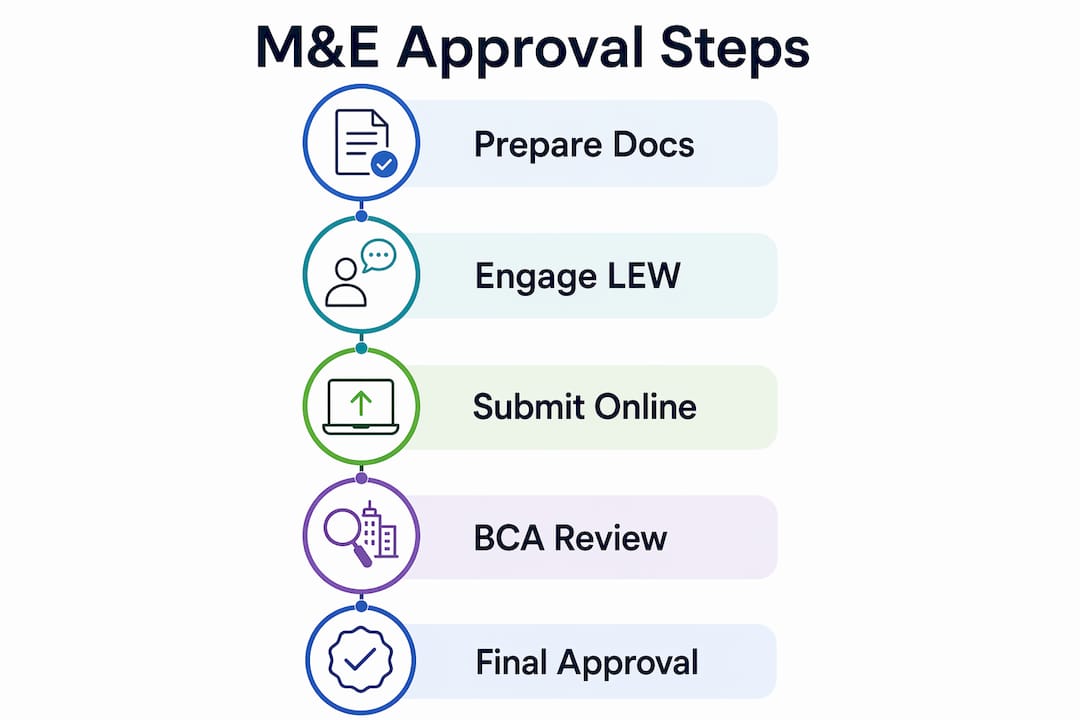
Engaging Licensed Electrical Workers (LEWs) is legally required for the design, installation, testing, and certification of all electrical installations. LEWs must be involved at every project stage to produce compliant deliverables. Their sign-off is a prerequisite for EMA certification and final approval.
For a broader view of how M&E approvals fit within the full construction workflow, the construction approval workflow guide from Aectechnicalsg provides useful context on sequencing across disciplines.

Who are the accredited professionals required for M&E approval submissions?
M&E approval submissions for major projects require accredited Resident Engineers (REs) and Resident Technical Officers (RTOs). These roles are not interchangeable with general site supervisors. They carry specific legal and professional responsibilities tied to the quality and safety of M&E works.
M&E RE and RTO accreditation is mandatory for major projects, and their supervision ensures buildings meet safety and quality standards. Accreditation is administered through the Institution of Engineers Singapore (IES) and the Association of Consulting Engineers Singapore (ACES). Without accredited personnel on record, submissions for qualifying projects will not be accepted.
The experience and qualification thresholds are as follows:
- Academic qualifications: Candidates must hold a recognized engineering degree, diploma, or Chartered Engineer status from a professional body.
- Project experience: RE and RTO candidates typically require 2–3 years of experience in M&E building services on projects valued at a minimum of S$20M to S$50M, depending on their academic level.
- Application documents: Required submissions include certified copies of academic certificates, a detailed project experience record, and referee endorsements from registered professional engineers.
- Registry listing: Once approved, the RE or RTO must be listed on the IES/ACES M&E RE/RTO Registry before commencing supervisory duties on a project.
The presence of accredited personnel directly affects submission credibility. Reviewers at BCA and EMA treat accredited sign-offs as a quality assurance signal. Projects with properly credentialed REs and RTOs move through technical review faster than those relying on unaccredited supervisors.
Pro Tip: Confirm RE and RTO accreditation status before project mobilization, not during the submission phase. Late accreditation checks are a common cause of preventable delays on projects above the S$20M threshold.
How to prepare and submit M&E technical documentation for regulatory approval
Documentation quality is the single largest variable in approval speed. Incomplete or incorrectly formatted submissions trigger manual reviews, which add weeks to the approval timeline.
The required documentation set for a standard M&E submission includes:
- Single-line diagrams (SLDs): These must accurately reflect the installed electrical system, including switchboard configurations, cable ratings, and protection devices.
- Test reports: Insulation resistance tests, earth fault loop impedance tests, and residual current device (RCD) tests must be completed and signed by the LEW.
- Compliance certificates: The LEW issues a Certificate of Completion and Inspection (CCI) confirming the installation meets SS 638 requirements.
- Control point lists: For building automation systems, ACMV controls, and energy management systems, structured point lists must be submitted through EPSS.
- Coordination drawings: Mechanical, electrical, and plumbing (MEP) layouts must be coordinated to avoid clashes and reflect the as-built condition.
The table below summarizes the key submission documents, the responsible party, and the target authority:
| Document | Responsible Party | Target Authority |
|---|---|---|
| Single-line diagram | Licensed Electrical Worker | EMA / BCA |
| Certificate of Completion and Inspection | Licensed Electrical Worker | EMA |
| EPSS control point list | M&E contractor / BAS specialist | BCA |
| Test reports (insulation, RCD, earth loop) | Licensed Electrical Worker | EMA |
| Coordinated MEP drawings | M&E RE / design consultant | BCA |
The BCA EPSS standardizes building system data submission and requires structured datasets with logical control point mapping. Point list mismatches between the physical installation and the submitted data are the most common trigger for EPSS rejection. Every control point name in the submitted dataset must match the installed system exactly.
Pro Tip: Prepare the EPSS control point list in parallel with the design phase, not after installation. Retroactively mapping installed points to submission requirements is time-consuming and error-prone.
Early coordination between architectural, structural, and M&E design teams prevents clashes that require documentation revisions later. The M&E engineering submission steps resource from Aectechnicalsg details the sequencing of submissions across disciplines for Singapore projects.
What are common challenges in the M&E approval process and how can they be mitigated?
Most approval delays trace back to a small set of recurring problems. Identifying these early gives project teams a clear path to faster regulatory acceptance.
The most frequent challenges include:
- EPSS data inconsistencies: Missing or incorrectly formatted control point lists for Building Automation Systems is a primary reason for EPSS submission rejection. Manual review triggered by data errors can add two to four weeks to the approval cycle.
- Incomplete LEW documentation: LEW certification and test reports submitted after installation, rather than during commissioning, create gaps in the compliance record that reviewers flag immediately.
- Multi-agency conflicts: Projects subject to both SCDF and BCA requirements for fire-rated electrical penetrations, for example, must satisfy the stricter of the two standards. Teams that apply only one agency’s standard routinely face resubmission.
- Underestimating LEW lead times: LEW scheduling for testing and certification is a critical path item. Treating it as a post-construction task delays the entire approval sequence.
- Naming convention inconsistencies: Control point names that differ between the design drawings, the BAS programming, and the EPSS submission dataset cause systematic rejection across all affected points.
“Standardizing control point naming conventions at the design stage, before any programming or installation begins, eliminates the most common cause of EPSS rejection. This single discipline saves more approval time than any other preparation step.”
The solution to most of these challenges is front-loading compliance work. Handling the most onerous requirement across overlapping regulatory agencies avoids costly redesigns and inspection failures. Project managers who map all applicable agency requirements at the design stage, rather than during construction, resolve conflicts before they become submission problems.
For guidance on mechanical compliance requirements specific to Singapore projects, Aectechnicalsg provides a focused reference covering the mechanical side of the approval process.
What role do prefabricated mechanical and electrical systems play in the approval process?
Prefabricated MEP systems are changing how M&E approvals are managed in Singapore. The shift toward off-site assembly reduces onsite errors, which directly reduces the documentation corrections that slow approvals.
The Prefabricated MEP Systems Guidebook by BCA and the Specialists Trade Alliance of Singapore (STAS) outlines how prefab MEP modules improve design, fabrication, and installation for increased productivity and safety. The DfMA (Design for Manufacturing and Assembly) approach requires service components to be fully designed and coordinated before fabrication begins. That upfront discipline produces cleaner as-built documentation and fewer field deviations.
The compliance benefits of prefab MEP systems include:
- Reduced onsite errors: Factory-assembled modules arrive pre-tested, which shortens the commissioning and certification phase.
- Cleaner documentation: Off-site fabrication produces accurate shop drawings that align with submission requirements from the start.
- Faster regulatory acceptance: Modules that arrive with factory test certificates reduce the volume of onsite testing required by the LEW.
- Improved safety records: Controlled factory environments reduce installation defects that would otherwise appear in inspection reports.
The DfMA approach in prefab MEP improves compliance outcomes through upfront planning and off-site assembly. This means the approval documentation is largely complete before the modules arrive on site. For commercial office projects, building services specialists who apply prefab MEP principles report fewer coordination clashes and faster sign-off cycles.
Pro Tip: Specify prefab MEP modules in the tender documents, not as a value-engineering option during construction. Late adoption of prefab approaches after design is fixed loses most of the compliance and documentation benefits.
For context on how prefab MEP fits within broader building services for commercial offices, the principles of coordinated service design apply equally to Singapore projects following BCA-STAS guidance.
My view on getting Singapore M&E approvals right in 2026
The projects I have seen fail at the approval stage almost always share one characteristic: the compliance work was treated as a downstream task. Teams finalize the design, complete the installation, and then attempt to build the submission package from whatever documentation exists. That sequence is the root cause of most rejections.
The EPSS submission system has made data quality a hard gate. BCA’s automated checks catch point list mismatches that previously slipped through manual review. Project managers who do not understand this are still operating on assumptions that no longer hold. The system does not forgive inconsistencies, and it does not accept partial submissions as a placeholder.
Accredited M&E REs and RTOs are equally non-negotiable. I have seen projects stall for weeks because the RE’s accreditation lapsed or was never confirmed before mobilization. That is a process failure, not a technical one. It is entirely preventable with a simple pre-mobilization checklist.
The growing adoption of prefab MEP is the most positive development in Singapore M&E compliance in recent years. When teams commit to DfMA at the design stage, the documentation practically writes itself. The factory test records, the coordinated shop drawings, and the as-built alignment are all products of the prefab process. That is a structural advantage over conventional onsite installation.
My advice for 2026: treat SS 638 compliance, EPSS data preparation, and RE accreditation confirmation as project initiation tasks, not pre-handover tasks. The teams that do this consistently are the ones that achieve first-pass approval.
— Aman
Aectechnicalsg’s M&E approval consultancy services for Singapore projects
Construction professionals managing M&E approval submissions in Singapore need more than general guidance. They need precise document preparation, accreditation support, and authority submission management across BCA, EMA, SCDF, and JTC.

Aectechnicalsg provides end-to-end engineering consultancy covering the full M&E approval process. Services include PE endorsement and authority submissions for electrical and mechanical systems, EPSS data preparation, and coordination across all relevant Singapore regulatory bodies. The team also supports project managers with engineering consultancy services tailored to developers and construction firms navigating complex multi-agency approval requirements. Contact Aectechnicalsg to confirm your project’s compliance pathway before the submission phase begins.
FAQ
What is SS 638 and why does it apply to my project?
SS 638 is Singapore’s Code of Practice for Electrical Installations, and compliance is legally mandatory under the Electricity (Electrical Installations) Regulations enforced by EMA. Every new or modified electrical installation in Singapore must meet its design, erection, inspection, and testing requirements.
When is an accredited M&E Resident Engineer required?
An accredited M&E Resident Engineer is mandatory for major building projects in Singapore, typically those valued above S$20M. The RE must be listed on the IES/ACES M&E RE/RTO Registry before supervisory duties begin.
What causes EPSS submission rejections?
Missing or incorrectly formatted control point lists for Building Automation Systems is the primary cause of EPSS rejection. Data inconsistencies between the installed system and the submitted dataset trigger manual review and approval delays.
How does the “most onerous rule” affect M&E design?
When BCA, SCDF, and JTC requirements overlap on a single project, the design must satisfy the strictest condition from each agency. Applying only one agency’s standard when multiple apply is a common cause of resubmission.
Do prefabricated MEP systems simplify the approval process?
Prefabricated MEP modules produced under the BCA-STAS DfMA framework arrive with factory test certificates and coordinated shop drawings, which reduce onsite testing requirements and produce cleaner documentation for regulatory submission.
Key takeaways
Successful M&E approval in Singapore requires early compliance planning, accredited personnel, and accurate digital submissions across BCA, EMA, SCDF, and JTC.
| Point | Details |
|---|---|
| SS 638 is the legal baseline | Every electrical installation must comply with SS 638 under EMA enforcement before certification is possible. |
| Accredited RE and RTO are mandatory | Projects above S$20M require IES/ACES-registered M&E Resident Engineers and Technical Officers before submission. |
| EPSS data accuracy prevents rejection | Control point lists must match the installed system exactly; mismatches trigger manual review and weeks of delay. |
| Apply the most onerous rule early | Multi-agency projects must satisfy the strictest requirement across BCA, SCDF, and JTC from the design stage. |
| Prefab MEP improves documentation quality | DfMA-based prefab modules produce factory test records and coordinated drawings that accelerate regulatory acceptance. |