
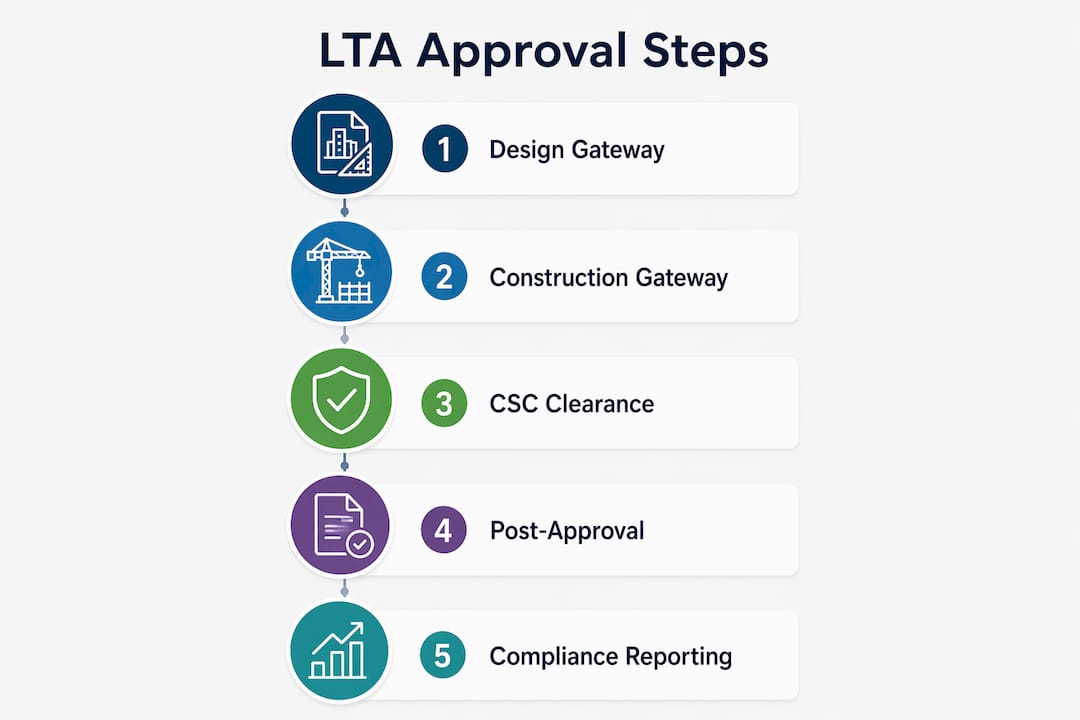
Securing LTA approval for any infrastructure or development project in Singapore follows a structured, multi-stage process governed by the Street Works Act and LTA’s prevailing codes of practice. The three major approval stages are the Layout Plan (Development Control/Design Gateway), the Street Plan (Building Plan/Construction Gateway), and the Certificate of Statutory Completion (CSC). A Qualified Person (QP) must obtain LTA clearance at each stage and bears full accountability for submission accuracy and regulatory compliance throughout.
The key steps for LTA approval, in sequence, are:
- Stage 1 (Design Gateway): QP prepares and submits the Layout Plan via CORENET, with self-declaration of compliance under the DC lodgement scheme where eligible.
- Stage 2 (Construction Gateway): QP submits the Street Plan based on the approved Layout Plan, including all required technical documentation and M&E coordination.
- Stage 3 (Completion Gateway/CSC): QP requests a CSC inspection upon completion of street works; LTA inspects and issues clearance when all conditions are met.
- Permits for public works: Contractors apply separately through LTA.PROMPT for any works on or near public streets, which is a distinct process from development submissions.
- Documentation accuracy: Incomplete or mismatched plans are the leading cause of rejection; internal review against LTA’s submission requirements checklist is mandatory before filing.
## 1. Key steps for LTA approval at each submission stage
LTA’s multi-stage submission framework covers Street Works Proposals at the Design Gateway (DG), Construction Gateway (CG), and Completion Gateway (CSC). Each stage carries distinct documentation requirements and procedural obligations.
| Stage | Key Documents | Responsible Party | Submission Channel |
|---|---|---|---|
| Design Gateway (DG) | Site plan, floor/section/elevation plans, topographical plan | QP (Architect/Civil) | CORENET |
| Construction Gateway (CG) | Detailed plans, traffic plan, utility services plan, design calculations, M&E submissions | QP (Civil), LEW | CORENET |
| CSC Clearance | Completed works inspection, as-built drawings, defect liability documentation | QP (Civil) | LTA direct request |
| Public Works Permit | Traffic control plan, work method statement, liability insurance, site photos | Registered contractor | LTA.PROMPT |
At the DG stage, the QP lodges the Layout Plan via CORENET and self-declares compliance with LTA’s codes of practice. Upon successful submission, CORENET issues an auto-acknowledgement letter confirming whether BP and CSC clearance will be required. At the CG stage, the Street Plan submission must include a site plan, longitudinal and cross-section plans, a coordinated utility plan per COP 5.6, a traffic plan with road markings and signage details, and design calculations for major road structures, tall slopes, or retaining walls. M&E works such as public street lighting or escalators to pedestrian overhead bridges require separate clearance before installation commences.
Key documentation requirements at each stage:
- DG stage: Site plan, floor plans, section plans including road features, elevation plans, topographical plan showing any encroachment on road reserve or state land, and latest site photos with date stamp (taken no more than one month before lodgement).
- CG stage: All DG documents updated to construction detail, plus traffic plan, utility services plan, coordinated utility plan, detailed structural and interfacing plans, and M&E specifications with product catalogues and test certificates.
- CSC stage: Completed application form, URA Written Permission copy, set of as-built street plans, and LTA’s Layout Plan clearance or lodgement acknowledgement letter.
## 2. How to apply for permits for works affecting public streets
Development submissions via CORENET and operational permits via LTA.PROMPT serve entirely different purposes. Misapplying LTA.PROMPT for development submissions, or attempting to use CORENET for road occupation permits, causes direct delays to the start of works.

LTA.PROMPT is the portal for permission to carry out works in or near public areas, including road closures, lane occupations, and utility excavations. Contractors must register as competent contractors on LTA.PROMPT before any application can be submitted, subject to LTA’s approval. Registration categories include Contractor, Applicant (Professional Engineer), Site Supervisor, and Applicant (Agency/Department), each with specific eligibility criteria.
Permit application checklist for public works:
- Register as a competent contractor on LTA.PROMPT under the appropriate category.
- For major utility proposals (tunneling, excavation at 4m depth or deeper, upgrading schemes), seek in-principle pre-consultation approval from LTA at least six months before applying for a permit.
- Prepare a Traffic Control Plan for any works involving road lane occupation.
- Provide photographs and schematic diagrams of existing road markings where carriageway is affected.
- Submit a work method statement, location and site plan, and photographs of existing ground conditions.
- Attach Workmen’s Compensation Policy and Public Liability Policy (minimum S$1 million, with LTA as a principal) where applicable.
- Submit the notification through LTA.PROMPT not less than seven working days before commencement of road or lane closure works.
Pro Tip: Engage LTA officers through the AskDBC portal (askdbc.lta.gov.sg) for pre-submission consultations before lodging any development proposal. Early clarification of site-specific requirements prevents costly resubmissions at the DG stage.
## 3. Common pitfalls in the LTA approval process and how to avoid them
Incomplete documentation is the most frequent cause of rejection. LTA reserves the right to reject incomplete submissions at any stage, and resubmissions caused by missing or insufficient technical details have historically caused significant project delays. The submission requirements checklist for DG and CG stages, published by LTA, exists precisely to address this pattern.
The most common causes of rejection and delay include:
- Missing QP endorsement on drawings, or failure to include the full names of the design firm, contractor, client, and personnel who developed, checked, and approved each drawing.
- Mismatch between the approved Layout Plan and the Street Plan lodged by the PE, which triggers mandatory rectification before CSC can proceed.
- Omitting the road reserve line (RRL), plot boundary, or land area details from site plans.
- Submitting M&E products not on LTA’s approved products list without providing the required specifications, test certificates, and catalogue annotations.
- Confusing the CORENET development submission pathway with the LTA.PROMPT permit pathway, which blocks commencement of works.
Practical steps to reduce rejection risk:
- Conduct a rigorous internal review against LTA’s published Submission Requirements checklist for DG and CG stages before filing.
- Verify that the DC Layout Plan and the Street Plan tally precisely, as discrepancies discovered during CSC inspection may require demolition and reconstruction of completed works.
- Annotate specific product selections from LTA’s approved M&E catalogue directly in the submission drawings.
- Maintain version control on all plan sets and document all amendments in the changelog annex (Item A13 of the submission requirements).
## 4. What are the QP’s core responsibilities in the LTA approval framework?
The QP carries statutory accountability at every stage of the LTA approval process under the Street Works Act. At the DG stage, the QP (Architect) self-declares that the Layout Plan complies with LTA’s prevailing codes of practice and lodges the plans via CORENET. At the CG stage, the QP (Civil) or Professional Engineer (PE) self-declares compliance with the Street Works Act and its Regulations when lodging the Street Plan, which must be based precisely on the approved Layout Plan.
The QP’s responsibilities extend well beyond plan preparation. Coordination with other professionals, including Licensed Electrical Workers for M&E submissions and utility service providers for coordinated utility plans, falls within the QP’s scope. After LTA issues feedback or a written direction, the QP must manage amendments and resubmit within the required timeframe.
Key QP deliverables across all stages:
- Prepare and endorse all plans at DG, CG, and CSC stages with full name, firm, and role details.
- Self-declare compliance under the DC and Street Plan lodgement schemes where applicable.
- Coordinate M&E design submissions and obtain clearance before installation of public street lights, escalators, or lifts to pedestrian overhead bridges.
- Request the CSC inspection upon completion of street works and attend joint site inspections for new streets, underpasses, or pedestrian overhead bridges.
- Rectify any non-compliance identified during CSC inspection, including potential reconstruction if completed works deviate from approved plans.
## 5. What is the typical timeline for the LTA approval process?
The LTA approval timeline varies by project complexity and submission pathway. Under the DC lodgement scheme, eligible developments (primarily landed house developments without new traffic schemes or commercial components) receive an auto-acknowledgement through CORENET immediately upon successful submission, allowing works to commence promptly without waiting for a formal approval letter. Developments that do not qualify for lodgement, such as commercial developments or those involving new traffic schemes, proceed through the standard approval route, which involves LTA review and may take longer depending on submission completeness.
At the CG stage, M&E product approvals are expedited when products are selected from LTA’s published approved products list, as these are accepted by default. For products outside the approved list, LTA reviews specifications and test results, which adds time to the clearance process. CSC clearance is issued after a satisfactory site inspection confirming that works comply with approved plans and LTA’s material and workmanship specifications. A defect liability period applies after handover to address latent defects that may not surface immediately upon completion.
## 6. Post-approval compliance and reporting requirements
Post-approval obligations begin the moment LTA issues clearance at any stage. After DC lodgement acknowledgement, LTA conducts audit checks on lodged Layout Plans. If street works details do not comply with LTA’s requirements, LTA issues a written direction to the QP to amend the proposal. Deviations discovered only at CSC inspection carry a more severe consequence: the QP may be required to demolish and reconstruct the non-compliant works at the developer’s cost.
For specialized approvals such as EV charger installations within street works, post-approval labeling obligations apply. All type-approved EV chargers must be affixed with LTA approval labels before supply or installation, and any alterations to approved chargers require a separate alteration approval application. Ongoing compliance with LTA’s codes of practice, the Street Works Act, and any conditions attached to the clearance letter remains the QP’s responsibility throughout the defect liability period.
## 7. Fee structure and associated costs for LTA approval
LTA publishes its service standards and fees in the Service Standard and Fees Schedule, available on the LTA Development and Construction Resources page. The specific fee applicable to each submission depends on the type of works, the submission stage, and the scale of the development. Fees are not publicly listed as a flat schedule in this guide; developers and QPs should refer directly to LTA’s published Payment Guide and FAQs for current fee schedules and payment methods.
For specialized approvals, LTA publishes specific fees. EV charger type approval applications carry an application fee of S$1,700, payable through the OneMotoring website at submission. Approval label applications are subject to a fee of S$2 per label (inclusive of GST), and alteration approval applications carry a fee of S$800. These figures apply to EV charger submissions specifically and are not representative of development submission fees, which are governed by a separate schedule.
Key Takeaways
The LTA approval process requires QP-led compliance across three mandatory stages, from Design Gateway to CSC clearance, with permits for public works handled separately through LTA.PROMPT.
| Point | Details |
|---|---|
| Three mandatory stages | Layout Plan (DG), Street Plan (CG), and CSC clearance are required for all development projects involving street works. |
| QP statutory accountability | The QP self-declares compliance at each stage and bears responsibility for rectification, including potential reconstruction, if deviations are found at CSC. |
| CORENET vs. LTA.PROMPT | Development submissions go through CORENET; permits for works on public streets require a separate application through LTA.PROMPT. |
| Six-month pre-consultation | Major utility works such as tunneling or deep excavation require LTA pre-consultation approval at least six months before permit application. |
| Checklist-driven submissions | Internal review against LTA’s published Submission Requirements checklist for DG and CG stages is the most effective way to prevent rejection. |
How Aectechnicalsg supports your LTA submission
Navigating the LTA approval process demands precise documentation, coordinated submissions, and a QP who understands both the regulatory framework and the practical realities of site-specific compliance. Aectechnicalsg provides engineering consultancy services for developers and construction firms managing LTA submissions across all three approval stages, from Design Gateway lodgement through CSC clearance. The team also handles PE endorsement and authority submissions for LTA, BCA, URA, PUB, and other Singapore regulatory bodies, reducing the risk of resubmissions and keeping project timelines on track.