
JTC development control is the prior written consent requirement mandated by JTC Corporation for any new development, redevelopment, or alteration works on JTC-managed industrial land or buildings. JTC Corporation, Singapore’s lead industrial infrastructure developer, functions as the landowner of a substantial portfolio of industrial estates, flatted factories, and business parks. Any tenant or lessee occupying JTC-managed property must secure JTC’s written consent before commencing construction, structural alterations, or significant fitting-out works. This consent is a contractual landowner’s approval, not a government planning permit, and it operates entirely separately from statutory approvals issued by the Urban Redevelopment Authority (URA), the Building and Construction Authority (BCA), or other regulatory bodies. For U.S.-based project developers and construction firms engaging with Singapore industrial projects, this distinction carries significant legal and operational weight.
Key characteristics of JTC development control:
- Applies to all tenants and lessees of JTC-managed properties, including standard factories, workshops, and business park units
- Covers new erections, redevelopments, additions and alterations (A&A), and changes in use
- Must be obtained before statutory approvals are sought from URA, BCA, SCDF, or NEA
- Governed by lease conditions and JTC’s internal land planning guidelines, not the Planning Act alone
- Non-compliance with JTC consent requirements can halt a project even when all statutory permits are in place
Table of Contents
- What works require JTC consent?
- How does a Qualified Person fit into JTC compliance?
- Why pre-submission coordination with JTC matters
- JTC consent versus statutory planning approvals
- What does the JTC consent documentation process require?
- How JTC development control affects project timelines and costs
- How JTC development control applies in practice for international project teams
- Key Takeaways
What works require JTC consent?
The JTC 2026 Space Submission Handbook defines the scope of works requiring JTC’s landowner consent and identifies a specific exemption list, known as List A, for minor works where JTC consent is not required. However, even List A exemptions do not remove the obligation to obtain statutory approvals from URA, BCA, or SCDF where those authorities’ requirements apply.
Works that typically require JTC consent include:
- Installation of heavy machinery or equipment within the tenanted area
- All rooftop equipment installations
- Demolition, hacking, drilling, or anchoring into walls, floors, ceilings, or structural elements
- Erection of internal partitions and drywalls
- Any works affecting the external aesthetics of the building
- Changes in use of the leased premises
- Major redevelopment or new erection on JTC land
Compliance requirements extend beyond plan approval. JTC mandates specific sustainability conditions, including mandatory solar panel deployment on roofs exceeding 800 square meters where a minimum 15-year lease remains. Green Mark sustainability ratings and urban design guidelines also form part of the consent conditions for larger redevelopment projects.
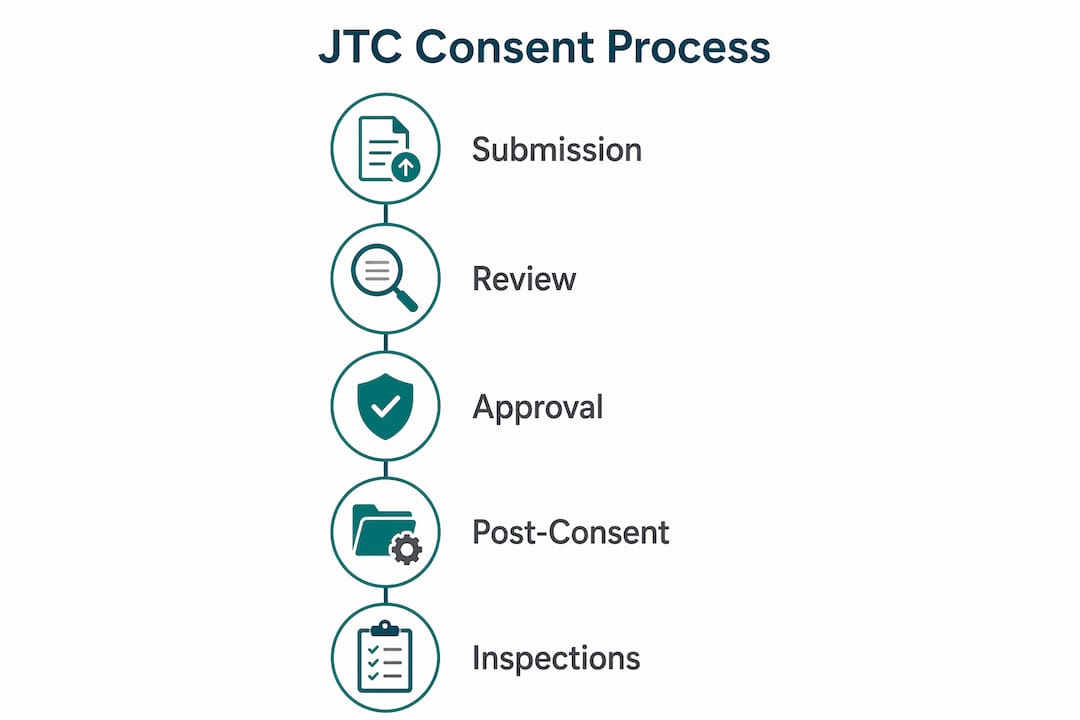
Submissions are made through two platforms: CORENET 2.0 for non-Qualified Person (non-QP) submissions, and ESPro for QP submissions. Selecting the wrong platform or using an incorrect form results in prompt rejection. The project submission requirements guide from Aectechnicalsg provides detailed procedural guidance on navigating these channels correctly.
How does a Qualified Person fit into JTC compliance?
A Qualified Person (QP) is a registered architect or professional engineer appointed to oversee and certify development works. For major redevelopment and complex A&A projects on JTC land, QP engagement is not optional. The JTC QP submission framework requires the QP to prepare and certify plans, submit declarations to the competent authority, and confirm that all planning and urban design guidelines have been met before works commence.
The QP’s responsibilities under JTC development control include:
- Incorporating JTC’s land planning requirements, urban design guidelines, and sustainability criteria into project plans
- Submitting plans to JTC and relevant statutory authorities concurrently
- Declaring compliance with all planning guidelines before lodging plans with the Commissioner of Building Control
- Managing mandatory solar deployment requirements and Green Mark criteria for qualifying projects
- Submitting a completion declaration before applying for a Temporary Occupation Permit (TOP) or Certificate of Statutory Completion (CSC)
The QP also carries responsibility for the Land Betterment Charge (LBC) process. Where a proposed development increases land value, the Singapore Land Authority (SLA) issues a Liability Order to the relevant party. The QP and applicant must coordinate the Notice of Assumption of Liability Form submission through JTC to SLA to ensure URA’s Written Permission is not delayed. For U.S. firms unfamiliar with Singapore’s multi-agency approval structure, engaging a locally registered QP with JTC submission experience is the most direct way to manage this complexity.
Why pre-submission coordination with JTC matters
Early engagement with JTC’s assigned Customer Engagement Officers is among the most consequential steps a developer can take. Pre-consultation meetings allow developers to clarify plot ratio constraints, design expectations, lease obligations, and any site-specific conditions before formal plan preparation begins. Projects that skip this step frequently encounter plan revision cycles that add weeks to approval timelines.
The pre-submission process involves several structured steps:
- Request a pre-consultation meeting with the assigned JTC Customer Engagement Officer
- Clarify plot ratio, gross floor area limits, and any site-specific design constraints
- Confirm lease conditions affecting the proposed use or structural works
- Engage a QP to prepare compliant plans incorporating JTC’s feedback
- Submit plans through the correct platform (ESPro for QP, CORENET 2.0 for non-QP) with all required forms and declarations
Facility management coordination runs in parallel. Before any site works begin, the tenant’s contractor must submit renovation guide forms (R1 to R4), a risk assessment form, and a permit to work form to JTC’s Facility Management Company (FMC). These are operational controls that govern safe site access, common area protection, and liability for any damage caused during works.
Pro Tip: Engage the JTC Customer Engagement Officer and the facility management team simultaneously, not sequentially. Waiting for JTC plan consent before initiating FMC coordination adds avoidable lead time to the commencement of physical works.
JTC consent versus statutory planning approvals
JTC consent and statutory approvals address fundamentally different obligations. JTC’s consent is a contractual landowner’s approval rooted in the lease agreement between JTC and the tenant. It governs whether the proposed works align with JTC’s land use policies, lease conditions, and estate management requirements.
Statutory approvals from URA, BCA, SCDF, and NEA are government regulatory permissions. URA’s planning permission addresses land use zoning and development intensity. BCA’s building plan approval governs structural safety and building code compliance. SCDF covers fire safety, and NEA addresses environmental controls. Both layers must be satisfied before works commence, and neither substitutes for the other.
The practical consequence: a project with full URA planning permission and BCA building plan approval can still be legally blocked from proceeding if JTC’s written consent has not been obtained. Failure to secure JTC consent constitutes a lease breach, exposing the tenant to contractual liability and potential project suspension.
Post-consent, facility management controls add another operational layer. JTC and the FMC conduct joint inspections before and after renovation works to document common area conditions. All reinstatement costs arising from damage during works are borne by the tenant or the tenant’s contractor.
What does the JTC consent documentation process require?
The documentation requirements for JTC plan consent are specific and sequenced. Submitting incomplete or incorrectly formatted packages leads to rejection without substantive review.
For QP submissions via ESPro, the required documents include:
- Completed plan consent application form (JTC_LPD_SD.XFDX)
- Letter of Declaration (SD-LD form), stamped and signed by the lessee or tenant, authorizing the QP to submit on their behalf
- Full set of architectural and engineering drawings prepared in compliance with JTC and URA guidelines
- URA Electronic Development Application (EDA) form, where URA planning permission is required
- Notice of Assumption of Liability Form (for proposals triggering Land Betterment Charge)
- Written Direction confirming CORENET approval, where applicable
For non-QP submissions via CORENET 2.0, the form used is JTC_LPD_SD_NonQP.XFDX. Non-QP submissions are limited to works that do not require a QP’s endorsement under the relevant statutory authorities’ requirements. The construction compliance checklist from Aectechnicalsg provides a structured reference for verifying document completeness before submission.
How JTC development control affects project timelines and costs
JTC development control introduces a consent layer that precedes statutory approvals, and that sequencing has direct timeline implications. Projects that treat JTC consent as a parallel track to statutory submissions, rather than a prerequisite, frequently encounter approval conflicts that require plan revisions across multiple authority submissions simultaneously.
The LBC process adds further timeline sensitivity. Where a proposed development triggers a Land Betterment Charge, SLA’s Liability Order must be paid within one month of issuance before URA releases its Written Permission. Delays in completing the Notice of Assumption of Liability Form, or in coordinating its submission through JTC to SLA, can hold up the entire approval chain. Submitting this form as part of the initial plan consent package, rather than waiting for SLA to prompt action, is the most effective way to compress this timeline.

Cost implications are equally concrete. Plan revision cycles driven by non-compliance with JTC’s urban design guidelines or sustainability requirements add consultant fees and delay contractor mobilization. Mandatory solar deployment on qualifying roofs represents a capital expenditure that must be budgeted at the project planning stage, not treated as a post-approval consideration. For U.S. developers unfamiliar with Singapore’s industrial estate requirements, engaging an experienced regulatory compliance consultancy at the pre-design stage is the most reliable way to contain both timeline and cost risk.
How JTC development control applies in practice for international project teams
U.S.-based developers and construction firms working on Singapore industrial projects most commonly encounter JTC development control in three scenarios: acquiring a JTC lease for a new facility, undertaking significant A&A works on an existing tenancy, or redeveloping a site for a change in industrial use.
In each case, the compliance sequence follows the same structure. The developer engages a locally registered QP, conducts pre-consultation with JTC’s Customer Engagement Officer, prepares compliant plans, and submits through the correct platform before any statutory authority applications are lodged. The JTC site plan submission guide from Aectechnicalsg outlines the site planning framework in detail, which is particularly useful for project teams preparing their first JTC submission.
For redevelopment projects, the additional requirements around solar deployment, Green Mark ratings, and urban design compliance mean that the QP must be engaged early enough to incorporate these criteria into the schematic design, not retrofitted after the statutory submission package is already prepared. International project teams that treat JTC development control as a procedural formality, rather than a substantive design and compliance constraint, consistently underestimate the approval timeline and the cost of late-stage plan revisions.
Key Takeaways
JTC development control is a contractual landowner’s consent requirement that must be secured before statutory approvals from URA, BCA, or SCDF, and non-compliance constitutes a lease breach that can halt a project regardless of other permits held.
| Point | Details |
|---|---|
| JTC consent is a lease obligation | It is a contractual landowner’s approval, distinct from statutory planning or building permits issued by URA or BCA. |
| QP engagement is mandatory for major works | A registered architect or professional engineer must prepare, certify, and submit plans for redevelopment and complex A&A projects. |
| Solar deployment applies to qualifying roofs | Roofs exceeding 800 square meters with a minimum 15-year lease remaining require mandatory solar panel installation. |
| Pre-consultation reduces revision cycles | Early engagement with JTC Customer Engagement Officers and the facility management team prevents costly plan revisions and delays. |
| Incorrect form selection causes rejection | QP submissions use ESPro with JTC_LPD_SD.XFDX; non-QP submissions use CORENET 2.0 with JTC_LPD_SD_NonQP.XFDX. |