
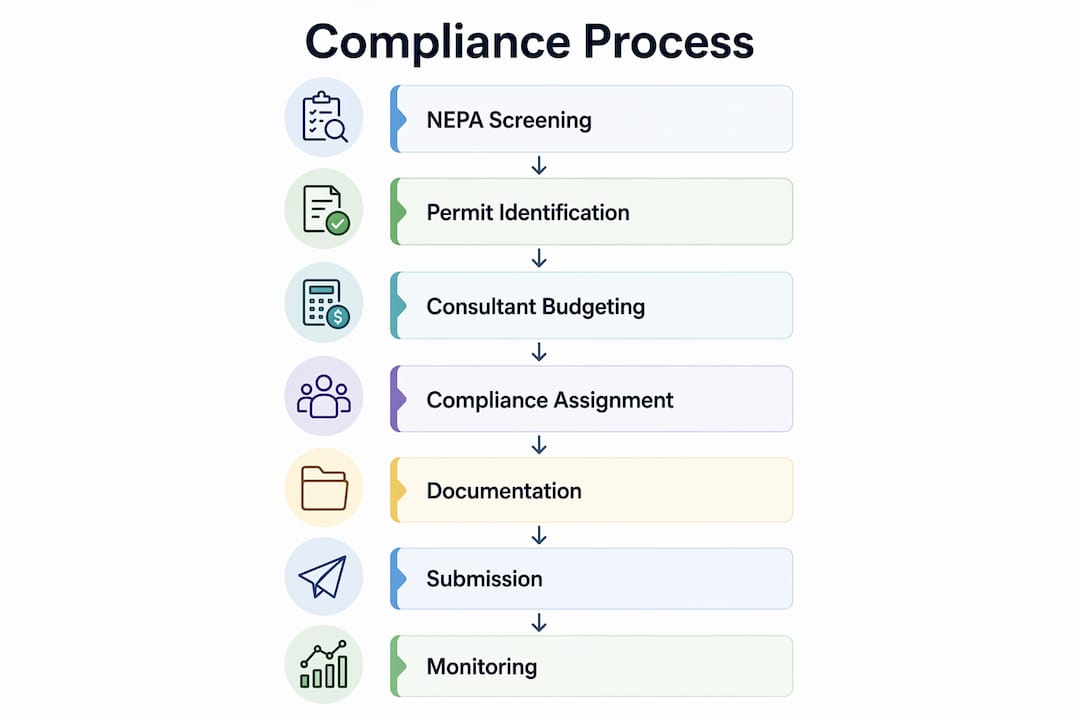
The infrastructure project compliance process in the United States is a defined, gate-driven workflow that runs from NEPA applicability screening through federal and state permitting, mitigation tracking, and final closeout. The single highest-priority action before pricing or final design is to run the NEPA applicability screen and assign named owners for every major permit. Contracts Connected documents an 18-step NEPA checklist and makes one consequence explicit: the contracting officer will not sign the Notice to Proceed until the environmental file is formally closed. That dependency alone makes early compliance ownership a schedule-critical decision, not an administrative formality. Projects that treat the compliance workflow as a late-stage review routinely face NTP delays, contract amendments, and cost overruns that could have been avoided with a structured approach from day one.
Table of Contents
- What does the infrastructure project compliance process require, step by step?
- Which federal, state, and local permits should you expect?
- How do you assign ownership and prevent compliance drift?
- What are the real consequences of compliance failures?
- What timelines and costs should you budget for permitting?
- What compliance deliverables must you produce and retain?
- How Aectechnicalsg’s compliance methodology supports submission-ready deliverables
- Key Takeaways
- The compliance gap most project teams underestimate
- Aectechnicalsg’s permit package and submission consultancy services
- Authoritative sources and further reading
What does the infrastructure project compliance process require, step by step?
The following checklist reflects the NEPA-style 18-step pathway adapted for U.S. federal infrastructure projects. Each step is a gate: the next step cannot begin until the current one is formally closed.
- Confirm federal nexus. Determine whether federal funding, federal land, or a federal permit triggers NEPA jurisdiction.
- Identify the lead federal agency responsible for the NEPA determination.
- Screen for Categorical Exclusion (CatEx). If the action qualifies, document the CatEx memo and close the environmental file.
- Decide EA vs. EIS. If CatEx does not apply, determine whether an Environmental Assessment or a full Environmental Impact Statement is required.
- Issue scoping notice. Publish the notice of intent and open the public scoping period.
- Conduct parallel reviews. Initiate Section 106 (historic properties), Section 7 ESA (threatened species), and Section 404 (wetlands/waters) processes concurrently with the EA or EIS.
- Prepare the EA or EIS draft. An EA is typically a 50–150 page public document; an EIS is substantially longer and requires a formal scoping record.
- Manage public comment period. Respond to agency and public comments; document responses in the administrative record.
- Issue FONSI or ROD. A Finding of No Significant Impact closes an EA pathway; a Record of Decision closes an EIS. Both carry enforceable mitigation commitments.
- Obtain Section 404 permit from the U.S. Army Corps of Engineers (USACE) for any discharge into waters of the United States.
- Secure NPDES permit for stormwater discharges under the Clean Water Act.
- Obtain Clean Air Act permits if construction or operations trigger applicable thresholds.
- Complete state and local permits (land use, right-of-way, utility relocations).
- Flow mitigation commitments into contract documents. Every FONSI/ROD mitigation measure must appear in contract specifications and submittal logs.
- Conduct USACE BCOES review. USACE ER 415-1-11 requires Biddability, Constructability, Operability, Environmental, and Sustainability review certification before the Contracting Division advertises the acquisition package.
- Receive NTP. The contracting officer signs NTP only after the environmental file and parallel concurrences are complete.
- Monitor and report mitigation. Track each mitigation commitment against its responsible party, verification method, and closure evidence throughout construction.
- Close out the environmental file. Retain all records; mitigation closure records are commonly required for 7 or more years.
Timeline benchmarks: A CatEx typically closes in weeks to a few months. An EA may take several months to approximately one year, depending on agency workload and public comment volume. An EIS routinely spans multiple years. Parallel reviews run on separate clocks and can extend beyond the NEPA decision itself.
Pro Tip: Run this checklist at three project gates: proposal/pre-award (to price the compliance scope), post-award kickoff (to assign owners and schedule reviews), and pre-closeout (to confirm every mitigation item has documented closure evidence).
Which federal, state, and local permits should you expect?
Mapping the regulatory authorities early prevents scope gaps and allows accurate consultant budgeting. The table below summarizes the primary permit types and the agencies that administer them.
| Authority | Permit / Review Type | Typical Trigger |
|---|---|---|
| Lead federal agency (e.g., FHWA, FTA, USACE) | NEPA determination (CatEx / EA / EIS) | Federal funding, federal land, or federal permit |
| USACE | Section 404 permit | Discharge into waters of the U.S. |
| EPA / State agency | NPDES / stormwater permit | Construction site disturbance |
| EPA / State agency | Clean Air Act permit | Emissions thresholds |
| SHPO / THPO | Section 106 NHPA consultation | Effect on historic properties |
| USFWS / NMFS | Section 7 ESA consultation | Potential effect on listed species |
| State DOT / local authority | Right-of-way, land use, utility permits | State/local jurisdiction |
Federal funding, federal land ownership, or the need for any federal permit independently creates NEPA jurisdiction. State and local requirements overlay the federal picture and run on separate timelines. Tribal consultation under Section 106 is mandatory when the area of potential effect includes tribal historic properties, and it cannot be waived or abbreviated unilaterally.
How do you assign ownership and prevent compliance drift?
PMP 2026 guidance identifies compliance drift as one of the most common project failure modes: teams assume another function owns a requirement, and the gap surfaces at audit or NTP. The mitigation is visible ownership and treated documentation as formal project deliverables.
A practical RACI for the core compliance workflow looks like this:
- NEPA applicability screen: Project manager Responsible; Environmental lead Accountable; Legal and design leads Consulted; Contracting officer Informed.
- Permit applications (Section 404, NPDES, CAA): Environmental specialist Responsible; Project manager Accountable; Agency liaison Consulted; Sponsor Informed.
- Mitigation tracking: Construction manager Responsible; Environmental lead Accountable; QA/QC Consulted; Contracting officer Informed.
- Contract integration of mitigation: Contracts lead Responsible; Project manager Accountable; Environmental lead Consulted; Sponsor Informed.
- BCOES certification: Design lead Responsible; Project manager Accountable; USACE reviewer Consulted; Contracting Division Informed.
Documentation controls that support this RACI include a live permit log, a mitigation register with closure evidence fields, versioned submittal packages, and an audit trail that links each mitigation commitment back to its FONSI or ROD source. Embedding compliance checks into delivery workflows and using digital tracking tools creates an always-ready audit trail rather than a document scramble at closeout.
Pro Tip: Tie every compliance owner assignment to a named line in the project schedule and the contractual submittal log. A RACI matrix that lives only in a spreadsheet is invisible to the contracting officer and unenforceable at audit. Ownership that appears in the schedule and the contract is ownership that gets executed.

What are the real consequences of compliance failures?
Common pitfalls follow a predictable pattern. Late NEPA screening allows design to harden around a noncompliant footprint. Integrating compliance during planning prevents the far costlier alternative: retrofitting scope after bids are received. Missing mitigation flow-through into contract specifications means construction proceeds without enforceable environmental controls, which is itself an audit finding. Poor record retention leaves the project unable to demonstrate closure.
Reviewing developer risk and code compliance obligations before procurement is one of the most cost-effective investments a project team can make.
What timelines and costs should you budget for permitting?
| Pathway | Typical Duration | Primary Cost Drivers |
|---|---|---|
| Categorical Exclusion (CatEx) | Weeks to a few months | Documentation, applicability review |
| Environmental Assessment (EA) | Several months to ~1 year | Biological surveys, cultural resources studies, public engagement |
| Environmental Impact Statement (EIS) | Multi-year | All EA drivers plus formal scoping, alternatives analysis, specialist reports |
| Section 404 / NPDES permits | Weeks to several months (parallel) | Application fees, mitigation design, agency coordination |
| Section 106 / Section 7 consultations | Weeks to months (parallel) | Cultural resources surveys, biological assessments, tribal coordination |
The largest cost surprises come from public comment-driven scope changes and agency-requested supplemental analyses. Budget a contingency line specifically for these, separate from standard design contingency.
Pro Tip: Commission biological surveys and cultural resources studies as early as possible in project development. Survey windows for certain species are seasonally constrained, and missing a survey window can delay the entire NEPA schedule by six months or more.
What compliance deliverables must you produce and retain?
Every project file should contain the following documents, tracked and version-controlled from proposal through closeout.
- NEPA applicability memo
- CatEx memo (if applicable) or EA/EIS drafts and final versions
- FONSI or Record of Decision with mitigation commitments
- Section 106 consultation records and any Memoranda of Agreement
- Section 7 biological assessment and biological opinion
- Section 404 individual or nationwide permit
- NPDES permit and stormwater pollution prevention plan
- Mitigation plan with responsible parties and verification methods
- Monitoring and reporting plan
- Permit conditions register (linked to contract specifications)
- Final environmental file with retention schedule
A permit log should track at minimum: permit type, issuing agency, application date, expected decision date, assigned owner, mitigation items, and closure evidence reference. Mitigation commitments must flow from the FONSI or ROD into contract specifications and the submittal log, not just the environmental file. For documentation practices that support permit submittals and evidence requirements, structured templates reduce the risk of missing fields at audit.
| Permit Log Column | Purpose |
|---|---|
| Permit type and number | Unique identifier for tracking |
| Issuing agency | Contact and submission portal |
| Application / decision dates | Schedule integration |
| Owner | Named individual accountable |
| Mitigation items | Links to FONSI/ROD source |
| Closure evidence | Document reference and date |
How Aectechnicalsg’s compliance methodology supports submission-ready deliverables
Aectechnicalsg structures its advisory process around the same gate-driven sequence described in this article: early NEPA applicability screening, integrated specialist commissioning, explicit RACI assignment, mitigation tracking through to contract integration, and audit-ready filing. For cross-jurisdictional projects where Singapore-based developers are procuring U.S. federal or state permits, the firm provides advisory services covering the full NEPA and permitting workflow and submission support for permit package assembly and agency coordination.
“Submission-ready deliverables are not produced at the end of a project. They are assembled continuously, from the first applicability memo through to the final closure evidence. A project team that treats documentation as a parallel workstream rather than an afterthought will close its environmental file without last-minute discovery. That is the standard Aectechnicalsg applies to every engagement.” — Aman, Technical and Regulatory Author
USACE BCOES reviews require that all comments across Engineering, Construction, Environmental, and other divisions be documented and resolved prior to certification. USACE ER 415-1-11 allows conditional certification only when amendments will resolve open comments, and that process is tightly controlled. Aectechnicalsg’s engagement model accounts for BCOES scheduling in the project quality plan from the outset.
Key Takeaways
The infrastructure project compliance process is a gate-driven workflow that must be initiated before final design, with named owners assigned to every major permit and mitigation commitment.
| Point | Details |
|---|---|
| Run NEPA screening first | Determine federal nexus and CatEx/EA/EIS pathway before design is finalized or bids are priced. |
| NTP depends on a closed environmental file | The contracting officer will not sign NTP until all NEPA decisions and parallel concurrences are formally complete. |
| Assign named owners via RACI | Tie every compliance item to a named individual in the project schedule and contract submittal log, not just a spreadsheet. |
| Flow mitigation into contracts | Every FONSI or ROD mitigation commitment must appear in contract specifications; a missing flow-through is an audit finding. |
| Aectechnicalsg advisory support | Aectechnicalsg provides NEPA/permitting advisory, permit package assembly, and audit-ready filing for cross-jurisdictional infrastructure projects. |
The compliance gap most project teams underestimate
The technical steps in the infrastructure project compliance process are well-documented. What is consistently underestimated is the organizational gap between the environmental file and the construction contract. Mitigation commitments documented in a FONSI or ROD routinely fail to appear in contract specifications, not because teams are negligent, but because the handoff between the environmental lead and the contracts team is informal and undocumented. By the time construction begins, the mitigation exists only in the environmental file, invisible to the superintendent and unenforceable by the contracting officer.
The second underestimated risk is the parallel-review clock. Teams plan for the NEPA decision timeline but treat Section 7, Section 106, and Section 404 as subordinate tasks. Each carries its own statutory timeline and can extend beyond the NEPA decision. A project that closes its EA in ten months but has an unresolved Section 7 biological opinion is not ready for NTP.
Early specialist engagement is the most reliable mitigation for both risks. Commissioning biological surveys and cultural resources studies at the proposal stage, before design commitments are made, preserves schedule flexibility and prevents the costly scenario of a survey window being missed entirely.
Aectechnicalsg’s permit package and submission consultancy services
For Singapore-based project developers and construction professionals managing U.S. infrastructure projects, Aectechnicalsg provides structured compliance advisory and submission consultancy services covering the full permitting workflow: NEPA applicability screening, permit package assembly, PE endorsement coordination, mitigation tracking, and audit-ready environmental file management.
The firm’s PE endorsement and authority submission services are designed for project teams that need submission-ready deliverables without building an in-house regulatory team for each jurisdiction. Advisory scope and filing support are scoped to the project’s specific federal and state permit requirements. Contact Aectechnicalsg for a project-specific compliance scope review and permit timeline assessment.
Authoritative sources and further reading
- NEPA compliance checklist for federal projects (Contracts Connected) — The primary practitioner reference for the 18-step NEPA pathway, NTP dependency, EA scope, and mitigation tracking requirements. Consult this for procedural sequencing and deliverable checklists.
- USACE ER 415-1-11: BCOES Reviews — The governing Engineer Regulation for BCOES review scheduling, certification requirements, and conditional certification procedures. Required reading for any USACE-funded or USACE-administered project.
- PMP 2026: Confirming compliance requirements (PMExams) — Practitioner-level guidance on compliance ownership, RACI, risk classification, and consequences of noncompliance. Useful for project managers integrating compliance into delivery frameworks.
- Project compliance framework and best practices (monday.com) — Analysis of digital compliance management, continuous monitoring, and workflow-embedded controls. Consult for guidance on audit-trail automation and compliance tracking systems.
- CDM compliance and construction safety documentation (LifeSafety.ai) — Technology reference for integrating safety and compliance documentation into construction project workflows.