
The Building and Construction Authority (BCA) in Singapore performs the same gatekeeping function as an Authority Having Jurisdiction (AHJ) in the United States: no building works may legally commence until the relevant authority has reviewed and approved submitted plans, endorsed by a licensed professional. For project teams, this single fact governs scheduling, insurance coverage, lender draw conditions, and contractual handover milestones. Whether you are working under BCA’s framework in Singapore or navigating a U.S. jurisdiction such as the NYC Department of Buildings or a California local building department, the role of BCA approval maps directly to the AHJ-issued building permit: a formal, authority-granted authorization that unlocks construction and creates legally binding inspection checkpoints.
- Plans must be submitted through a Qualified Person (QP) before any building works begin.
- Approval is not a single event; it is a staged process with distinct deliverables at each phase.
- Non-compliance at any stage can trigger stop-work orders, withheld financing, or revoked lodgment privileges.
Table of Contents
- What does an AHJ or BCA approval actually cover?
- What are the stages of the approval process?
- Who is responsible at each step?
- Why do approvals affect your project commercially?
- How do alternative solutions and variances work?
- What documents do you need and how long does it take?
- When should you engage architects, engineers, and specialist consultants?
- How do you avoid delays and legal risk?
- Key Takeaways
- What practitioners often underestimate about approval processes
- Aectechnicalsg: full-cycle authority submission management for Singapore projects
What does an AHJ or BCA approval actually cover?
Authority approvals span multiple technical disciplines simultaneously. Plan reviewers and inspectors assess architectural drawings, structural calculations, fire and life-safety systems, accessibility compliance, mechanical and electrical (M&E) engineering, and site drainage. In Singapore, the BCA’s scope overlaps with other authorities: the Urban Redevelopment Authority (URA) governs land use and development control, the Singapore Civil Defence Force (SCDF) reviews fire safety submissions, and the Public Utilities Board (PUB) covers drainage and water. A QP must coordinate submissions across these agencies before BCA plan approval can be granted.
Some approvals are document-only reviews, such as initial plan submissions and structural calculations. Others create mandatory on-site inspection checkpoints, including foundation checks, structural frame inspections, and final occupancy verification. Understanding which category each submission falls into determines where inspection delays can stall construction progress.
What are the stages of the approval process?
-
Pre-application coordination. Confirm jurisdictional scope, identify all relevant authorities, and attend pre-submission meetings where available. In Singapore, this includes securing URA written permission before lodging with BCA. In U.S. jurisdictions, early AHJ engagement often surfaces zoning conflicts before costly design work is complete.
-
Plan submission for initial review. Submit architectural and structural drawings, specifications, engineering calculations, fire engineering reports, accessibility statements, and all required declarations. In Singapore, building plan submissions must carry QP endorsement, and fees are payable at first submission in accordance with the Building Control Regulations fee schedules. In the U.S., a licensed architect or registered PE stamps and seals the drawings before submission to the AHJ.
-
Permit issuance and permit conditions. Once plans are approved, a permit to carry out works is issued. Under BCA guidance, structural works permits are typically processed within a standard processing timeframe. Permit conditions commonly specify mandatory hold points, approved material specifications, and documentation requirements that must be met before each phase proceeds.
-
Construction-stage inspections. Inspections are triggered by permit conditions at defined construction milestones: foundation completion, structural frame, waterproofing, and M&E rough-in. The QP or licensed PE must certify each stage. Missing an inspection hold point without authority clearance constitutes a violation and can require demolition of concealed work.
-
Final sign-off and occupancy certificate. The authority issues a Certificate of Statutory Completion (CSC) in Singapore, or a Certificate of Occupancy (CO) in U.S. jurisdictions, only after all inspections are passed and outstanding conditions are cleared. No building may be legally occupied before this certificate is issued.
Who is responsible at each step?
| Party | Primary Responsibility | Signature / Stamp Required |
|---|---|---|
| Owner / Developer | Appoints QP; bears ultimate legal liability for compliance | Authorization forms |
| Architect (QP) | Prepares and endorses architectural plans; coordinates multi-authority submissions | QP declaration and stamp |
| Registered PE (Structural) | Prepares structural calculations; certifies design adequacy | PE stamp and declaration |
| Accredited Checker | Independent review of structural submissions; reduces BCA processing time | Accredited Checker certification |
| Contractor | Executes works per approved plans; notifies QP of site conditions | Site records and inspection logs |
| BCA / AHJ Inspector | Reviews submissions; conducts site inspections; issues written directions | Authority approval and inspection sign-off |
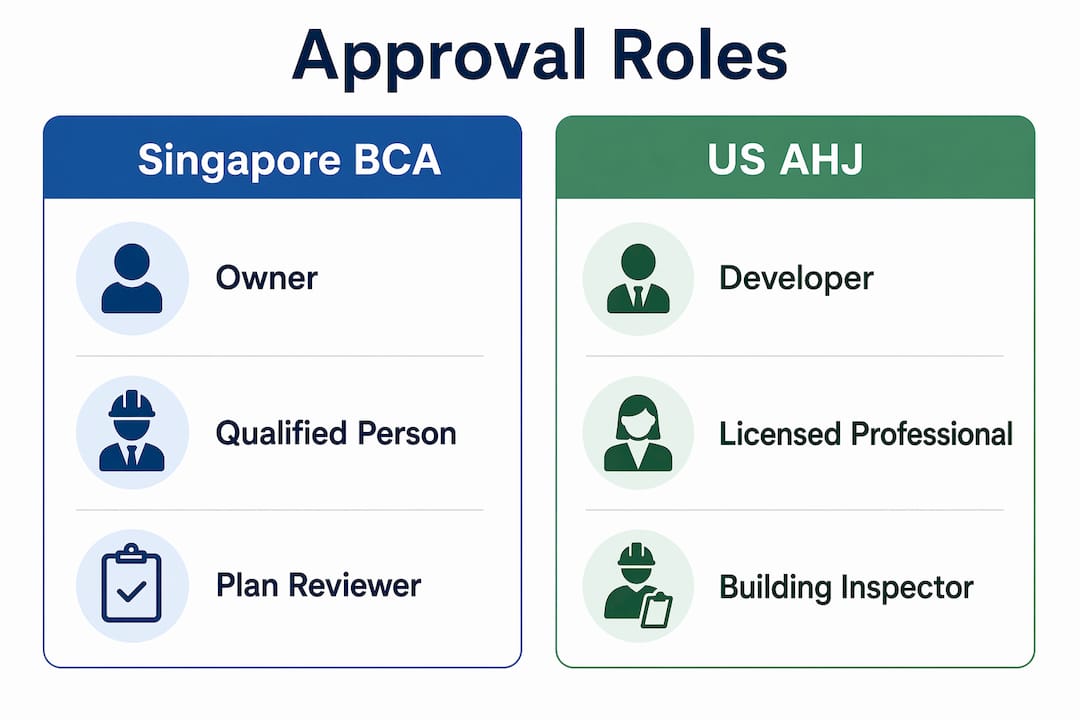
Liability for design errors sits with the design professional who stamped the drawings. Site supervision failures are shared between the contractor and the QP responsible for supervision. Where an accredited checker is engaged, their certification is a prerequisite for a faster processing window on first structural submissions.
Why do approvals affect your project commercially?
Approval status directly controls access to financing, insurance, and occupancy. Lenders typically release construction draw payments only after confirmed permit issuance and passed inspections. Insurers may void coverage for works carried out without a valid permit, shifting liability entirely to the owner. A stop-work order freezes all site activity until the non-compliance is resolved, and the associated delay costs fall on the project, not the authority.
Key stakeholders who verify approval status before proceeding:
- Banks and lenders: Require permit confirmation before each draw disbursement.
- Insurers: Condition coverage on works being carried out under a valid, current permit.
- Certifiers and surveyors: Cannot issue completion or occupation certificates without authority sign-off.
- Prospective buyers: Conduct title searches that reveal unapproved works, which can block sale or require costly rectification.
Building code compliance matters commercially, not just legally. Unapproved works discovered at resale routinely result in price reductions or failed transactions.
How do alternative solutions and variances work?
When a proposed design cannot meet a prescriptive code requirement, the authority may accept an “alternative solution” that demonstrates equivalent safety outcomes through technical justification. This is distinct from an “acceptable solution,” which is a pre-approved prescriptive pathway requiring no further substantiation.
The process for substantiating an alternative solution typically follows this sequence:
- Identify the specific code clause the design cannot satisfy prescriptively.
- Prepare a technical justification package: comparative analysis against the prescriptive standard, risk assessment, and supporting engineering reports (such as a fire engineering report or structural performance analysis).
- Submit the package to the AHJ or BCA for review. In Singapore, experienced QPs negotiate alternatives directly with BCA and must demonstrate safety equivalence through detailed technical substantiation.
- Expect extended review periods. Alternative solution reviews add weeks to standard processing windows, and phased approvals may be required if the alternative affects multiple disciplines.
Pro Tip: Engage your fire engineer or structural PE at concept design stage when an alternative solution is anticipated. Submitting a half-developed technical justification is the single fastest way to trigger a Written Direction and restart the clock.
BCA’s Lodgment Scheme offers a “deemed approved” pathway for lower-risk submissions, but lodged plans remain subject to retrospective audit. Non-compliances found during audit can revoke lodgment privileges entirely, which is a significant commercial risk for firms that rely on the scheme for routine projects.
What documents do you need and how long does it take?
Submission checklist:
- Architectural drawings (plans, sections, elevations, details)
- Structural drawings and engineering calculations
- Fire engineering report (where performance-based design is used)
- Accessibility compliance statement
- M&E drawings and specifications
- QP declarations and stamped forms
- Accredited Checker certification (where applicable)
- Fees paid per Building Control Regulations schedules
| Submission Type | Processing Window |
|---|---|
| Structural plans (with accredited checker, first submission) | 10 working days |
| Structural plans (subsequent submissions) | 14 working days |
| Expedited structural submissions (qualifying criteria met) | 7 working days |
| Permit to carry out structural works | 7 working days |
Common rejection reasons include incomplete QP declarations, missing accredited checker certification, drawings that conflict with approved URA parameters, and inadequate technical justification for alternative solutions. Fees increase with resubmissions and complex technical assessments. A QP with a history of poor submission quality or high Written Direction counts will face longer response times from BCA on all subsequent projects.
When should you engage architects, engineers, and specialist consultants?
- Architect (QP): At project inception. Architectural planning decisions made before the QP is engaged routinely require costly redesign once code constraints are identified.
- Structural PE: At schematic design stage, before structural systems are fixed. Late engagement means structural calculations are prepared under time pressure, increasing error risk.
- Fire engineer: At concept stage for any project using performance-based fire design or alternative solutions. Fire safety submissions to SCDF require detailed engineering reports that cannot be rushed.
- MEP consultants: At design development, with coordination drawings required before permit submission.
- Accredited Checker: Before structural plan submission. Their certification is the mechanism that unlocks the faster processing window and reduces BCA review burden.
Deliverables to require by milestone: a pre-application memo confirming jurisdictional scope and submission strategy; issued-for-permit drawings with all required stamps; shop drawings reviewed and approved before fabrication; and a signed inspection log maintained throughout construction.
How do you avoid delays and legal risk?

Top causes of approval delay are poor submission quality, uncoordinated MEP and structural interfaces, and late design changes that require material amendment approvals. Material changes to approved structural plans during construction require BCA approval before the change is executed on site. Immaterial changes may proceed but must be formally documented. Many site teams conflate the two, which is a common source of Written Directions.
Practical mitigation steps:
- Conduct a pre-submission QC review with the QP and accredited checker before lodging.
- Engage the AHJ or BCA early, particularly for projects involving alternative solutions or unusual structural systems.
- Establish a documented immaterial-change process in the construction contract so site variations are categorized and recorded consistently.
- Monitor the QP’s Written Direction history. A QP with a poor track record will slow every submission on your project.
Pro Tip: For projects using BCA’s Lodgment Scheme, build a retrospective audit response protocol into your quality management plan before lodgment, not after. The time to prepare your compliance evidence is before the acknowledgement is issued.
Key Takeaways
Authority approval is a staged, multi-party process: the role of BCA approval in Singapore maps directly to the AHJ building permit in the U.S., and both require licensed professional endorsement, phased inspections, and documented compliance at every construction milestone.
| Point | Details |
|---|---|
| Engage the QP at project inception | Late QP engagement is the leading cause of redesign costs and submission delays. |
| Accredited checker certification matters | It unlocks a faster structural processing window and reduces BCA review burden. |
| Alternative solutions extend timelines | Technical justification packages add weeks; engage specialist engineers at concept stage. |
| Lodgment Scheme carries audit risk | Deemed-approved status does not mean compliant; retrospective audits can revoke lodgment privileges. |
| Aectechnicalsg manages full-cycle submissions | From PE endorsement and authority submissions to multi-agency coordination across BCA, URA, SCDF, and PUB. |
What practitioners often underestimate about approval processes
The conventional view treats authority approval as a bureaucratic checkpoint: submit the drawings, wait for the stamp, proceed. That framing consistently underestimates the approval process’s role as a design quality filter. Written Directions are not administrative inconveniences; they are signals that the design or documentation does not yet meet the standard the authority requires. Teams that treat them as negotiating friction rather than technical feedback tend to accumulate them, and BCA’s response is to extend review times on every subsequent submission from that QP.
The more consequential risk is the Lodgment Scheme. The speed advantage is real, but the audit exposure is equally real, and most project teams do not build audit-readiness into their quality management plans until after a non-compliance notice arrives. The time to prepare compliance evidence is before lodgment, not after.
Early consultant engagement is not a cost; it is schedule insurance. A fire engineer brought in at concept stage can shape the design so that no alternative solution is needed. A structural PE engaged at schematic design can select a system that satisfies prescriptive requirements without a variance. The projects that move fastest through authority review are almost always the ones where the full consultant team was assembled before the design was fixed.
Aectechnicalsg: full-cycle authority submission management for Singapore projects
For project teams that need more than a checklist, Aectechnicalsg provides end-to-end engineering and architectural consultancy for authority submissions across BCA, URA, SCDF, PUB, and NEA. The concrete advantage over assembling a piecemeal consultant team is coordination: one firm managing structural and geotechnical engineering, M&E design, façade engineering, and QP supervision means submission packages are internally coordinated before they reach the authority, which reduces Written Directions and resubmission cycles.
Aectechnicalsg’s scope covers engineering consultancy for Singapore developers from pre-application through final CSC, including accredited checker coordination and alternative solution substantiation. For project teams at the planning stage, the practical next step is a scoping consultation to confirm submission strategy, identify multi-authority coordination requirements, and establish a realistic approval timeline before design is fixed. Contact Aectechnicalsg directly to discuss your project’s submission requirements.