
Every QP design consultation scope must define seven items in writing: verified professional credentials, a fixed deliverables list (drawings, calculations, BIM files), named authority submissions, a supervision structure, a capped number of revision rounds, professional indemnity insurance limits, and submission lead times. Miss any one of these, and you inherit the risk of it later, usually at the worst possible moment in the project calendar.
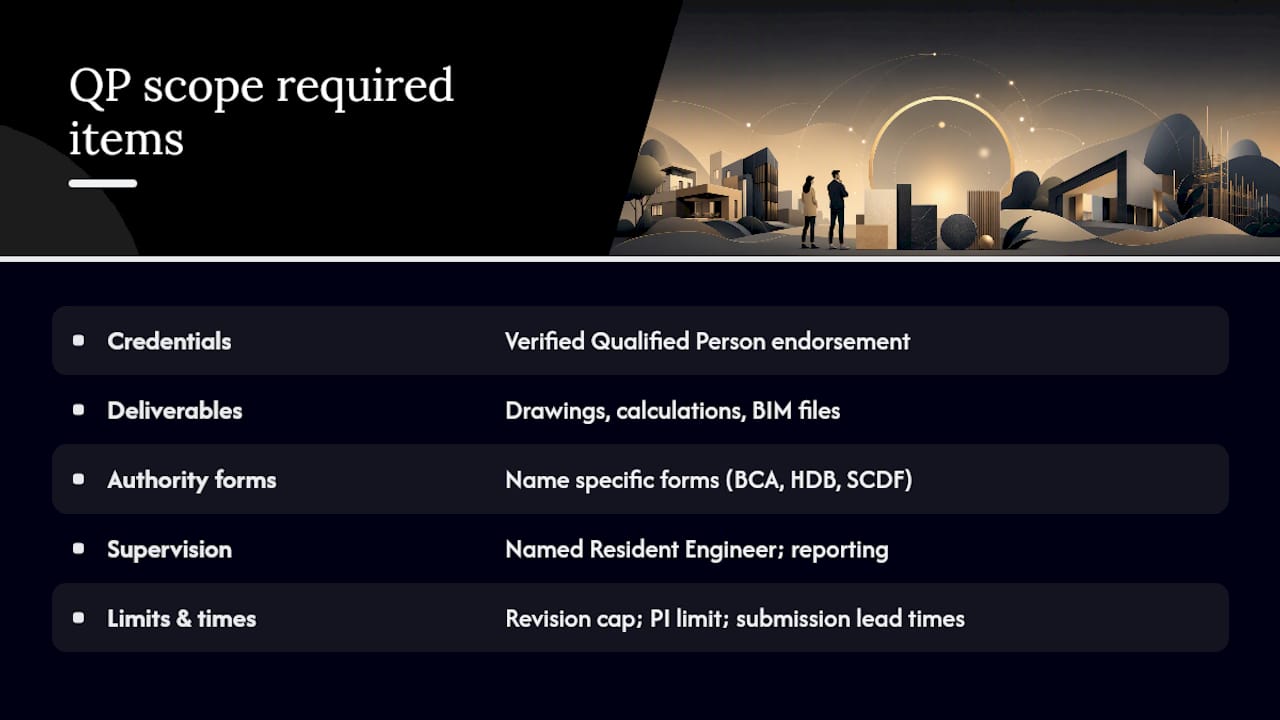
Each item ties to a specific regulatory exposure. A structural submission without a properly endorsed Qualified Person invalidates the structural plan submission with the Building and Construction Authority (BCA) outright. An undefined revision count turns into a billing dispute the moment the authority kicks back plans for the third time. A vague supervision clause means nobody can prove a Resident Engineer actually visited the site when a defect surfaces two years post-handover.
Before signing anything, attach the specific forms your QP will file (BCA structural forms, HDB QPAPP01/QPAPP02, SCDF’s fire checklist) as annexes to the tender document, not as a vague reference to “authority submissions.” Name the forms. Name the counts. Name the dates.
Key Takeaways
A QP design consultation scope only holds up when credentials, deliverables, authority forms, supervision duties, revision limits, insurance minimums, and lead times are all fixed in writing before work begins.
| Point | Details |
|---|---|
| Verify credentials first | Check PEB registration and discipline match before signing any QP appointment. |
| Fix deliverables in writing | List drawing sets, calculation books, and BIM formats as numbered contract items, not prose. |
| Name the authority forms | Attach BCA, PUB, SCDF, or HDB-specific forms to the tender document rather than referencing them generically. |
| Cap revision rounds | Define the included number of rounds and set a rate for extras before design work starts. |
| Enforce supervision evidence | Require dated inspection reports, NCRs, and site diaries, not verbal assurances. |
| Work with Aectechnicalsg | Aectechnicalsg builds scope schedules and manages authority submissions across BCA, PUB, SCDF, and HDB for developers who want the checklist enforced from appointment through handover. |
Table of Contents
- Who Can Act as a QP and How Do You Verify Their Credentials?
- What Design Deliverables Should the Scope Define?
- What Forms and Timelines Apply to Authority Submissions?
- How Should Site Supervision Be Defined in the Contract?
- What Contract Clauses Protect You Commercially?
- What Should You Verify at Each Project Milestone?
- Practitioner Guidance and Common Pitfalls
- A Practical Checklist Template for Busy Project Managers
- How Aectechnicalsg Helps You Lock Down QP Scope Before It Costs You
- Frequently Asked Questions
- Sources
Who Can Act as a QP and How Do You Verify Their Credentials?
A Qualified Person under Singapore law is either a registered Professional Engineer in the relevant discipline (civil/structural, mechanical, or electrical) or a registered architect holding a current practising certificate. Titles like “senior designer” or “technical director” mean nothing legally if the individual isn’t on the statutory register for the discipline your project needs.

Verification takes ten minutes and saves months. Check the person’s registration status directly against the Professional Engineers Board (PEB) register, and cross-reference their listed discipline against the actual scope of work you’re contracting for. A civil-registered engineer cannot sign off mechanical ventilation calculations, no matter how experienced they claim to be on paper. For structural submissions specifically, BCA requires that only a registered Professional Engineer sign and endorse the first and last pages of both the structural calculations and the plans, using standard certification wording, not a generic company letterhead.
Ask for these documents before appointment:
- Current PEB registration certificate or architect practising certificate
- Proof of professional indemnity (PI) insurance in force
- Accredited Checker credentials if the project falls under mandatory peer review
- A list of comparable projects the individual personally signed, not just projects their firm was involved in
Red flags worth walking away from: a registration certificate that expired within the past year, a discipline mismatch between the QP and the scope of work, or a candidate who can’t produce evidence of having personally endorsed plans on a project of similar scale.
Pro Tip: Ask the QP candidate to walk you through one rejected submission from a past project and how they resolved it. Their answer tells you more about competence than any credential check.
What Design Deliverables Should the Scope Define?
Ambiguity about deliverables is the single most common source of scope disputes on Singapore projects. The fix is a numbered list attached to the contract, not a paragraph of prose that a QP can interpret however suits them later.
At minimum, the scope should specify:
- Drawing sets — architectural, structural, and M&E drawings at each design stage (concept, developed, tender, construction issue), each clearly dated and revision-lettered.
- Calculation books — structural design calculations bound and indexed, signed and endorsed on the first and last page per BCA requirements, matching Form BCA-BE-STAPPV01 requirements where structural approval applies.
- BIM/3D deliverables — file format (typically .rvt or IFC for exchange), Level of Development target for each design stage, and who owns clash detection between disciplines.
- Subconsultant coordination — a named lead who resolves conflicts between structural, architectural, and M&E models before issue, not after site queries start arriving.
- Fire safety drawings — means of escape, fire engine access, hydrant locations, and fire protection system layouts, matching the detail level SCDF’s own checklist recommends for a clean submission.
On BIM specifically, don’t accept “3D coordination included” as a line item. Specify the exchange format, the LOD target, and whose responsibility it is to run clash detection reports. Projects that skip this step routinely discover clashes on site where fixing them costs multiples of what a desk-based clash check would have cost.
Revision rounds need the same precision. Fix the number included in the base fee (three rounds per design stage is a reasonable industry default), define what counts as a “round” (a full markup cycle, not a single comment), and set a per-round rate for anything beyond that ceiling. Authority liaison responsibilities close out this section: name who prepares submission packages, who physically lodges them, who fields authority queries, and what response time applies once a query lands. Without a stated turnaround, “we’ll get to it” becomes the default answer.
What Forms and Timelines Apply to Authority Submissions?
Each authority expects a different package, and mixing them up costs weeks. Building a scope checklist around the actual named forms, rather than a generic “handle authority submissions” clause, is what separates a workable contract from one that generates change orders.
For BCA, structural submissions require detailed structural plans signed by the QP plus design calculations endorsed on the cover and closing pages, filed through Form BCA-BE-STAPPV01 for structural plan approval.
For PUB, sewerage and drainage works require both Development Control (DC) and Detailed Plan (DP) clearances. Projects meeting simple-project criteria can use Simplified Submission (SS), which returns acknowledgement far faster than a Detailed submission. Confirm SS eligibility during scope negotiation, not after the QP has already started drafting for the longer pathway, and require the QP to document the eligibility decision in writing so you retain an audit trail if the authority later questions it.
For SCDF, the fire safety checklist calls for a complete drawing list, fire-safety system specifications, and QP endorsements consistent with applicable circulars and fire code provisions.
For HDB projects, the required package includes building plans reflecting fire and building safety works, Form HDB(ARCH)-QPAPP02 and QPAPP01, certified true copies of the URA-approved DC layout, and final as-built plans digitally signed by the QP.
Build in a buffer beyond the authority’s stated minimum lead time. Authorities routinely return first-pass submissions with clarification queries, and each round adds days you won’t get back if your construction program is already tight. Standard QP certification wording, the exact phrasing that appears on the signed plan or calculation page, should be specified in the scope document itself so there’s no ambiguity about what “signed and endorsed” actually looks like on the final page.
How Should Site Supervision Be Defined in the Contract?
QP(Design) and QP(Supervision) are two distinct legal roles, and conflating them in a contract is one of the more expensive mistakes a developer can make. The design QP is responsible for the plans and calculations. The supervision QP, often filled by a Resident Engineer or Resident Technical Officer (RTO), is responsible for confirming the works on site match those approved plans.

The scope should state visit frequency in concrete terms, not “as needed.” A structural pour at a high-rise foundation stage warrants a different visit cadence than routine finishing works, and the contract should reflect that difference rather than applying one blanket frequency across the whole build.
Require these specific outputs from the supervision team:
- Dated site inspection reports tied to specific work stages, not general monthly summaries
- Non-conformance reports (NCRs) issued at the point of discovery, with a tracked closure date
- Site diaries maintained by the RE or RTO, available for review on request
- A named escalation path when defects exceed the RE’s authority to resolve on site
A supervision plan without enforcement is just a paragraph of good intentions. Build in the right to request signed logs, dated photographs, and inspection reports at any point during construction, not only at handover. A comparative reference worth reviewing is this building defects checklist, which lays out the kind of inspection documentation that should exist behind every NCR you receive.
Pro Tip: Request one sample inspection report from the RE before construction starts. If it’s vague or unstructured, that’s exactly what you’ll get for the next eighteen months.
What Contract Clauses Protect You Commercially?
Regulatory scope and commercial scope are two different documents doing two different jobs, and treating them as one paragraph is how disputes start. The technical checklist tells the QP what to deliver. The contract clauses tell them what happens when they don’t.
Tie payment milestones to deliverables and authority approvals rather than calendar dates. A payment triggered by “structural drawings issued” is meaningless if those drawings still need three more revision cycles before BCA will accept them; tie the milestone to acceptance, not to a draft being emailed.
Fix these commercial terms explicitly:
- The exact number of revision rounds included in the base fee, and the hourly or fixed rate for rounds beyond that
- Minimum PI insurance coverage, matched to the scale of the project, with the QP obligated to maintain it for the full engagement plus a defined tail period after completion
- Who bears the cost of resubmission when an authority rejects a package due to QP error versus a policy change outside the QP’s control
- Deliverable acceptance criteria (what “complete” looks like for each drawing set) and a retention percentage held back until outstanding items close out
Retention clauses matter more than developers often realize going in.
What Should You Verify at Each Project Milestone?
Three checkpoints catch most scope failures before they become expensive: pre-construction, pre-TOP/CSC, and final handover. Each has its own document set, and accepting a milestone without the full set is how gaps go unnoticed until they surface during an authority audit.
- Pre-construction: Confirm you hold the fully approved plan set, stamped and signed calculation books, and copies of the authority receipt or acknowledgment letter for every submission filed.
- Pre-TOP/CSC: Require complete as-built drawings, compliance certificates from each relevant authority, QP endorsements on the final drawing set, and any third-party test reports (fire system commissioning, structural load tests) referenced in the submission.
- Final handover: Confirm digitally signed PDF drawings using the QP’s registered digital signature, a complete drawing list cross-referenced against the as-built set, and file partitioning consistent with authority size limits, filed under a consistent ES number where the overall package exceeds single-file limits.
| Milestone | Key Documents to Obtain |
|---|---|
| Pre-construction | Approved plan set, stamped calculations, authority acknowledgment receipts |
| Pre-TOP/CSC | As-built drawings, compliance certificates, QP endorsements, test reports |
| Final handover | Digitally signed drawings, cross-referenced drawing list, ES-numbered file partitions |
Sequence matters as much as content. The structural QP should sign off before the architectural as-built set is finalized, since architectural drawings often reference structural grid lines and levels that need to be locked first. Getting this order backward means re-issuing documents that should have been final. A full walkthrough of this handover sequence sits in our Singapore building owner legal obligations checklist, which covers the documentation trail owners are expected to retain long after handover.
Practitioner Guidance and Common Pitfalls
Consultants who negotiate scope well ask about Simplified Submission eligibility in the first meeting, not the third. Confirming early whether a project qualifies for PUB’s faster pathway shapes both the fee structure and the program, and it’s a conversation that’s far easier to have before drawings exist than after.
Collaborating with the design QP early to jointly define the work plan rather than handing down a scope unilaterally tends to produce a more realistic deliverable schedule, one the QP actually has input into meeting.
The recurring mistakes worth flagging:
- Vague BIM clauses that say “3D model provided” with no file format, LOD, or clash-detection ownership specified
- Revision definitions left undefined until the third round is already in dispute
- Authority-liaison responsibility split ambiguously between the QP and the developer’s own project team, so queries sit unanswered while each side assumes the other is handling it
In scope schedules for our own engagements, we typically require a signed submission-readiness checklist from the QP before any package goes to an authority. It’s a small procedural step that catches missing annexes before a rejection letter does.
A submission-readiness checklist signed by the QP before lodgement is one of the cheapest risk controls available to a developer: it costs nothing and gives you contractual evidence if an authority rejects a package for a missing document that should have been caught internally first.
Escalate to the client when a decision involves fee exposure or program risk beyond what the QP was contracted to absorb. Let the QP manage routine authority queries and technical clarifications without needing sign-off on every email.
A Practical Checklist Template for Busy Project Managers
Four milestones, four short checklists. Copy this structure directly into your project tracker.
- Appointment: PEB/architect registration verified, PI insurance certificate on file, scope schedule signed with revision count and fee basis fixed.
- Design submission: Drawing set complete per the agreed list, calculations signed on first and last pages, BIM files delivered in the agreed format.
- Authority lodgement: Correct forms attached for each authority, submission pathway (Simplified or Detailed) confirmed in writing, acknowledgment receipts filed.
- Construction handover: As-built drawings digitally signed, compliance certificates collected, retention amount confirmed against outstanding items.
Before accepting any deliverable, run a five-minute check: confirm the file is digitally signed, the drawing list matches what was submitted, and the revision number on the cover sheet matches your tracker. Standardize file names using project code, discipline, and revision letter so nothing gets misfiled during a rushed submission week. For projects that plausibly qualify for Simplified Submission, ask the QP to confirm eligibility in writing before drafting begins, not after the Detailed submission package is already half finished.
How Aectechnicalsg Helps You Lock Down QP Scope Before It Costs You
Most developers discover scope gaps the hard way, mid-project, when a revision dispute or a missed authority form stalls the program. Aectechnicalsg builds the scope schedule, the deliverables list, and the authority-submission plan into the engagement from day one, so the checklist above isn’t something you have to enforce alone against a resistant consultant.
Our services map directly to the gaps this checklist identifies: structural and geotechnical design with proper PE endorsement, authority submission management across BCA, PUB, SCDF, and HDB, and supervision coordination that produces the inspection records developers actually need at handover. Our PE endorsement and authority submission service is built specifically around the forms and lead times covered in this article so submissions go in complete the first time rather than bouncing back on missing annexes.
Before an initial consult, bring your project’s authority scope (which of BCA, PUB, SCDF, or HDB apply), your target program dates, and any existing consultant proposals you want reviewed against this checklist. Get in touch to have your scope draft checked before you sign it.
Frequently Asked Questions
What is a QP design consultation scope checklist supposed to cover?
It should cover verified QP credentials, a fixed deliverables list including drawings and calculations, named authority submission forms, supervision responsibilities, a capped number of revision rounds, PI insurance minimums, and stated lead times for each authority.
Who qualifies as a Qualified Person in Singapore?
A registered Professional Engineer in the relevant discipline, or a registered architect holding a current practising certificate, verified against the PEB register before appointment.
What’s the difference between Simplified Submission and Detailed submission?
Simplified Submission applies to qualifying simple projects and returns faster acknowledgment from PUB. Detailed submission applies to more complex projects and takes longer to process; eligibility should be confirmed during scope negotiation, not after drafting begins.
How many revision rounds should be included in a QP design contract?
Three rounds per design stage is a common industry default, though the exact number should be fixed in the contract along with a per-round rate for anything beyond that ceiling.
What documents should a developer request before final handover?
Digitally signed as-built drawings, compliance certificates for each authority, QP endorsements on the final drawing set, and any referenced test reports, cross-checked against the original drawing list.
Sources
Consult these sources directly when drafting or reviewing a QP scope schedule:
- Building Plan Submission Process Flow | PUB, Singapore’s National Water Agency
- Structural plan submission | Building and Construction Authority
- SCDF fire safety checklist for building plan submissions