
Yes, changing how a commercial unit in Singapore is used almost always requires Urban Redevelopment Authority (URA) permission. Two routes apply: the Change of Use Lodgment Scheme for eligible, pre-identified uses (instant approval) or a standard Change of Use application for everything else, assessed on a case-by-case basis. Check zoning on URA SPACE and the Master Plan through GoBusiness Singapore before signing any lease or starting fit-out works.
TL;DR:
- A change of use in Singapore requires URA approval unless it qualifies for the instant Change of Use Lodgment Scheme, which has strict eligibility conditions.
- The lodgment scheme applies only to certain commercial buildings, within the floor area cap, with owner consent, and no overriding planning restrictions.
- Applications must include detailed plans, owner consent, and supporting agency clearances, and are generally processed within ten working days for complete submissions.
- Disqualifiers such as AGU zones, exclusion areas, or traffic-sensitive locations push projects into the standard application process, which involves more case-by-case review.
- Securing professional support for handling multi-agency coordination, proper documentation, and compliance checks can significantly reduce approval delays.
Table of Contents
- When Does Property Use Alteration Require URA Approval?
- Lodgment Scheme or Standard Application: Which One Fits?
- How Do You Apply for a Change of Use in Singapore?
- What Are the Fees and Timeline for a Change of Use?
- Other Agency Clearances and Common Filing Mistakes
- Practical Submission Tactics That Cut Approval Delays
- What the Change of Use Process Actually Rewards
- Get Managed Support for Your Change of Use Submission
- Sources
When Does Property Use Alteration Require URA Approval?
URA’s planning control exists to prevent disamenity. That is the term the authority uses for the noise, traffic congestion, and social friction a new use can dump on neighbors who never signed up for it. Every proposed change gets weighed against the Master Plan zoning for that plot, and against how the new activity behaves compared to the old one.
Not every swap needs a fresh look. Moving between a shop, a showroom, and a restaurant on the same premises often qualifies for the fast lodgment track, because URA already treats these as compatible commercial uses within the same risk band. Other situations get excluded outright. Residential premises generally cannot pivot into commercial activity without a separate approval process, and certain zones carry what URA calls Additional Gross Floor Area (AGU) or exclusion status, where extra restrictions apply regardless of how harmless the new tenant seems.
Before signing anything, pull up the plot on URA SPACE and cross-check it against the current Master Plan. A few line items worth confirming early:
-
- The zoning classification assigned to the specific plot, not just the general area
- Whether the unit sits inside an AGU or exclusion zone
- Whether the building has any existing planning conditions tied to prior approvals
- Whether the intended use appears on the lodgment list for that building type
Lodgment Scheme or Standard Application: Which One Fits?
The Change of Use Lodgment Scheme gives instant approval the moment a compliant submission clears the system. No waiting, no case officer, no discretionary judgment call, because URA has already pre-cleared the use category for that building type. It only works, though, when every condition on the checklist is met.
- The premises sit within selected commercial buildings or qualifying first-storey shophouses on eligible Master Plan zones.
- The new use falls within the commercial gross floor area category and does not increase the unit’s floor area.
- The property owner has given written consent to the change.
- The site carries no special planning controls, conservation restrictions, or existing conditions that override the lodgment pathway.
A handful of situations disqualify a proposal from lodgment even when the use itself looks routine: AGU or exclusion area status, location within what URA flags as a problematic traffic area, floor area quantums above the lodgment cap, or a use falling under separate special controls. Any of those bump the application into the standard Change of Use process, where a case officer weighs the proposal contextually, sometimes pulling in other agencies for consultation before issuing a discretionary decision.
Pro Tip: Run a quick self-check against the lodgment conditions before you draft anything. If even one item fails, plan your timeline around the standard track from day one instead of discovering the mismatch after submission.
How Do You Apply for a Change of Use in Singapore?
Applications go through GoBusiness Singapore, and three types of users can file one: an individual using Singpass, a business filing under its UEN through CorpPass, or an authorized third-party agent such as a Qualified Person (QP) acting on the owner’s behalf.
The sequence that keeps a submission moving:
- Check zoning, AGU status, and traffic classification on URA SPACE before committing to anything.
- Collect the property owner’s written consent and the current floor plan.
- Draft a cover letter that states the proposed use plainly and attach any agency clearance letters already in hand.
- Submit the full package on the GoBusiness portal.
- Pay the applicable processing fee at submission.
- Wait for acknowledgment, then the decision.
A complete file typically needs:
- A location plan showing the unit within the wider building and street context
- A floor plan marking the proposed layout and how each area will be used
- The owner’s signed consent letter
- Supporting clearance letters from agencies such as SCDF, NEA, or PUB where the use touches their jurisdiction
URA and GoBusiness both publish sample location plans and a step-by-step submission guide, and matching your file names and layout to those templates avoids a chunk of the back-and-forth that slows down first-time filers. For anything involving structural changes, façade work, or conservation elements, bringing in a Qualified Person early saves rework later, particularly on shophouse conversions where conservation guidelines add another layer of documentation.
What Are the Fees and Timeline for a Change of Use?
URA charges a $150 processing fee for a lodgment application and $500 for a standard Change of Use application, both payable at submission and non-refundable regardless of outcome.
Typical processing window: a complete standard application typically takes about a working week or more for assessment. Incomplete documents or the need for inter-agency referrals push that timeline out considerably.
- Lodgment approvals: instant, once the system confirms eligibility
- Standard applications: roughly 10 working days for a complete file
- Delays usually trace back to missing owner consent, unclear floor plans, or referrals triggered by AGU or traffic-sensitive zoning
Land Betterment Charge (LBC) adds a separate layer. The Singapore Land Authority issues a Liability Order whenever a change of use triggers an LBC assessment, and that amount can be payable before the planning permission takes effect. Running the SLA’s LBC estimator early gives a rough figure before you commit budget to fit-out or lease negotiations.
Other Agency Clearances and Common Filing Mistakes
URA’s decision rarely stands alone. Depending on the use, expect to loop in the Singapore Civil Defence Force (SCDF) for fire safety, the National Environment Agency (NEA) for food premises, PUB for sanitary and drainage matters, and landowner consent from JTC, HDB, or SLA where the property falls under their portfolios.
Sequencing matters as much as the paperwork itself. Secure the URA decision before committing to any physical works, and coordinate PE or QP submissions across agencies in parallel rather than serially, which cuts down on repeated revisions.
The mistakes that surface most often:
- Signing a lease before confirming URA eligibility, which the Changing the Use of Your Property guidance flags as a recurring cause of wasted fit-out spend and forced lease breaks
- Submitting without the owner’s written consent attached
- Miscalculating gross floor area against the lodgment cap
- Skipping the AGU or exclusion area check entirely
Pro Tip: A short pre-enquiry with URA or a QP validation before you sign anything costs far less than discovering, three months into a fit-out, that the unit sits in an exclusion zone.
Practical Submission Tactics That Cut Approval Delays
A tight submission package moves faster than a thorough one that reads like a legal brief. AECTechnicalSG typically packages a Change of Use file around a concise cover letter, clearly named supporting documents, and pre-integrated agency clearances so URA does not have to chase missing pieces mid-review.
A few checks worth running before filing, not after a rejection letter arrives:
- Confirm AGU and exclusion status against the current Master Plan map, not an older cached version
- Flag problematic traffic area status early, since it silently disqualifies lodgment eligibility
- Lock in landowner consent before drafting the cover letter, not after
When a project needs SCDF, NEA, and PUB clearances simultaneously, coordinated filing across agencies typically shortens total turnaround more than sequencing them one after another. Readers managing multi-agency submissions themselves for the first time often underestimate how much a temporary fire permit timeline can shift the overall schedule if SCDF review starts late.
What the Change of Use Process Actually Rewards
Most guidance on this topic treats URA change of use as a paperwork exercise: fill in the form, attach the plans, wait ten working days. That framing undersells what actually determines outcomes. URA’s own assessment criteria lean heavily on demonstrated mitigation. A proposal that shows how noise, waste, or traffic impact will be managed tends to move faster than one that simply asserts the use is harmless.
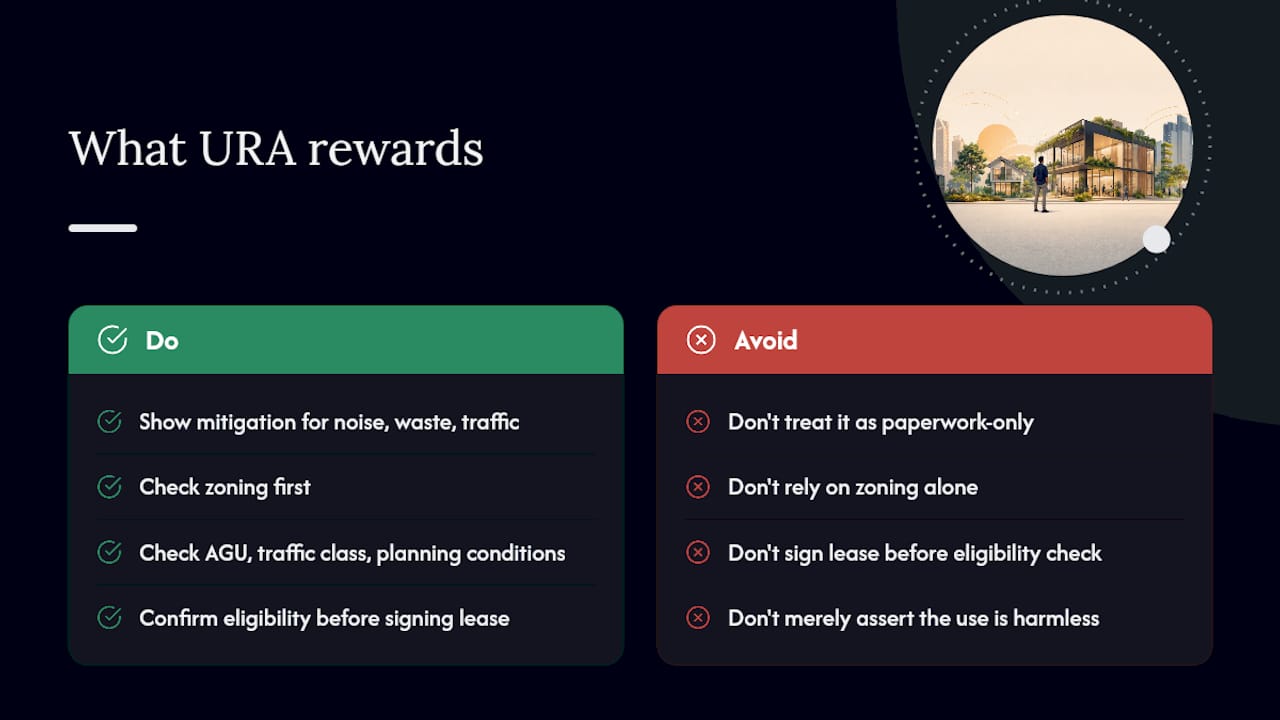
The conventional advice to “check zoning first” is correct but incomplete. Zoning tells you whether a use is theoretically allowed. It says nothing about AGU status, traffic classification, or existing planning conditions tied to the specific building, and those three factors disqualify more lodgment applications than zoning mismatches ever do.
If there is one priority worth putting ahead of everything else, it is sequencing: confirm eligibility before signing a lease, not after. The businesses that get burned are rarely the ones with a complicated use case. They are the ones who committed to rent before running a five-minute check that would have flagged the problem.
— Aman
Get Managed Support for Your Change of Use Submission
Filing a Change of Use application solo means juggling URA’s assessment criteria, GoBusiness paperwork, and whatever SCDF, NEA, or PUB clearances your use triggers, all while a landlord waits for an answer. Professional firms can handle that coordination directly, preparing location and floor plans, securing owner-consent documentation, managing PE endorsements, and liaising with each relevant authority so the file goes in complete the first time.
Typical engagements start with a scope review of your intended use against current zoning and AGU status, followed by a proposal covering plan preparation, submission management, and agency coordination through decision. If your project also touches structural work or M&E changes, that scope folds into the same engineering consultancy engagement rather than requiring a separate vendor. Reach out with your property address and intended use, and get a clear read on eligibility and next steps before you sign anything binding.
Sources
- Change of Use Lodgment | Urban Redevelopment Authority (URA)
- Change of Use Approval | Licence & Accreditation (GoBusiness)
- Land betterment charge | Singapore Land Authority (SLA)