
Six families of column jacketing dominate current practice: reinforced concrete/mortar jacketing, steel jacketing, externally bonded FRP, near-surface mounted (NSM) reinforcement, shape memory alloy (SMA) systems, and hybrid configurations combining NSM with UHPC or ECC and GFRP mesh. Choose RC jacketing for severe material loss or large capacity gains, steel for tight sites or rapid retrofits, and FRP, FRCM, or NSM when geometry must stay near-original or timelines are short. Recent hybrid NSM plus UHPC testing has pushed ultimate load capacity up by as much as 49% in select configurations, making it the method to watch for seismic upgrades.
TL;DR:
- Hybrid NSM plus UHPC or ECC with GFRP mesh can increase a column’s ultimate load capacity by up to 49 percent, with energy absorption nearly five times that of unstrengthened specimens.
- External FRP systems often suffer from premature debonding, which reduces their effective capacity to about 30 to 35 percent in real-world conditions.
- RC jacketing involves added mass and stiffness that can alter seismic demands, requiring careful consideration of slab continuity and construction time.
- Steel jacketing offers quick installation and confinement benefits but necessitates additional corrosion protection and grout quality controls to prevent load transfer issues.
- Selection of a jacketing method should be driven by capacity needs, space constraints, environmental exposure, and long-term durability considerations, not just material preferences.
Table of Contents
- What Column Jacketing Actually Does
- RC and Mortar Jacketing: Mechanics, Detailing, and Trade-offs
- Steel Jacketing: Installation Options and Protective Requirements
- FRP, FRCM, and NSM Systems: Bond Mechanics and Failure Modes
- SMA and Emerging Jacketing Techniques
- Hybrid Jacketing: NSM Plus UHPC or ECC With GFRP Mesh
- How to Choose a Jacketing Method: A Practical Checklist
- Implementation Best Practices That Prevent Field Failures
- What the Evidence Actually Shows
- Where AECTechnicalSG Fits Into a Jacketing Project
- A Practical Note on Conservative Versus Innovative Choices
- Get a Technical Review Before You Commit to a Method
- Sources
What Column Jacketing Actually Does
Column jacketing wraps or encases an existing reinforced concrete column with new structural material to restore or increase its axial, flexural, or shear capacity. It differs from beam-column joint retrofits, which target the connection zone rather than the member itself. Engineers reach for jacketing when corrosion has eaten into the original steel section, when as-built reinforcement falls short of current code demand, or when a column shows shear or buckling vulnerability under seismic load.
The state-of-the-art literature review covering the field groups methods into six categories:
- Reinforced concrete or mortar jacketing
- Steel jacketing
- Externally bonded FRP (EB-FRP)
- Near-surface mounted (NSM) FRP or steel reinforcement
- Shape memory alloy (SMA) jacketing
- Hybrid systems combining two or more of the above
EB-FRP dominates the published record, appearing in roughly 59 of the 99 studies reviewed, largely because it is fast to test and easy to instrument in lab settings.
RC and Mortar Jacketing: Mechanics, Detailing, and Trade-offs
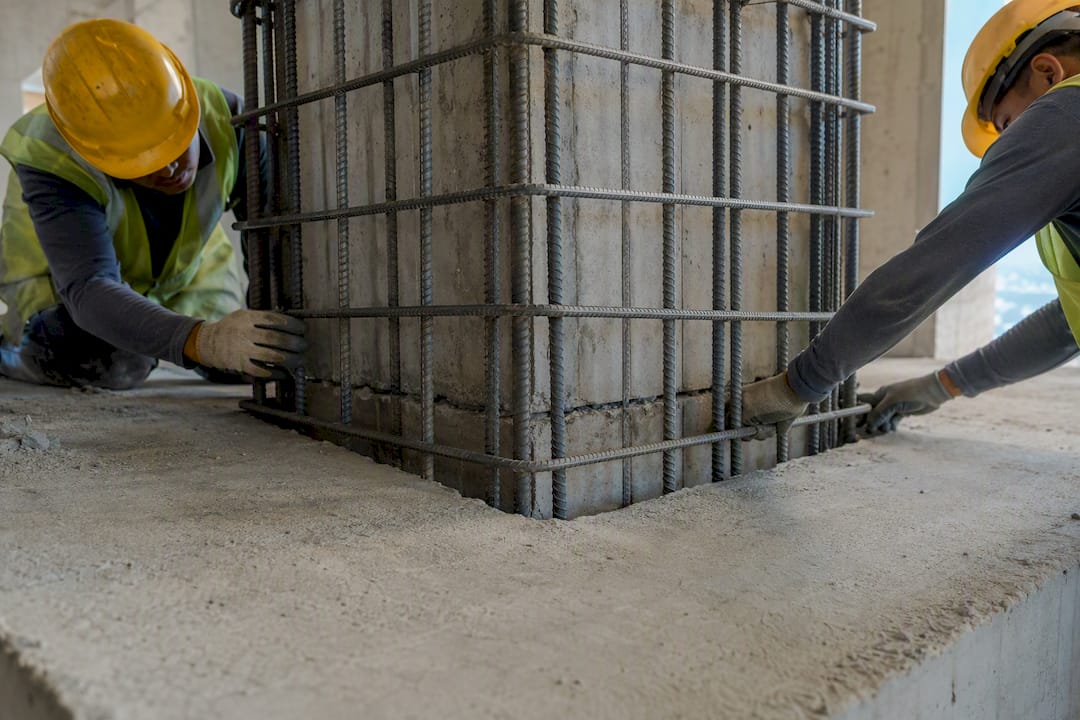
RC jacketing adds a new concrete shell around the existing column, tied together with new longitudinal bars, closely spaced stirrups, and anchorage into the foundation or slab above. Formwork wraps the column, additional bars run parallel to the original cage, and dowels or epoxy anchors stitch the new shell to the parent section so the composite behaves monolithically under load reversal.
- Drill and anchor dowels into the existing core before placing new longitudinal steel.
- Space added stirrups at half the spacing of the original transverse reinforcement.
- Place new stirrups out of phase with the original set to improve cyclic performance, a detail confirmed in rehabilitation studies on RC jacketing.
- Continue reinforcement through the slab when full continuity is required, or leave a gap if the goal is shear and ductility only.
RC jacketing adds mass and stiffness, which shifts the building’s natural period and can redistribute seismic demand elsewhere in the frame. High-performance concretes sometimes substitute for conventional mixes specifically to limit how much the column grows in cross-section. Expect shoring, extended curing time, and a longer construction program compared with lighter-weight alternatives.
Pro Tip: Check slab continuity requirements before you finalize the jacket detail. Drilling through an occupied slab to extend longitudinal bars adds weeks to a program that a shear-only jacket with a clean gap would not need.
Steel Jacketing: Installation Options and Protective Requirements
Steel jacketing wraps the column in preformed shells, rolled plates for circular sections, or bolted and welded plate assemblies for rectangular ones. The annular gap between the jacket and the existing concrete gets pressure-grouted to lock the shell against the parent section and transfer load through bearing and friction rather than adhesive bond.
- Rolled circular shells install fast and confine concrete efficiently under axial load.
- Welded or bolted rectangular jackets suit tight urban sites where formwork clearance is limited.
- Grout consolidation quality determines whether the jacket actually engages the original column under service load.
Steel jackets win on speed and compact profile, but they add scope elsewhere: corrosion protection and fireproofing become separate line items the RC alternative handles inherently through concrete cover.
Pro Tip: Specify weld inspection and grout sampling as separate acceptance criteria in the contract. A visually clean steel jacket can still hide inconsistent grout fill that shows up only under load testing.

FRP, FRCM, and NSM Systems: Bond Mechanics and Failure Modes
Externally bonded FRP applies fiber sheets with epoxy resin directly to a prepared concrete surface, adding strength with almost no change to column geometry. FRCM, sometimes called textile-reinforced mortar, swaps the epoxy for a cementitious matrix, which trades a small amount of tensile efficiency for far better performance in wet or high-temperature environments where epoxy bond can degrade.
NSM reinforcement takes a different path: grooves get cut into the cover concrete, and FRP or steel bars are anchored into those grooves with structural adhesive. Because the reinforcement sits embedded rather than surface-mounted, NSM often resists premature debonding better than EB-FRP.
- EB-FRP’s main failure mode is premature debonding, which studies link to effective utilization as low as 30 to 35% of the fiber’s theoretical strength.
- End anchorage and mechanical fasteners at sheet termination points reduce debonding risk.
- Surface preparation, including profiling and moisture control, matters as much as the material choice itself. Aectechnicalsg’s FRP strengthening overview covers detailing specifics for aging concrete substrates.
SMA and Emerging Jacketing Techniques
Shape memory alloy jacketing wraps columns in SMA wire or strip that gets activated through heat treatment, causing the material to contract and apply confining pressure to the concrete core. The confinement effect happens without epoxy bonding, which sidesteps the debonding problem that plagues EB-FRP.
- SMA jacketing suits niche seismic retrofit cases where repeated deformation cycles are expected.
- Cost and limited material availability keep it out of routine specification for now.
- Long-term service data remains thin compared with decades of RC and steel jacketing performance history.
Most current SMA applications pair the wire confinement with a conventional jacket for redundancy, and any installation should include monitoring provisions since the alloy’s activation behavior is sensitive to installation temperature control.
Hybrid Jacketing: NSM Plus UHPC or ECC With GFRP Mesh
Hybrid systems combine NSM bars, an external jacket of ultra-high-performance concrete or engineered cementitious composite, and a GFRP mesh layer, each component doing a distinct job. NSM bars carry flexural reinforcement, the UHPC or ECC shell provides confinement and crack control, and the GFRP mesh distributes tensile stress across the new jacket surface.
Experimental finding: Combining NSM bars with an external UHPC or ECC jacket reinforced by GFRP mesh raised ultimate load capacity by 25% to 49% depending on configuration, with energy absorption gains reaching nearly 4.7 times the control specimen in UHPC variants.
- UHPC variants generally outperform ECC variants on confinement in tested specimens.
- Mixing and curing UHPC requires tighter quality control than conventional shotcrete or cast-in-place mortar, a point worth reviewing alongside UHPC design considerations for slender structures.
- Performance varies meaningfully by configuration, so lab results should not be read as a fixed multiplier for every project.
How to Choose a Jacketing Method: A Practical Checklist
Matching the method to the project starts with the capacity gap, not the material catalog.
- Quantify the required capacity increase against current demand, not just visible deterioration.
- Confirm space constraints. RC jacketing needs formwork clearance; steel and FRP need far less.
- Set your tolerance for program interruption. FRP and NSM install faster than RC.
- Define fire resistance and long-term durability requirements before selecting a polymer-based system.
- Assess environmental exposure. Choose FRCM over EB-FRP in wet or high-heat conditions.
- Confirm budget ceiling and any aesthetic or heritage constraints on visible geometry change.
- Run minimum investigations: material and cover testing, rebar corrosion assessment, as-built drawing review, and a shoring workload estimate.
Pro Tip: Never finalize a jacketing method before a PE has reviewed the as-built condition on site. Drawings routinely misstate actual cover depth and bar layout on buildings older than 20 years, and that gap changes which method is even viable. Structural changes affecting load path typically require PE endorsement and authority submission before construction begins.
Implementation Best Practices That Prevent Field Failures
Surface preparation, anchorage detail, and sequencing decide whether a jacket performs as designed or debonds within a few years.
- Sandblast or grind the substrate when bonding FRP or FRCM; a bonding primer alone rarely compensates for inadequate surface profile.
- Drill and epoxy-anchor dowels for RC jackets, keeping added stirrup spacing at half the original and placing new stirrups out of phase with the existing set.
- Decide early whether the column can carry load during the jacketing sequence or whether loads must transfer to temporary shoring first.
- Monitor grout consolidation in steel jackets and cure timing in UHPC or ECC jackets; both are common points of quality slippage on site.
- Run acceptance testing before sign-off: grout sample strength for steel jackets, weld and coating inspection, and bond-pull checks for FRP or FRCM systems.
Pro Tip: Treat the shoring plan as part of the structural design, not a contractor afterthought. A column jacketed while still carrying full service load behaves differently than one relieved by temporary props, and that difference belongs in the calculation, not just the site method statement.
What the Evidence Actually Shows
The literature review of 99 studies categorizing jacketing into six methods found EB-FRP represented the largest single share of published research, roughly 59 studies, reflecting how easy the material is to test rather than a claim that it outperforms alternatives universally.
- EB-FRP’s real-world effective utilization drops to 30 to 35% in some tested configurations because of premature debonding.
- Hybrid NSM plus UHPC or ECC configurations produced ultimate load increases up to 49% and energy absorption gains near 4.7 times control specimens.
- UHPC confinement outperformed ECC confinement within the same test series, although both remain configuration-dependent.
Lab specimens rarely match field boundary conditions exactly. Test columns are often stub sections with idealized loading, while real columns carry eccentric loads, prior damage, and inconsistent cover. Treat published percentage gains as a calibration reference, not a design guarantee, and verify against project-specific material testing before committing to a hybrid system.
Where AECTechnicalSG Fits Into a Jacketing Project
Structural assessment, design iteration, and PE endorsement for column strengthening projects, including coordination with authorities such as BCA and SCDF where structural changes trigger submission requirements, are typically involved. The firm’s approach starts with condition assessment and as-built verification, moves through method selection and detailing, and closes with site supervision through the jacketing sequence. For projects weighing a conventional RC jacket against a hybrid FRP or UHPC system, that assessment stage is where the real decision gets made, not the material spec sheet.
A Practical Note on Conservative Versus Innovative Choices
RC and steel jacketing earn their reputation through decades of service history. Default to them when the project carries high consequence of failure or when the owner has low appetite for unproven systems. Hybrid NSM plus UHPC systems deserve a pilot mindset. The performance numbers are genuinely strong, but they come from controlled test configurations, not decades of buildings in service. Pair any polymer-based or high-performance cementitious jacket with a monitoring plan, and be honest with clients about where the evidence base is thin versus where it is deep.
— Aman
Get a Technical Review Before You Commit to a Method
Choosing between RC, steel, FRP, and hybrid jacketing is not a catalog decision. It is a site-specific engineering call that depends on as-built conditions, load demand, and how much program disruption the building can tolerate.

Aectechnicalsg provides structural assessment, jacketing design, and PE endorsement for authority submissions across Singapore, cutting out the back and forth of coordinating a separate structural consultant and submission agent. The firm’s range of consultancy services covers everything from initial condition survey through detailed jacket design, and its PE endorsement and authority submission service handles the regulatory path directly with BCA and SCDF. If a column on your site shows corrosion, cracking, or a capacity shortfall against current load requirements, request a technical review to confirm which jacketing method actually fits the condition on the ground.
Sources
For jacketing taxonomy and comparative constructability data, start with the state-of-the-art review of jacketing methods. For hybrid NSM and UHPC design equations and experimental setup, consult the Scientific Reports study on integrated NSM and GFRP-reinforced jacketing. Engineers evaluating FRCM against EB-FRP for environmental exposure should review the FRCM performance study, and for a broader synthesis of seismic strengthening options, see the review of traditional and modern column strengthening techniques. Engineers wanting supplemental FRP training material can also review this technical webinar on FRP strengthening systems.
- Strengthening and Repair of Reinforced Concrete Columns by Jacketing: State-of-the-Art Review
- Integrated NSM and GFRP‑reinforced ECC/UHPC techniques for strengthening deficient RC columns | Scientific Reports
- Strengthening and Repair of Reinforced Concrete Columns by Jacketing: State-of-the-Art Review