
CORENET X replaces siecemeal, agency-by-agency approvals with three sequential gateways (Design, Construction, Completion) plus an optional Piling Gateway, each reviewed against a single federated model. Project teams already meeting the mandatory thresholds must register on the CORENET X Submission Portal, confirm IFC+SG model readiness, and assign Qualified Person roles before touching a submission. Everything else in your CORENET X workflow builds from that single starting point.
TL;DR:
- Submissions that meet mandatory thresholds must use the CORENET X portal, which enforces role assignment, federated model preparation, and model checks before agency approval.
- The approval process is designed around four gateways, with the Construction Gateway being the most complex, and delays often stem from missing documents or late declaration signatures.
- IFC+SG format is mandatory for projects with a gross floor area of 5,000 square meters or more, with smaller projects allowed lighter formats; failure to comply can cause rejection or delays.
- Running model quality checks early and fixing flagged issues before formal submission can reduce the chance of rejection and shorten review times within the 20-day SLA.
- External support from specialists like Aectechnicalsg can streamline the process, ensure model compliance, and help manage gate-specific requirements.
Table of Contents
- What Are the CORENET X Gateways and How Do They Work?
- How Do You Move a Project Through the CORENET X Submission Portal?
- Who Does What: Roles, Accounts, and Documentation
- What Model Format Does CORENET X Require?
- How Long Does CORENET X Approval Take?
- What Training and Resources Support the CORENET X Transition?
- How Aectechnicalsg Supports CORENET X Submissions
- What CORENET X Really Changes About Project Delivery
- Get Hands-On Help With Your CORENET X Submission
- Where to Find Official CORENET X Information
- Sources
- FAQ
What Are the CORENET X Gateways and How Do They Work?
The Regulatory Approval for Building Works (RABW) framework folds more than 20 separate agency touchpoints into a structure most teams can hold in their heads. It runs as three sequential gateways, plus a fourth optional one for projects with substantial foundation work, all reviewed against a coordinated, federated model instead of a stack of disconnected drawing sets.
Design Gateway (G1) locks down macro design parameters. This is where the Urban Redevelopment Authority (URA), Land Transport Authority (LTA), National Environment Agency (NEA), PUB, and NParks weigh in on massing, setbacks, drainage, and greenery provisions before anything gets detailed further.
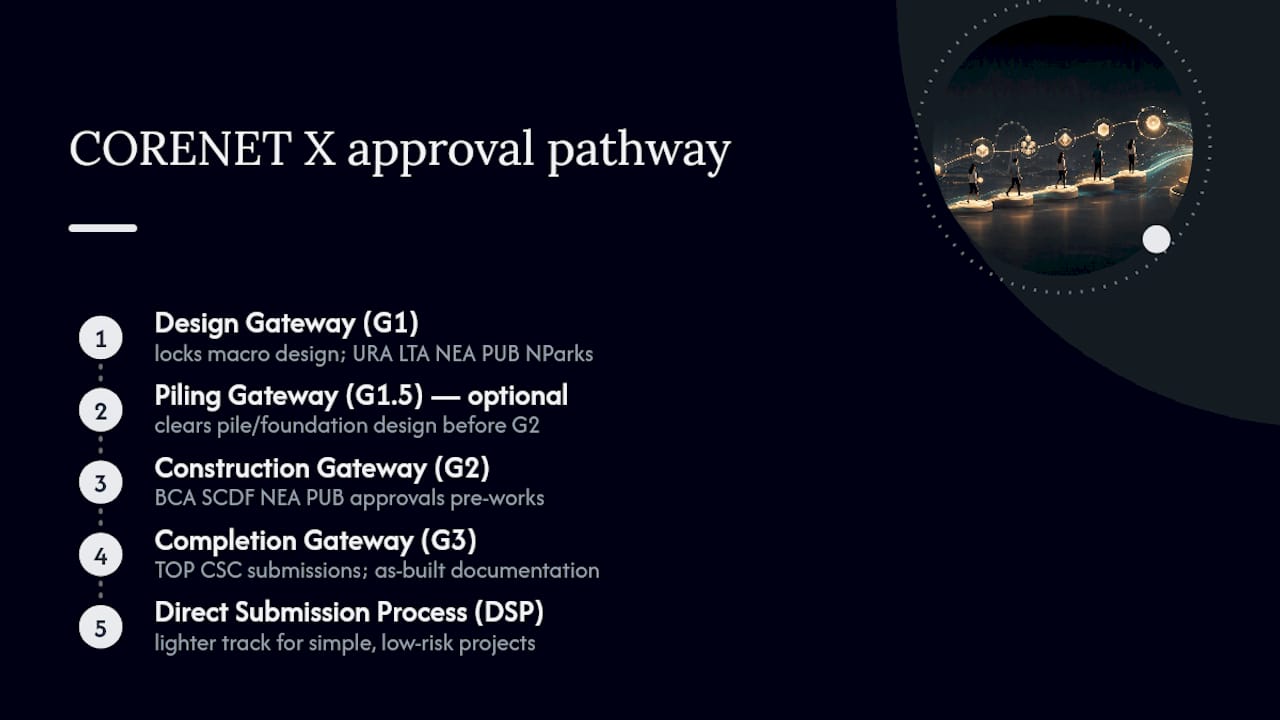
Piling Gateway (G1.5) is optional and applies mainly to projects with deep foundations or complex geotechnical conditions. It clears pile and foundation design ahead of the main Construction Gateway, so foundation work can start without waiting on the full G2 package.
Construction Gateway (G2) is the heavyweight stage. Building plan and structural approvals from the Building and Construction Authority (BCA), fire safety clearance from the Singapore Civil Defence Force (SCDF), and relevant NEA and PUB items all converge here, ahead of main works and any sales launch.
Completion Gateway (G3) covers Temporary Occupation Permit (TOP) and Certificate of Statutory Completion (CSC) submissions, along with as-built documentation.
Simple, low-risk projects may bypass some of this through the Direct Submission Process (DSP), a lighter-touch track for developments that don’t need the full multi-agency coordination.
How Do You Move a Project Through the CORENET X Submission Portal?
The portal workflow follows a logical sequence, but the order matters more than most teams expect. Skipping a checkpoint tends to surface as a rejection two steps later, not immediately.
- Create the project and set up access. The Project Coordinator (PC) creates the project shell, invites team members, and assigns roles. Every organization involved needs Corppass access, and individual users authenticate through Singpass.
- Select the gateway and submission type. Inside the Submission Workspace, the team picks whether this is a G1, G1.5, G2, or G3 submission, which determines what documents and model views the portal expects.
- Prepare the federated model and supporting documents. Discipline models get merged into one coordinated federated model, alongside any non-BIM attachments the submission type requires.
- Run the Model Checker. The Automated Model Checker (AMC) runs quality checks against the model before anything goes to an agency reviewer, returning results as BCF files that flag specific issues by location and element.
- Fix flagged issues and resubmit for checking. Import the BCF file into your BIM authoring tool, resolve the flagged clashes or naming errors, and rerun the checker until the report comes back clean.
- Complete declarations, pay, and submit. Each Qualified Person must sign their own statutory declaration personally. Nobody else can sign on a QP’s behalf, so build this into your schedule rather than treating it as an afterthought.
- Track agency acknowledgement. Once submitted, agencies acknowledge receipt and may return further comments through the same BCF-based workflow, keeping the conversation tied to specific model elements instead of scattered email threads.
Pro Tip: Run the Model Checker on a partial or interim model well before your target submission date. Catching a coordinate misalignment or naming error a week early costs you an afternoon. Catching it after formal submission can cost you the full 20 working day SLA cycle.
Who Does What: Roles, Accounts, and Documentation
CORENET X assigns specific responsibilities to specific roles, and the portal enforces those boundaries rather than leaving them to convention.
- The Project Coordinator owns onboarding, adds and removes team members, and tracks milestone progress across all gateways.
- Qualified Persons, architects, surveyors, and professional engineers, carry the statutory declaration and submission responsibility for their discipline; this cannot be delegated.
- Accredited checkers and specialist consultants attach their discipline-specific submissions to the coordinated model rather than submitting standalone packages.
- Every user needs Singpass for identity verification and the organization needs Corppass access mapped to the correct roles, with finance and IT stakeholders looped in early since payment and notification settings sit outside the technical team’s usual remit.
Getting these accounts sorted before a submission window opens, not during it, is the single most common thing that separates a smooth CORENET X submission from a stalled one.
What Model Format Does CORENET X Require?
Format requirements scale with project size, and getting this wrong early is one of the more expensive mistakes a team can make.
IFC+SG, the local openBIM extension, is mandatory for BIM submissions at defined thresholds, including new developments with gross floor area of 5,000 square meters or more. Smaller projects can often get away with 2D drawings or lightweight BIM formats, but anything approaching that threshold should plan for full openBIM compliance from the design phase, not retrofit it later.
The Model Checker runs progressively deeper regulatory checks as the portal matures, and returns every finding as a BCF file rather than a PDF report, which lets teams jump straight to the flagged element in their authoring software.
The pitfalls that show up most often in BCF reports are predictable:
- Coordinate systems that don’t align across discipline models, throwing off every downstream clash check.
- Inconsistent room tagging or level naming between architectural and M&E models.
- Unresolved clashes left in the model rather than cleared before submission.
- Non-BIM supplementary documents packaged loosely instead of tagged against the correct gateway and discipline.
Because the portal runs on Agile development, checks that don’t flag an issue today may catch it in a future release, so treat a clean Model Checker pass as a snapshot, not a permanent guarantee.
How Long Does CORENET X Approval Take?
Agencies aim to return a Written Direction or Approval within 20 working days of a formal submission. That’s the baseline to build your master schedule around, and it assumes a clean, complete submission on the first pass.
Independent, agency-specific submissions, certain NParks environmental management items or NEA clearances handled outside the portal, can often run in parallel with your main gateway submission rather than waiting behind it.
Most delays trace back to a handful of avoidable causes highlighted by experts in Construction SEO Services | Prove It & Win More Bids, who emphasize the importance of strategic project marketing and visibility in preventing approval slowdowns:
- Missing supplementary documents that only surface once an agency reviewer opens the file.
- Model formats that don’t match the required IFC+SG threshold for the project size.
- QP declarations signed late because the signing step got scheduled as an afterthought.
Pro Tip: For structural-heavy projects, plan a part-ST submission ahead of the main G2 package where the scope allows it. Clearing structural elements early keeps the 20-day clock from resetting on the whole submission if a non-structural item needs revision.
What Training and Resources Support the CORENET X Transition?
The rollout comes with real preparation tools, and using them ahead of a live submission is far cheaper than learning the portal’s quirks under deadline pressure.
- Practice in the training environment before running a live submission, using the sandbox to rehearse role assignments, model uploads, and gateway selection without risk.
- Track the mandatory timeline: CORENET X submission became mandatory on October 1, 2025 for new projects with GFA of 30,000 square meters or greater, extends to all new projects from October 1, 2026, and continues onboarding ongoing projects through October 1, 2027.
- Consult the Code of Practice and Good Practices Guidebook for agency-specific requirements and federated modeling guidance that the portal interface alone won’t spell out.
Resources, including sign-up links for training courses and productivity grant information for BIM tools, are consolidated at go.gov.sg/cx, and the SPM briefing document is worth reading before your first live gateway submission.
How Aectechnicalsg Supports CORENET X Submissions
Aectechnicalsg works alongside project teams on the technical side of CORENET X submissions, including model readiness checks, PE endorsements, and coordination across SCDF/FSSD and BCA approvals. A typical engagement runs through a readiness audit, model quality control against IFC+SG requirements, submission packaging by gateway, and follow-up with agencies through the SLA window.
What CORENET X Really Changes About Project Delivery
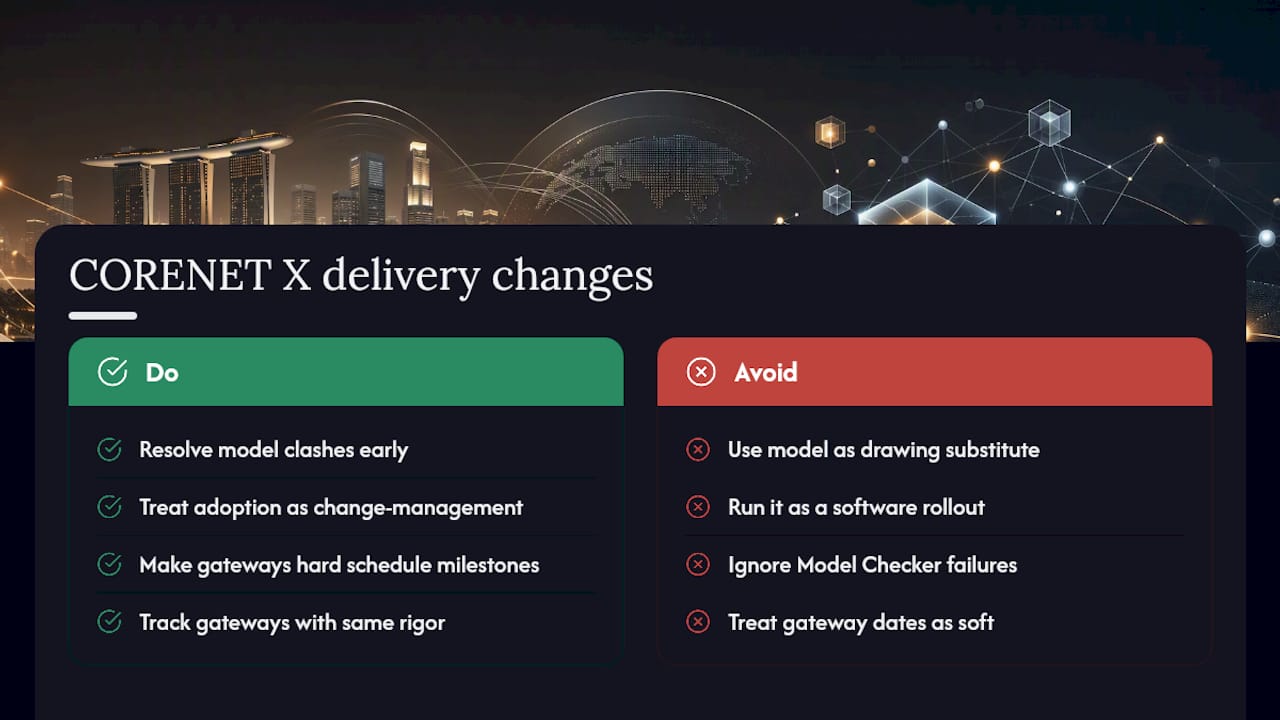
Model-centric, gateway-based review rewards teams that resolve clashes early and punishes teams that treat the model as a drawing substitute rather than the actual submission artifact. That’s a bigger cultural shift than most implementation guides admit.
Treat CORENET X adoption as a change-management exercise, not a software rollout. The gateways belong in your master schedule as hard milestones, tracked with the same rigor as a structural pour date, because a Model Checker failure two days before a G2 deadline behaves exactly like a missed site inspection.
— Aman
Get Hands-On Help With Your CORENET X Submission
Most in-house teams already stretched thin on design and construction management don’t have spare capacity to also become CORENET X portal specialists overnight. Aectechnicalsg exists as that specialist capacity: an engineering consultancy that manages the submission mechanics, PE endorsements, and model quality control so your team stays focused on the building itself.
Our work spans structural and geotechnical engineering consultation, PE endorsements for architectural and structural submissions, and coordination with BCA, SCDF, URA, and other agencies through the gateway process. If your team is bracing for a Design or Construction Gateway submission and wants a second set of eyes on model readiness before the Model Checker does, request a readiness review through our services page or get in touch about assisted onboarding support for your next project.
Where to Find Official CORENET X Information
- CORENET X overview and Code of Practice
- CORENET X Submission Portal
- Implementation circular and timeline
Sources
- CORENET X implementation circular (BCA / CORENET X)
- Overview of CORENET X (CORENET official)
- URA guidance on submitting development applications via CORENET X
- CORENET support: service level agreement guidance
FAQ
What Is the CORENET X Submission Portal?
It’s the centralized platform where project teams create projects, assign roles, upload federated models, and submit through the RABW gateways. The portal replaces the previous system of separate agency touchpoints with one coordinated submission workflow.
When Does CORENET X Submission Become Mandatory?
Mandatory submission started October 1, 2025 for new projects with GFA of 30,000 square meters or more, expands to all new projects on October 1, 2026, and phases in ongoing projects through October 1, 2027.
How Long Does a CORENET X Gateway Approval Take?
Agencies work to a Service Level Agreement of up to 20 working days for Written Directions or Approvals after formal submission. Clean, complete submissions with no Model Checker errors tend to move faster within that window.
What Is IFC+SG and When Is It Required?
IFC+SG is Singapore’s local openBIM format extension, and it’s mandatory for BIM submissions at defined project size thresholds, including new projects with GFA of 5,000 square meters or greater. Smaller projects may qualify for 2D or lightweight BIM submissions instead.
Can Aectechnicalsg Help Manage a CORENET X Submission?
Yes, Aectechnicalsg provides structural, geotechnical, and submission management services covering model readiness, PE endorsements, and agency liaison across BCA, SCDF, and URA gateways. Current service scope and engagement details are available on the services page rather than a fixed published price.