
If you manage professional fees on building or infrastructure projects in Singapore, you already know that civil and structural consultancy costs can be one of the hardest line items to pin down. This guide cuts through the ambiguity surrounding fee structures in Singapore C&S consultancies – specifically time-based models – so Project Finance Directors and Procurement Heads can make sharper appointment decisions in 2026.
1. Executive summary for finance and procurement leaders
Singapore C&S consultancies typically price their professional services using three models: fixed fee (lump sum), percentage of construction cost, or time-based (hourly rate or per-diem). In practice, consultancy agreements in Singapore often combine time-based rates with lump-sum or percentage fees for core project scopes – meaning most appointments are hybrids.
This article is written for 2026 market conditions and addresses the questions finance and procurement leaders ask most: when are time-based fees appropriate, what hourly rate bands should you expect, how do these charges interact with your total fee and construction cost budget, how consultants are paid across different fee structures including time-based arrangements, and how does AEC Technical Advisory structure time-charge work for transparency.
Here are the fast answers you can take away:
-
Time-based fees usually appear for additional services, authority liaison beyond agreed cycles, and pre-contract advisory where the exact scope is still evolving.
-
Typical roles billed by the hour range from junior BIM modellers (~S$90–140/hr) to principal PEs (~S$350–500/hr).
-
The developer sets project objectives and budget; your consultancy’s fee model should align with both.
-
Hidden additional costs are avoidable if contracts clearly separate basic services from additional services, and require written approval before time-charge work begins.
2. What you are really paying for in time-based C&S consultancy fees
Time-based fees are not simply “hours on site.” They cover highly specialised design services and statutory roles mandated under Singapore’s Building Control Act. Time-based structures are often utilised for advisory tasks when project scopes are unpredictable, but the underlying work is technical and regulated.
Activities commonly billed at hourly rates include:
-
Structural calculations – load analysis, seismic, wind, vibration, and finite-element modelling
-
Value engineering workshops and alternative scheme studies during concept design or design development
-
Authority liaison – drafting responses to BCA, LTA, PUB, or SCDF comments; attending inter-agency meetings
-
Contractor RFI responses and re-analysis triggered by construction method changes
-
Construction-stage site visits, reinforcement inspections, and structural safety checks
-
Specialist inputs such as temporary works design or façade interface coordination
Time-based fee structures allow billing for additional services like design changes or extra authority submissions that fall outside the original fixed fee scope. Reimbursable expenses – authority processing fees, laboratory testing, travel – are usually treated separately in time-based fee contracts and should be itemised with caps.
Fees also fund overheads you rarely see on an invoice: professional indemnity insurance, BIM software licences, maintaining accredited checker relationships, and the risk premium for uncertain scope.
3. Common fee models used by Singapore C&S consultancies
Three compensation methods dominate the Singapore market. Understanding each one – and when to blend them – is fundamental to your contract strategy.
Fixed fee / lump sum. One agreed price for a clearly defined scope. Lump sum fees provide budget certainty for clients and work well for smaller, well defined projects: landed house A&A, simple renovations with existing drawings, or standard industrial sheds. The risk sits with the consultant if scope grows, which is why a clearly defined scope at appointment is essential.
Percentage of construction cost. Percentage fees link compensation to construction costs, scaling naturally with project size. This model suits full design commissions on new builds, providing cost certainty through staged payments tied to milestones. Percentage fees vary based on project type and construction value. Note that construction costs typically exclude land costs and architect’s fees but include management fees and applicable taxes.
Time-based / hourly / per diem. Charged where scope is uncertain – feasibility studies, specialist advisory, or extended authority support. It offers flexibility but requires active cost management from owners.
Multiple fee types are common for complex projects. Sophisticated appointments blend a lump sum for basic services with hourly rates for additional services and variations. Unit costs based on project-specific metrics like square footage may also appear for repetitive elements such as pile cap checks.
Pros and cons at a glance:
-
Lump sum: high cost certainty, low flexibility, risk of inflated contingencies
-
Percentage: scales with project, fair for evolving scope, less transparent by discipline
-
Time-based: maximum flexibility, requires rigorous financial control, risk of budget overruns if unmanaged
4. Typical hourly rate ranges for C&S roles in Singapore (2026)
Actual rates vary by consultancy size, track record, project complexity, and market conditions. Market demand and resource scarcity can drive fluctuations in time-based fees in Singapore – particularly for niche specialisms. The following are indicative 2026 bands for budgeting, drawn from current market commentary:
-
Principal PE / Expert Advisory (accredited checker coordination, complex advisory, expert review): ~S$350–S$500/hour
-
Senior C&S Engineer (design leadership, checking, authority liaison): ~S$220–S$320/hour
-
Design Engineer (detailed structural work, modelling, schematic design): ~S$150–S$220/hour
-
BIM / CAD Modeller (drawing production, revisions, documentation): ~S$90–S$140/hour
-
Site Supervision / RE / RTO (when billed time-based rather than as the contractor’s responsibility): ~S$120–S$180/hour equivalent
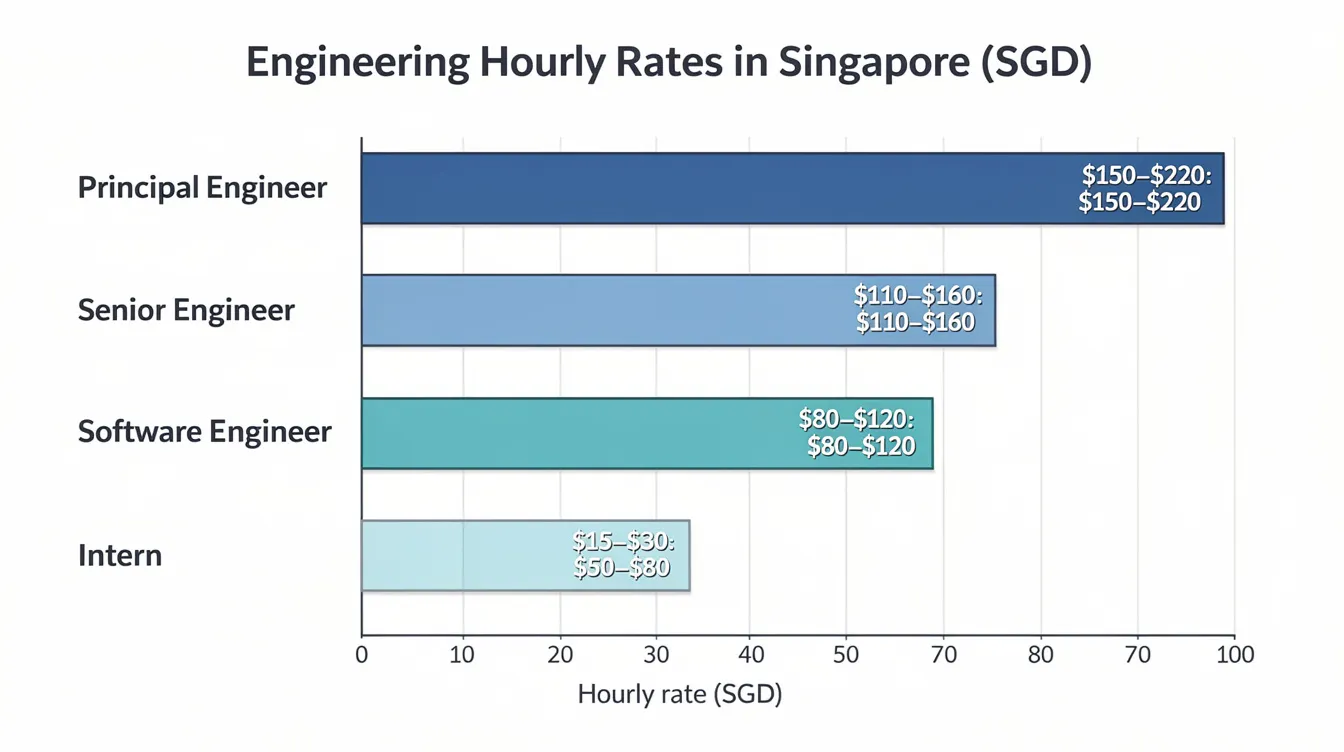
Professional seniority directly influences time-based fee structures and calculations. Hourly rates are based on the worker’s labour rate plus overheads and margin, and time-based fee calculations often include hourly or daily rates linked to staff seniority. Some firms offer daily per-diem rates (eight-hour day equivalent) for on-site meetings, audits, or intensive coordination workshops.
AEC Technical Advisory prefers to convert raw hourly rates into task-based estimates – for example, “two PE review days plus one site visit” – to give clients more cost certainty in proposals, even when the underlying pricing is time-based.
5. Where time-based fee structures commonly appear in Singapore C&S contracts
Major C&S appointments in Singapore frequently blend lump sum and time-based elements within the same professional services agreement. Core design and BCA submission packages for typical buildings are covered by fixed fee; time-based charges handle the unpredictable tail.
Typical situations where time-charge applies:
-
Pre-contract advisory and feasibility studies – early due diligence, option studies, or site condition assessments where scope is still evolving
-
Additional services beyond basic services – redesign after tender value engineering, extra seismic or blast checks, ERSS extensions, or façade re-analysis. An ERSS submission is needed for deep or constrained excavations and requires engineering design and approval coordination.
-
Extended construction support – extra site visits, unscheduled inspections, protracted testing reviews caused by programme slippage
-
Commercial and dispute support – variation assessments, forensic structural reviews, or expert reports
-
Authority re-submissions – the submission process includes document preparation and authority liaison. Authority submissions in Singapore involve agencies like BCA and LTA, and re-submissions not caused by consultant error, or triggered by new regulatory circulars mid-project, are typically billed hourly.
Time-based structures are commonly applied to undefined scopes in construction, avoiding the need to load large contingencies into a fixed fee for work that may never materialise.
6. Defining basic services vs additional services to control time-based fees
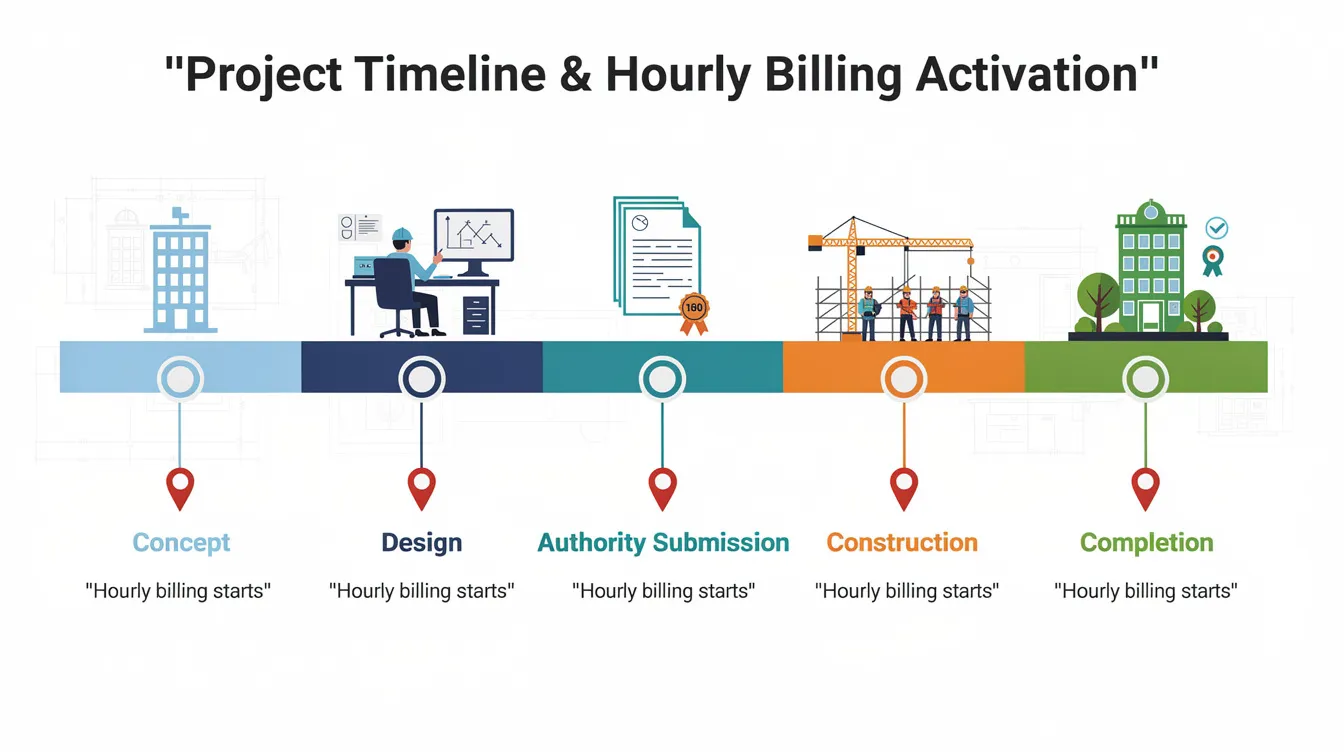
Clarity of scope at appointment is the single most effective tool for controlling additional costs and preventing disputes over hourly rates. Consultants must manage authority submissions and approvals, and the qualified person coordinates engineering submissions and professional responsibilities – but the contract must spell out what is included and what is not.
Basic services for a typical C&S commission in Singapore:
-
Concept design and structural scheme design
-
Permanent works detailed design, calculations, and drawings
-
Standard BCA structural submissions (base scope includes agreed submission cycle allowances)
-
Limited tender support and response times for contractor queries
-
Defined construction-stage inspections up to TOP / CSC
Additional services (typically billed time-based):
-
Major redesign due to significant changes in building footprint or loading
-
Alternative contractor proposals needing full re-analysis
-
Prolonged submission cycles for reasons outside the consultant’s control
-
Post-failure forensic investigations or extended peer review required
-
Major BIM re-modelling or coordinated package rework
Contracts should specify exactly when basic services switch to additional services. At AEC Technical Advisory, we issue short written variation proposals – with estimated hours, roles, and expected turnaround – before starting any significant additional work. This preserves cost certainty and creates good records for procurement audit.
7. Time-based fees, construction cost, and percentage-fee benchmarks
Procurement teams should view time-based fees alongside the wider percentage-fee structure, not in isolation. Treating them separately makes it easy to lose sight of how the total fee compares to construction cost benchmarks.
For large building or infrastructure projects in Singapore, overall C&S professional fees for basic services often sit around 1.5–3.0% of construction cost depending on structural complexity and project size. Time-based extras commonly add 5–20% on top of the base C&S fee where scope changes are significant.
Project complexity can result in higher time-based rates due to increased required effort – deep basements, long-span structures, or performance-based design services push both base percentages and variation hours upward. Construction costs exclude land costs and architect’s fees, so make sure your percentage benchmarks reference the correct denominator.
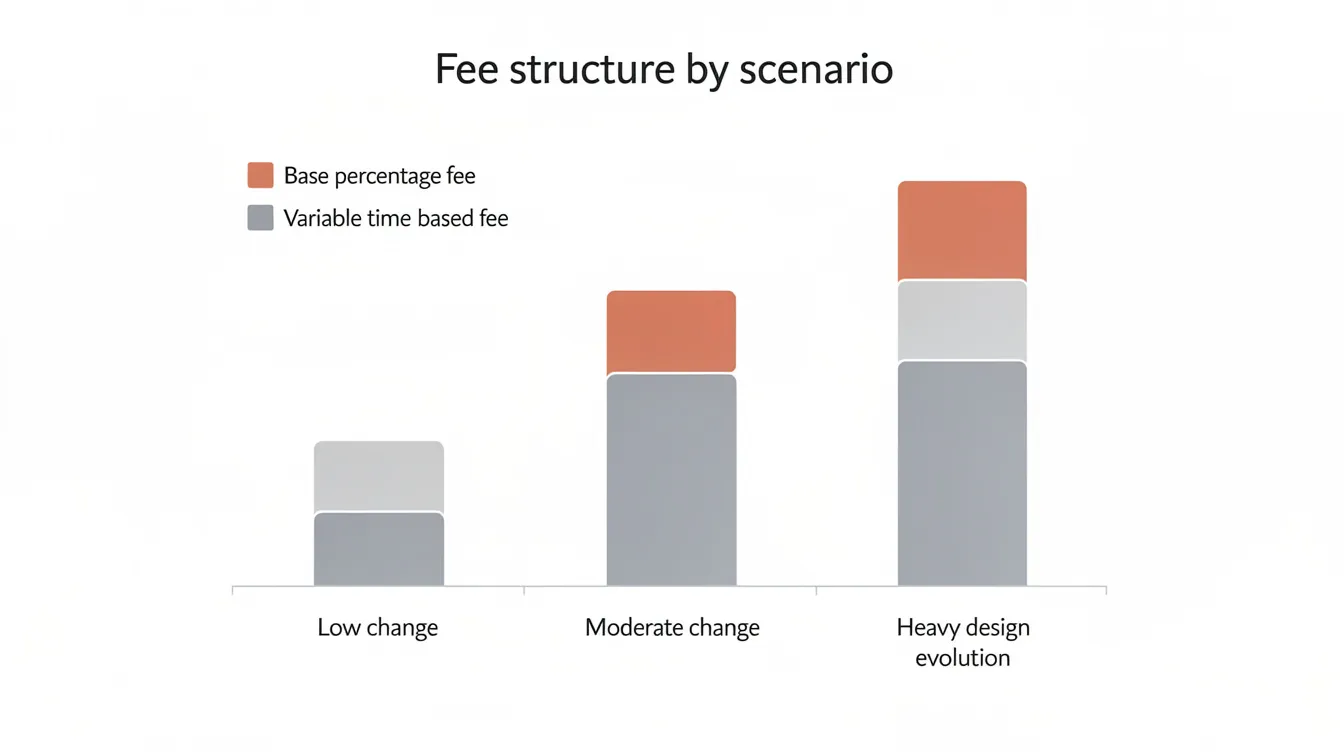
Extensive use of time-based work can push effective design fees well above initial benchmarks if change management is weak. AEC Technical Advisory reports both lump sum and accumulated time-based spend against an agreed cost plan so Finance Directors can reconcile professional fees to overall project economics at any point.
8. Cost reimbursable vs lump sum: when to prefer time-based C&S arrangements
A cost reimbursable professional services arrangement means the client pays actual hours at agreed rates plus approved disbursements. This contrasts with a lump sum or fixed fee contract where money changes hands against milestones regardless of actual effort.
When cost reimbursable makes sense:
-
Complex brownfield sites with unknown ground or as-built site conditions, where structural or geotechnical scope is hard to fix upfront
-
Fast-track or design-and-build programmes where the contractor’s proposals evolve during construction
-
Innovation-heavy or complex projects – new materials, modular systems, performance-based fire or structural design – with experimental iterations
-
The trend is shifting towards cost reimbursable contracts for complex projects where risk appetite for fixed-price appointments is low
When lump sum is preferable:
-
Simple landed A&A or renovation with a clear scope and existing documentation
-
Repeat layouts or standard industrial sheds with well defined briefs
-
Lump sum contracts provide budget certainty for clients who need a guaranteed maximum price or tight cash flow forecasting
Cost reimbursable contracts require active project management from owners. Owners must actively monitor costs, and these contracts expose owners to cost escalation risks if controls are absent. At the same time, they offer flexibility and transparency in project management and allow consultants to resource appropriately without padding fixed fees. Cost reimbursable contracts require strong project management resources on the client side.
AEC Technical Advisory can structure hybrid commercial models – for example, a capped time-charge (not-to-exceed) for poorly defined stages, converting to a fixed fee once the scope stabilises.
9. How to budget time-based C&S fees during feasibility and tender
Early budgeting of potential time-based elements prevents professional fees from becoming unplanned “contingency drains.” The Quantity Surveyor translates project scope into a cost plan, and the commercial manager tracks project exposure and contractual changes – but they both need realistic inputs from the C&S consultancy at feasibility stage.
Recommended budget line items:
-
Base C&S lump sum or percentage fee linked to initial construction cost plan
-
Time-based services allowance – hours for extra authority meetings, additional design options, unexpected accredited checker queries, scope changes
-
Separate contingency for monitoring, testing, and extended construction support if programme risk is high
For mid-size private developments, an initial allowance of roughly 10–20% of the base C&S fee as a time-charge reserve, adjusted by risk appetite and project complexity, is a reasonable starting point.
Ask consultants for a following breakdown of likely time-based triggers with indicative hour ranges so these can be priced into the budget. AEC Technical Advisory can provide scenario-based fee forecasts – “no major changes,” “moderate changes,” “heavy design evolution” – to help finance teams stress-test budgets before committing money.

Build your feasibility estimate, embed it in the RFP, lock it into the contract, then track actual vs allowance monthly. That cycle is what separates controlled projects from costly surprises.
10. Managing scope creep, variations, and additional costs on time-charge
Uncontrolled scope creep is the primary reason time-based C&S bills exceed expectation and undermine cost certainty. Strong cost control is not about refusing changes – it is about documenting them.
Practical controls for Project Finance Directors and Procurement Heads:
-
Insist on written confirmation before consultants start any additional services billed at hourly rates, including an estimate of hours, roles, and pricing
-
Require monthly time-sheet and cost summaries by workstream (design changes, authority liaison, site support) against the variation budget
-
Set thresholds for pre-approval – for example, any additional service forecast above S$10,000 requires a formal change order
-
Align the consultant’s change-control process with the main contractor’s variation process to maintain consistent commercial documentation
-
Independent checking of designs is required before submission to authorities; ensure this review is not double-counted in both the consultant’s and the checker’s fees
Clearly distinguish consultant-caused rework (absorbed within the original fee) from client-, contractor-, or authority-caused changes (chargeable at hourly rates). This distinction must be spelled out in the construction contract and the consultancy appointment.
AEC Technical Advisory uses concise variation memos and tracked registers so procurement can audit what triggered each time-based charge. Every entry records the cause, the requesting party, estimated vs actual hours, and the business justification – giving owners full visibility.
11. Accredited Checker, submissions, and time-based authority liaison fees
Singapore’s statutory framework creates specific fee touchpoints. The qualified person (PE C&S) carries professional responsibilities for design and submission. For certain building categories, an accredited checker must independently review the design before authorities accept it. Singapore’s public-sector consultancy framework emphasises quality fee evaluation over just price, reinforcing the importance of getting these appointments right.
AC fees are normally separate professional fees on a lump sum basis, but the additional queries and redesign requests they trigger can generate significant time-based effort for the design consultant.
Authority-related activities that frequently fall under hourly rates:
-
Additional technical justifications or re-analysis requested by BCA, LTA, PUB, or SCDF after initial submission
-
Extra meetings or workshops with authorities beyond those assumed in basic services
-
Re-submissions caused by client or contractor scope changes, or new regulatory circulars issued mid-project
-
Extended support for TOP / CSC clearance where site or construction deviations need additional design input
PE endorsement fees – distinct from design fees – range from about S$250 to S$2,500 depending on submission type and structural complexity.
AEC Technical Advisory states clearly in every proposal how many submission cycles and authority meetings are included in the fixed fee, and which are billed at hourly rates. This single practice eliminates the most common source of hidden charges in the entire project lifecycle.
Terms should cap the number of included submission cycles per authority, with further cycles billed time-based at the agreed rate card.
12. How AEC Technical Advisory structures transparent time-based C&S fees
AEC Technical Advisory is a one-stop architecture and engineering consultancy in Singapore providing civil, structural, geotechnical, M&E, and architectural design services alongside PE endorsements, temporary works, and façade and structural inspections. Our clients include developers, building owners, contractors, and MCSTs who need consultancy services they can trust and verify.
Our default approach to fee structures:
-
Fixed fee or lump sum for clearly defined basic services on C&S, architectural, and M&E scopes
-
Time-based hourly rates reserved for clearly labelled additional services: complex scope changes, extra authority liaison, forensic reviews, or extended construction support
-
Rate cards by role and discipline provided upfront so procurement teams can build accurate cost models and stress-test their budget against different scenarios
Transparency practices we maintain on every project:
-
Itemised proposals separating professional fees, cost reimbursable expenses, third-party costs (testing, AC), and contingency
-
Monthly statements showing hours by role and work category for any time-charge scope
-
Pre-approval workflow for additional services above agreed thresholds, protecting your cost certainty and cash flow
We encourage clients to engage us early in feasibility so fee models can be structured around your construction cost expectations and internal governance – including CAPEX approval gates, guaranteed maximum price envelopes, and risk appetite.
Understanding time-based fee structures is the first step toward controlling them. If you are preparing to appoint a C&S consultant for an upcoming project in Singapore, request a scenario-based fee proposal and insist on the controls described in this guide. Contact AEC Technical Advisory for a transparent breakdown tailored to your project’s scope, complexity, and programme.