
Introduction
Tender project management for Land Transport Authority (LTA) infrastructure tenders is the disciplined orchestration of every activity between the moment a tender notice appears on GeBIZ and the final electronic response upload – and the two tools that determine whether that effort succeeds are the bid evaluation matrix and a systematic regime of compliance checks. For contractors, consultants, and developers bidding on Singapore’s expanding rail, tunnel, and road infrastructure projects, these two instruments translate LTA’s published evaluation criteria into actionable internal workflows and prevent the administrative, technical, or regulatory gaps that lead to outright disqualification.
This article is a practical checklist – with suggested visuals and diagrams at every stage – for teams preparing LTA tenders from 2024 through 2028, a period of accelerated civil works across the Cross Island Line, viaduct extensions, depot packages, and road infrastructure upgrades. The scope covers the bid phase only: pre-qualification, tender preparation, internal evaluation, and bid submission via the government electronic business portal (GeBIZ). Construction-phase project management and tender regimes outside Singapore fall outside this guide.
In short: effective tender project management for LTA infrastructure tenders hinges on building an internal bid evaluation matrix that mirrors LTA’s Price-Quality Method (PQM) weightings and running rigorous compliance checks across administrative, technical, and regulatory requirements so that nothing derails your submission before evaluators even read it.
AEC Technical Advisory is a Singapore-based multi-disciplinary engineering and architecture consultancy that supports clients through the technical, design, and authority submission dimensions of LTA tender preparation – from PE-endorsed method statements to regulatory liaison with BCA, URA, SCDF, and PUB.
By the end of this article you will know how to:
-
Structure a bid evaluation matrix tailored to LTA quality-and-price criteria and public sector procurement guidelines.
-
Set up a compliance checklist that prevents disqualification on technicalities.
-
Organise a tender project team and backward-planned timeline for complex LTA civil and rail tenders.
-
Identify the documents, forms, and evidence LTA typically expects – including safety records, PE endorsements, and Building and Construction Authority (BCA) registration grades.
-
Leverage AEC Technical Advisory’s support for technical documentation, design reviews, and authority submissions.
Understanding Tender Project Management for LTA Infrastructure Contracts
Tender project management, in the context of large Land Transport Authority (LTA) rail, tunnel, and civil infrastructure projects, is the structured process of governing decisions, coordinating multi-disciplinary inputs, managing risk, and controlling deliverables throughout the bid phase. For contracts frequently exceeding S$100 million – and involving complex interfaces with live MRT operations, deep excavation, and utility diversions – an ad-hoc approach virtually guarantees weak proposals, missed details, or outright non-compliance.
Key Components of Tender Project Management
Four interlocking components underpin every well-run LTA tender campaign:
Governance. Decision rights must be allocated before work begins. Who signs off the technical solution? Who approves the commercial pricing and risk acceptance? For high-value tenders, an internal approval committee or board typically reviews financial exposure and contractual risk before the final submission is authorised.
Planning. Planning starts the day a new tender or PQ notice appears on GeBIZ. The entire timeline maps backward from the closing date, factoring in site briefings, the clarification period, internal design freeze, PE review windows, and mock uploads. Because LTA’s design criteria are strict – mandating compliance with its Civil Design Criteria (CDC), Infrastructure Design Criteria (IDC), and Materials & Workmanship Specifications – designs must be frozen weeks before submission to allow PE checking.
Coordination. Structural, civil, geotechnical, mechanical/electrical, safety, environmental, and traffic disciplines must converge into a single coherent proposal. The commercial team needs engineering inputs to produce accurate cost estimation; method statements and construction sequencing must be consistent across every discipline. Authority submission specialists covering BCA, URA, SCDF, and PUB often deal with overlapping criteria that demand close coordination.
Risk management. LTA infrastructure projects carry risks ranging from unknown ground conditions in tunnelling to interface clashes with live rail systems. These should be identified early, assessed for cost and schedule impact, and either mitigated through design or covered by adequate contingency in the pricing schedule. A robust approach to risk management is necessary during the evaluation of infrastructure proposals, and evaluators look for evidence that bidders have thought through these issues systematically.
In summary, the core components are:
-
Governance – clear decision rights, escalation paths, and sign-off authorities.
-
Planning – backward-scheduled timeline from submission closing date.
-
Coordination – multi-disciplinary integration of design, commercial, and regulatory streams.
-
Risk management – early identification, assessment, and mitigation of project-specific risks.
These components apply directly to current and upcoming LTA contracts such as Cross Island Line civil packages, Downtown Line extension works, viaduct erection, and depot construction scheduled through 2030.
How LTA Infrastructure Tenders Are Structured
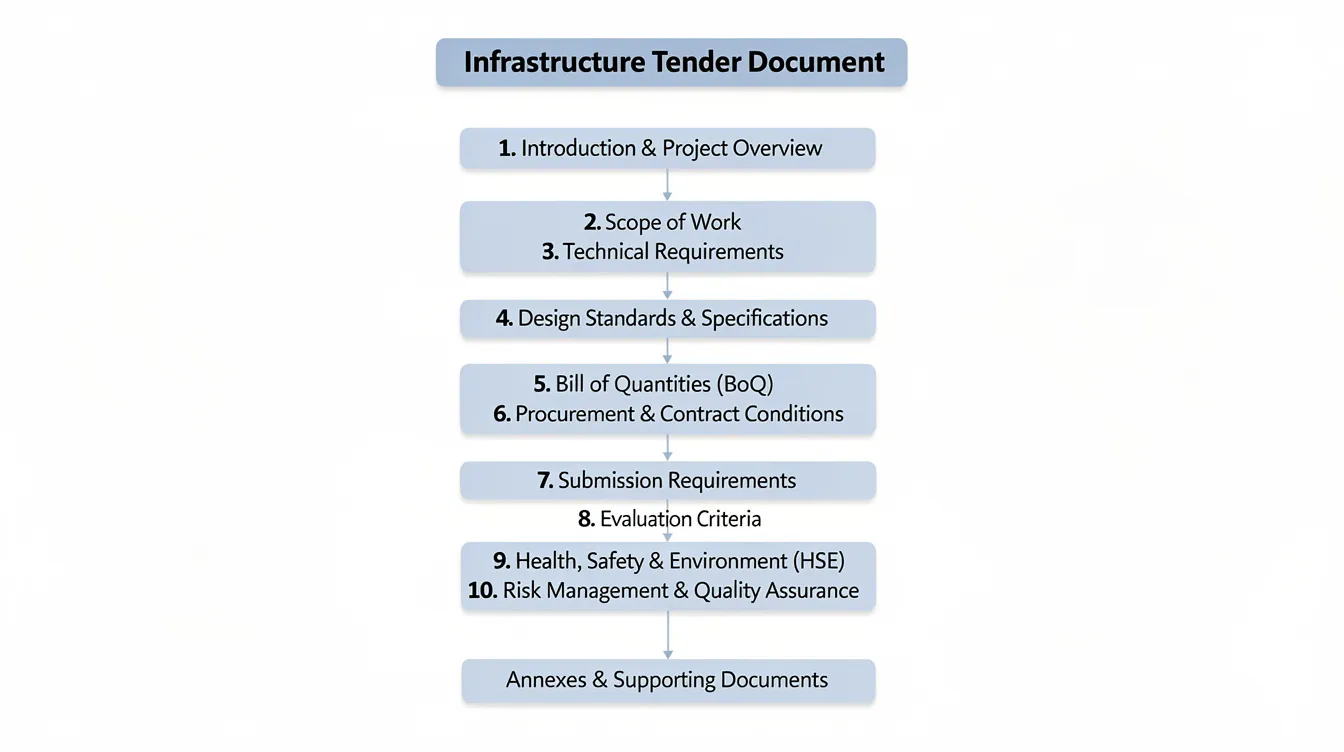
Typical LTA tender documents are organised into well-defined sections that bidders must navigate methodically:
-
Instructions to Tenderers – contains critical requirements, the two-envelope system rules (separating technical and price proposals), eligibility conditions, and submission format.
-
Conditions of Contract – LTA’s standard contract terms covering warranty, defect liability, and the Public Sector Standard Conditions of Contract. Contractual compliance reviews ensure bidders accept these terms.
-
Technical Specifications and Drawings – referencing LTA’s CDC, IDC, and Materials & Workmanship Specifications (e.g. Rev A2, Sep 2020 for civil/structural works), plus project-specific details.
-
Pricing Schedules / Bills of Quantities / Schedules of Rates – where the commercial proposal is built.
-
Returnable Forms – tender submission form, method statements, safety plans, CVs of key personnel, QA/QC forms, and PE declarations.
LTA tenders typically use one of several procurement formats. Open tenders allow any qualified supplier to bid. Selective tenders are limited to pre-qualified suppliers only, where a PQ brochure is issued first and only pre qualified tenderers are invited to submit full proposals. Multi-stage tenders involve successive rounds of filtering suppliers. Framework agreements cover multi-year arrangements for recurring services, while negotiated tenders involve direct negotiation with preferred suppliers.
For most major civil contract packages, LTA uses the two-envelope system: the technical envelope is evaluated first – sometimes against minimum pass/fail thresholds – before the price envelope is opened. A pass/fail checkpoint is included before scoring in the evaluation matrix, meaning that bids failing critical criteria are eliminated without their price being considered. Specific requirements commonly found in LTA tenders include Workplace Safety & Health (WSH) performance records, quality management system certifications (ISO 9001, ISO 45001), track record in MRT and civil works, and the use of Professional Engineers for design and construction endorsement.
Understanding this structure and the evaluation criteria it contains is essential before building your bid evaluation matrix – the subject of the sections that follow.
From Tender Notice to Internal Bid Plan
Translating an LTA GeBIZ tender notice into an organised internal project plan is where discipline either takes hold or breaks down. The first hours and days after publication set the trajectory for everything that follows.
Initial Opportunity Screening and Bid/No-Bid Decision
Within the first 48–72 hours after an LTA notice is published on GeBIZ – which handles over SGD 30 billion in annual procurement – the bid team should download all documents, sign any required NDAs, and log critical dates: site briefing, clarification deadline, and submission closing date. Tenders above SGD 90,000 require formal bidding processes, but LTA infrastructure packages are typically orders of magnitude larger.
A simple screening checklist helps determine whether to pursue:
-
Eligibility – Does your company hold the required BCA registration? BCA registration under CW02 civil engineering is a minimum requirement for civil engineering tenders. Is PE certification available for the relevant branch (Civil, Structural, Geotechnical)? Professional Engineer certification requires an approved engineering degree, passing two professional examinations, and a minimum of four years of relevant practical experience.
-
Technical capability – Does the firm have demonstrable track record in projects of similar scope (MRT tunnels, viaducts, depot civil works)?
-
Capacity – Are sufficient resources available for the projected construction period (e.g. 2026–2030), or will this tender overstretch the team?
-
Commercial appetite – Does the risk profile – ground conditions, utility diversions, interface with live rail – align with the company’s risk tolerance and financial capacity?
Suggested visual: a decision-flow diagram illustrating the bid/no-bid screening process, with each gate corresponding to the checklist items above.
Setting Up the Tender Project Team
Once the decision to bid is confirmed, appoint the core team immediately. Roles typically required for an LTA infrastructure bid include:
-
Bid/Tender Manager – overall coordination, timeline enforcement, submission logistics.
-
Technical Lead (Civil/Structural) – design narrative, construction methodology, PE-endorsed method statements, temporary works approach.
-
M&E Lead – mechanical and electrical design inputs where scope demands them.
-
QS/Estimator – pricing schedules, bills of quantities, cost estimation, contingency analysis.
-
Planning Engineer – construction programme, mobilisation plan, critical path analysis.
-
Safety Lead / WSH Specialist – safety plan, WSH method statements, past performance evidence (LTIFR, demerit records).
-
Authority Submission Specialist – ensures compliance with requirements from government agencies such as BCA, URA, SCDF, PUB, and NEA.
-
Legal/Contracts Advisor – reviews conditions of contract, risk allocation, bond and insurance requirements.
AEC Technical Advisory can fill gaps as external A&E and PE support – particularly for PE structural endorsement, constructability reviews, temporary works certification, and authority liaison across LTA, BCA, URA, SCDF, and PUB. For teams that lack in-house PE(Geo) capability, engaging a specialist PE Geo alongside PE Civil is essential for geotechnically complex packages.
A RACI chart (Responsible / Accountable / Consulted / Informed) clarifies hand-offs: for example, the Technical Lead is responsible for design; the Estimator is accountable for pricing accuracy; the Safety Lead is consulted on methodology risk; and the Bid Manager is informed at each milestone.
Suggested visual: a swimlane RACI diagram showing roles, deliverables, and hand-off points across the tender timeline.
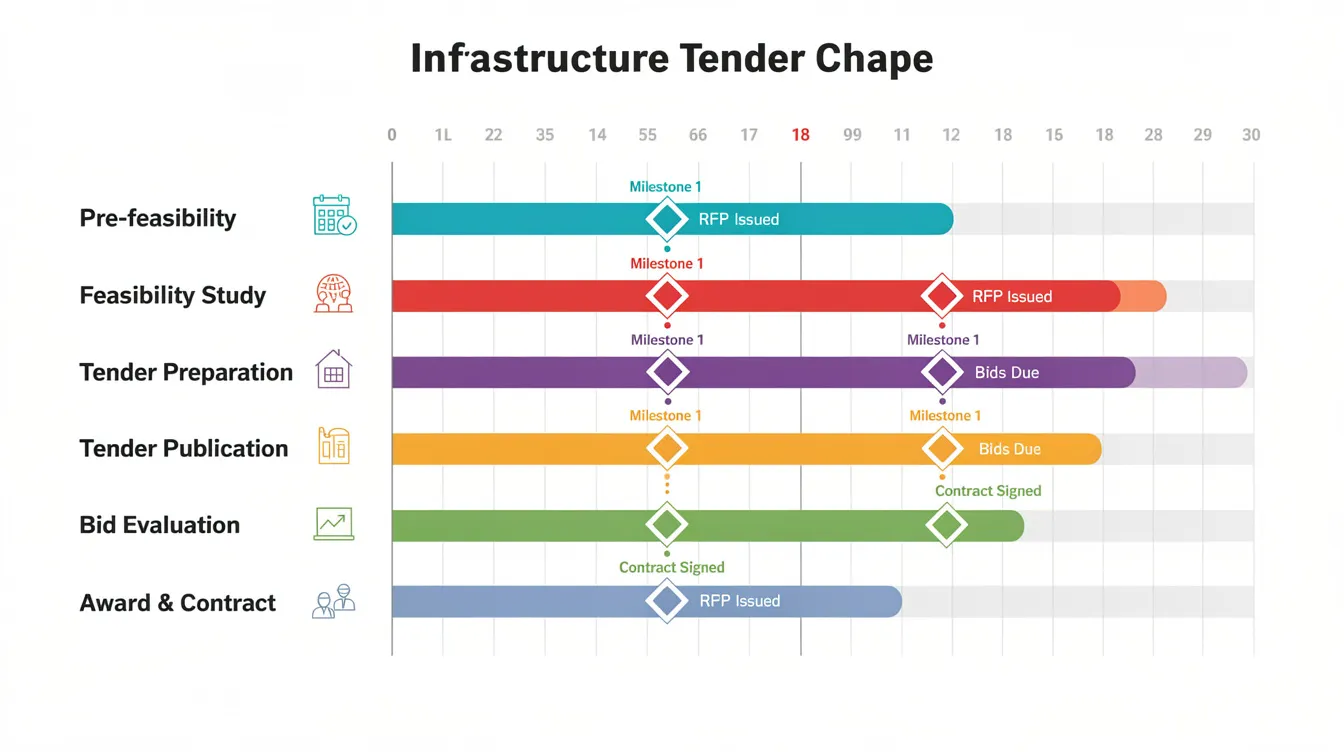
Building the Tender Programme
Convert the LTA submission deadline into a backward-planned schedule with non-negotiable internal cut-off dates. Late tender submissions are typically rejected without review – there is zero tolerance for missing the closing date.
Key milestones in sequence:
-
Tender release and document download – register opportunity on internal log.
-
Critical criteria verification – confirm GeBIZ registration, BCA grade, PE availability within 48 hours.
-
Site briefing / site visit – attend LTA’s mandatory or optional briefing; record observations.
-
Clarification period – use the clarification period to raise technical or contractual questions. Submit queries pertaining to ambiguities in technical specifications, design criteria, or contract terms before the stated cut-off.
-
Internal concept and design freeze – lock the technical approach to allow PE review and authority alignment.
-
Risk workshop – formal session to identify, assess, and price key risks.
-
Methodology and temporary works plans completed – PE-reviewed and endorsed.
-
Pricing freeze – final cost estimation sealed, contingencies agreed by management.
-
Internal review using bid evaluation matrix – mock-evaluate the submission, highlight weaknesses, assign corrective actions.
-
Full compliance check – administrative, technical, regulatory, and commercial items verified.
-
Management and legal sign-off – senior approval of financial exposure and contractual terms.
-
Mock upload to GeBIZ – test file sizes, naming conventions, and envelope separation.
-
Final submission – upload well before the closing date, confirm receipt.
Build buffer days for PE reviews, corrections after management review, and possible LTA clarifications. For a typical 6–8 week tender period on a major civil contract, at least 3–5 days of buffer should be allocated before the submission date.
Suggested visual: an example Gantt chart showing milestones, durations, and buffer zones for a hypothetical LTA civil package.
Designing an Effective Bid Evaluation Matrix for LTA Projects
Before finalising the offer, the bid team needs an internal evaluation matrix that mirrors LTA’s scoring approach. LTA employs the Price-Quality Method (PQM) for infrastructure evaluations, meaning bids are not awarded solely on lowest price. Evaluation matrices must align with public sector procurement guidelines in Singapore, and a weighted evaluation matrix aligns scoring with LTA’s core priorities: safety and quality.
Translating LTA Evaluation Criteria into a Matrix
Start by extracting criteria from the “Instructions to Tenderers” and “Evaluation Criteria” sections of the tender documents. LTA infrastructure tenders typically use a 60:40 or 70:30 price-to-quality ratio, though some rail and civil packages weight quality as high as 70% and price at 30%. The PQM framework for CW02 civil engineering work heads typically sets price weight between 50–70% and quality at 30–50%. Always extract the specific proportions from the tender being bid – never assume.
For a detailed walkthrough of how Singapore civil tender criteria work in practice, refer to our guide on Singapore civil tender evaluation criteria.
Create your matrix with the following columns:
|
Criterion |
LTA Weighting (%) |
Internal Target Score |
Current Assessment |
Evidence Source |
Action Owner |
Risk / Weakness & Improvement Needed |
|---|
Populate the rows with LTA-relevant criteria. A typical set includes:
-
Technical solution and construction methodology – including PE-endorsed method statements and temporary works design.
-
Safety performance and WSH plan – LTIFR, safety awards, demerit point history, project-specific safety measures. Safety, Health, and Environmental (SHE) performance is critical in evaluations.
-
Environmental and sustainability measures – noise and vibration mitigation, waste management, carbon reduction. From November 2024, environmental sustainability became a mandatory quality attribute under PQM for all BCA construction tenders ≥ S$3 million.
-
Organisation chart and key personnel CVs – experience on similar LTA works, local Singapore project history, PE certification credentials. Professional Engineer certification strengthens tender submissions.
-
Programme realism and mobilisation plan – credible construction sequencing, realistic durations, interface management.
-
Traffic management and interface with live operations – staging, temporary diversions, public safety.
-
Local experience and track record – past projects of similar scope with LTA or other public buyers.
-
Price competitiveness – overall value for money against the technical proposal quality.
Quality components in evaluations must be specifically broken down into measurable categories. Published criteria must be clearly addressed in tender proposals – vague or generic responses score poorly.
Suggested visual: an annotated example of a completed bid evaluation matrix for an LTA civil contract, showing populated columns and colour-coded assessments.
Scoring Technical, Commercial, and Risk Factors
Apply a consistent internal scoring scale – either 1–5 or 1–10 – with clear definitions:
-
1 = Fails to meet minimum requirement; disqualifying gap.
-
2 = Partially meets; significant improvement needed.
-
3 = Meets LTA requirements adequately.
-
4 = Exceeds requirements with strong evidence.
-
5 = Exemplar submission that demonstrably exceeds LTA requirements with project-specific innovation.
Factor risk items directly into the matrix. For example:
-
Ground conditions – if geotechnical data is limited, score the methodology lower unless the proposal includes probing, monitoring, and contingency measures.
-
Utility diversions – if diversion routes are unconfirmed, flag the risk and assess whether the programme accounts for delays.
-
Temporary works complexity – proposals lacking independent PE checking for shoring, falsework, or deep excavation support should score low under technical methodology, triggering corrective action.
-
Rail operations interface – for works adjacent to live MRT, method statements must address possessions, protection measures, and coordination with the rail operator.
Commercial scoring deserves special attention. While LTA scores price primarily by ranking (commonly computed as lowest tender price ÷ your price × price weightage), the internal matrix should also assess:
-
Margin adequacy and financial capacity to sustain the contract.
-
Contingency allowances for high-risk items.
-
Provisional sums and their alignment with the technical proposal.
-
Escalation assumptions over multi-year contracts.
Bids with abnormally low prices may trigger further investigation for compliance and viability – underpricing is not a winning strategy.
Scoring tips:
-
Avoid optimism bias: score based on evidence, not aspiration.
-
Use external reviewers or consultants to challenge internal assessments.
-
Where possible, compare against past winning submissions on similar LTA projects.
-
Proposal evaluations utilize weighted scoring systems and defined criteria – ensure your internal system mirrors this logic.
Using the Matrix to Drive Tender Improvements
The matrix is not a static document. Hold regular internal review sessions – weekly for major tenders – to update scores, highlight weak areas, and assign corrective actions. Bids are scored based on published criteria and weightings, so every improvement to a weak criterion translates directly into a higher evaluated score.
Examples of actions triggered by low internal scores:
-
Low methodology score → Revise construction staging to address site-specific constraints; add detailed temporary works drawings with PE endorsement; include a traffic management plan with phasing diagrams.
-
Weak safety narrative → Compile comprehensive safety records including LTIFR data, MOM demerit history, and safety awards; draft a project-specific WSH plan rather than a generic template.
-
Missing sustainability content → Develop an environmental mitigation plan covering noise limits (aligned with NEA guidelines), waste reduction, material sourcing, and carbon accounting. LTA has installed 21.5 km of noise barriers along MRT viaducts at residential frontages and is deploying a further 5.5 km at 16 locations – demonstrating the regulatory emphasis on environmental impact.
-
Insufficient key personnel experience → Substitute stronger CVs or engage additional specialists; ensure all nominated PEs hold current practising certificates. PE certification is necessary for civil and structural engineering projects.
A “before and after” comparison of matrix scores – showing how targeted actions raised an initially weak submission to a competitive position – is one of the most powerful internal tools for bid improvement. The most economically advantageous tender evaluates quality and price together, so even modest technical score improvements can outweigh small price increases.
Suggested visual: a before-and-after matrix snapshot showing score uplift after targeted improvements on a hypothetical LTA tender.
The matrix directly feeds into the next critical activity: rigorous compliance checking.
Compliance Checks for LTA Infrastructure Tenders
Many bids fail not on merit but on basic compliance – a missing form, an unsigned declaration, an absent PE endorsement. Bid evaluation includes administrative, technical, and financial compliance checks, and any gap in these areas can mean instant disqualification. A structured compliance checklist is non-negotiable for any LTA infrastructure submission.
Document and Administrative Compliance
Verify every item below before submission. Bidders must comply with all mandatory requirements before evaluation – there are no second chances for administrative errors.
-
GeBIZ registration – confirm your company’s registration as a GeBIZ trading partner is active. Government Supplier Registration (GRA) must be valid; if renewal is pending, include the receipt. Contractors must have Building and Construction Authority (BCA) workhead registrations for eligibility – specifically CW02 for civil engineering tenders.
-
PEB registration – verify Professional Engineers Board registration and practising certificate for the relevant branches (Civil, Structural, Geotechnical, M&E). Missing or expired PE credentials are immediate show-stoppers.
-
Mandatory forms and declarations – all LTA-prescribed forms completed, signed by authorised signatories, dated correctly. Ensure the bid validity period is stated and all addenda are acknowledged.
-
Submission format – follow the two-envelope system precisely. Technical and price documents must be kept strictly separate. Adhere to file naming conventions, allowed file types, and size limits (GeBIZ typically limits attachments to 30–35 MB per file).
-
Clarifications log – confirm that responses to all LTA clarifications have been incorporated and acknowledged in the required forms.
-
Financial statements – audited financials, turnover evidence, and proof of financial capacity to execute the contract.
-
Document versions – verify you are using the latest drawings, specifications, and addenda versions issued by LTA.
Bids must be submitted by the specified deadline. Late submissions are typically rejected without review.
For a comprehensive pre-submission walkthrough, our Q4 tender season technical submission checklist covers many of these items in additional detail.
Suggested visual: a screenshot mock-up of a well-organised submission folder structure showing envelope separation, file naming, and document grouping.
Technical and Design Compliance
Cross-check every element of your proposed design and methodology against:
-
LTA’s technical specifications and design criteria – including the CDC, IDC (with latest revisions such as IDC Volume B for Rail Infrastructure), and Materials & Workmanship Specifications. Evaluation must adhere to LTA technical specifications and safety regulations.
-
Singapore Standards and Eurocodes – where adopted for civil and structural works, including local annexes. LTA’s Engineering Group Documents (e.g. E/GD/09/104/A2) mandate that temporary works materials conform to SS or Eurocodes.
-
Requirements from related authorities – BCA for structural plans, URA for planning and conservation, SCDF for fire safety, PUB for drainage and sewerage, NEA for noise and environmental limits.
Professional Engineers and Qualified Persons play a central role at tender stage. A strong technical proposal includes structural analysis and design calculations, and temporary works proposals must be independently checked and certified by a PE and/or PE(Geo). Method statements, drawings, and calculations should carry the PE seal. For clarity on what a PE signs off on in construction, our dedicated guide explains scope and liability in detail.
AEC Technical Advisory can run independent PE-led reviews, identify design gaps, and align submissions with authority expectations – particularly for temporary works, geotechnical elements, and regulatory compliance in construction.
Build a tabular compliance matrix mapping each LTA technical clause to your firm’s response and the specific document reference where compliance is demonstrated:
|
LTA Technical Clause |
Requirement Summary |
Bidder’s Response |
Document Reference |
PE Endorsed? |
Status |
|---|---|---|---|---|---|
|
CDC Section X.X |
[Specific design parameter] |
[How your design meets it] |
[Drawing/report ref] |
Yes/No |
✓/✗ |
This compliance matrix becomes a living document that the technical team updates throughout the tender period.
Regulatory, Safety, and ESG Compliance
Key regulatory and safety areas to verify:
-
WSH records and safety statistics – present LTIFR, safety awards, and MOM demerit point records in the format LTA specifies. Safety, Health, and Environmental (SHE) performance is critical in evaluations.
-
Environmental sustainability – address noise and vibration limits (aligned with NEA guidelines and LTA’s design criteria for noise barriers), waste management, material sourcing, and carbon reduction measures. Under the PQM framework update effective November 2024, environmental sustainability is a mandatory quality attribute for all BCA construction tenders ≥ S$3 million.
-
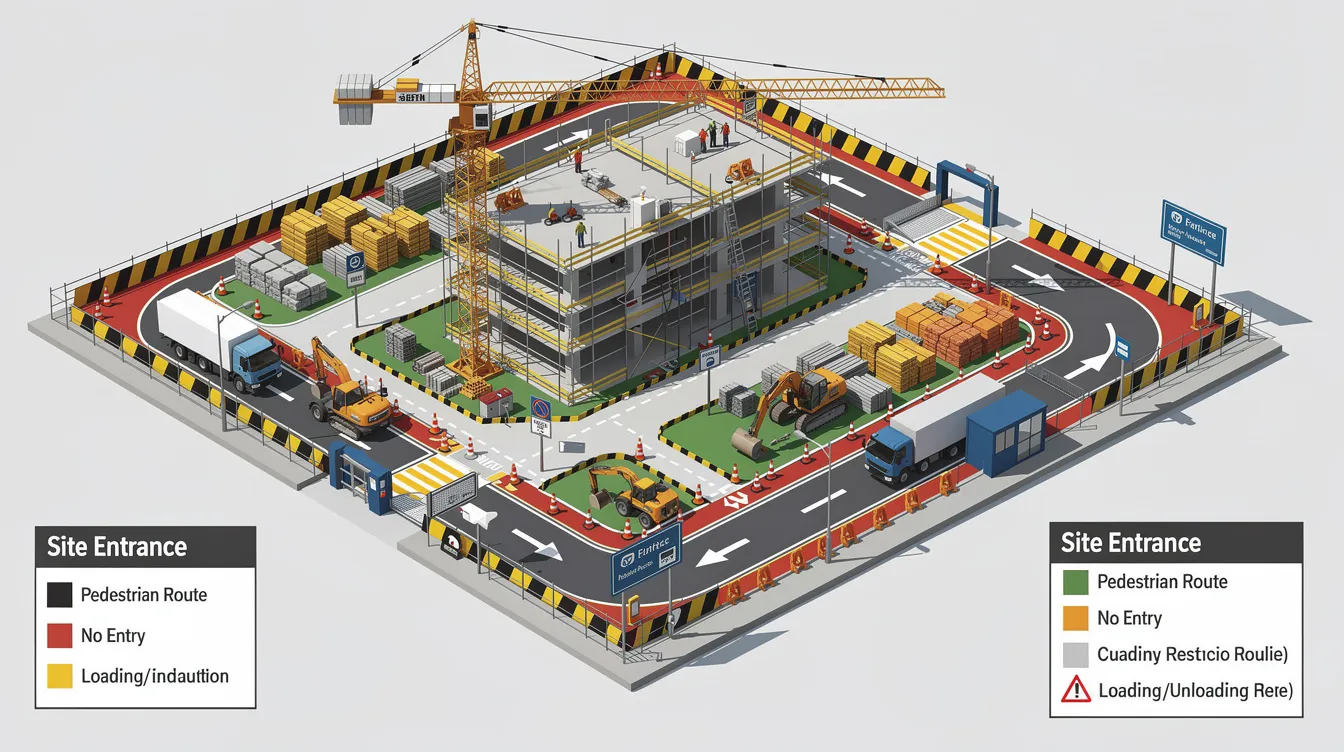
Traffic management and pedestrian safety – include method statements, staging plans, and logistics layouts for works on live roads or near MRT operations. Temporary diversions must be planned with public safety as the primary concern.
-
Compliance with anti-bribery and conflict-of-interest policies – essential in evaluations; ensure corporate governance declarations are included.
Documented procedures, method statements, and certifications (ISO 9001, ISO 14001, ISO 45001) should be attached as supporting evidence. Each certification should be current, with validity dates visible.
Suggested visual: a traffic management plan sketch and site logistics layout demonstrating compliance in practice.
Step-by-Step Tender Project Management Checklist (With Pictures)
This section consolidates everything into a sequential checklist suitable for printing and using as a project control tool. Each step includes a suggested visual to accompany it in your internal bid management pack.
End-to-End Tender Management Process
Step 1 – Receive and Register LTA Tender Register the opportunity on your internal log with tender reference, closing date, key contacts, and contract value. Download all tender documents from GeBIZ immediately. Visual: screenshot of an internal opportunity register template.
Step 2 – Conduct Bid/No-Bid Assessment Run the screening checklist (eligibility, capability, capacity, commercial appetite). Hold an executive decision meeting within 48–72 hours of tender notice publication. Visual: decision-flow diagram showing bid/no-bid gates.
Step 3 – Appoint Bid Manager and Form Tender Team Appoint the bid manager, assemble the multi-disciplinary team, and engage external advisors such as AEC Technical Advisory where PE support, submission consultancy, or authority liaison is required. Visual: organisation chart showing team structure and external advisor integration.
Step 4 – Develop Tender Programme Build the backward-planned schedule from the submission date. Allocate responsibilities, set internal deadlines, and identify critical path activities. Prepare to seek clarification on any ambiguities during the clarification period. Visual: Gantt chart with milestones and buffer days.
Step 5 – Prepare Technical Solution and Design Concept Develop the construction methodology, temporary works approach, and design narrative. Secure PE input and define the authority compliance strategy across BCA, URA, SCDF, PUB, and NEA. Technical evaluations must assess methodology against project-specific performance requirements. Visual: schematic of construction staging sequence.
Step 6 – Populate and Review the Internal Bid Evaluation Matrix Score every criterion against LTA’s published weightings. Identify weaknesses and assign improvement actions with owners and deadlines. The combined score from price and quality evaluations determines the recommendation outcome. Visual: annotated bid evaluation matrix with colour-coded scores.
Step 7 – Build Commercial Offer Develop pricing schedules, risk allowances, and contingencies consistent with the construction methodology. Ensure cost estimation aligns with the technical proposal – misalignment between the two is a common cause of low scores. Visual: pricing build-up summary showing cost categories and risk contingencies.
Step 8 – Run Full Compliance Checks Execute document, technical, regulatory, and commercial compliance checks against the master checklist. Document control, compliance checks, and scoring records form part of the evaluation process. Visual: one-page compliance checklist grouped by category (administrative, technical, safety, regulatory).
Step 9 – Hold Internal Sign-Off Meeting Senior management and legal/contracts advisor review the final submission. Confirm financial exposure, contractual terms, risk acceptance, and authority sign-off. Visual: sign-off approval form template.
Step 10 – Mock Upload and Final Submission Conduct a mock upload to GeBIZ to test file sizes, naming conventions, and envelope separation. Then perform the final upload and confirm receipt well before the closing date. Late submissions are typically rejected without review. Visual: GeBIZ upload confirmation screenshot template.
Practical Templates and Visual Aids to Include
The final article and your internal bid pack should include these ready-to-use visuals:
-
Annotated bid evaluation matrix tailored to an LTA civil contract, with populated columns and scoring guidance.
-
One-page compliance checklist showing grouped requirements: administrative, technical, safety, and regulatory.
-
Swimlane diagram of tender project management roles and hand-offs (RACI-based).
-
Authority submissions roadmap mapping submissions to LTA, BCA, URA, SCDF, and PUB against the proposed construction sequence and timeline.
These visuals should be clean, easy to interpret at a glance, and formatted for both screen and print use.
Common Tender Management Pitfalls and How to Avoid Them
Even experienced contractors lose LTA tenders due to avoidable errors. LTA enforces a framework emphasizing transparency, fairness, and value for money – and evaluation processes must provide fair competition and uphold the integrity of public procurement. Proactive checks and a robust evaluation matrix reduce the risk of falling into common traps.
Weak Technical Narratives and Method Statements
Generic, copy-paste descriptions of tunnelling, viaduct erection, or traffic staging undermine evaluation scores. Quality-to-price ratios often use a 70% quality and 30% price weighting for complex civil works – meaning a weak technical narrative can cost far more than a slightly higher price.
Actionable tips:
-
Tailor every method statement to the site’s specific constraints – ground conditions, proximity to existing infrastructure, access limitations.
-
Include staging diagrams that show clear sequencing and interface management, not just text descriptions.
-
Explicitly address risks such as utility diversions, soft ground treatment, and night works restrictions, with quantified mitigation measures.
-
Demonstrate productivity and safety gains through project-specific data rather than generic claims.
AEC Technical Advisory can help craft project-specific methodology supported by robust structural, geotechnical, and M&E design thinking – especially for infrastructure project workflows that require multi-authority coordination.
Incomplete or Non-Compliant Documentation
Typical documentation failures include:
-
Missing appendices or supporting documents referenced in the proposal.
-
Unacknowledged addenda or clarification responses.
-
Unsigned or undated declarations and forms.
-
Absent CVs, project references, or PE endorsements.
-
Wrong envelope submissions – mixing price and technical content.
-
Exceeded file size limits on GeBIZ uploads.
Solution checklist:
-
Create a master document register at tender kick-off, listing every required form, appendix, and attachment.
-
Assign a single person to own the document register and track completion status daily.
-
Perform the final compliance check using someone not involved in drafting – fresh eyes catch what tired ones miss.
-
Run the mock GeBIZ upload at least 48 hours before the submission date to catch formatting and size issues.
Bidder eligibility involves confirming qualifications and financial capacity to execute projects – and the administrative proof of both must be watertight.
Misaligned Pricing and Construction Strategy
When pricing is based on optimistic productivity assumptions or unrealistic programmes that contradict the technical proposal, evaluators notice. The PQM framework balances cost efficiency with technical and safety standards – a low price paired with an unconvincing methodology raises red flags.
Solutions:
-
Hold joint workshops between estimators and engineers to validate key quantities, rates, and productivity assumptions against the proposed methodology.
-
Run scenario tests for high-risk items – deep excavation support, night works premiums, extended rail possessions – and build these into pricing sensitivity analysis.
-
Ensure the programme duration and resource loading in the technical proposal are fully consistent with the pricing build-up.
Integrated design-and-cost reviews, led by multi-disciplinary consultants like AEC Technical Advisory, ensure the technical proposal and commercial offer tell the same story.
Conclusion and Next Steps
Winning LTA infrastructure tenders requires disciplined tender project management built on two pillars: a structured bid evaluation matrix that translates LTA’s PQM criteria into actionable internal scoring, and meticulous compliance checks that eliminate the administrative, technical, and regulatory gaps responsible for disqualification.
These practices do more than improve win rates. They force clear thinking about design, constructability, safety, and authority approvals at the earliest stage – reducing downstream project risk and producing proposals that stand up to scrutiny from LTA’s evaluation panels. For contractors and consultants competing for Singapore’s expanding pipeline of civil, rail, and road infrastructure projects through 2028, investing in systematic tender project management is a competitive necessity.
Your next steps:
-
Adapt the bid evaluation matrix structure in this article to your next LTA tender, populating it with the specific criteria and weightings from the tender documents.
-
Create a standard bid compliance checklist tailored to LTA and GeBIZ rules, grouped by administrative, technical, safety, and regulatory categories.
-
Run a dry-run tender management process on a smaller project to train your team on the backward-planning approach, matrix scoring, and compliance checking.
-
Engage AEC Technical Advisory for a PE-led technical and compliance review before submission of high-value tenders – particularly where temporary works, geotechnical design, or multi-authority submissions are involved.
Related topics to explore next include authority submission workflows, PE endorsement requirements across civil and structural disciplines, and integrating BIM and digital delivery into tender-stage methodology for technical score advantage.
Additional Resources
-
GeBIZ Portal – Singapore’s government electronic business platform for accessing LTA tender notices, submitting bids, and managing procurement communications with public buyers.
-
LTA Transport Infrastructure Design Criteria and Specifications – Official repository for CDC, IDC, and Materials & Workmanship Specifications that define mandatory compliance standards for all LTA infrastructure projects.
-
BCA Price-Quality Method (PQM) Framework – Building and Construction Authority’s procurement framework governing how public sector construction tenders are evaluated on price and quality.
-
AEC Technical Advisory’s in-house checklists and templates – purpose-built for LTA infrastructure tender management, covering PE endorsement workflows, authority submission roadmaps, and compliance matrices. Contact the firm to request samples or discuss advisory support for upcoming tenders.
-
MEAT (Most Economically Advantageous Tender) evaluation guidance – the principle underpinning PQM, where the most economically advantageous tender evaluates quality and price together rather than awarding solely on lowest cost. Suppliers interested in LTA tenders should understand how this approach shapes every aspect of bid preparation and scoring.