Silt Discharge Control During Heavy Rain QECP Practical Measures for Singapore Construction Sites
Managing silt discharge control during heavy rain is one of the most demanding challenges on any Singapore construction site. When a monsoon cloudburst dumps 50 mm in under an hour, exposed earth transforms into sediment laden runoff within minutes, overwhelming drains, sumps, and holding ponds that were never stressed under lighter showers. This article is a practical, section-by-section guide for site teams, contractors, and qualified erosion control professionals who need to keep silty water out of public drains – before, during, and after the storm.
Immediate Actions During a Heavy Rain Event
Picture this: 3:15 pm on a December afternoon. The sky turns slate-grey over your site in Tengah. Within ten minutes, rainfall intensity hits 40 mm/h. Exposed platforms begin sheeting water toward perimeter drains. Your holding ponds are filling fast. Every minute of inaction increases the risk of silty water discharge into public waterways.
Managing silt discharge during heavy rainfall requires a multi-layered defense strategy – and the first 15 to 30 minutes are critical. Here is what the qualified erosion control professional and earth control measures officer should execute immediately:
Within the first 15 minutes:
- Stop all active earthworks and vehicle movements on exposed soil
- Close temporary discharge valves or divert flows back to holding ponds
- Confirm cut-off drains are open and conveying runoff to intended sumps
- Check silt fences at low points and slope toes for damage or bypass
- Verify CCTV and monitoring systems at discharge points are functional
- Ensure pumps are running with backup power available
Rain mode triggers should be pre-defined in your ECM plans. Activate site-wide rain mode when:
- Onsite rain gauge records more than 20 mm in 30 minutes
- NEA/MSS issues a Yellow, Orange, or Red rainfall warning for your area
- Forecast models show sustained intense rainfall approaching
Priority checks during the event:
- Perimeter cut-off drains leading all runoff to sediment basins
- Overflow weirs in ECM treatment tanks and holding ponds
- Discharge pipe to public drains – visually confirm clarity, no sediment escaping
- Silt fences trap sediment and prevent runoff from bypassing the treatment train
Regular inspections should be conducted before and after heavy rainfall events, and emergency response plans must be developed for flood scenarios well in advance of monsoon season.

Role of the QECP in Heavy-Rain Silt Control
A qualified erosion control professional in Singapore is a Civil Engineer registered with IES/ACES who has completed accredited ECM training and holds relevant field experience. PUB requires QECP endorsement before any earthworks begin on a project – no endorsed plan, no clearance.
QECPs translate the ECM guidebook and regulatory requirements into practical, storm-ready designs for construction projects. This means sizing drains and ponds for a design storm event, not just fair-weather conditions. During heavy rain, the QECP’s responsibilities include:
- Reviewing real time monitoring feeds (CCTV and SIDS) to assess discharge quality
- Advising on temporary shut-off of discharge when total suspended solids approach limits
- Authorising emergency bypass or extra detention capacity where needed
- Coordinating with the earth control measures officer and site manager to balance safety, programme, and erosion and sediment control
A QECP must design and endorse the ECM plan, and an ECM plan must be endorsed by a QECP before PUB submission. In practice, QECPs bridge regulatory compliance and practical site management – they are the link between what the regulations demand and what happens in the mud.
AEC Technical Advisory can act as QECP or support QECPs through drainage, geotechnical, and temporary works design advisory for complex sites where silt control intersects with deep excavation, slope stability, or staged construction.
Regulatory Context: PUB ECM Requirements for Storm Events
Singapore’s average annual rainfall is approximately 2,400 mm, delivered through frequent cloudbursts that can exceed 50 to 100 mm/h locally. This tropical intensity is precisely why silty water regulation is strict and enforcement is proactive.
Key regulatory points relevant to heavy rain:
- Under the Sewerage and Drainage Act and its Surface Water Drainage Regulations, silty rainwater runoff must have TSS below 50 mg/L before entering public drains
- Contractors must submit an ECM plan before starting earthworks, and earth control measures must be endorsed before earthworks begin
- Sites of 0.2 hectares or larger require continuous CCTV monitoring at discharge points, linked to PUB’s Silt Imagery Detection System
- PUB enforces compliance through site inspections without notice – PUB officers can arrive at any time
Silty runoff versus process water: earth control measures ECM handle silty stormwater from exposed surfaces. Process water such as slurry, bentonite, or wash water must be managed under separate environmental controls and must not be mixed into ECM streams.
ECM systems must be designed to cope with a design storm event (minimum 5-year return period) as set out in the ECM guidebook, not just typical light showers. Non-compliance during storms can trigger stop-work orders and rectification notices. In 2023, PUB halted site clearance at the West Glades BTO project in Bukit Batok after finding omission of proper cut-off drains and silt fences – even before visible discharge occurred.
For a detailed walkthrough of the ECM submission process, including first submission requirements and PUB clearance timelines, refer to our ESCP guide.
Understanding Storm-Driven Erosion on Singapore Construction Sites
Intense rainfall hits hardest on cut-and-fill platforms, basement excavations, and temporary slopes – exactly the areas most common on infrastructure and building construction sites during the early construction phases.
Singapore’s typical soil characteristics influence erosion behaviour significantly:
| Soil Type | Erosion Behaviour During Storms |
|---|---|
| Residual granitic soils | Free-draining but coarse; prone to sheet erosion on exposed platforms |
| Marine clays | Become plastic under saturation; generate fine suspended sediment that is difficult to settle |
| Fill materials | Often loosely compacted; highly vulnerable to rill and gully erosion |
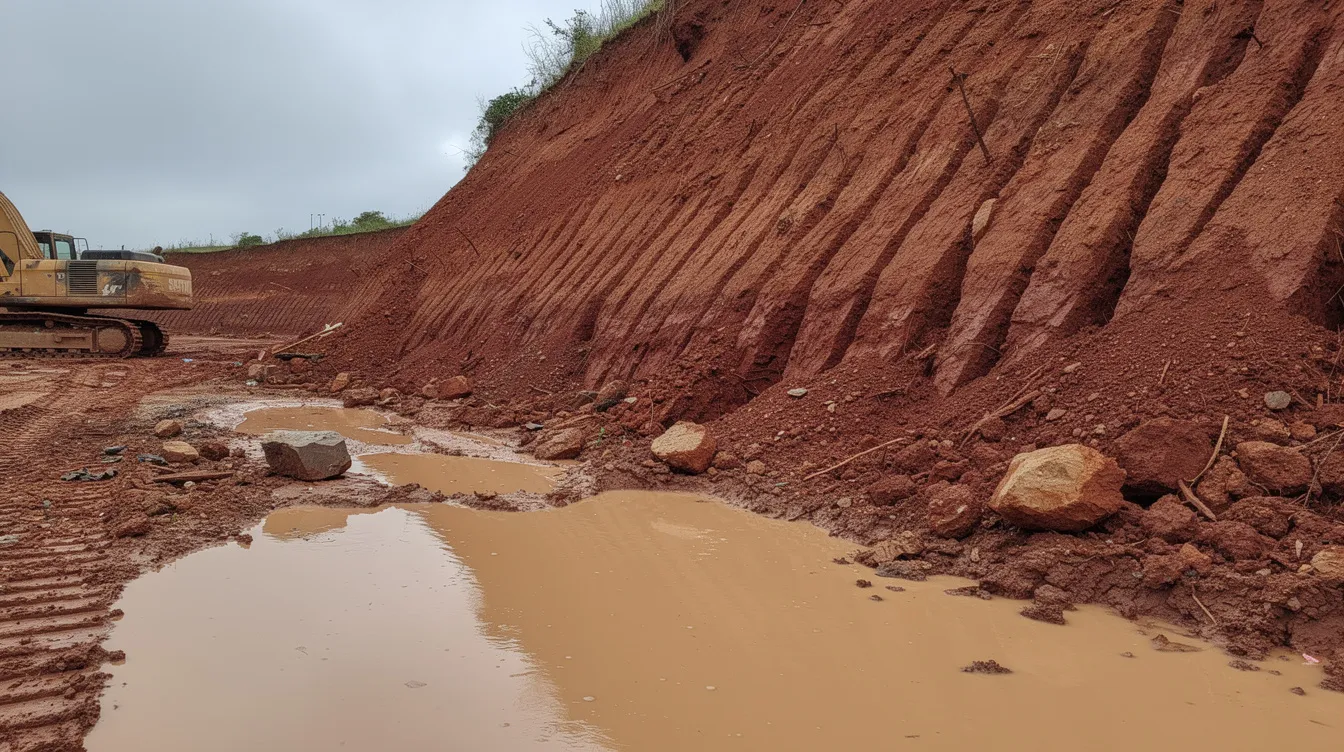
Erosion control prevents soil from detaching during rainfall – and that matters because once sediment is mobilised, it loads every downstream component. Sheet erosion strips thin layers of bare soil from flat platforms. Rill erosion cuts narrow channels along haul roads. Gully erosion carves deep slots on unprotected slopes where surface water drainage concentrates.
Constructed earth bunds help divert runoff and prevent erosion during intense storms by breaking concentrated flow paths on slopes and platforms. Understanding these mechanisms is essential because robust erosion and sediment control at the source reduces the load on downstream ECM hardware, especially during storms when treatment capacity is already stressed.
Pre‑Storm Planning: Designing Earth Control Measures (ECM) for Heavy Rain Resilience
Storm-ready ECM must be designed before earthworks begin, not improvised mid-monsoon when the first holding pond overtops. Early QECP engagement during the design phase is the single most effective way to avoid reactive, costly fixes, especially across the construction industry where storm disruptions can affect programme, safety, and nearby drains.
The design sequence a QECP should follow:
- Topographic survey and site assessment – establish existing ground levels, slopes, and catchment boundaries
- Catchment delineation – map sub-catchments using site specific data to determine where runoff concentrates
- Hydrological calculations – apply local rainfall intensity-duration-frequency curves for the design storm event
- Sizing – calculate required capacity for cut-off drains, sediment basins, holding ponds, and treatment systems
- Layout integration – coordinate ECM positions with crane pads, site offices, haul roads, and temporary works to avoid clashes during wet seasons
Construction sites of 0.2 hectares or larger must include detention tanks. Holding ponds and sumps are essential for sediment settlement and water treatment, and must include sufficient freeboard and maintenance access for desilting.
Implementing best management practices is crucial for effective sediment and erosion control. Proper planning at this stage saves rework later. AEC Technical Advisory typically coordinates ECM planning with BCA temporary works submissions and Drainage Impact Assessment where required for larger infrastructure and building projects.
Source Control: Reducing Silt Generation Before It Reaches Drains
Source control is the most cost-effective erosion control strategy under heavy rain. If sediment never mobilises, your treatment systems have far less work to do.
Practical source control measures:
- Phased clearing – minimise the disturbed area at any one time; only strip what you can actively work on
- Temporary vegetative cover – hydroseeding reduces sediment generation on construction sites by stabilising inactive zones; erosion control blankets protect slopes until vegetation establishes
- Slope protection – geotextile or plastic sheeting on steep cut slopes prevents sheet and rill erosion
- Compacted access tracks – reduce sediment pickup from vehicle movements
Control measures must prioritize covering exposed soil to minimize erosion risk during rain. Stockpiles should be covered with tarpaulins, sited away from perimeter drains, and surrounded by toe berms to catch eroded material.
Seal hoarding footings and temporary ramps to prevent underflow of silty water during intense storms. Sediment control measures include silt fences and sediment basins positioned at the site boundary and around the site perimeters to intercept anything that slips past source controls. Silt fences are used to trap sediment on construction sites and remain a frontline defense at low points and slope toes.

Conveyance Control: Keeping Runoff Within Safe Paths
Properly designed conveyance routes prevent uncontrolled overland flow and soil erosion during cloudbursts. Without them, runoff finds its own path – usually straight through your site boundary to the nearest public drain.
Key conveyance measures:
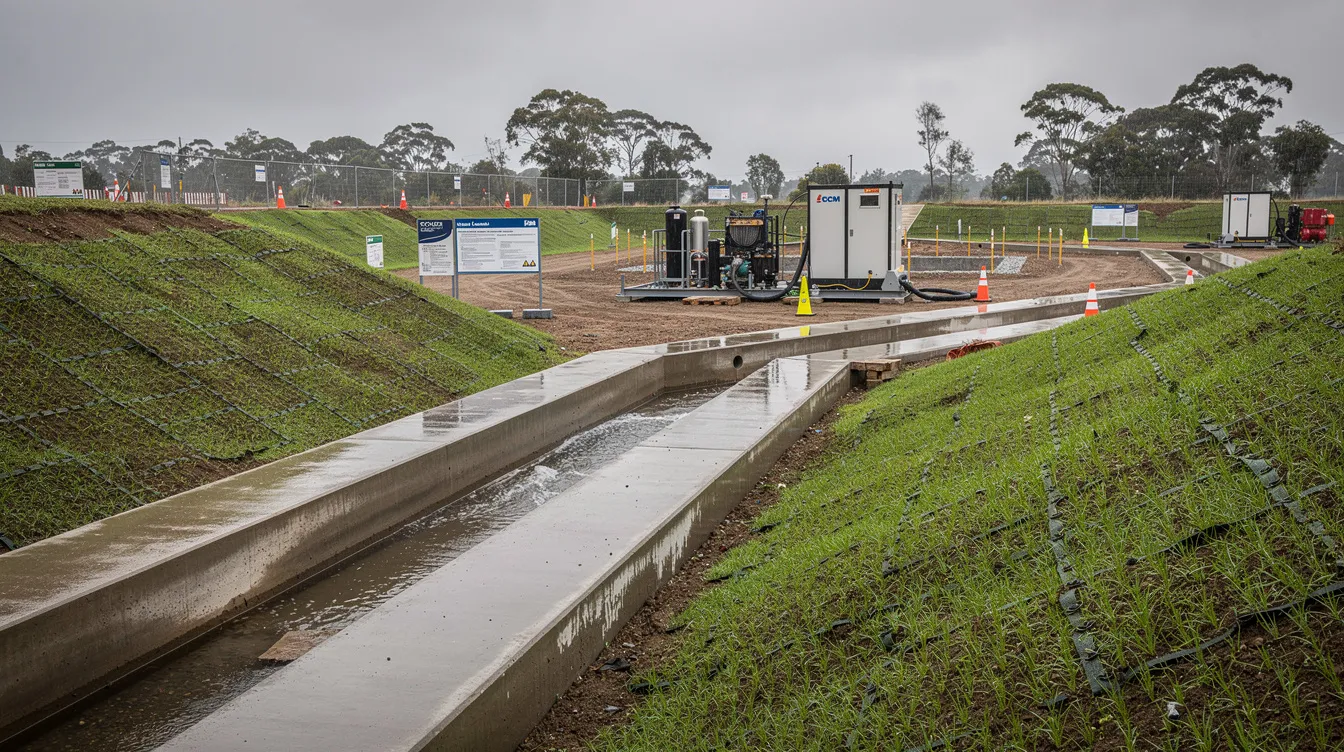
- Concrete-lined perimeter cut-off drains are vital for runoff management – sized for the design storm, with gradients, fall directions, and drop inlets clearly shown on ECM drawings
- Internal temporary drains along haul roads and excavation perimeters, connecting to sumps and holding ponds rather than spilling at site exits
- Check dams and gravel bags at intervals within drains to slow velocity and trap sediment without causing overtopping
- Sediment traps capture sediment laden runoff before it reaches the discharge pipe
Runoff interception protects clean water and channels dirty water to treatment zones. The critical principle is separation: clean upstream stormwater should be diverted around the site area via clean-water bypass drains, while dirty runoff from exposed earth flows to ECM treatment. This approach reduces the volume your drainage systems need to treat under peak loads.
Treatment Systems: ECM Trains That Cope With Storm Peaks
A typical ECM treatment train moves water from collection through settlement to monitored discharge. Under heavy rainfall, every stage is stressed. The system must be sized for worst-case inflows, not average conditions.
Components of the treatment train:
- Inlet sumps with coarse sediment traps and debris racks to remove gravel and large particles
- Holding ponds or detention ponds sized for storm events, with capacity to be emptied within 10 hours post-storm
- Mechanical or chemical treatment units – lamella clarifiers or polymer dosing where permitted – for fine particle removal
- Final monitoring chambers at discharge points before water enters public drains
To manage inflows during heavy rain, use throttling at pond outlets and bypass weirs for extreme events. During the early phase of a storm, first-flush water carries the highest sediment load – route this preferentially through full treatment capacity before allowing later, cleaner flows to bypass.
PUB requires continuous visual monitoring at discharge points, and PUB requires sediment control measures to keep TSS below 50 mg/L as treatment systems monitor suspended solids before release. Treatment systems must treat silty water before discharge to external drainage systems, and that cleaning must be verifiable.
AEC Technical Advisory does not sell ECM hardware but can help contractors and developers evaluate vendor treatment systems and treatment plants for local compliance, constructability, and lifecycle cost savings through our erosion control measures advisory.
Instrumentation, Monitoring and Automatic Shut‑Off During Storms
Real time monitoring turns reactive guesswork into data-driven decisions when site conditions change by the minute during a storm.
PUB’s SIDS and CCTV requirements include:
- CCTV must capture snapshots every five minutes for compliance, with clear view of the discharge pipe and a fixed reference point using a blue marker
- CCTV must capture snapshots every five minutes for 15 days of storage with minimal downtime
- CCTV monitoring can effectively track discharge quality and identify silt issues before they become enforcement actions
Beyond CCTV, practical instrumentation includes:
- TSS meters and turbidity sensors at discharge points for dynamic feedback
- Onsite rain gauges linked to alert systems
- Pond-level sensors to warn of overtopping risk
- Automatic silt shut-off valves or pump interlocks that close the discharge when TSS goes above 50 mg/L or when equipment failures are detected
The April 2025 COP Addendum No. 3 strengthened requirements on treatment system performance, automatic intervention features, and night-time continuous operation – reflecting PUB’s expectation that sediment control systems work even when nobody is physically on site.

Operational Playbook for Qualified Erosion Control Professionals (QECPs) and ECMOs in Monsoon Seasons
Every ECM plan should include a seasonal storm operations plan for the Northeast monsoon (December to March) and Southwest monsoon (June to September). This is not a generic document – it is a playbook keyed to your site’s specific layout, equipment, and risks.
Daily and weekly tasks during monsoon periods:
- Walk pre-storm inspection routes covering all sediment traps, cut-off drains, and silt fences
- Clear trash racks and gratings of debris
- Check pump priming and backup power readiness
- Verify slope covers, stockpile sheeting, and erosion control blankets
- Regular inspections of sediment control systems are required weekly at minimum
Event-based actions:
| Timing | Action |
|---|---|
| 24 hours before forecast heavy rain | Confirm pump fuel/power, deploy extra covers on exposed soil, check all valves |
| During rainfall | Activate rain mode, monitor CCTV/SIDS, halt construction activities on exposed areas |
| 24 hours after storm | Desilt sumps and ponds, repair damaged silt fences, photograph conditions for records |
Document everything: logbooks of TSS readings during storm discharges, maintenance records, and photographic evidence. These records support PUB inspections and demonstrate your sustainable practices on site.
AEC Technical Advisory can help contractors formalise this playbook and train site ECMOs and supervisors, integrating it with existing WSH and ISO systems. Our monsoon readiness guide for temporary works provides further detail on excavation-specific protocols.
Cost Management and Long‑Term Savings from Robust Storm Control
ECM is not a sunk compliance cost. When designed for heavy-rain reliability, it becomes a source of measurable cost savings through avoided stoppages, reduced clean-up, and smaller treatment plant sizing.
Typical cost drivers include treatment systems, CCTV hardware, additional drains and sumps, maintenance labour, and emergency pump capacity. Good erosion control and construction sequencing at the source – covering bare soil, phasing clearing, compacting haul roads – reduce the volume of silty water reaching treatment, which in turn reduces the size and running cost of treatment plants.
Consider two scenarios: a site that under-designs ECM faces repeated PUB inspections, a stop-work order lasting two weeks, emergency rectification at premium rates, and reputational damage with the waterways department. A comparable site that invests in storm-ready design from the outset spends more upfront on proper planning but avoids project delays, penalties, and costly emergency mobilisation. The net difference almost always favours early investment.
Encourage early QECP engagement and AEC Technical Advisory involvement during tender and feasibility stages so contractors can price ECM realistically and avoid later disputes.
Integrating Silt Control with Broader Site Flood and Safety Management
Silt discharge control, flood mitigation, and worker safety are tightly interlinked – especially on infrastructure and deep excavation projects where water bodies, PUB’s catchment sensitivities, and below-ground works converge.
Coordination between ECM design and Drainage Impact Assessment, platform level design, and temporary works like cofferdams and sheet pile walls prevents conflicts between flood pathways and ECM infrastructure. A flood bypass designed for a 50-year event should not route water through your sediment basins intended for a 5-year design storm.
Safety considerations during storms:
- Restrict access to flooded zones and deep excavations
- Electrically isolate pumps and monitoring equipment in standing water areas
- Designate safe inspection routes for ECMOs checking ECM installations
Integrated planning reduces both environmental risk and construction delays. AEC Technical Advisory’s multidisciplinary capability – spanning civil, structural, geotechnical, M&E, and authority submissions – helps clients create coherent, storm-resilient site layouts where water quality, flood safety, and buildability work together instead of against each other.
Getting Professional Support for Storm‑Ready ECM in Singapore
AEC Technical Advisory is a Singapore-based architecture and engineering consultancy with hands-on experience across construction sites requiring robust earth control measures. We work with developers, contractors, and public-sector project managers who need erosion control that performs under real monsoon conditions – not just on paper.
How we can assist:
- Reviewing or preparing ECM plans with QECP partners, including PUB clearance coordination
- Designing temporary surface water drainage, platform levels, and conveyance systems
- Advising on monitoring layouts, sediment control, and water quality compliance
- Peer review for complex infrastructure where ECM intersects geotechnical and structural works
- Troubleshooting for sites that have faced PUB non-compliance during storms
Typical engagement points: pre-tender advisory, ECM design before earthworks begin, peer review for infrastructure construction projects, and rectification support after enforcement.
If you are a developer or contractor preparing for bulk earthworks, engage early – ideally before the monsoon season – to avoid rework and programme slippage. QECPs ensure compliance with Singapore’s environmental regulations, but they work best when supported by a multidisciplinary team that sees the full picture.
Reach out to AEC Technical Advisory to discuss your project’s silt discharge control needs and ensure your site is storm-ready from day one.