
Singapore’s architectural design submission workflow is defined by CORENET X, the Building and Construction Authority’s (BCA) mandatory BIM-based platform that consolidates regulatory approvals from multiple agencies into a single, gateway-driven process. This replaces what was previously a fragmented sequence of 20+ approval touchpoints with three structured gateways: Design, Construction, and Completion. From October 2026, all building projects regardless of size must submit coordinated BIM models in IFC+SG format through this platform. Architects, project managers, and construction professionals who understand this workflow from the outset will avoid the rework cycles and approval delays that continue to affect teams who treat CORENET X as a last-minute technical step rather than a project-wide process commitment.
What prerequisites and tools are required before starting the architectural design submission workflow
Preparing for a CORENET X submission begins well before any model is exported. The foundation is BIM authoring software capable of producing IFC+SG-compliant exports. Autodesk Revit, Graphisoft ArchiCAD, and Trimble Tekla are the most widely used platforms in Singapore’s construction sector, and each requires specific export configuration to meet IFC+SG property set requirements. Selecting the wrong export settings at the start of a project creates compounding errors that are costly to fix at submission stage.
BCA provides downloadable templates and BIM guides that pre-configure property sets, classification mappings, and export settings for compliant submissions. These templates are not optional reference material. They define the exact data structure CORENET X expects, and deviating from them is one of the most common causes of validation failure. Project teams should load these configurations into their authoring tools at project initiation, not after design development is complete.

A BIM Execution Plan (BEP) is the second non-negotiable prerequisite. A well-structured BEP documents export protocols, validation checkpoints, and submission responsibilities across all disciplines. Structured BEP workflows that define iterative export-validation-upload cycles reduce last-minute scramble and rework before regulatory submission. The BEP should name the person responsible for IFC+SG export configuration in each discipline, the validation tool to be used, and the internal review schedule.
Key prerequisites before initiating any CORENET X submission include:
- BIM authoring software with verified IFC+SG export capability (Revit, ArchiCAD, or Tekla)
- BCA-issued export templates loaded and configured in each discipline’s authoring tool
- A completed BIM Execution Plan that assigns export ownership and validation checkpoints
- Team training on IFC+SG property requirements, particularly for architectural and structural leads
- ISO 19650-aligned information management protocols for federated model coordination and version control
Pro Tip: Assign a single BIM coordinator per discipline to own the IFC+SG export configuration file. When that person leaves a project, the configuration knowledge leaves with them unless it is documented in the BEP.
How to execute the step-by-step submission process through CORENET X
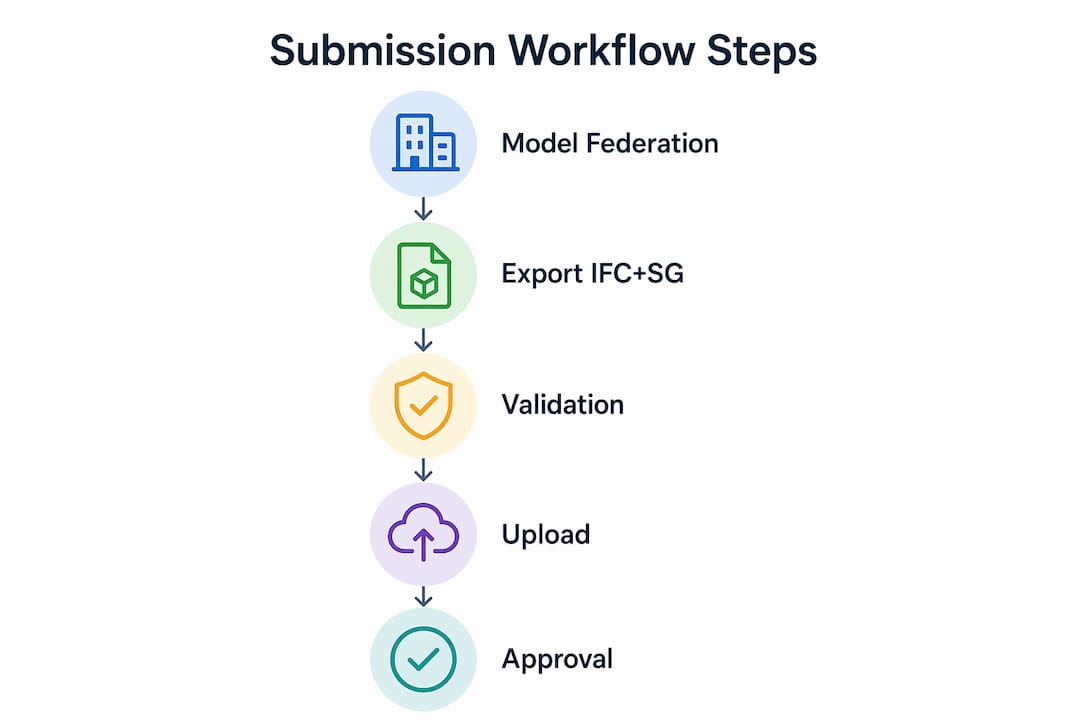
The submission process for architecture projects under CORENET X follows a defined sequence. Skipping or compressing any stage increases the probability of rejection at the gateway level. The following steps reflect current BCA requirements for the Design Gateway submission, which is the first and most documentation-intensive stage.
-
Federate the BIM models. Combine architectural, structural, and MEP discipline models into a single coordinated federated model. Spatial conflicts and data inconsistencies must be resolved before export, not after. Use clash detection tools within Revit, Navisworks, or BIM Collaborate Pro to identify and resolve coordination issues.
-
Configure and run IFC+SG export. Apply BCA-issued export configuration files to each discipline model. Export to IFC+SG format, verifying that spatial coordinates align with the SVY21 coordinate system used in Singapore. Incorrect coordinate referencing is a leading cause of federation failures during validation.
-
Validate using the Bimeco Validator. Upload the exported IFC+SG files to the Bimeco Validator, a free web-based tool designed specifically for CORENET X submissions. The tool identifies missing or incorrect IFC+SG parameters, displays errors in an integrated 3D viewer, and supports bulk editing of property values without returning to the native BIM software.
-
Resolve validation errors and re-export. Address all flagged errors in the authoring tool or directly in the Bimeco Validator. Re-export and re-validate until the model passes all mandatory checks. Schedule this cycle at least two weeks before the intended submission date.
-
Upload to CORENET X. Log into the CORENET X portal and upload the validated IFC+SG models through the appropriate gateway. Attach required supporting documents, including the BEP, and submit for agency review.
-
Maintain records in a Common Data Environment (CDE). Store all exported files, validation reports, and submission receipts in a CDE such as Autodesk Construction Cloud or BIM 360. Version control at this stage is critical for responding to agency queries and managing resubmissions.
| Submission stage | Key action | Primary tool |
|---|---|---|
| Model federation | Coordinate all discipline models | Navisworks, BIM Collaborate Pro |
| IFC+SG export | Apply BCA export configuration | Revit, ArchiCAD, Tekla |
| Pre-submission validation | Identify and fix property errors | Bimeco Validator |
| Gateway upload | Submit validated models | CORENET X portal |
| Record management | Version control and audit trail | Autodesk Construction Cloud, BIM 360 |
Pro Tip: Treat the export-validate-upload cycle as a scheduled recurring task rather than a one-time event. Running this cycle monthly during design development catches errors early and prevents multi-day correction sprints before submission deadlines.
What common challenges cause submission failures and how to avoid them
Most submission failures arise from three root causes: missing or incorrect IFC+SG property mappings, coordinate system misalignments, and disjointed federated models. Each of these is preventable with the right process controls in place from project initiation.
Incorrect property mapping is the most frequent issue. IFC+SG requires specific property sets that do not map automatically from native BIM element properties. Manual translation of these requirements is error-prone, particularly when different team members configure exports independently. The solution is to establish a validated BIM object library at project start, where every element type carries the correct IFC+SG property set by default. Assigning clear ownership of export parameters per discipline and maintaining that library across projects eliminates the need to reconfigure from scratch each time.
SVY21 coordinate errors are the second major failure point. Singapore’s national coordinate system requires precise georeferencing of BIM models, and even small offsets between discipline models cause federation rejection during validation. The architectural model sets the coordinate origin, and all other disciplines must reference it explicitly. This must be confirmed in the BEP and verified at each model federation checkpoint.
“Architectural teams that integrate BIM validation and property set compliance from project initiation reduce late-stage submission errors significantly. The teams that struggle are those who treat IFC+SG compliance as a submission-week task rather than a design-phase discipline.”
Additional challenges that teams encounter include:
- Discrepancies between native model data and export output, where properties visible in Revit do not transfer correctly to the IFC+SG file due to misconfigured export mappings
- Multi-hour export-validation cycles caused by large model sizes and high error counts, which compress the time available for corrections
- Federation conflicts between discipline models that were developed without a shared coordinate origin or consistent naming conventions
- Late-stage clash detection, where coordination issues are discovered during validation rather than during design, forcing design changes that require re-approval
Proactive clash detection and a structured internal review gate scheduled two weeks before submission are the most effective controls against these failure modes.
How does the submission workflow integrate with other agency approvals in Singapore
CORENET X handles the BIM model submission to BCA, but Singapore building projects require parallel clearances from multiple technical agencies. The full building design review process involves URA for planning permission, SCDF for fire safety, PUB for drainage and sewerage, LTA for transport impact, NEA for environmental clearance, and JTC for industrial estate projects. Each agency has its own submission format, document checklist, and endorsement requirement.
Qualified Persons (QPs) carry the legal responsibility for assembling, endorsing, and submitting these packages. A QP for architectural works manages the CORENET X BIM submission, while QPs for structural and M&E works handle their respective discipline submissions. For projects with complex agency requirements, such as dormitory developments that require URA, SCDF, and Ministry of Manpower clearances alongside the CORENET X model submission, the coordination burden is substantial.
| Agency | Primary concern | Submission format |
|---|---|---|
| BCA via CORENET X | Building plan approval, structural safety | IFC+SG BIM model |
| URA | Planning permission, land use compliance | Architectural drawings, written permission |
| SCDF | Fire safety, emergency egress | Fire safety plans, FSM endorsement |
| PUB | Drainage, sewerage, water supply | Engineering drawings, drainage plans |
| LTA | Traffic impact, road access | Transport impact assessment |
| NEA | Environmental compliance | Environmental impact documents |
The critical practice is maintaining separate but synchronized submission schedules for each agency. CORENET X approval does not automatically trigger clearance from URA or SCDF. Project managers must map each agency’s processing timeline against the overall project program and submit to technical agencies in parallel with, not sequentially after, the CORENET X Design Gateway submission. Delays in any single agency clearance can hold the entire construction commencement date, regardless of BCA approval status.
Key takeaways
A successful architectural design submission workflow in Singapore requires BIM model coordination, IFC+SG compliance, and parallel multi-agency clearance management from project initiation, not from submission week.
| Point | Details |
|---|---|
| CORENET X is mandatory from 2026 | All building projects must submit IFC+SG BIM models through CORENET X regardless of size from October 2026. |
| BEP and export ownership are foundational | A documented BIM Execution Plan with named export owners per discipline prevents the most common validation failures. |
| Validate early and repeatedly | Running the Bimeco Validator on a scheduled cycle during design development eliminates last-minute error corrections. |
| Multi-agency coordination runs in parallel | URA, SCDF, PUB, and other agency submissions must proceed alongside CORENET X, not after BCA approval. |
| SVY21 coordinate alignment is non-negotiable | All discipline models must reference a shared coordinate origin to pass federation validation. |
Why CORENET X is a process change, not just a portal upgrade
From my experience working across Singapore construction projects, the teams that struggle most with CORENET X are those that assign it entirely to a BIM coordinator and treat it as a technical upload task. The teams that succeed treat it as a project-wide process change that starts at the first design coordination meeting.
The Novo Place project demonstrated what early BIM coordination delivers in practice: better schedule visibility, fewer coordination conflicts, and a measurable reduction in delays. That outcome does not happen because the team used better software. It happens because the team restructured their workflow around federated model coordination from the start.
The hardest cultural shift is convincing structural and M&E consultants to align their export configurations with the architectural model’s coordinate origin before design development begins. Most consultants have their own BIM standards and resist reconfiguring them for each project. A clearly written BEP with explicit coordinate referencing requirements, signed off by all discipline leads at project kick-off, is the only reliable way to enforce this alignment.
The evolving submission requirements, including the staged expansion of IFC+SG data rules for projects over 5,000 m² GFA, signal that BCA will continue raising the data quality bar. Teams that build compliant BIM workflows now will find future requirement expansions manageable. Teams that are still treating CORENET X as a submission-week problem in 2026 will face compounding rework costs as the requirements tighten.
— Aman
How Aectechnicalsg supports your CORENET X submission readiness
Navigating the CORENET X submission process alongside multi-agency clearances demands more than software proficiency. It requires coordinated technical expertise across architectural, structural, and M&E disciplines, combined with direct experience managing PE endorsements and authority submissions for Singapore projects.

Aectechnicalsg provides engineering consultancy services covering BIM validation support, IFC+SG export configuration review, and submission coordination for BCA, URA, SCDF, PUB, LTA, NEA, and JTC. The team includes Qualified Persons across architectural and engineering disciplines who manage the full submission workflow from Design Gateway through Completion Gateway. For developers and project managers who need a single point of accountability for engineering consultancy services across all submission requirements, Aectechnicalsg offers structured engagement models suited to projects of all scales.
FAQ
What is CORENET X and when does it become mandatory?
CORENET X is BCA’s centralized BIM submission platform that consolidates approvals from multiple agencies through Design, Construction, and Completion gateways. All building projects regardless of size must submit IFC+SG BIM models through CORENET X from October 2026.
What causes most CORENET X validation failures?
The most common causes are missing IFC+SG property mappings, SVY21 coordinate misalignments between discipline models, and disjointed federated models. Running the Bimeco Validator on a scheduled basis during design development catches these errors before they reach the submission gateway.
Does CORENET X approval cover all required agency clearances?
No. CORENET X handles BCA building plan approval, but separate submissions to URA, SCDF, PUB, LTA, NEA, and JTC are required in parallel. Qualified Persons manage each agency’s specific document package and endorsement requirements.
What is an IFC+SG file and why does it matter?
IFC+SG is Singapore’s national BIM data format, an extension of the international IFC standard with additional property sets required by BCA. All CORENET X submissions must use this format, and incorrect property mapping within the file is the leading cause of submission rejection.
How early should teams start preparing for a CORENET X submission?
BIM Execution Plans, export configurations, and federated model coordination should be established at project kick-off. Internal export-validate-upload cycles should begin at least two weeks before the intended gateway submission date to allow adequate time for error correction.