
The building control process is the statutory regulatory framework that governs how all building works in Singapore comply with safety, technical, and environmental standards before, during, and after construction. Established under the Building Control Act 1989, this framework enforces compliance through plan approvals, staged inspections, and formal certification. The Building Control Regulations 2003 and 2008 define the procedural rules that architects, engineers, and developers must follow on every project. Understanding this process is not optional. Non-compliance carries legal penalties, project delays, and in serious cases, revocation of occupation rights.
What are the key steps in the building control process?
The building control process follows a defined sequence from plan submission through to the issuance of a Completion Certificate. Each stage has mandatory documentation requirements and legal consequences for non-compliance.
Step 1: Plan lodgment and approval

All building projects must submit plans for regulatory review before any construction begins. The submission package includes architectural drawings, structural calculations, fire safety plans, and supporting technical reports. Plans must demonstrate compliance with the Building Control Regulations 2003, covering structural integrity, fire safety, accessibility, and environmental performance.
Step 2: Multi-agency concurrent review via CORENET-X
Singapore’s CORENET-X digital platform routes submitted plans simultaneously to seven key agencies: BCA, URA, NParks, LTA, SCDF, PUB, and NEA. This concurrent review replaces the older sequential process, where each agency reviewed plans independently and in turn. The result is a measurable reduction in total approval time. CORENET-X is mandatory for all new building projects exceeding 30,000 square meters gross floor area as of june 2026, with full extension to all project sizes by october 1, 2026.
Step 3: Inspection Service Plan and site inspections
Once plans are approved, the project team submits an Inspection Service Plan that maps out the required inspection stages. Staged inspections typically cover foundation works, structural elements, fire safety systems, and final finishes. Each inspection stage must be passed before the next phase of construction proceeds.
Step 4: Managing deviations
Sections 18, 18A, and 19 of the Building Control Regulations govern how deviations from approved plans are handled. Any change to approved drawings must be formally reported and approved before implementation. Unauthorized deviations are a common regulatory risk and can trigger enforcement actions, including stop-work orders.
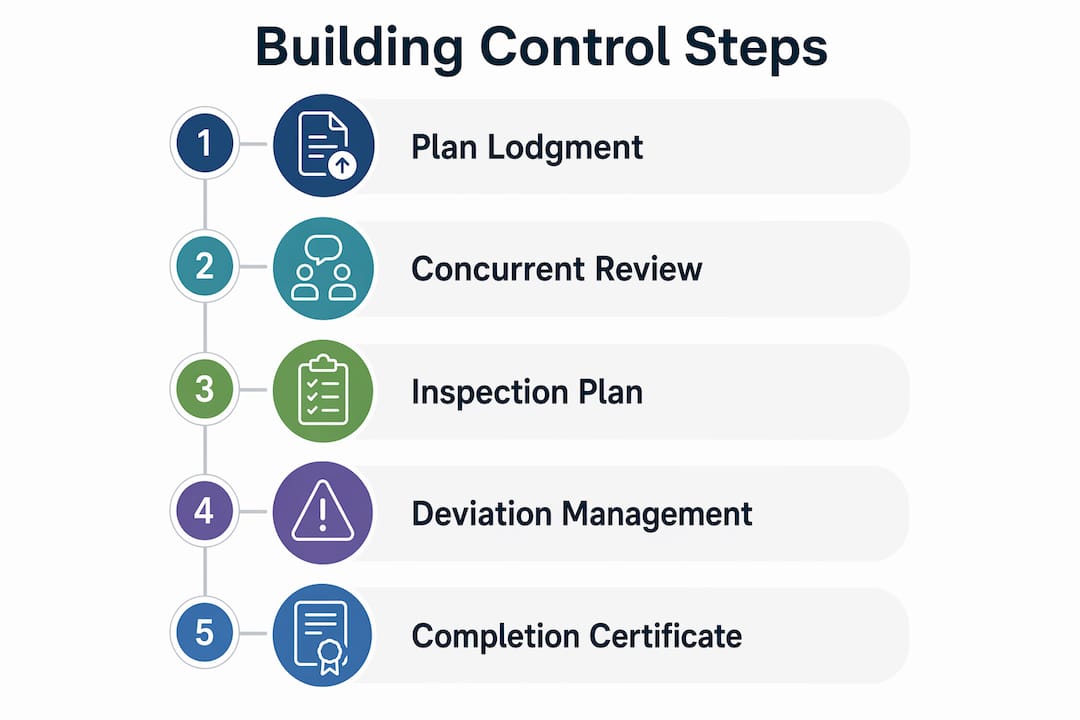
Step 5: Completion Certificate
The Completion Certificate is issued after all inspection stages are passed and the building is confirmed compliant. This certificate is the legal confirmation that a building may be occupied. Without it, occupation is unlawful regardless of the construction quality.
- Validity periods for plan approvals are time-bound. Projects must track expiry dates and apply for extensions before lapse.
- All documentation must be retained for post-completion audits and future regulatory reference.
Pro Tip: Submit your Inspection Service Plan at the same time as your building plan approval application. This reduces administrative lag between approval and the start of site inspections.
How do environmental sustainability regulations integrate into building control?
Environmental sustainability is a mandatory compliance requirement embedded directly into Singapore’s building control approvals. The Building Control (Environmental Sustainability) Regulations 2008 require that all qualifying buildings achieve minimum Green Mark scores before plans can be approved.
The Green Mark scoring system assesses energy efficiency, water conservation, indoor environmental quality, and sustainable construction practices. Scores are not self-reported. An “appropriate practitioner,” a qualified professional recognized under the regulations, must assess and submit the environmental sustainability scores as part of the regulatory approval package. This compliance artifact is legally binding and monitored throughout the project lifecycle.
Key obligations under the Environmental Sustainability Regulations include:
- Achieving the minimum Green Mark score threshold applicable to the building type and size
- Submitting the sustainability assessment as part of the plan approval package, not as a separate post-design exercise
- Providing post-completion as-built reports confirming that the built outcome matches the approved sustainability design
- Accepting penalties for non-compliance, including rejection of the Completion Certificate
The practical implication for design teams is significant. Sustainability compliance cannot be treated as a late-stage add-on. Green Mark scores affect building orientation, facade design, mechanical and electrical system specifications, and material selection. Retrofitting these elements after design completion is costly and often technically impractical.
Pro Tip: Engage a Green Mark Accredited Professional at the concept design stage, not after schematic design is complete. Early integration of sustainability targets prevents abortive design work and avoids last-minute score shortfalls before submission.
For a detailed breakdown of how building regulations in Singapore address environmental compliance in 2026, the Aectechnicalsg resource covers current scoring thresholds and submission requirements.
What practical benefits does CORENET-X bring to project approvals?
CORENET-X transforms the regulatory approval process by enabling concurrent multi-agency review rather than sequential sign-off. The platform reduces regulatory approval timelines by up to 20% compared to the prior process. That efficiency gain translates directly into earlier construction start dates and reduced holding costs for developers.
The platform standardizes submission formats using Industry Foundation Classes, specifically the IFC and IFC+SG extension. This requirement means all project teams must work with Building Information Modeling (BIM) tools capable of exporting to IFC format. The standardization enables early clash detection using federated BIM models, where architectural, structural, and mechanical and electrical models are overlaid to identify conflicts before construction begins.
| Benefit | Impact on project teams |
|---|---|
| Concurrent multi-agency review | Reduces total approval timeline by up to 20% |
| Standardized IFC+SG BIM submissions | Enables early clash detection across disciplines |
| Single digital submission portal | Eliminates duplicate submissions to individual agencies |
| Transparent review status tracking | Allows project teams to monitor agency feedback in real time |
| Early builder involvement support | Facilitates value engineering before design is locked |
“Digital regulatory ecosystems like CORENET-X transform regulatory processes by enabling concurrent multi-agency reviews, greatly improving efficiency and clarity for project teams.” — CNA Brand Studio
The collaborative workflows enabled by CORENET-X also support early builder involvement. When contractors can review federated BIM models during the approval phase, they can identify constructability issues and propose value engineering options before the design is finalized. This reduces abortive work on site and improves cost certainty for developers. The construction approval workflow under CORENET-X requires all project stakeholders to align their digital deliverables to a common standard from the outset.
What are common challenges in navigating Singapore’s building control process?
The building control process presents consistent compliance risks that experienced professionals encounter across project types. Recognizing these risks early is the most effective way to manage them.
Unauthorized deviations remain the most frequent enforcement trigger. Under Section 18 of the Building Control Regulations, any deviation from approved plans must be formally reported and approved before implementation. Projects that proceed with unapproved changes face stop-work orders, financial penalties, and potential invalidation of the original approval. The risk is highest during the construction phase, when site conditions prompt design changes that teams implement without returning to the approving authority.
Common challenges and best practices include:
- Approval validity tracking: Plan approvals carry expiry dates. Projects that stall due to funding or procurement delays must apply for extensions before lapse. Lapsed approvals require full resubmission, which resets the timeline.
- Documentation gaps: Incomplete submission packages are the leading cause of approval delays. Every required document, including structural calculations, fire safety reports, and sustainability assessments, must be present and consistent before submission.
- Late sustainability integration: Design teams that treat Green Mark compliance as a post-design exercise routinely face score shortfalls that require costly redesign. Sustainability targets must be embedded from concept stage.
- Coordination failures between disciplines: Architects, structural engineers, and mechanical and electrical engineers working in silos produce inconsistent drawings that fail agency review. Federated BIM coordination resolves most of these conflicts before submission.
- Regulatory update lag: Singapore’s building control regulations are updated periodically. Teams that rely on prior project experience without checking current requirements risk submitting plans against superseded standards.
Pro Tip: Assign a dedicated compliance coordinator on every project. This person tracks approval validity dates, manages deviation submissions, and maintains the documentation register. On projects without this role, compliance tasks fall between disciplines and create gaps that surface during inspections.
The construction compliance checklist from Aectechnicalsg provides a structured framework for tracking regulatory obligations across all project phases. For architects specifically, the regulatory compliance guide covers documentation requirements and submission best practices in detail.
Key Takeaways
Singapore’s building control process is a mandatory, multi-stage regulatory system requiring concurrent digital submissions, environmental sustainability compliance, and staged inspections before a Completion Certificate can be issued.
| Point | Details |
|---|---|
| Sequential process with legal stages | Plan approval, inspections, and Completion Certificate each carry distinct legal obligations. |
| CORENET-X is now mandatory | All projects above 30,000 sqm must use CORENET-X, with full rollout by october 2026. |
| Sustainability compliance is non-negotiable | Green Mark scores must be submitted by a qualified practitioner as part of plan approval. |
| Deviations require formal approval | Unauthorized changes to approved plans trigger enforcement actions under Section 18. |
| Early coordination reduces risk | Federated BIM and early builder involvement prevent costly rework and approval delays. |
Why early compliance integration is the only viable strategy
Working across Singapore construction projects, the pattern is consistent. Teams that treat building control as a back-end administrative task consistently face the most painful delays. The agencies reviewing submissions under CORENET-X are not processing paperwork. They are checking whether the design is safe, sustainable, and technically sound. Submitting an incomplete or inconsistent package does not pause the clock. It resets it.
The shift to CORENET-X has changed the compliance dynamic in a way that many project teams have not fully absorbed. Concurrent multi-agency review means that a weakness in one discipline’s submission, say, a mechanical and electrical design that conflicts with the structural model, surfaces simultaneously across all reviewing agencies. The old approach of fixing issues agency by agency no longer applies. The entire submission must be coherent before it goes in.
Sustainability compliance is where I see the most avoidable failures. The Building Control (Environmental Sustainability) Regulations 2008 are not new. Yet design teams still engage Green Mark practitioners after schematic design is complete, then discover that the building orientation or facade specification cannot achieve the required score without fundamental redesign. The cost of that redesign is always higher than the cost of early engagement would have been.
The professionals who navigate Singapore’s building control process most effectively share one characteristic. They treat regulatory compliance as a design input, not a design output. That shift in mindset, from compliance as a checkpoint to compliance as a constraint that shapes design decisions, is what separates projects that achieve timely Completion Certificates from those that do not.
— Aman
How Aectechnicalsg supports building control compliance in Singapore
Aectechnicalsg provides technical advisory services specifically structured around Singapore’s building control framework, including submission consultancy, design for safety reviews, and compliance documentation support.
For project teams managing 2026 regulatory requirements, Aectechnicalsg offers direct support on design safety compliance and project submission requirements, covering BCA, URA, SCDF, and other agency submissions. The team works with architects, structural engineers, and developers to align documentation with current BIM and IFC+SG standards, track approval validity periods, and manage deviation submissions. For teams preparing submissions under the updated 2026 regulatory framework, Aectechnicalsg’s submission consultancy services provide structured support from concept stage through Completion Certificate.
FAQ
What is the building control process in Singapore?
The building control process is the statutory framework under the Building Control Act 1989 that regulates plan approvals, site inspections, and compliance certification for all building works in Singapore. It requires coordination between BCA, URA, SCDF, and other agencies before construction can legally proceed.
What is CORENET-X and who must use it?
CORENET-X is Singapore’s digital regulatory platform that enables concurrent review of building submissions by seven agencies simultaneously. It is mandatory for all new projects exceeding 30,000 square meters gross floor area as of june 2026, with full extension to all project sizes by october 1, 2026.
What happens if deviations from approved plans are not reported?
Unauthorized deviations from approved plans violate Section 18 of the Building Control Regulations 2003 and can result in stop-work orders, financial penalties, and invalidation of the original approval. All design changes during construction must be formally submitted and approved before implementation.
When is a Completion Certificate issued?
A Completion Certificate is issued after all staged inspections covering foundation, structural work, fire safety systems, and final finishes are passed and the building is confirmed compliant. Without this certificate, occupation of the building is not legally permitted.
Is Green Mark compliance mandatory for all buildings?
Green Mark compliance is mandatory for all qualifying buildings under the Building Control (Environmental Sustainability) Regulations 2008. Minimum scores must be assessed by a qualified appropriate practitioner and submitted as part of the plan approval package, with post-completion as-built reporting required to confirm compliance.