
The most common PE statutory declaration errors fall into five categories: incorrect or incomplete factual information, wrong or missing legal wording, signing before the authorized witness is present, using an unauthorized or unqualified witness or notary, and filing the wrong form for the receiving jurisdiction. A sixth, less frequent but far more serious error is a materially false statement, which carries criminal exposure under federal and state perjury statutes. Identifying which category your error falls into determines every subsequent step.
Immediate action checklist:
- Preserve the original document exactly as submitted. Do not alter it.
- Determine whether the error is clerical (a typo, transposed date, or misspelled name that does not change the substance) or material (a factual statement that is wrong or misleading).
- Contact the receiving authority to confirm whether the document has been processed and whether a correction window is still open.
- For clerical errors, prepare an affidavit of correction or errata sheet; for substantive errors, prepare a re-sworn declaration.
- If the error involves a false statement, stop and consult a licensed attorney before taking any further action.
- Confirm the corrected document is witnessed or notarized by a qualified person under the rules of the receiving jurisdiction.
Pro Tip: Before attempting any correction, gather and preserve all supporting records: stamped plans, site diaries, inspection reports, and email chains. These documents establish the factual baseline and will be required if the correction is challenged.
Key Takeaways
Witnessing defects and materially false statements are the two highest-risk PE statutory declaration errors because neither can be self-corrected once the authority has acted in reliance on the original document.
| Point | Details |
|---|---|
| Top error categories | Incorrect facts, wrong legal wording, timing/witnessing defects, wrong form, and false statements cover the vast majority of PE declaration failures. |
| Materiality test | An error is clerical if it does not change any asserted fact; it is material if it could have influenced the authority’s decision or changes the subject matter. |
| Correction instrument | Use an Affidavit of Correction for clerical errors; a re-sworn declaration for substantive errors; retain counsel immediately for any false statement. |
| Witnessing is not curable | A declaration signed without a qualified witness present may be void, not merely voidable, as confirmed by court rulings on witnessing defects. |
| Prevention over correction | A two-person pre-submission review with source-document cross-checking eliminates most errors before they reach the authority. |
Table of Contents
- What is a statutory declaration in the US context?
- Common PE statutory declaration errors, identified and explained
- Why these errors carry real legal and administrative consequences
- How to correct a declaration error: the US procedure
- Who may witness or notarize declarations in the US
- Special procedures for patent oaths, court filings, and recorded instruments
- Sample wording and templates for correcting declaration errors
- A prevention checklist to avoid declaration errors before they happen
- Red flags that mean you should stop and get legal help
- An editorial perspective on declaration errors in engineering practice
- Need professional help with PE submissions and authority filings?
- Sources
What is a statutory declaration in the US context?
The term “statutory declaration” is a Commonwealth legal concept, used in Australia, the UK, and Canada, where a prescribed form of written statement is made before an authorized witness under a specific statute. In the United States, the functional equivalent is a notarized affidavit or a sworn declaration under 28 U.S.C. § 1746, which allows an unsworn declaration made under penalty of perjury to substitute for a notarized oath in federal proceedings. When engineers, legal drafters, or compliance officers encounter the phrase “PE statutory declaration” in a US context, they are almost always dealing with one of these instruments.
Understanding which form a receiving authority expects is the first practical task, because the correction procedures differ by form type.
| Form Type | Jurisdiction | Who Uses It | Witness/Notary Required |
|---|---|---|---|
| Statutory declaration | Commonwealth (AU, UK, CA) | Individuals, companies, courts | Authorized witness per statute |
| Affidavit | US (state and federal) | Litigants, agencies, professionals | Notary public or court officer |
| Sworn declaration (28 U.S.C. § 1746) | US federal | Patent, federal agency, court filings | None (self-sworn under penalty of perjury) |
| Notarized statement | US (state) | Real estate, licensing, contracts | Notary public |
Quick markers to identify which form the authority expects:
- Check the form’s title and any statutory citation printed on it. A form citing a state notary statute requires a notary; a form citing 28 U.S.C. § 1746 does not.
- Look at the signature block. If it says “subscribed and sworn before me,” a notary or court officer must be present. If it says “I declare under penalty of perjury,” no notary is required.
- Review the authority’s instructions for any explicit statement about witness category. State licensing boards, for example, often specify “notary public” by name.
Official guidance from Victoria’s Department of Justice confirms that statutory forms prescribe content and witnessing requirements precisely, and that small mistakes may or may not be valid depending on the circumstances and legal interpretation. In the US, the same principle applies: minor defects in form may be waived by some authorities, but witnessing defects rarely are.
Common PE statutory declaration errors, identified and explained
Practitioner guides consistently identify incorrect or incomplete information, wrong wording, failure to sign before an authorized witness, and failing to retain a copy as the most frequent, avoidable causes of rejection or legal complication. The list below adds PE-specific examples that engineers will recognize from regulated submission contexts.
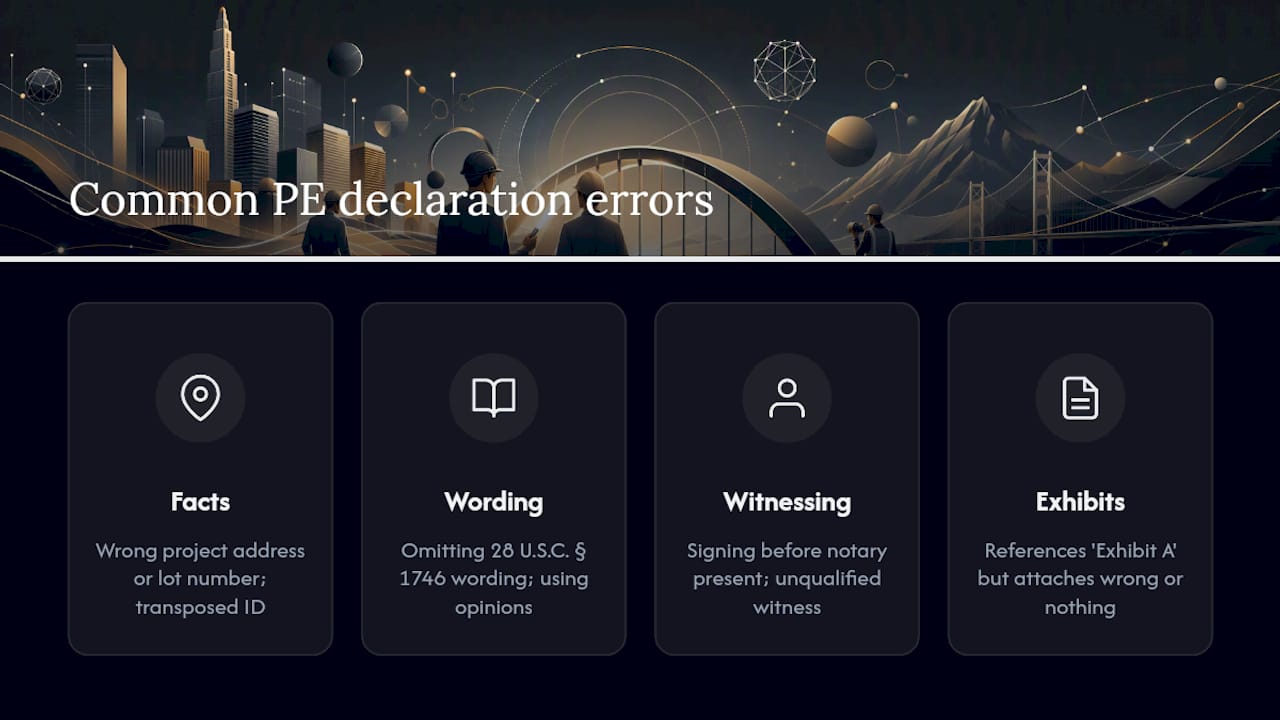
1. Incorrect or incomplete factual information
A PE declaration for a structural submission that lists the wrong project address, an incorrect lot number, or an outdated permit reference contains an incomplete factual record. Even a transposed digit in a parcel ID can trigger rejection. The error becomes material if the wrong address describes a different structure entirely.
2. Wrong or missing legal wording
Affidavits and sworn declarations require specific language: “I, [name], being duly sworn, depose and say…” or the 28 U.S.C. § 1746 formula “I declare under penalty of perjury that the foregoing is true and correct.” Omitting or paraphrasing this language can render the document legally defective. Sprintlaw’s practitioner guidance notes that using opinions instead of facts and guessing dates are recurring causes of rejection.
3. Signing before the witness is present (timing error)
The declarant must sign in the physical presence of the notary or authorized witness, not before. A PE who signs a declaration at the office and then mails it to the notary for stamping has produced an invalid document, regardless of how minor the error appears. This is one of the most common witnessing mistakes across jurisdictions.
4. Using an unauthorized or unqualified witness
Not every notary commission is current, and not every witness category is acceptable for every form. A notary whose commission has expired, a colleague who is not a commissioned notary, or a family member of the declarant may all be disqualifying witnesses depending on state rules and the receiving authority’s requirements. Sprintlaw’s analysis of authorized witness categories identifies this as a frequent source of invalidity.
5. Spelling or typographical errors that change meaning
A misspelled street name that matches a different real address, a transposed date that places a site inspection before the permit was issued, or a wrong unit number on a structural plan reference can each shift an error from clerical to material. The test is whether a reasonable reader would understand the same fact from the corrected and uncorrected versions.
6. Attaching wrong exhibits or failing to attach required exhibits
A PE declaration that references “Exhibit A: Structural Calculations dated March 15, 2025” but attaches a different document, or attaches nothing, is factually incomplete. Authorities reviewing the declaration cannot verify the referenced basis for the engineer’s opinion.
7. Using the wrong form (state vs. federal, or wrong agency form)
A federal agency form requiring a 28 U.S.C. § 1746 declaration cannot be substituted with a state notarized affidavit, and vice versa. State licensing boards often require their own prescribed forms. Using a generic template downloaded from an unrelated jurisdiction is a common source of this error.
8. Stating opinions instead of facts
A PE declaration must assert facts within the declarant’s direct knowledge or professional determination, not opinions or inferences. Writing “I believe the structure is compliant” instead of “The structure meets the requirements of [specific code section] based on my review of the calculations dated [date]” introduces ambiguity that authorities may reject.
9. Failing to retain a copy
Practitioners who do not keep a certified copy of the executed declaration cannot verify what was submitted if the authority loses the document, disputes the content, or requests a re-submission. This is a procedural failure with practical consequences, not a legal defect in the document itself.
10. Filing or jurisdiction mismatches
Submitting a declaration to the wrong agency, the wrong office within an agency, or under the wrong statutory authority for the project type creates a filing error that may not be caught until the project is already delayed. For PE submissions, this includes filing under a residential permit pathway when the project requires a commercial pathway with different declaration requirements.
Classifying errors as clerical vs. material: A clerical error is one that does not change the substance of any fact asserted, could not mislead a reasonable reader, and can be corrected without altering the declarant’s sworn position. A material error changes a fact, creates ambiguity about the subject matter, or could have influenced the receiving authority’s decision. When in doubt, treat the error as material and seek counsel.
Pro Tip: When reviewing a declaration for errors, read it against the underlying source documents (plans, calculations, site reports) line by line. Discrepancies between the declaration and the supporting record are the fastest way to identify material errors before the authority does.
Why these errors carry real legal and administrative consequences
The consequences of declaration errors scale directly with the type of defect. A clerical error typically results in rejection and resubmission delay. A substantive or false statement can trigger criminal liability. A witnessing defect may render the document a legal nullity with no path to cure.
Consequences by error type:
- Clerical errors: Rejection by the receiving authority, resubmission requirement, project hold-up, and potential contract or financing delays. These are correctable but costly in time.
- Substantive factual errors: Depending on the authority and the nature of the error, these may require a re-sworn declaration, an affidavit of correction, or a formal amendment. If the error was known at the time of signing, criminal exposure exists.
- False statements: Under 18 U.S.C. § 1001, making a materially false statement in any matter within the jurisdiction of the executive, legislative, or judicial branch of the US government carries penalties of up to five years’ imprisonment. State perjury statutes impose comparable penalties for false sworn statements in state proceedings.
- Witnessing defects: A declaration signed without a qualified witness present is not merely voidable; it may be void. A UK court ruling in an insolvency context held that a missing authorized witness rendered a statutory declaration a nullity, a defect that could not be waived and had material consequences for the entire proceeding. US courts apply similar reasoning to affidavits with defective notarization.
Practical effects for engineers: An invalid PE declaration can halt a building permit, delay a certificate of occupancy, trigger a stop-work order, and expose the engineer of record to licensing board complaints. In financing transactions, a defective declaration supporting a title or survey certification can delay or kill a closing.
Administrative systems compound the problem. Agencies processing large volumes of declarations often use structured error codes to flag defective submissions, as documented in Northern Ireland Customs and Trade Academy guidance on declaration error codes. Each error code maps to a specific resolution procedure, and failing to follow the prescribed path can result in the submission being permanently rejected rather than corrected.
How to correct a declaration error: the US procedure
The correction path depends on the type of error and the stage at which it is discovered. The decision flow below applies to most US administrative and legal contexts.
Decision flow:
- Minor clerical error (no change in substance) → errata sheet or affidavit of correction
- Substantive factual error (substance changes but no false statement) → re-sworn declaration with a cover letter explaining the correction
- False statement with potential criminal exposure → retain counsel immediately; do not attempt self-correction
Step-by-step correction procedure:
- Preserve the original. Secure a certified copy of the original declaration exactly as submitted. Do not alter, annotate, or destroy it.
- Assess materiality. Apply the clerical vs. material test from the section above. Document your reasoning in writing.
- Contact the receiving authority. Confirm whether the document has been processed, whether a correction window exists, and what correction form or procedure the authority requires.
- Draft the corrective instrument. For a clerical error, prepare an Affidavit of Correction identifying the original document by date, title, and filing reference, stating the error verbatim, and stating the correct information. For a substantive error, prepare a complete re-sworn declaration.
- Arrange proper witnessing or notarization. The corrective instrument must be executed before a qualified notary public or authorized witness in the state where the correction is made, with the declarant physically present at signing.
- Assemble the submission package. Include: the original declaration (or a certified copy), the Affidavit of Correction or re-sworn declaration, a cover letter identifying the error and the correction, corrected exhibits if applicable, and proof of the notary’s current commission.
- File or deliver to the receiving authority by the method specified in the authority’s instructions (in-person, certified mail, or electronic portal).
- Obtain written confirmation of acceptance. Request a stamped receipt, a confirmation email, or a case number. Do not assume acceptance from silence.
Affidavit of Correction: required fields and sample structure
- Caption: State, county, and case or permit reference number
- Identification clause: “I, [Full Name], [Professional License Number], being duly sworn, depose and say:”
- Reference to original: “On [date], I executed a [document title] filed with [authority] as [reference number].”
- Error statement: “The [field name] in that document incorrectly stated [error]. The correct [field name] is [correction].”
- Verification clause: “I declare under penalty of perjury that the foregoing is true and correct to the best of my knowledge.”
- Signature block, notary block with commission expiration date, and notary seal
Typical timeline and cost range: Simple clerical corrections with a cooperative authority are often resolved relatively quickly. Substantive re-sworn declarations may take longer depending on the authority’s review cycle. Notary fees are set by state statute and are generally modest. Attorney fees for drafting a corrective affidavit or advising on materiality vary by market and complexity.
Pro Tip: When submitting a correction package, include a one-page cover letter that maps each corrected field to the original error. Authorities processing high volumes of corrections process clearly organized packages faster and with fewer follow-up requests.
Who may witness or notarize declarations in the US
Witness and notary requirements vary by state and by the type of document being executed. Getting this wrong is one of the most common PE statutory errors because engineers often assume any notary will do.
Common US witness and notary categories:
- Notary public: The standard witness for most affidavits, sworn statements, and notarized declarations in the US. Must hold a current commission in the state where the notarization occurs. Verify commission status through the state’s notary database before signing.
- Attorney at law: Licensed attorneys may administer oaths in many states and may serve as witnesses for certain documents, but this varies by state statute.
- Court clerk or deputy clerk: Authorized to administer oaths for court-filed affidavits in most jurisdictions.
- Not acceptable as witnesses: The declarant’s spouse, parent, child, or other close family member; a party with a direct financial interest in the document’s subject matter; a colleague who is not independently commissioned; and any person whose commission has expired.
How to verify a notary’s commission: Most states maintain a public online database. Search “[state name] notary public verification” to find the official portal. Confirm the notary’s name, commission number, and expiration date before the signing appointment.
Remote online notarization (RON): As of 2026, most US states have enacted RON statutes, but the rules differ significantly. Some states require the notary and declarant to be in the same state; others permit cross-state RON under reciprocity agreements. Before using RON for a PE declaration, confirm that the receiving authority accepts electronically notarized documents and that the RON platform is approved under the relevant state’s statute.
Pro Tip: For PE declarations submitted to state licensing boards or building departments, call the authority directly and ask whether they accept RON. Many agencies have not updated their internal procedures to reflect newer state RON statutes, and a RON-notarized document may be rejected on procedural grounds even when it is technically valid under state law.
Special procedures for patent oaths, court filings, and recorded instruments
Different legal domains impose their own correction procedures, and the general affidavit-of-correction approach does not always apply.
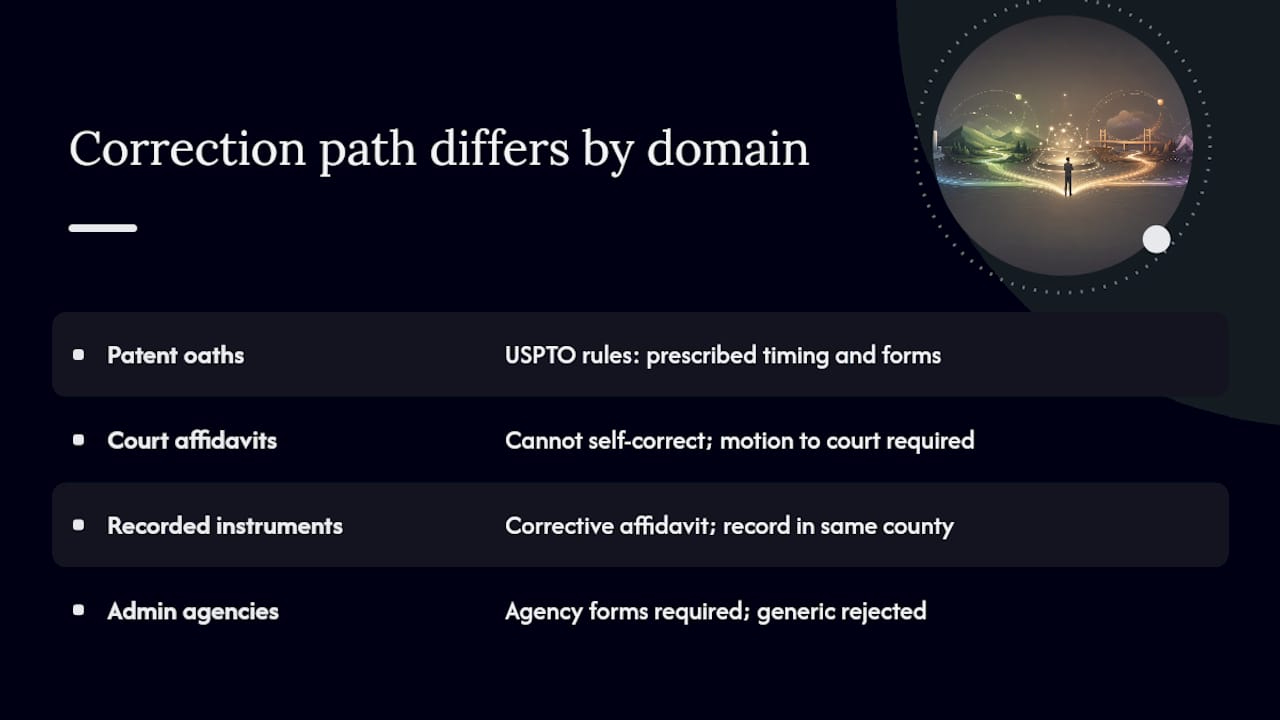
Patent oaths and declarations (USPTO):
Patent oaths and declarations are governed by MPEP 602 and USPTO-specific rules. Corrections must follow prescribed timing and form requirements. A missed procedural step, whether a timing deadline or a required form, can bar correction and require a petition to the USPTO. Practitioners should consult MPEP 602 directly and use the USPTO’s official correction forms rather than generic affidavit templates.
From patent practice: Oath or declaration errors in patent applications require timely, rule-specific remedial steps. A single missed procedural requirement can bar correction and force a court or agency petition to preserve patent rights. The correction route is not discretionary; it is prescribed.
Court-filed affidavits:
An affidavit already filed with a court cannot be unilaterally corrected by the affiant. Correction requires a motion to the court, which may or may not be granted depending on the stage of the proceeding and the materiality of the error. An attorney must file the motion; self-represented correction attempts are procedurally improper in most jurisdictions.
Recorded instruments (deeds, mortgages, easements):
Errors in recorded real estate instruments require a corrective or scrivener’s affidavit, which must itself be recorded in the same county recorder’s office. The corrective affidavit identifies the original instrument by recording reference, states the error, and states the correction. Some states require both parties to the original instrument to execute the corrective affidavit.
Administrative agency forms (licensing boards, building departments):
Many agencies have their own internal correction forms and procedures. Submitting a generic affidavit of correction to an agency that has a prescribed correction form will often result in rejection. Check the agency’s website or call the filing office to confirm the required correction path before preparing any document.
Administrative error code guidance from structured submission systems illustrates how agencies map specific error types to specific resolution procedures. The same logic applies to US agency portals: each error type has a prescribed remedy, and substituting a different remedy prolongs the delay.
Sample wording and templates for correcting declaration errors
The templates below are skeleton structures. They identify required clauses and witness language but are not substitutes for legal advice when the error is material or involves potential perjury exposure.
Template 1: Affidavit of Correction
STATE OF [STATE]
COUNTY OF [COUNTY]

AFFIDAVIT OF CORRECTION

I, [Full Legal Name], [Professional License: PE No. XXXXX], being duly sworn, depose and say:

1. On [original date], I executed a [document title] filed with [authority name] under reference number [reference].

2. That document contained an error in [field name], which incorrectly stated: "[error text]."

3. The correct [field name] is: "[corrected text]."

4. All other statements in the original document remain true and correct.

5. I make this affidavit to correct the record and not for any improper purpose.

Signed: ___________________________
[Full Legal Name], PE
Date: ___________________________

Subscribed and sworn before me this ___ day of [Month], [Year].

Notary Public: ___________________________
Commission No.: ___________________________
Commission Expires: ___________________________
[Notary Seal]
Template 2: Re-sworn Declaration (28 U.S.C. § 1746 format)
DECLARATION UNDER PENALTY OF PERJURY

I, [Full Legal Name], declare under penalty of perjury under the laws of the United States of America that the following is true and correct:

[Full corrected text of the declaration, replacing the original in its entirety]

This declaration supersedes and replaces the declaration dated [original date] filed with [authority] under reference [reference number].

Executed on [date] at [city, state].

Signature: ___________________________
[Full Legal Name], PE No. XXXXX
Template 3: Supplemental Affidavit (for additional facts, not correction of error)
STATE OF [STATE]
COUNTY OF [COUNTY]

SUPPLEMENTAL AFFIDAVIT

I, [Full Legal Name], [Professional License: PE No. XXXXX], being duly sworn, depose and say:

1. I previously executed a [document title] dated [date], filed with [authority] under reference [reference].

2. I make this supplemental affidavit to provide additional facts not included in the original.

3. [Additional factual statements, each numbered separately.]

4. All statements in the original affidavit remain true and correct.

Signed: ___________________________
Date: ___________________________

[Notary block as above]
Warning: Do not use a simple affidavit of correction when the original document contained a materially false statement, when the error affects a recorded instrument’s chain of title, or when the receiving authority has already acted in reliance on the original. These situations require legal counsel.
Pre-submission checklist for corrected affidavits:
- Full legal name of declarant matches professional license records
- Project address, permit number, and parcel ID verified against source documents
- Dates of inspection, certification, or review are accurate and in sequence
- Exhibits are attached in the order referenced in the text
- Witness block is complete: notary name, commission number, expiration date, and seal
- Declarant signed in the physical presence of the notary
- A certified copy is retained before submission
Pro Tip: Number every page of a multi-page declaration as “Page X of Y” and have the notary initial each page. This prevents pages from being substituted or disputed after execution.
A prevention checklist to avoid declaration errors before they happen
Prevention is faster and cheaper than correction. Major logistics operators recommend formal checklists and SOPs for declaration submissions precisely because the cost of a single error, in time, fees, and project delay, consistently exceeds the cost of a structured review process. The same principle applies to PE declarations.
Pre-submission checklist (adopt as a standing SOP):
- Confirm the correct form type for the receiving authority (state, federal, or agency-specific)
- Verify all legal wording against the authority’s prescribed language or the applicable statute
- Cross-check all project identifiers (address, permit number, parcel ID, plan reference) against source documents
- Confirm all dates are accurate and in logical sequence
- Attach all required exhibits in the order referenced in the text; label each exhibit clearly
- Confirm the authorized witness or notary holds a current commission in the correct state
- Sign only in the physical presence of the witness or notary
- Retain a certified copy of the fully executed document before submission
- Log the submission: date, method, reference number, and name of person who completed the review
Pro Tip: Institute a two-person review for all PE declarations before execution. The second reviewer should work from the source documents, not from the declaration itself, checking each factual statement independently. Keep a versioned file with timestamps for each draft and the final executed version.
Red flags that mean you should stop and get legal help
Some errors cannot and should not be self-corrected. Attempting to correct a document that carries criminal exposure, or that has already been relied upon by a court or authority, can make the situation materially worse.
Stop and consult a licensed attorney when:
- The declaration contains a statement you knew or suspected was false at the time of signing. This is potential perjury or a false statement under 18 U.S.C. § 1001 or applicable state statutes.
- The error affects a recorded instrument (deed, mortgage, easement) and the chain of title is in question.
- Two or more signatories to the original declaration disagree about what the correct facts are.
- The receiving authority has already acted in reliance on the declaration (issued a permit, approved a license, or recorded the instrument) and is now disputing its validity.
- The authority has refused to accept a correction and has indicated the original document is under review or investigation.
- A missing sworn statement was required by statute and the deadline for filing has passed.
- The error was discovered in the context of litigation or a regulatory investigation.
After counsel is engaged, the likely next steps include a court motion to correct or strike the original document, a negotiated administrative remedy with the receiving authority, or, in the most serious cases, coordination with criminal defense counsel. Engineers facing licensing board complaints arising from declaration errors should retain counsel with experience in professional licensing matters, not only general litigation.
For PE submissions in regulated construction contexts, understanding the full scope of Commercial Renovation Compliance in Singapore and common reasons for PE submission rejection can help practitioners identify systemic vulnerabilities before they produce a declaration error that requires legal intervention.
An editorial perspective on declaration errors in engineering practice
Declaration errors in engineering practice are almost never random. They cluster around the same pressure points: rushed submissions at project milestones, unfamiliarity with the specific form required by a particular authority, and the assumption that a notary’s stamp cures any defect in the underlying document. That last assumption is the most dangerous. A notary confirms identity and presence; the notary does not verify the truth of the statements or the adequacy of the legal wording.
The more consequential observation is about materiality classification. Most practitioners treat this as a binary: either the error matters or it does not. In practice, the receiving authority’s response is the real variable. An error that one agency treats as clerical, another treats as grounds for rejection, and a third refers for investigation. The only reliable protection is a declaration that is correct on its face from the moment of execution, supported by a documented review process that can be produced if the submission is challenged.
For engineers working across regulated submission contexts, the discipline of treating every declaration as a legal instrument, not an administrative formality, is what separates practitioners who rarely face correction procedures from those who encounter them repeatedly.
Need professional help with PE submissions and authority filings?

When a PE declaration error has already reached the authority, or when the stakes of a submission are too high to risk a procedural defect, professional consultancy support makes the difference between a corrected filing and a project hold. Aectechnicalsg provides PE endorsement and authority submission services for construction and infrastructure projects, including submission management, compliance review, and coordination with regulatory bodies. For developers and engineering firms managing complex multi-authority submissions, the full range of engineering consultancy services covers structural, geotechnical, M&E, and façade work through to final authority approval.
Sources
The following sources were used in preparing this guide. Each is a primary or practitioner-level authority for the specific topic it covers.
- Avoid Costly Mistakes: What You Need to Know About Statutory Declarations in the UK | Parachute Law
- Information for authorised statutory declaration witnesses | Department of Justice and Community Safety Victoria
- Statutory Declarations NSW | Sprintlaw Australia
- Guidance on resolution to common error codes for Supplementary and Full Frontier Declarations – Northern Ireland Customs and Trade Academy
- 7 common mistakes when filling in customs declarations and how to avoid them
This article is general information, not a substitute for advice from a qualified lawyer. Consult a qualified legal professional about your own circumstances before acting on anything here.