
A construction dust control plan in Singapore is not a stand-alone document. It sits inside the Site Environmental Control Plan (SECP) that the site’s Environmental Control Officer, the ECO(SCS), prepares under NEA’s Code of Practice, and it must be backed by physical controls, monthly inspections and records that an NEA public health officer can ask to see at any time. Projects that treat dust as a design and sequencing question, settled before mobilisation, avoid most of the rework and enforcement exposure that arises when dust is handled only as a housekeeping task on site. Our engineering and authority-submission team works on that front end of the project, where these decisions are cheapest to make.
TL;DR
- Dust abatement is one of the eight issues the SECP must cover, and the ECO(SCS) writes the SECP using NEA’s Appendix 2 template.
- The occupier endorses the SECP and submits it through FormSG within one month after works start, then keeps monthly Site Environmental Control Reports (SECRs) available for inspection.
- NEA’s Code names water spray, shielding, netting and covered or hoarded storage as the core controls; scaffold netting must be tall enough to contain dust and debris.
- Dust comes from many small activities, so the plan should be tied to the construction sequence, haul routes and stockpiles, not written as a generic list.
- Design and sequencing decisions made with the Qualified Person (QP) and the PE reduce the dust that site controls have to catch.
Table of Contents
- What a dust control plan has to achieve in Singapore
- Who is responsible: the occupier, the ECO(SCS) and the project team
- Step 1: Identify dust-generating work and the people it reaches
- Step 2: Choose controls for each activity
- Step 3: Build dust control into design and sequencing
- Step 4: Write the SECP section and submit it
- Step 5: Inspect, record and keep the plan current
- How we handle this at AEC Technical
- Our perspective
- FAQ
- Sources
What a dust control plan has to achieve in Singapore
The plan has two jobs. The first is regulatory: showing NEA that air pollution and dust abatement have been assessed and controlled for the specified construction site. The second is practical: keeping neighbours, workers and the programme free of dust complaints and stop-work disruptions.
The legal frame is the Environmental Public Health (Specified Construction Sites) Regulations 2021 and NEA’s 5th-edition Code of Practice for Environmental Control Officers, published on 9 June 2022. The Code identifies air pollution and dust abatement as a required focus and reminds occupiers that other obligations, including the Environmental Protection and Management Act 1999 (EPMA), still apply.
The EPMA is worth reading for its definitions. It treats a construction site as any premises where construction, alteration or demolition of a building or structure is carried on, including nearby land the principal contractor controls access to and on-site offices and canteens. It defines air impurities to include solid particles of any kind, and it describes the best practicable means as including the efficient maintenance of plant and supervision of any process by or on behalf of the occupier. In practice, that means a dust control plan cannot stop at the hoarding line: site offices, access land and the equipment itself are within scope.
Two other points from the Code matter for dust. Open burning of construction waste is an offence under the EPMA, and construction equipment and machinery must be well maintained and must not emit dark smoke. Both belong in the plan’s controls for air emissions.
Who is responsible: the occupier, the ECO(SCS) and the project team
Responsibility is split, and the plan should say so in writing.
| Role | What the Code assigns |
|---|---|
| Occupier of the specified construction site | Appoints the ECO(SCS), endorses and submits the SECP via FormSG within one month after works start, provides resources for the ECO, requires site personnel to follow good environmental health practice, answers for site irregularities and violations, and appoints a replacement ECO within 14 days if the registration of the appointed ECO is terminated, suspended or cancelled |
| ECO(SCS) | Develops the SECP, inspects the site, advises the occupier on remediation, engages site workers and submits the SECR at least monthly |
| Project team (QP, PE, contractor) | Sets the design, sequencing and temporary works that determine how much dust the site produces and how easily it can be contained |
The ECO’s time commitment depends on the project. NEA’s scheme requires a part-time ECO of at least 15 hours per week or a full-time ECO of at least 40 hours per week, with a full-time ECO required where the contract sum exceeds $50 million.
The ECO’s role is environmental health inspection and plan preparation. It does not replace the employer’s duties under the Workplace Safety and Health Act. The WSH Council’s guidelines state that employers and principals must, so far as reasonably practicable, protect workers and others affected by their work, including by conducting risk assessments and providing instruction, training and supervision. Dust is therefore both an environmental health matter for NEA and a worker health matter for the Ministry of Manpower’s regime. The two should share one risk register.
Site environmental control also touches vector control. The SECP is reviewed when the ECO, the general waste collector or the vector control operator changes, so occupiers who arrange vector control for construction sites early keep that section of the SECP stable while the dust section is being refined.
Step 1: Identify dust-generating work and the people it reaches
A plan starts with an inventory. Dust is rarely one big source. The UK’s BRE guidance notes that site emissions are mainly the sum of a large number of small activities, which is why attention to detail decides the total. Its method, which transfers well to Singapore, is to identify dust-generating activities before the project starts, then assess weather, the proximity of sensitive receptors such as schools, hospitals and homes, and any toxic materials such as asbestos.
For a Singapore project, build the inventory from the construction programme:
- Demolition and hacking, including the removal of existing finishes.
- Excavation, earthworks and spoil loading.
- Concrete work: cutting, grinding, chipping and the handling of cement and sand.
- Material storage: aggregate, sand and spoil stockpiles.
- Vehicle movement on unpaved haul roads and at the site exit.
- Debris handling from upper floors, including chutes and skips.
A New Zealand transport project’s dust management plan lists wind speed, moisture, exposed area and the percentage of fine particles as the factors that drive dust generation. Those factors apply in Singapore too, with one local twist: during the drier months, exposed earthworks dry out quickly, and in heavy rain the same surfaces become a silt problem. The dust plan and the erosion plan therefore need to be read together, and our guides on erosion control measures and silt discharge control during heavy rain cover the wet-weather side.
Where demolition is involved, the WSH Council’s demolition technical advisory requires a risk assessment that identifies the hazards of the process and takes reasonably practicable steps to eliminate or control them. Dust from demolition should be a named hazard in that assessment, not a footnote.
Dust that is also a health hazard
Some dust is a regulated occupational exposure. Under the WSH (Medical Examinations) Regulations 2011, workers exposed to the dust of asbestos, raw cotton or silica must undergo pre-placement and periodic medical examinations by a doctor registered with the Ministry of Manpower. The General Provisions Regulations also require a competent person to test the workplace atmosphere at sufficient intervals, with records kept for at least five years, and workers must not be exposed above the permissible exposure levels. Work that cuts or grinds concrete, masonry or old materials should be screened against these rules at the planning stage.
Step 2: Choose controls for each activity
NEA’s Code sets the baseline for controls. It calls for effective measures such as water sprinklers or spray, shielding, netting, and covers or hoarding for aggregate and sand storage. Netting or barriers on scaffolding must be of suitable height to contain dust and debris. Debris must be stored properly and removed promptly, and chutes from higher floors must be lined with suitable material to prevent noise pollution.
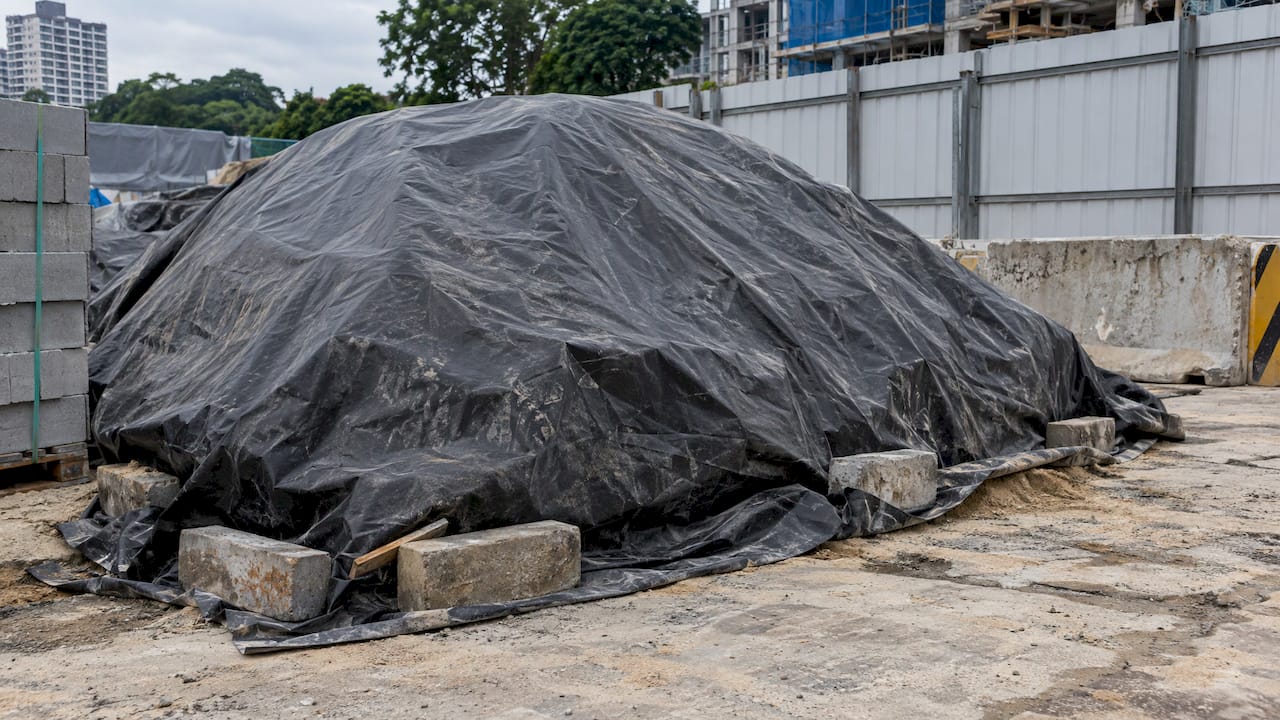
Other Singapore agencies publish more specific figures that are useful as benchmarks for what “effective” looks like. NParks’ environmental management plan appendices for projects in the Bukit Brown, Bukit Timah and Hillview areas require, among other measures, hoarding around the site, phased earthworks, water suppression during demolition, minimised drop heights, no on-site crushing or screening of demolished material, covered loads of dry materials, wetting of unpaved access roads, speed limits of 25 km/h on paved and 15 km/h on unpaved haul roads, covered stockpiles and spoil removal at least every five days. These are requirements for those projects, not universal rules, but they give a plan realistic numbers to adopt where the contract does not set its own.
For large outdoor areas, LTA’s Good Practices Handbook (version 4, December 2020) recommends a misting machine to suppress dust and a dust collection system to arrest it. For interior work, NTU’s contractor handbook asks contractors to minimise the dispersion of fine particulates by local extraction and full drop sheeting, to issue PPE to workers in direct contact with airborne dust and to ensure it is worn, and it allows the facility owner to demand an indoor air quality analysis at the contractor’s cost before handover.
A control matrix keeps this readable:
| Activity | Primary control | Supporting control |
|---|---|---|
| Demolition and hacking | Water suppression, shielding | Lined debris chutes, minimised drop heights |
| Excavation and earthworks | Phased exposure of small areas | Wetting, covered spoil trucks, spoil removal on a fixed cycle |
| Cutting and grinding | Local extraction or wet cutting | Drop sheeting, PPE for exposed workers |
| Aggregate, sand and spoil storage | Covers or hoarding | Positioning away from the nearest receptor |
| Haul roads and site exit | Wetting of unpaved roads, speed limits | Covered loads, exit cleaning |
| Scaffolding and façade works | Netting or barriers of suitable height | Prompt debris removal |
The row on scaffolding links directly to design. Where façade works are heavy, the screening system is part of the temporary works and façade design, which is the point at which a PE and a façade designer decide on netting height and fixings, not the site foreman.
Step 3: Build dust control into design and sequencing
The cheapest dust is the dust never produced. The BRE guidance advises that designers and contractors work together to avoid or reduce dust risks within the design itself, for example through prefabrication, instead of relying only on the contractor’s controls. It also recommends site layouts that place dusty work away from receptors and an adequate water supply with hoses that reach every part of the site.
For Singapore developers, this translates into design-stage decisions:
- Prefabrication and off-site cutting. Rebar cut and bent off site, and precast elements, move cutting dust away from the neighbours. Detailed shop drawings and bar bending schedules make that practical.
- Phasing of earthworks. Excavation sequenced to disturb limited areas at a time reduces exposed surface, which the NParks measures also reflect.
- Temporary works layout. Gantries, hoardings and scaffold screens are designed elements. Their height and loading should be checked by the PE, not left to improvisation.
- Haul route and stockpile location. Fixed in the site layout before mobilisation, away from the nearest homes, schools and clinics.
This is where the QP and the PE earn their place on a dust plan. They are the people who can change the design or sequence, rather than only mitigate its effects. The site team’s responsibilities, including supervision of works by the QP, are covered in our site supervision plan checklist.
Step 4: Write the SECP section and submit it
The ECO(SCS) develops the SECP using NEA’s Appendix 2 template, which covers eight issues including air pollution and dust abatement. The dust section should contain at minimum:
- A site layout showing hoardings, haul roads, stockpiles, wash facilities and the nearest receptors.
- The dust-generating activities by construction phase, with the control for each.
- Named persons responsible for inspection and maintenance, with contact details.
- Water supply arrangements and equipment maintenance routines.
- Triggers for action, such as visible dust at the boundary, and the response expected.
- A complaint record and the way complaints are closed out.
Items 1 to 3 and 6 follow the structure of dust emission control plans published by Australian local authorities, such as the Townsville City Council guidance, which develops a plan in three phases: site impact assessment (low, medium or high risk), control measures and monitoring. That three-phase logic is a sound way to organise the Singapore document, even though the Australian rules do not apply here.
The occupier then endorses the SECP and submits it through FormSG within one month after works commence. The plan must be reviewed and updated when the ECO, the general waste collector or the vector control operator changes, when environmental management plans change, or when the site layout changes. A site layout changes whenever a hoarding moves or a stockpile relocates, so the practical rule is to review the dust section at every major phase change.
For the wider approval picture, including how NEA stages fit with other authority submissions, see our guides to NEA approval for Singapore construction projects, pollution control approval and Singapore air quality requirements.
Step 5: Inspect, record and keep the plan current
A plan that is not inspected is a document, not a control. The ECO(SCS) must inspect the site to ensure that facilities, equipment and operations do not pose environmental health hazards, and must submit an SECR at least monthly after works commence. The occupier endorses and files the reports and keeps them available for inspection by the Director-General of Public Health or a public health officer at any time.
A workable inspection routine looks like this:
- Daily: the site supervisor checks water supply, sprinklers or misting, netting condition, covers on stockpiles and the state of the site exit.
- Weekly: a walk-through against the control matrix, with photographs and corrective actions logged.
- Monthly: the ECO’s inspection and SECR, with open actions carried forward.
- At each phase change: a review of the SECP dust section against the new layout and activities.
Keep the records together. The same file should hold the SECP, the SECRs, equipment maintenance logs, complaint records and any air or atmosphere test results required for hazardous dust. Where atmosphere testing is required for regulated substances, the five-year record-keeping rule applies.
Recent changes to keep in view
NEA’s 21 July 2021 circular renamed ECO(CS) to ECO(SCS) under new subsidiary legislation, with revised licensing requirements and a $160 licence fee applying from 1 April 2022. More recently, NEA’s FY2024 sustainability report notes that from 1 April 2025, tenders for large-scale projects near residential and noise-sensitive areas must include noise barriers along the site perimeter. Perimeter barriers often serve dust containment as well, so the two should be designed as one system. The EPMA itself was amended several times in 2025 and 2026, so confirm the in-force text on Singapore Statutes Online before relying on a clause in a contract or plan.
How we handle this at AEC Technical
AECTechnicalSG is a Singapore engineering and architectural consultancy. We prepare authority submissions to URA, BCA, SCDF, JTC, LTA, PUB and NEA, provide structural, geotechnical, civil and M&E design, and offer qualified person supervision and temporary works design. Those are the services that shape how much dust a project creates: the excavation sequence, the temporary works, the façade screening and the submission programme.
If your project team needs engineering design, PE endorsement or statutory submission management alongside its environmental plan, see our authority submission and PE endorsement services or our full services page. Our construction compliance checklist shows where the dust plan sits among the other approvals.

Our perspective
Most dust problems we see on paper begin as sequencing problems. A site that opens large areas of earth at once, places stockpiles where the hoarding is weakest and routes trucks past the nearest neighbour will need constant water and constant supervision, however good the plan reads.
Our view is that the dust control plan should be drafted alongside the structural, geotechnical and temporary works design, not after them. The PE who designs the excavation support and the scaffold screening is the person best placed to decide how much surface is exposed and how long. The QP who supervises the works can confirm that the controls in the plan are the ones in place.
That is why we put engineering design, qualified person supervision and authority submissions in one team. A single team is designed to keep the submission documents, the design and the site controls consistent when the layout or programme changes, which is exactly when an SECP needs updating.
Aman
FAQ
Is a dust control plan mandatory in Singapore?
For specified construction sites, yes in effect: the SECP prepared by the ECO(SCS) must cover air pollution and dust abatement, and the occupier must endorse and submit it through FormSG within one month after works start. Obligations under the EPMA and the WSH framework also apply.
Who prepares the plan?
The ECO(SCS) develops the SECP using NEA’s Appendix 2 template. The occupier is responsible for endorsing it, submitting it and providing the resources the ECO needs. Design and sequencing input comes from the QP, the PE and the contractor.
How often must dust controls be inspected and reported?
The ECO(SCS) submits an SECR at least monthly after works commence. The occupier keeps the reports available for inspection by public health officers at any time. Daily and weekly site checks by the contractor sit underneath that monthly cycle.
What are the main dust controls NEA expects?
NEA’s Code lists water sprinklers or spray, shielding, netting, and covers or hoarding for aggregate and sand storage. Scaffold netting or barriers must be tall enough to contain dust and debris, and debris must be stored properly and removed promptly.
When should the plan be updated?
When the ECO, general waste collector or vector control operator changes, when environmental management plans change, or when the site layout changes. A move of hoardings, haul roads or stockpiles counts as a layout change.
Sources
- NEA Code of Practice for Environmental Control Officers, 5th edition
- Environmental Protection and Management Act 1999, Singapore Statutes Online
- EPMA 1999 amendment timeline, Singapore Statutes Online
- WSH Council, WSH Guidelines on statutory medical examinations
- WSH Council, Technical Advisory for Demolition
- NParks environmental management plan appendices
- LTA Good Practices Handbook 2020, version 4
- NTU ODFM Safety and Health Handbook for Contractors
- NEA circular on ECO(SCS) terminology and licensing, 21 July 2021
- NEA Annual Sustainability Report FY2024
- BRE, Control of dust from construction and demolition activities
- NZTA Dust Management Plan, Mill Road Stage 1
- Townsville City Council, Management of Dust from Development Sites
Recommended
- Silt Discharge Control During Heavy Rain: QECP Practical Measures
- Erosion Control Measures in Singapore: A Comprehensive Guide by Qualified Erosion Control Professionals (QECP)
- Earth Control Measures Submission in Singapore: PUB Guide
- The Ultimate Guide to Singapore Air Quality Requirements and NEA Submissions