
Infrastructure project approvals are the formal authorizations issued by Singapore’s regulatory agencies that clear a project for construction after verifying compliance with planning, building, environmental, and safety standards. Defining infrastructure project approvals correctly matters because a misread timeline or missed submission can halt construction, trigger enforcement action, or void an existing permit. Seven agencies coordinate these approvals in Singapore: URA, BCA, NParks, LTA, SCDF, PUB, and NEA. Each agency reviews a distinct compliance domain, and no project proceeds to site without satisfying all relevant authorities. This guide explains the full approval process, the 2026 digital submission mandates, and the compliance risks that project stakeholders and consultants must manage.
What does defining infrastructure project approvals mean in Singapore?
Infrastructure project approvals are defined as the sequential and concurrent regulatory clearances that a project must obtain before construction can legally begin. The process covers multiple compliance codes including structural design, fire safety, accessibility, and environmental regulations, each enforced by a separate statutory body under the Building Control Act. No single agency holds authority over all domains. That distributed structure means project teams must coordinate submissions across all relevant bodies simultaneously to avoid cascading delays.
The Urban Redevelopment Authority governs land use and planning permission. The Building and Construction Authority enforces structural and building safety codes. The Singapore Civil Defence Force reviews fire safety provisions. The Land Transport Authority assesses traffic and infrastructure impact. The Public Utilities Board oversees drainage and water supply. The National Environment Agency handles environmental compliance. NParks reviews greenery and tree conservation requirements. Each agency applies its own technical standards, and a deficiency flagged by one does not pause reviews by the others under the current digital framework.

What are the typical approval steps and timelines?
The infrastructure project approval process in Singapore follows a defined sequence from planning submission through to the Permit to Commence Building Works, commonly called the PCBW.
-
URA planning approval. The project team submits development application drawings to URA. URA planning approval typically takes 4–8 weeks for standard landed developments. Conservation projects routinely require 12 or more weeks due to added heritage and environmental review layers.
-
BCA building plan approval. After URA clears the planning submission, the Qualified Person submits building plans to BCA. BCA building plan review takes 4–6 weeks under standard conditions. However, approximately 60% of initial BCA submissions receive Plan Reject Letters, requiring at least one resubmission. Each Plan Reject Letter round adds 14–28 working days to the schedule.
-
Multi-agency technical clearances. Concurrent submissions to SCDF, PUB, LTA, NEA, and NParks run alongside or immediately after BCA review. Each agency issues its own conditions of approval, which the project team must incorporate before the PCBW is issued.
-
PCBW issuance. BCA issues the PCBW once all agency conditions are satisfied and the structural and geotechnical submissions are endorsed by a Professional Engineer.
| Project type | URA planning | BCA building plan | Typical total |
|---|---|---|---|
| Standard landed | 4–8 weeks | 4–6 weeks | 12–20 weeks |
| Conservation project | 12+ weeks | 4–6 weeks | 20+ weeks |
| Good Class Bungalow | 6–10 weeks | 4–6 weeks | 16–24 weeks |
The construction approval workflow for most projects falls within the 12–20 week range when submissions are complete and accurate on first lodgment.
Pro Tip: Engage your Qualified Person to conduct a pre-submission review against BCA’s checklist before lodging building plans. Catching deficiencies internally costs days, not weeks.
How has Corenet X changed the infrastructure approval process?
Corenet X is Singapore’s mandatory digital regulatory ecosystem for all new building projects, with full implementation required from october 2026. It replaces the previous fragmented submission model with a unified platform where seven agencies review a single BIM-based model concurrently. Corenet X integration cuts approval times by approximately 20% compared to sequential submission workflows.
The platform requires all submissions in IFC-SG format, which is a Singapore-specific BIM standard that mandates early collaboration between architects, structural engineers, MEP consultants, and planners. The integrated model enables automated clash detection and allows each agency to review its domain within the same dataset. That coordination eliminates the common problem of conflicting agency conditions discovered late in the process.
Key changes Corenet X introduces for project teams:
- Concurrent multi-agency review. All seven agencies review the project simultaneously rather than in sequence, removing weeks of waiting between individual approvals.
- BIM model as the legal submission. The IFC-SG BIM model replaces 2D drawings as the primary submission document. BIM-based submissions require higher upfront coordination but reduce rework during review.
- Coordinated agency feedback. Agencies issue comments within the same platform, allowing the project team to address all conditions in a single revision cycle rather than managing separate correspondence streams.
- Digital audit trail. Every submission, comment, and revision is logged, creating a complete compliance record that supports post-completion audits.
Industry leaders note that Corenet X shifts project teams from fragmented submissions to a unified, coordinated digital process that reduces rework and improves overall efficiency.
Pro Tip: Allocate BIM coordination time at the concept design stage, not after design development. Retrofitting an IFC-SG compliant model from 2D drawings costs significantly more in consultant hours than building it correctly from the start.
What compliance risks should project teams understand?
The infrastructure approval process carries specific legal and procedural risks that project teams frequently underestimate. Understanding these risks is not optional. Non-compliance can void permits, trigger enforcement notices, and expose the Qualified Person and developer to statutory liability.
- The deemed approval trap. The deemed approval provision under the Building Control Regulations 2003 allows a QP to declare compliance and proceed without explicit agency sign-off in certain circumstances. Legal experts advise that deemed approval does not guarantee immunity from enforcement. Projects remain subject to audit, and any deviation from declared compliance triggers full liability.
- Unauthorized deviations from approved plans. Any material change to an approved plan requires a fresh submission and agency clearance. Teams that proceed without resubmission risk permit invalidation and mandatory demolition of non-compliant works.
- Permit validity periods. Approvals carry statutory validity windows. A PCBW that lapses before construction commences requires a fresh application. Project teams must track expiry dates and apply for extensions before permits lapse, not after.
- Late-stage agency conflicts. When agency conditions contradict each other, resolving conflicts after design is complete is expensive. Early BIM coordination under Corenet X surfaces these conflicts at the model stage, where resolution costs are lowest.
Deemed approval under Building Control Regulations 2003 relies on the QP’s declaration but does not absolve the developer or QP from liability if works deviate from statutory requirements. Regulatory enforcement can follow even after deemed approval is invoked.
The construction compliance checklist for Singapore projects provides a structured framework for tracking these obligations across all approval stages.
How does Singapore’s approval process compare internationally?
Singapore’s integrated multi-agency approval process stands apart from the fragmented permit regimes common in the United States and Canada. In those jurisdictions, overlapping regulators often review projects sequentially, with each agency operating on its own timeline and communication channel. A project requiring environmental, structural, and fire safety clearances in a U.S. jurisdiction may wait months between each agency’s review cycle.
| Dimension | Singapore (Corenet X) | U.S. and Canada (typical) |
|---|---|---|
| Agency review model | Concurrent, seven agencies | Sequential, agency by agency |
| Submission format | Unified BIM model (IFC-SG) | Mixed: 2D drawings, PDFs, agency portals |
| Feedback coordination | Single platform, integrated | Separate correspondence per agency |
| Approval timeline | 12–20 weeks (standard) | 6–24+ months depending on jurisdiction |
| Audit trail | Digital, centralized | Varies by agency and jurisdiction |
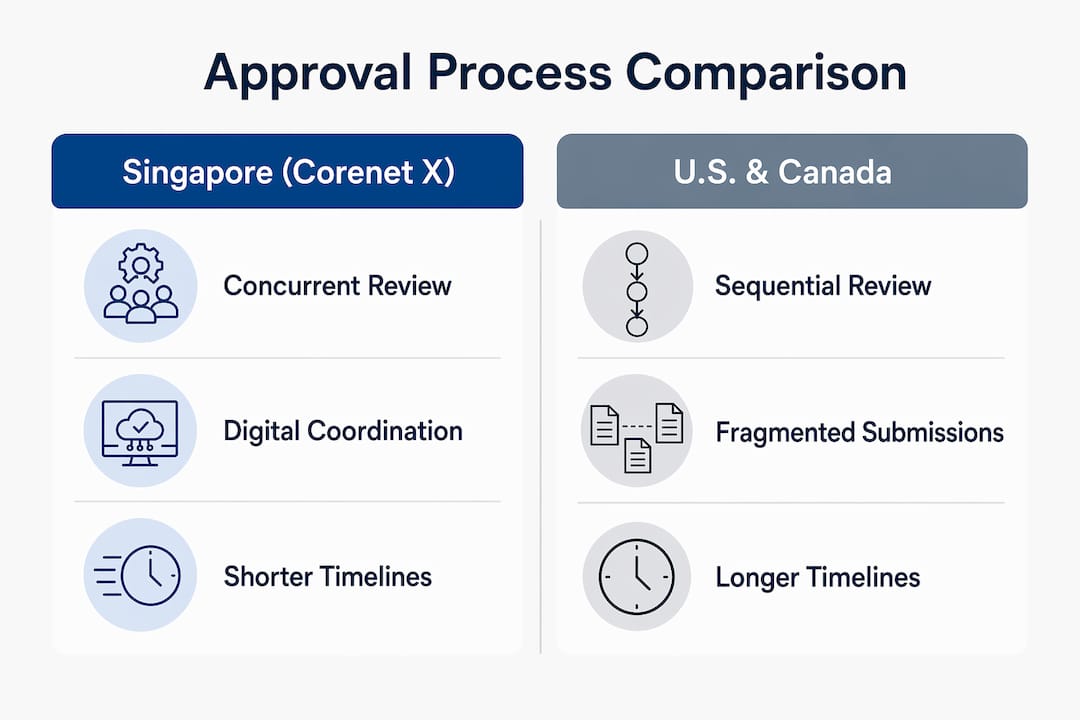
Singapore’s competitive advantage is structural. The Corenet X platform forces coordination that other jurisdictions leave to the project team to manage informally. For international developers entering Singapore, that structure reduces uncertainty. For Singapore-based teams working on projects abroad, the contrast highlights how much time fragmented systems add to project schedules. Tier 1 infrastructure projects in other markets, such as those seen in large-scale construction portfolios, still navigate multi-agency complexity without the benefit of a unified digital platform.
Key Takeaways
Infrastructure project approvals in Singapore require coordinated multi-agency submissions across URA, BCA, SCDF, PUB, LTA, NEA, and NParks, with Corenet X now mandating BIM-based concurrent review for all new projects from october 2026.
| Point | Details |
|---|---|
| Multi-agency coordination is mandatory | Seven agencies review distinct compliance domains; no single authority clears all requirements. |
| Standard timelines run 12–20 weeks | URA and BCA reviews together take 12–20 weeks for standard projects, longer for conservation or GCB sites. |
| Plan Reject Letters are common | Approximately 60% of BCA submissions receive a PRL, adding 14–28 working days per round. |
| Corenet X cuts approval time by 20% | Concurrent digital review under IFC-SG BIM format reduces rework and speeds coordinated agency feedback. |
| Deemed approval carries legal risk | Invoking deemed approval does not remove liability; projects remain subject to audit and enforcement. |
The 2026 approval landscape rewards preparation, not reaction
My view, after working through Singapore’s regulatory submission environment, is that most project delays are self-inflicted. Teams treat agency submissions as a downstream task, something to hand off after design is complete. That approach was marginal before Corenet X. Under the 2026 mandate, it is a direct path to costly rework.
The projects that move through approvals fastest share one characteristic: the QP and BIM coordinator are engaged before schematic design is locked. At that stage, agency requirements can be designed into the project rather than retrofitted onto it. Structural grid decisions, fire compartment layouts, drainage reserve setbacks, and greenery replacement ratios all affect multiple agencies simultaneously. Resolving those intersections in a BIM model at concept stage costs a fraction of what it costs to revise a completed design.
The deemed approval provision deserves particular caution. I have seen teams invoke it to accelerate timelines, then face enforcement queries months later when post-completion audits surface deviations. The provision exists for legitimate use, but it is not a shortcut around due diligence. Every use of deemed approval should be documented with the QP’s full compliance declaration and a clear record of the statutory basis.
Singapore’s approval framework is genuinely well-designed compared to most international equivalents. The discipline it demands upfront is the price of the speed it delivers downstream. Teams that invest in early-stage BIM coordination consistently outperform those that do not.
— Aman
How Aectechnicalsg supports your project approvals
Aectechnicalsg provides engineering consultancy and regulatory submission services for infrastructure and building projects across Singapore. The firm handles PE endorsement and authority submissions to BCA, URA, SCDF, PUB, NEA, LTA, and NParks, covering the full scope of multi-agency coordination required under the 2026 Corenet X framework.
For project stakeholders who need to move from concept to PCBW without timeline surprises, Aectechnicalsg offers structured consultancy across engineering consultancy types suited to Singapore developers. The team’s experience with IFC-SG BIM submissions and concurrent agency review means your project enters the approval process correctly prepared. Contact Aectechnicalsg to discuss your project’s submission requirements and regulatory timeline.
FAQ
What is the definition of infrastructure project approvals?
Infrastructure project approvals are formal regulatory clearances issued by statutory agencies confirming that a project meets planning, structural, fire safety, environmental, and accessibility standards before construction begins. In Singapore, seven agencies coordinate these clearances under the Building Control Act and related regulations.
How long does the infrastructure approval process take in Singapore?
Standard landed projects typically require 12–20 weeks from URA planning submission to PCBW issuance. Conservation projects and Good Class Bungalows take longer, often exceeding 20 weeks, due to additional heritage and environmental review requirements.
What is Corenet X and why does it matter for project approvals?
Corenet X is Singapore’s mandatory digital submission platform for all new building projects from october 2026. It enables concurrent review by seven agencies using a single BIM model in IFC-SG format, reducing approval times by approximately 20% compared to sequential submission processes.
What happens if a BCA submission receives a Plan Reject Letter?
A Plan Reject Letter requires the project team to address all flagged deficiencies and resubmit. Each PRL round adds 14–28 working days to the approval timeline. Approximately 60% of initial BCA submissions receive at least one PRL, making pre-submission quality checks a critical risk mitigation step.
Is deemed approval a safe alternative to standard BCA clearance?
Deemed approval under Building Control Regulations 2003 is a legitimate expedited route but does not remove liability. Projects that invoke deemed approval remain subject to regulatory audit, and any deviation from the QP’s compliance declaration can trigger enforcement action.