Wet Weather Excavation: ERSS Monitoring and Instrumentation Triggers
Introduction: Why Wet Weather ERSS Monitoring Matters in Singapore
Wet weather excavation ERSS monitoring and instrumentation triggers refer to the sensors, threshold values, and escalation protocols that govern how earth retaining and stabilising structures are observed and managed when heavy rainfall changes ground and groundwater conditions around a deep excavation. In Singapore’s tropical climate, where the northeast monsoon (November to January) and southwest monsoon (June to September) deliver intense, often unpredictable storms, managing these triggers is not optional – it is the difference between a controlled site and a dangerous one.
Heavy rain rapidly alters pore-water pressure, increasing the risk of structural failure in retaining walls, struts, and anchors. Sudden storm events exceeding 60 mm per hour can overwhelm surface drainage, saturate exposed soil, and shift groundwater levels within hours. Thorough planning is essential before starting excavation work, and managing earth retaining and stabilising structures during wet-weather excavation requires heightened vigilance from every member of the project team.
The construction sites most exposed to these risks include MRT station boxes, cut-and-cover tunnels, depressed road underpasses, deep basements, and sewer or utility shafts. AEC Technical Advisory is a Singapore-based civil and geotechnical engineering consultancy providing ERSS design, temporary works design, monitoring plans, and PE endorsements for exactly these types of infrastructure projects. The sections that follow will guide contractors, developers, and engineers through setting up wet-weather-specific monitoring, calibrating instrumentation triggers, and defining clear response actions.
Regulatory and Guidance Framework for Wet Weather Excavation in Singapore
ERSS monitoring and triggers must comply with local regulations and align with international good practice. In Singapore, several authorities set the rules that govern how deep excavation and its instrumentation are planned, reviewed, and enforced.
The Building and Construction Authority provides guidelines for monitoring and instrumentation on ERSS, most notably through Advisory Note 1/09, which specifies maximum allowable wall deflection ratios, multi-tier action levels, and mandatory monthly reporting by the Qualified Person. Excavation in Singapore follows the WSH Act regulations, with the Ministry of Manpower and WSH Council issuing safety protocols for excavation work, work at height, and operations near waterlogged areas. PUB’s Code of Practice on Surface Water Drainage sets standards for runoff control and on-site detention, while LTA imposes additional requirements for deep excavation near rail infrastructure.
The QP or Professional Engineer must design the ERSS, specify monitoring, and define action levels in the Geotechnical Instrumentation and Monitoring Plan. When excavation work forms part of a larger mixed-use or infrastructure development, coordination with URA, SCDF, and other authorities is mandatory. For a detailed walkthrough of the ERSS submission checklist for QPs, AEC Technical Advisory’s guide covers the process step by step.
International best practices supplement local guidance. CIRIA Report C760 on embedded retaining wall design and Eurocode 7 (BS EN 1997) provide frameworks for the Observational Method, groundwater management, and monitoring under changing ground conditions – all directly relevant to wet weather scenarios. Monitoring protocols should include trigger levels for action during excessive ground movement, and these should be documented before excavation begins.
When is a PE endorsement required? In Singapore, any ERSS exceeding 1.5 m in depth, or any excavation adjacent to critical structures, utilities, or MRT infrastructure, requires PE endorsement. The QP must submit designs to BCA and, where applicable, LTA for review before construction proceeds.
Wet Weather Hazards in Deep Excavation and ERSS Performance
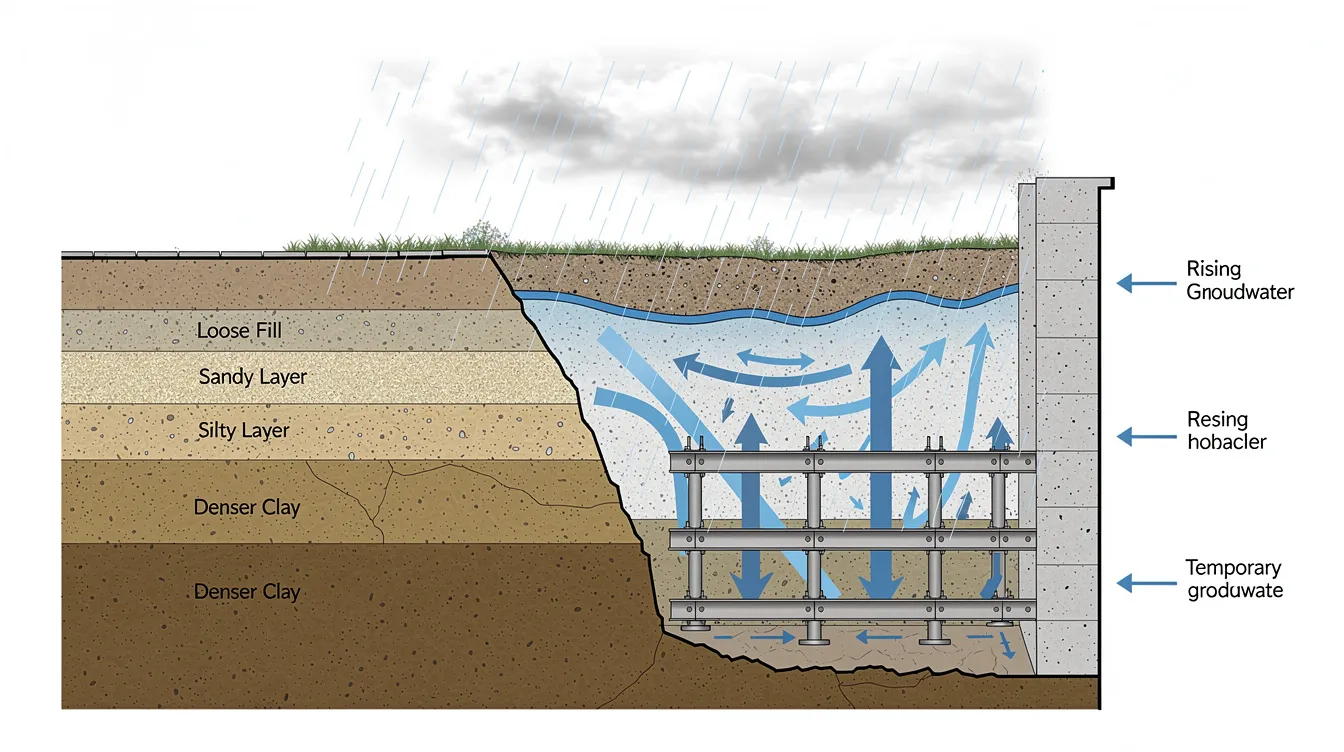
Heavy rainfall and prolonged wet spells change the groundwater regime and increase lateral earth pressures acting on ERSS. The process is straightforward: infiltration reduces matric suction in unsaturated zones, raises pore pressure in saturated zones, and weakens the soil that the retaining system depends on for stability.
Typical wet-weather hazards in deep excavation include:
- Loss of effective stress and strength – rapid saturation softens residual soils and sensitive marine clays, reducing their ability to resist lateral loads
- Basal heave risk – uplift forces beneath the excavation base increase when water pressure rises faster than the system can relieve it
- Piping and erosion – water flowing through wall joints, interlocks, or permeable sand lenses can erode soil internally, creating voids beneath footings or utilities
- Slope instability – temporary batters or cut slopes exposed to surface runoff may fail, especially when crest drainage is inadequate
- Undermining of nearby buildings – ground softening and differential settlement can crack foundations, tilt structures, or rupture buried pipelines
Groundwater fluctuations can trigger significant structural movements in retaining walls, and heavy rain can cause rapid spikes in hydrostatic pressure behind those walls. Enhanced monitoring of slope stability is essential during wet weather conditions. Excavation hazards include soil instability and underground utilities, both of which become more dangerous when the ground is saturated.
In Singapore, these risks are amplified by the geology. Thick Kallang Formation marine clays exhibit low permeability and low undrained shear strength – as low as 20–40 kPa in some areas. Deeply weathered granitic residual soils can collapse when saturated. Recent studies using 122 rain gauges across Singapore show that extreme convective storms are becoming more persistent and spatially extensive, even if peak intensities are not always increasing.
A typical worst-case scenario: an intense 90 mm storm arrives after a prolonged wet week while excavation is at intermediate depth with only the first level of struts installed. The soft ground behind the wall saturates rapidly, pore pressures spike, and the partially supported wall deflects beyond its design assumptions.
Planning Wet Weather Strategies Before Excavation Starts
Proper planning before the first pile is driven sets the foundation for safe wet-weather excavation. This section serves as a checklist for pre-construction preparation.
Risk assessment identifies potential hazards before excavation begins, and evaluating soil conditions is crucial for safe excavation planning. These tasks must be completed well in advance of mobilisation:
- Rainfall statistics review – use long-term data from MSS to identify design storm intensities, monsoon windows, and short-duration extremes (5-, 10-, 15-minute intensities) relevant to the site
- Geotechnical interpretive report – detail soil stratification, hydraulic conductivity, seasonal water table fluctuations, and permeable interbeds that may act as preferential flow paths
- ERSS design basis – integrate wet weather scenarios into the design, including contingency designs following the Observational Method where appropriate
- Scheduling – where feasible, programme high-risk excavation stages outside peak rainfall months to reduce exposure
- Underground utilities mapping – locating underground utilities prevents accidents during excavation; use ground penetrating radar, trial trenches, and coordination with utility owners to confirm alignments and depth
- Surface drainage design – temporary drains, sump pits, and pumps must be sized for design storm events (10-year or 50-year return periods per PUB guidelines); active runoff diversion measures prevent surface water from entering excavation sites
- A site-specific safety plan addresses identified risks effectively and must document wet-weather-specific trigger levels in both the Construction Environmental Management Plan and the Project Safety Plan
Pre-monsoon site audits are crucial for ensuring drainage systems are functioning correctly before heavy rain. AEC Technical Advisory typically conducts joint planning workshops with the contractor and developer to align risk appetite, trigger levels, and response actions. For a deeper look at monsoon readiness for temporary works excavations, our practical guide covers the full preparation process.
ERSS Types and Their Behaviour Under Heavy Rainfall
Different types of ERSS respond differently under wet weather conditions, and understanding this behaviour is essential for selecting the right monitoring approach.
- Diaphragm walls and secant bored pile walls – these can act as effective groundwater cut-off barriers when properly constructed. However, rainfall infiltration behind the wall and through defective joints increases passive pressure and may lead to greater wall deflections or anchor loads.
- Sheet piles with struts or anchors – highly sensitive to embedment depth and support loading. Soft ground below the toe can result in toe displacement when rainfall causes basal soil softening or seepage under the toe. Shoring systems stabilise trench walls to prevent collapses, but their effectiveness depends on maintaining design assumptions about water pressure.
- Soldier pile and lagging – lagging boards may rot or displace when saturated. Wet soil behind the facing becomes heavier, increasing loads on the support system.
- Soil nail walls and reinforced soil walls – nail pull-out resistance decreases in saturated soil. Face sloughing and erosion of cover soil over nails are common during intense storms. Drainage behind the facing is critical.
Structural load monitoring is essential in assessing the impact of wet weather on these support systems. Each soil profile – granite residual soil versus Jurong Formation versus Kallang Formation marine clay – interacts differently with each ERSS type during wet periods. Marine clay’s low permeability means pore pressures take longer to dissipate, while weathered granite may drain faster but has fissures that create localised flow paths.
For staged construction of MRT station boxes and depressed road cuttings, where adjacent traffic loads remain active, the stakes are higher. Detailed guidance on temporary excavation support covers selection and design considerations for these scenarios.
Instrumentation Suite for Wet Weather ERSS Monitoring
Instrumentation must capture both structural response and geotechnical behaviour under changing moisture and groundwater conditions. The right tools installed in the right locations provide the data that drives every trigger decision.
Key instrument types include:
- Inclinometers – inclinometers are used to track lateral ground and wall movements in excavation sites. Both manual probes and in-place inclinometer systems are deployed along the retaining wall at intervals, with denser coverage near corners and sensitive zones.
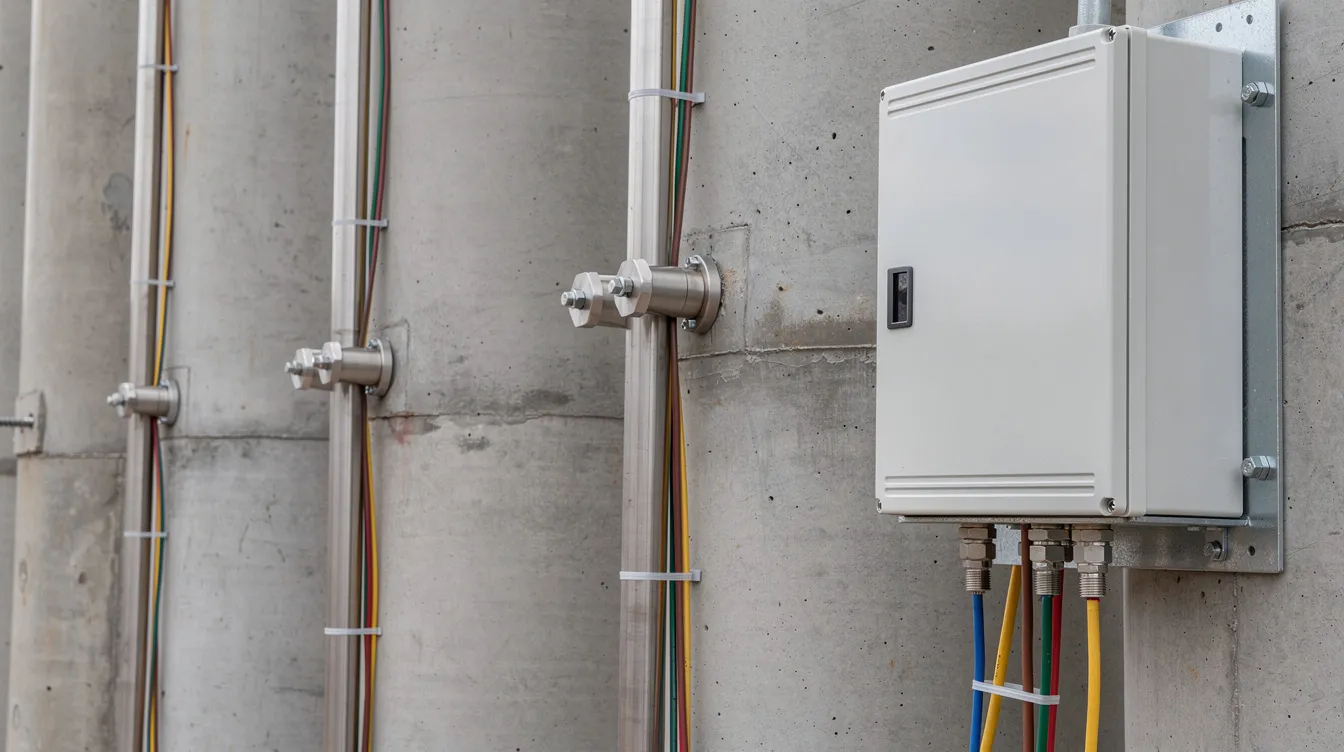
- Piezometers – piezometers are installed to monitor pore-water pressure and groundwater levels during wet weather. Vibrating wire piezometers offer fast response times ideal for storm events; standpipe piezometers provide long-term reference readings. Vertical arrays at multiple depths capture pressure changes across different soil layers.
- Strain gauges and load cells – mounted on struts, walers, and ground anchors to detect force changes as excavation progresses and as weather conditions shift.
- Settlement markers and levelling pins – installed on adjacent buildings, pavements, and utility corridors to detect ground movement and differential settlement.
- Observation wells and rain gauges – on-site rain gauges with high time resolution (5- or 10-minute intervals) enable direct correlation between rainfall and instrument response.
Automated monitoring systems provide continuous data during wet weather, and real-time groundwater monitoring is critical for managing wet-weather excavation risks. Cloud-based dashboards and automated total stations now enable robotic tracking of wall deflection and building settlement, with alerts pushed to project personnel during storms. Soil analysis tools provide insights into soil properties for excavation planning, complementing the real-time data stream.
AEC Technical Advisory designs and reviews Instrumentation and Monitoring Plans and provides independent PE review of third-party proposals. For a comprehensive overview of sensor types, our 2026 field guide to geotechnical instrumentation covers the full range.
Defining ERSS Monitoring Frequencies and Wet Weather Intensification
Baseline monitoring frequencies during normal conditions typically follow a predictable rhythm: weekly or bi-weekly readings for inclinometers and piezometers, daily or twice-weekly readings for settlement markers during active excavation stages, and continuous logging for automated instruments at critical phases.
When heavy rainfall is forecast or underway, this rhythm must intensify. Continuous monitoring is vital for maintaining excavation site safety, and a combination of hydrogeological and structural monitoring is necessary in wet-weather conditions.
Monitoring intensification should follow these principles:
- Forecast heavy rainfall (per MSS warnings) – shift to daily manual readings for inclinometers, activate continuous logging on all piezometers, and stream automated data in near real-time
- During and immediately after storms – log piezometer and load cell data at intervals of 15 minutes or less; conduct visual inspections of wall joints, sump pits, and drainage channels
- Key excavation stages – first excavation below the groundwater table, first strut preloading, excavation approaching final depth, and any period when temporary drainage is being modified all demand heightened frequency regardless of weather
- Post-storm follow-up – regular visual inspections are necessary after significant rainfall events to assess structural integrity; check for seepage, soil slumping, ponding, and blockages
Monitoring parameters during wet weather should include pore-water pressure, wall deflection, and groundwater levels at minimum. For critical infrastructure, or where nearby buildings are highly sensitive, automated alerts via SMS and email should reach the RE/RTO, QP(Geo), and contractor site team when thresholds are exceeded – especially during overnight storms or public holidays.
Monitoring frequency schedules should be clearly tabulated in the method statement, with a separate column specifying a “Wet Weather Intensified Regime.”
Setting Instrumentation Trigger Levels for Wet Weather Events
Trigger levels are multi-tiered thresholds that translate raw instrument readings into decisions. Under BCA’s Advisory Note, the standard framework uses three tiers tied to the Work Suspension Level (WSL):
| Trigger Tier | Wall Deflection | Typical Response |
|---|---|---|
| Check / Green | ≤ 50% of WSL | Normal operations, routine monitoring |
| Alert / Amber | 50–70% of WSL | Increase monitoring frequency, inspect site |
| Work Suspension / Red | 100% of WSL | Halt excavation, mobilise PE/QP, notify BCA |
For wet weather events, additional pore pressure and settlement triggers are layered on:
- Piezometer Alert – when observed pore pressure exceeds the design phreatic line by 5 kPa, or when a rapid rate of rise (several kPa within hours) is detected
- Settlement Alert – when overnight settlement exceeds a predetermined rate (e.g. 5 mm in 24 hours) even if absolute settlement remains below the main limit
- Strut load Alert – at 80% of design capacity, with alarm above 100%
- Rainfall trigger – on-site gauge recording more than 50–60 mm in one hour, or cumulative rainfall exceeding design assumptions over a defined window
Exceeding designed action levels requires immediate suspension of excavation work for safety. Critically, triggers should capture not only absolute values but also rates of change – a sudden 20 mm settlement after a storm demands immediate attention even when total movement is within limits.
Triggers should be correlated to rainfall intensity data from on-site rain gauges to support cause analysis and to verify whether ground response matches design predictions. AEC Technical Advisory helps clients calibrate triggers using design analyses, historical project data from similar site conditions, and site-specific risk tolerance. A useful visual for field crews is a time-series chart of deflection with colour-coded bands: green up to 50% WSL, amber to 70%, red at 100%.
Wet Weather Response Actions When Triggers Are Exceeded
Clear, pre-agreed response actions eliminate hesitation when instruments signal trouble. Every project should have a documented response matrix differentiating between structural triggers (wall deflection, strut loads), geotechnical triggers (pore pressure, settlement), and rainfall triggers (intensity over defined time windows).
Alert-level responses:
- Increase monitoring frequency to daily or continuous
- Check instrument calibration and verify readings
- Visually inspect ERSS, wall joints, and exposed soil faces
- Confirm pumps and drainage channels are functioning; clear any blockages in sump pits
- Review weather forecast for the next 24–48 hours
Action-level responses:
- Slow down or temporarily pause excavation work
- Install additional sump pumps and enhance pumping capacity
- Strengthen surface diversion berms and redirect site runoff away from wall tops
- Review temporary drainage adequacy and adjust if needed
- Brief all personnel on heightened safety protocols
Alarm / Red-line responses:
- Halt all excavation activities immediately
- Lower water levels via pumping or relief wells if designed into the contingency plan
- Add emergency props or struts to increase support
- Mobilise PE/QP for immediate site assessment
- Notify client, BCA, and relevant authorities if structural or public safety is at risk
Special actions to protect underground utilities include temporary bridging over exposed services, localised grouting to prevent void formation, sandbagging, and encasement of cables and pipes to prevent wash-out during intense storms. Communication protocol must assign clear responsibilities: who receives the alert, the required inspection timeline, and the authority to stop work.
Safe Work Practices, Personal Protective Equipment and Site Logistics in Wet Conditions
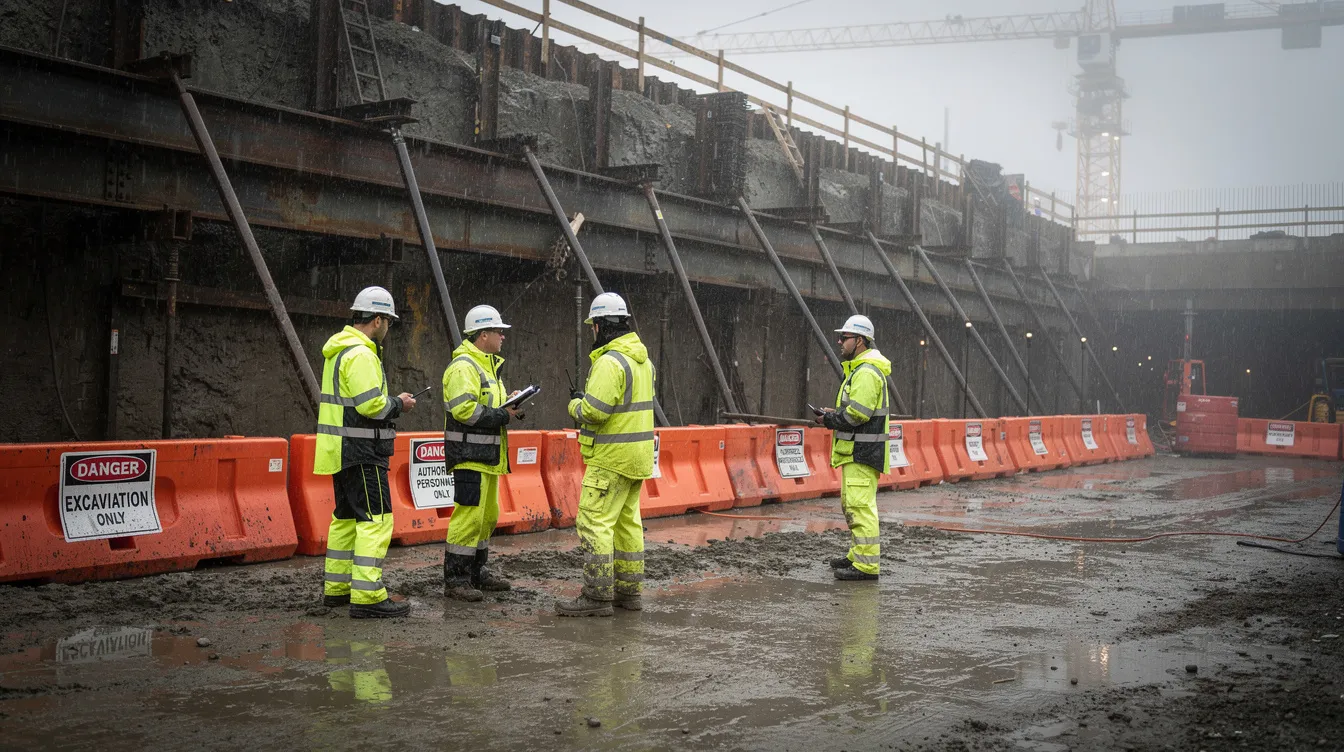
Heavy rainfall affects not only ERSS stability but the day-to-day health and safety of workers performing excavation work. Accidents increase when surfaces are slippery, visibility is poor, and ground bearing capacity drops.
Personal protective equipment is essential for excavation safety. Critical PPE for wet weather includes:
- High-visibility rain jackets with reflective strips
- Non-slip safety boots rated for waterlogged conditions
- Helmets with chin straps to prevent dislodgement in wind
- Safety glasses with anti-fog coating for visibility
- Gloves suitable for wet handling of steel and tools
- Harnesses when working near open deep excavation edges
Housekeeping at the construction site demands constant attention: clearing mud build-up on ladders and platforms, maintaining non-slippery access routes, providing adequate lighting during dark stormy conditions, and ensuring signage remains visible and legible. Proper ventilation in enclosed or partially covered excavation areas prevents buildup of exhaust fumes from pumps and generators.
Crane lifts and movement of heavy equipment should be suspended when visibility or ground bearing capacity is compromised by heavy rainfall. Modern excavators feature GPS guidance systems for precision, and automation in excavation reduces manual labour in hazardous environments – but even automated systems require human oversight during adverse weather conditions.
Clearly delineated exclusion zones near ERSS during and after storms prevent accidental falls or loading of weakened ground. All workers must receive training on wet weather procedures, and competency in recognising signs of ground distress – such as seepage through wall joints, sudden ponding, or cracking of adjacent pavement – should be verified before personnel are deployed to excavation areas.
Protecting Surrounding Assets and Underground Utilities During Heavy Rainfall
Wet weather increases the risk of settlement, uplift, or washout affecting underground utilities – water mains, gas pipes, power cables, and telecommunication ducts – adjacent to deep excavation. A single pipe rupture triggered by ground movement can escalate costs, delay project timelines, and create legal issues with asset owners.
Pre-construction utility surveys using ground penetrating radar and trial trenches are mandatory. Vacuum excavation safely exposes underground utilities without damage, making it the preferred method for confirming alignments and depth near sensitive services. Hydraulic excavation uses high-pressure water to break up soil in areas where mechanical methods risk damaging existing infrastructure. Trenching is used for installing utilities like water pipes, and horizontal drilling minimises surface disruption in urban areas where access is constrained. In hard rock, controlled blasting breaks up rock formations for easier removal, though this is rare in Singapore’s urban context.
Monitoring strategies focused on underground utilities should include settlement markers on utility corridors, vibration monitoring near sensitive services, and leak detection in water or gas lines when significant movement is recorded. Mitigation measures include temporary supports for exposed services, concrete slab bridging, and localised grouting to prevent soil collapse and void formation around pipes after intense storms.
Sudden ground softening after heavy rainfall may require traffic diversion above utility corridors to reduce live loads and protect both the utilities and the public. AEC Technical Advisory assesses risk to critical lifeline utilities and proposes monitoring and contingency arrangements that satisfy asset owners and regulatory authorities.
Case-Based Scenarios and Lessons Learned from Singapore Projects
Real-world scenarios illustrate how wet weather monitoring and triggers work in practice. The following examples, drawn from recent Singapore infrastructure projects, demonstrate both effective response and the consequences of inadequate preparation.
Scenario 1: MRT Station Box – Rapid Groundwater Rise During excavation of an 18 m deep MRT station box along a busy arterial road, automated piezometers detected a rapid groundwater rise after a 90 mm, 3-hour storm. Pore pressure readings exceeded the Alert threshold within two hours. The Action-level trigger led to an immediate excavation halt, additional pumping was mobilised, and the integrity of the diaphragm wall cut-off was verified through inspection of wall joints. Wall deflection remained within limits because the response was fast. The lesson: automated instruments and pre-agreed triggers saved critical hours. For detailed guidance on ERSS design and analysis in MRT construction, AEC Technical Advisory’s article covers the design process.
Scenario 2: Underpass Excavation – Settlement Near Water Main Beneath a major junction, heavy rainfall caused localised settlement near a 400 mm water main. Settlement markers reached the Alert level after 8 mm of overnight movement. The contractor immediately implemented road traffic management above the utility corridor and called for utility inspection. The pipe was intact, but the ground around it had softened. Additional grouting stabilised the zone, and no pipe rupture occurred. The lesson: settlement rate triggers – not just absolute values – caught the problem early.
Scenario 3: Soil Nail Wall – Inadequate Surface Drainage A smaller infrastructure project used a soil nail wall to support a slope above a drainage canal. After a week of intermittent rain, nail head seepage was observed and facing panels showed signs of sloughing. The root cause was inadequate crest drainage – surface water was flowing over the wall top and infiltrating behind the facing. Reviewing wet weather procedures and improving crest drainage with diversion berms stabilised performance within days. The lesson: even modest projects require proper surface water management.
Across all three scenarios, the common threads are clear: early installation of instruments, realistic trigger levels calibrated to site conditions, and rehearsed response procedures make the difference between incidents and controlled outcomes.
How AEC Technical Advisory Supports Wet Weather ERSS Monitoring
AEC Technical Advisory provides end-to-end support for infrastructure projects where wet weather is a critical design driver:
- ERSS and deep excavation design – geotechnical analysis incorporating wet-season groundwater conditions, seepage modelling, and contingency designs
- Instrumentation and Monitoring Plan preparation – selecting instruments, defining trigger levels, and specifying monitoring frequencies for both normal and wet weather regimes
- PE endorsements – for temporary works, ERSS designs, and monitoring plans requiring professional engineer certification
- Authority submissions – coordinating with BCA, LTA, PUB, URA, and SCDF to incorporate their requirements into monitoring and trigger frameworks
- Pre-monsoon risk reviews – assessing site readiness including drainage capacity, pump sizing, berm effectiveness, and emergency response planning
- Collaborative workshops – aligning developers, contractors, and consultants on trigger levels and response actions based on observed performance and updated rainfall data
If you are planning deep excavation or infrastructure works in 2026–2027, engage AEC Technical Advisory early for wet-weather-ready ERSS solutions and monitoring strategies that protect your project, your neighbours, and your programme.
Conclusion: Building Resilient Excavations Through Proactive Wet Weather Management
- Effective wet weather ERSS monitoring and instrumentation triggers are essential for safety, productivity, programme control, and protecting surrounding assets and structures
- Early and proper planning – covering rainfall analysis, soil assessment, instrument selection, trigger calibration, and response protocols – prevents reactive crisis management
- Singapore’s increasingly intense rainfall patterns and developments in automated monitoring demand that every infrastructure project builds compliance and resilience into its excavation process from day one
- Adopting data-driven monitoring, real-time alerting systems, and robust wet-weather procedures will deliver safer, more efficient outcomes for the construction industry on future deep excavation projects
The effectiveness of your ERSS monitoring programme is only as strong as the weakest link in the chain – from instrument installation to trigger calibration to the speed of your response. Build that chain properly, and wet weather becomes a managed risk rather than a project-ending event.