
Engineering consultant fees in Singapore run on four models: percentage of construction cost, time-based billing, lump-sum pricing, and reimbursables layered on top of any of the three. Small projects under roughly SGD 1 million typically see hourly or lump-sum arrangements rather than percentage fees, while larger developments blend percentage and time-based structures with separate authority-submission costs. The single move that protects your budget most: lock a detailed Terms of Reference and fee model into writing before any consultant starts work.
TL;DR:
- Using a detailed Terms of Reference and explicit fee model before work starts can prevent most disputes over engineering consultant costs.
- For projects under SGD 1 million, lump-sum or hourly billing is more common than percentage-based fees due to fixed overheads.
- Scope clarity, including the number of disciplines and authority submissions, has a greater impact on final costs than fee negotiation alone.
- Reimbursables should be itemized separately with caps or approval thresholds to avoid unexpected expenses during construction.
- Custom projects require tailored proposals; generic rate calculators cannot accurately reflect site-specific conditions or discipline needs.
Table of Contents
- Understanding Engineering Consultant Fee Structures
- Typical Rates and Ranges for Singapore Projects
- How Fees Are Actually Calculated
- Sample Budgets by Project Scale
- Locking In Fees Through the Contract
- Choosing a Consultant Without Overpaying or Under-Protecting Yourself
- Practice Notes From AECTechnicalSG
- What Actually Determines Whether You Overpay
- Get a Fee Proposal Built Around Your Actual Scope
- Sources
- FAQ
Understanding Engineering Consultant Fee Structures
Most disputes over consulting engineering costs trace back to one root cause: nobody agreed on the pricing model before work started. Singapore’s engineering consultancy market uses four remuneration modes, and international fee guidelines from bodies like the Association of Consulting Engineering Companies Ontario converge on the same four structures used locally, even though that guideline itself is Canadian.
Percentage of construction cost ties the consultant’s fee to the estimated or actual construction value, usually somewhere between 3% and 8% depending on discipline and project complexity. It works well for larger, well-defined developments where the construction sum is stable. It works poorly for smaller jobs. On a project under SGD 1 million, fixed overheads like authority liaison, PE endorsement, and document preparation don’t scale down proportionally, so a percentage fee either underpays the consultant or overcharges the client relative to actual effort.
Time-based fees, billed hourly or by man-month, suit projects where scope is still being defined. Geotechnical investigations, early feasibility studies, and additions to existing structures often start this way because nobody, including the consultant, knows exactly how many site visits or design iterations the work will need. Time-based billing protects the client from paying for undefined scope and protects the consultant from being locked into a fixed price for open-ended work.
Lump-sum or fixed fees work only when the scope is genuinely fixed. A clearly bounded structural design for a landed property extension, a defined M&E fit-out, or a single BCA submission package can all be quoted as lump-sum. The catch: lump-sum pricing demands contract discipline. Any change to drawings, additional authority queries beyond a stated number of resubmissions, or added disciplines should trigger a documented variation, not silent scope absorption.
Reimbursables sit outside all three fee modes and typically cover:
- Authority submission and processing fees (BCA, URA, SCDF, and similar)
- Testing and laboratory charges for soil, concrete, or materials
- Site travel and site-visit costs beyond an agreed radius
- Printing, plotting, and document reproduction
- Specialized software licenses or equipment hire tied to the project
- Third-party specialist reports (acoustics, wind, traffic)
Reimbursables should never be buried inside a lump-sum figure. Ask for them itemized, with a cap or an approval threshold, so you’re not surprised by a testing invoice three months into construction.
Typical Rates and Ranges for Singapore Projects
Rate expectations vary sharply by seniority and discipline, and market summaries from 2026 industry commentary put general engineering consultancy hourly bands on a wide spectrum, with niche specialisms and rush-delivery work commanding meaningfully higher premiums, according to InteSpring’s 2026 cost breakdown.
Pro Tip: Ask every shortlisted consultant to quote their hourly rate by seniority tier, not just a blended average. A blended rate hides whether your project will actually get senior review time or mostly junior drafting hours.
Broadly, Singapore engineering consultancies structure hourly rates across three tiers:
- Entry-level engineers and drafters handle routine documentation, shop drawings, and coordination tasks at the lowest end of the band.
- Mid-level engineers manage day-to-day design development, calculations, and authority liaison, sitting comfortably above entry rates.
- Senior engineers and PE-registered professionals command the highest rates, reflecting the liability they carry when they endorse drawings for statutory submission.
Project-fee ranges track construction value roughly as follows:
- Small projects (under SGD 1 million): typically hourly or lump-sum, since structural engineer costs at this scale are driven more by fixed submission and documentation overhead than by construction value.
- Medium projects (SGD 1 million to SGD 25 million): often a mix, with percentage-based structural and M&E fees alongside lump-sum authority submission packages.
- Large projects (above SGD 25 million): multidisciplinary percentage fees dominate, frequently supplemented by dedicated site-supervision allowances and independent checking engineer fees.
A handful of factors push quoted fees above these baseline bands. Specialist disciplines like façade engineering, wind engineering, or vibration analysis carry premiums because fewer local firms practice them. PE and QP supervision duties add cost when a project requires ongoing site presence rather than periodic review. Authority checking fees, particularly for SCDF fire safety submissions or complex URA planning applications, can extend both timeline and consultant hours. Rush work, where a client needs a submission turned around in weeks instead of the usual cycle, almost always carries a surcharge because it displaces other scheduled work.
How Fees Are Actually Calculated
A fee proposal is never just a number pulled from a rate card. It’s built from a series of inputs, and understanding them lets you interrogate a quote instead of just accepting or rejecting it.
- Scope definition. The number of disciplines involved (structural, geotechnical, M&E, façade), whether Earth Retaining and Stabilizing Structures (ERSS) design is needed, and how many ground investigation boreholes are planned all move the price directly.
- Terms of Reference quality. A precise TOR that spells out deliverables, drawing counts, and submission rounds gives the consultant confidence to quote tightly. A vague TOR pushes consultants to add risk premiums, since they’re pricing for unknowns rather than known work.
- Risk premiums. Constrained sites, adjacent building protection, unusual soil conditions, or a history of contentious authority submissions all justify a premium, but a credible consultant should be able to explain exactly why the premium exists.
- Deliverables list. Calculations only, or calculations plus shop drawings plus bar bending schedules? Each added deliverable is a cost line, and shop drawing production and bar bending schedules are commonly quoted separately from core design work.
- Authority submission scope. Fees differ depending on whether the consultant handles only the initial submission or every round of resubmission through to Temporary Occupation Permit.
A precise TOR does more than stabilize price. It also tends to speed up the review cycle with authorities like BCA and URA, because clearly defined deliverables reduce the back and forth that iteration-heavy submissions generate.
Before signing anything, verify these assumptions on the proposal: how many resubmission rounds are included before extra charges apply, whether site supervision is periodic or continuous, whether reimbursables are capped or open-ended, and whether the quote covers one discipline or several. A proposal that’s silent on any of these four points is a proposal likely to generate a variation order later.
Sample Budgets by Project Scale
Numbers land better than abstractions, so here’s how the fee models above translate into actual line items across three project sizes.
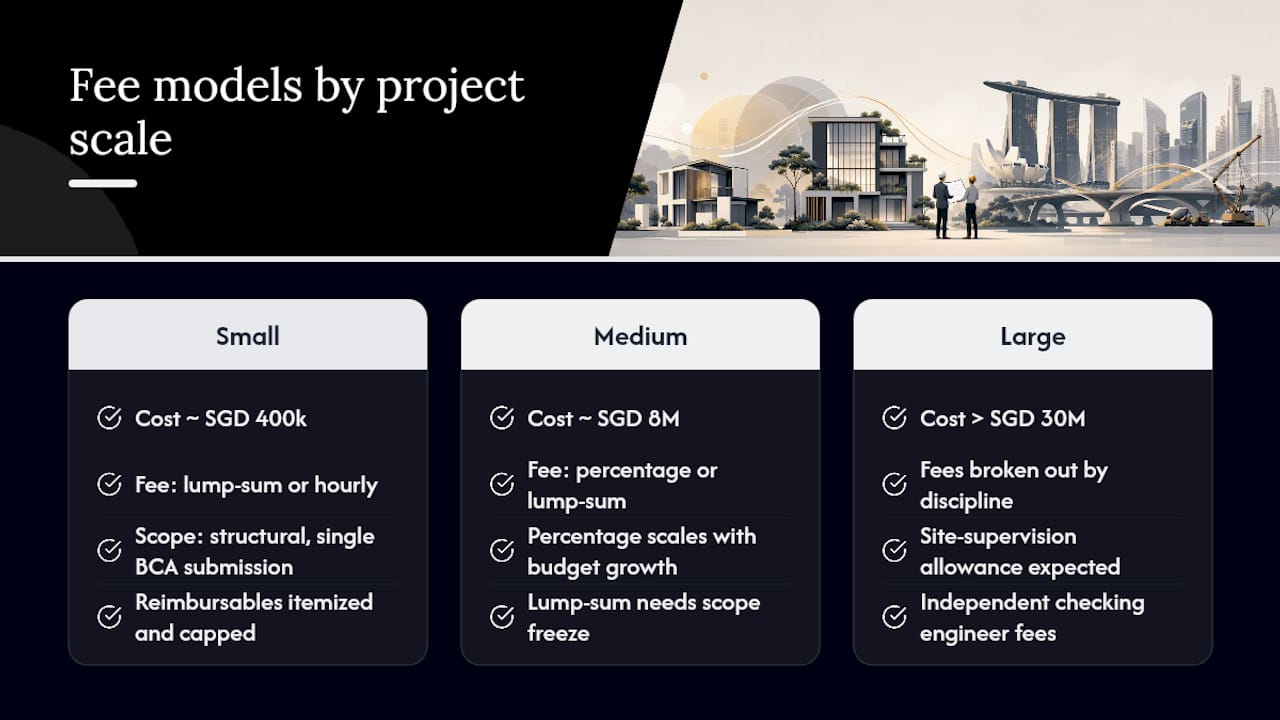
Small project, landed property addition or reinstatement, construction cost around SGD 400,000. This scale almost always runs on lump-sum or hourly billing rather than percentage fees, given the fixed-overhead problem described earlier. A typical structural scope, covering calculations, drawings, and a single BCA submission, might be quoted as a fixed fee with reimbursables (testing, submission fees) itemized separately and capped at an agreed ceiling.
Medium project, mixed-use renovation or small development, construction cost around SGD 8 million. Here the interesting decision is percentage versus lump-sum. A percentage fee scales automatically if the construction budget grows mid-project, which protects the consultant but can frustrate a client trying to hold a fixed number. A lump-sum quote gives budget certainty but needs a firm scope freeze and a clear variation process for anything beyond it. Many Singapore consultants offer either, and the right choice depends on how settled your design is at the point of engagement.
Large project, multidisciplinary development, construction cost above SGD 30 million. Fees here typically break out by discipline: structural, geotechnical, M&E, and façade each quoted as a separate percentage or lump-sum line. On top of design fees, budget for a site-supervision allowance if the consultant provides periodic or continuous QP presence, and for independent checking engineer fees where the project involves ERSS works or falls under mandatory third-party review.
Across all three scales, reimbursables deserve a dedicated line rather than a rounding error. Clients frequently under-budget this category, and treating reimbursables as a contingency of a moderate percentage of base fees, common in several international fee guidelines, tends to prevent funding shortfalls later in the project. A general project contingency of 15% to 20% on top of consultant fees is standard advice for structural engineering budgets in Singapore, and it applies just as well to the consultancy line item as to construction costs.
Locking In Fees Through the Contract
The fee model only protects you if the contract around it is specific. A handshake agreement on “percentage of construction cost” without a defined payment schedule is an invitation to dispute.
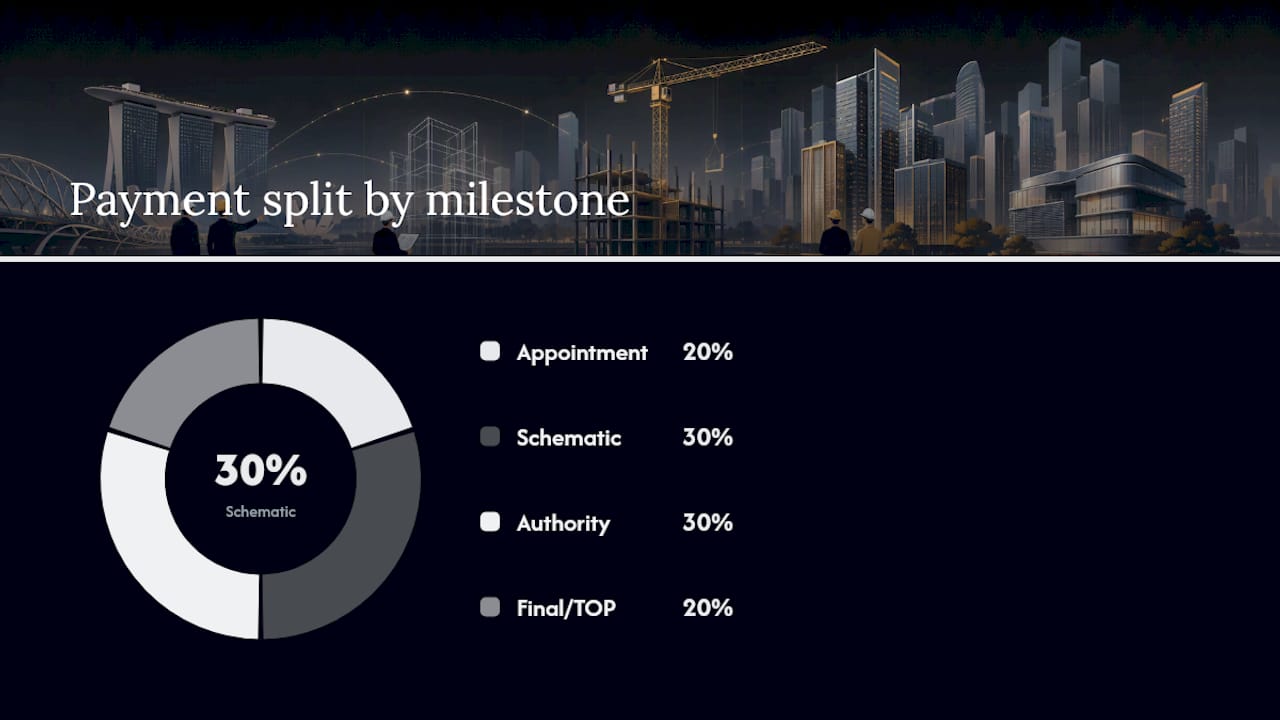
- Set payment milestones to deliverables, not dates. A common structure ties roughly 20% to appointment and mobilization, 30% to schematic or preliminary design submission, 30% to authority submission, and the remainder to final approval or Temporary Occupation Permit. Tying payment to dates instead of outputs creates friction the moment a submission gets delayed by the authority, not the consultant.
- Document scope changes before work begins on them. Any variation, an added discipline, an extra resubmission round beyond what the TOR specified, a change in building height, should be priced and approved in writing before the consultant proceeds. Verbal go-aheads are the single most common source of fee disputes.
- Set an approval threshold for reimbursables. Agree that any reimbursable expense above a set amount, say SGD 500, needs written client approval before it’s incurred. This keeps testing and specialist-report costs from ballooning without your knowledge.
Pro Tip: Request that the contract explicitly names which authority-liaison rounds are included. “Submission to BCA” can mean one clean submission or five rounds of query responses, and those are very different price points.
Beyond payment structure, ask for four specific clauses in any consultancy agreement: a full deliverables list with format and revision count, explicit authority-liaison scope naming which agencies and how many resubmission cycles, defined inspection or supervision scope if the engagement includes site visits, and a variation-pricing mechanism so scope changes have a pre-agreed pricing method rather than being negotiated from scratch mid-project.
Choosing a Consultant Without Overpaying or Under-Protecting Yourself
Price is one variable in a decision that also involves risk transfer, timeline certainty, and the cost of getting a submission rejected. The cheapest quote on paper is rarely the cheapest outcome if it comes from a consultant unfamiliar with a particular authority’s current requirements.
Weigh these factors when comparing proposals:
- Track record with the specific authorities your project touches (URA for planning, BCA for structural, SCDF for fire safety, PUB for drainage, and so on).
- PE or QP supervision experience relevant to your building type and site conditions.
- A clear resourcing plan naming who does the work, not just who signs the proposal.
- Documentation quality in the sample deliverables they can show you.
Prefer capability over lowest price whenever your project involves ERSS, constrained sites, or a history of neighbor objections at the planning stage. The cost of a rejected submission, in time and resubmission fees, usually dwarfs the savings from a cheaper initial quote. Red flags worth checking against references: a proposal with no named senior reviewer, silence on resubmission rounds, and reluctance to name past clients you can call. A short but useful interview checklist: how many similar authority submissions have you completed in the past two years, who specifically will be assigned to this project, what’s your average resubmission count with this authority, and can you share a sample deliverable from a comparable project. The value consultants bring often shows up less in the design itself and more in how they manage regulatory submissions and risk premiums before problems reach your desk.
Practice Notes From AECTechnicalSG
An engineering consultancy typically works across structural and geotechnical engineering, mechanical and electrical design, and architectural planning, with submission experience spanning several relevant regulatory authorities. That breadth matters for fee budgeting because a multidisciplinary project touching several of these agencies needs a proposal that itemizes each authority-liaison line separately, not one blended estimate.
A fee proposal that names each authority explicitly, and states how many resubmission rounds are included per agency, is the clearest signal that a consultant has actually scoped the project rather than quoted from a template.
In practice, submission timelines vary enough by agency that budgeting a single flat allowance for “authority fees” tends to underestimate the slower agencies and overestimate the faster ones. Independent checking fees, common on projects involving ERSS or constrained adjacent structures, are worth flagging early rather than discovering mid-proposal. Fee proposals are often structured with deliverables, submission scope, and reimbursables broken out as distinct sections, which gives clients a document they can check line by line rather than a single lump number to accept on faith.
What Actually Determines Whether You Overpay
The conventional advice on engineering consultant fees in Singapore treats fee negotiation as the main lever, haggling a percentage point off a quote, pushing back on an hourly rate. That’s the wrong place to spend your effort. The research here points somewhere else entirely: the biggest swings in what you end up paying come from scope clarity, not price negotiation. A vague TOR generates risk premiums that dwarf anything you’d save by negotiating rate. A precise one lets a consultant quote tight the first time.
What’s overrated is chasing the lowest hourly rate across three or four quotes. What’s underrated is asking each bidder the same specific question: how many resubmission rounds does this price include? That single question exposes more hidden cost than any rate comparison. If there’s one thing to prioritize before requesting a single proposal, it’s writing the TOR yourself, or paying someone to write it properly, before you ask anyone to price the work. Everything else, the fee model, the payment schedule, the reimbursable caps, becomes far easier to negotiate once the scope stops moving.
— Aman
Get a Fee Proposal Built Around Your Actual Scope
Generic online rate calculators can’t account for your site’s soil conditions, your building’s authority pathway, or how many disciplines your project actually needs. Fee proposals should be built around your specific Terms of Reference, itemizing different disciplines and authority submissions as separate, transparent lines rather than one bundled estimate.
If you’re at the stage of comparing consultants, the fastest way to get an accurate quote is to have your project brief, any existing drawings, and a rough construction budget ready before you reach out. That lets AECTechnicalSG scope the disciplines you actually need, flag likely reimbursables upfront, and quote a fee model that fits your project size rather than a one-size-fits-all percentage. Start by reviewing the full range of engineering and authority-submission services and requesting a proposal tailored to your scope.
Sources
For readers who want to verify fee-setting practices beyond this guide, the consulting fee guidance for Singapore businesses covers pricing models and rate-setting factors in more depth. Procurement teams and quantity surveyors comparing international fee philosophies can reference the ACEC Ontario fee guideline for standard remuneration modes and payment-schedule examples. Due diligence on a consultancy’s registered entity status can be checked through Singapore’s official business registry.
- How much does engineering consultancy cost in 2026? – InteSpring
- 2020 Fee Guideline – ACEC Ontario (fee model guidance)
FAQ
How much does an engineering consultant cost in Singapore?
It depends entirely on the fee model and project scale: small projects under SGD 1 million typically use hourly or lump-sum pricing, while larger developments often use percentage-of-construction-cost fees layered with reimbursables. Getting an accurate number requires a defined Terms of Reference and a written proposal from a consultant, since generic figures rarely reflect your project’s specific disciplines and authority-submission scope.
What is the average salary for an engineering consultant in Singapore?
Salary bands vary by seniority, with entry-level engineers earning the least and PE-registered senior engineers commanding the highest pay, reflecting the liability they carry when endorsing statutory submissions. Consultancy hourly billing rates, which fund those salaries, follow the same tiered structure across entry, mid, and senior levels.
How much is a normal consulting fee for an engineering project?
There’s no single “normal” fee because it depends on the model used: percentage fees commonly range between 3% and 8% of construction cost depending on discipline and complexity, while lump-sum and hourly fees are scoped project by project. A precise TOR is what makes a quoted fee predictable rather than inflated by risk premiums.
How should I charge for a consultation fee if I’m a consultant sizing up a new project?
Base it on the fee model that fits the scope certainty you have: use time-based billing when scope is still undefined, lump-sum when deliverables are fixed and clear, and percentage-of-cost for larger, stable-budget developments. Always separate reimbursables like testing, travel, and authority submission fees from your base fee rather than folding them in.
Does AECTechnicalSG publish fixed pricing for its services?
AECTechnicalSG doesn’t publish flat rate cards, since fees depend on project scope, discipline mix, and authority-submission requirements. Current proposals are prepared on request through the services page based on your project’s specific Terms of Reference.