
A fire engineering approach lets a project depart from the prescriptive Fire Code by demonstrating, through engineering analysis and modelling, that a design meets the same safety outcomes. The minimum compliance path runs from a Fire Safety Engineering Design Brief (FEDB) to SCDF in-principle acceptance, then a full Fire Engineering Report (FER) with an independent peer review before final approval. Every step traces back to the Fire Code 2023 and the Singapore Fire Safety Engineering Guidelines (SFEG) 2025.
TL;DR:
- Performance-based fire engineering is most beneficial for complex building geometries, exposed structural steel, or unconventional egress designs where prescriptive rules are inadequate.
- Successful SCDF submissions require early engagement, detailed assumption documentation, comprehensive sensitivity analysis, and coordinated modelling of smoke and occupant evacuation.
- Peer review and validation of computer simulations are mandatory, with a preference for re-running scenarios with varied inputs to confirm safety margins.
- Costs are higher upfront due to modelling and peer review; however, properly executed PB strategies can optimize fire protection system sizing and reduce overall construction costs.
- Clear scoping, disciplined documentation, and early multidisciplinary coordination are essential to avoid delays and unnecessary rework during the performance-based fire safety approval process.
Table of Contents
- What Is a Performance-Based Fire Engineering Approach?
- What Documents Does SCDF Require for a PB Submission?
- How Does CFD and Evacuation Modelling Support an SCDF Submission?
- When Should You Choose PB Design Over the Prescriptive Route?
- How Do You Avoid SCDF Review Delays on a PB Submission?
- How Does Fire Engineering Design Integrate With Other Disciplines?
- What Does a Fire Engineering Approach Cost to Budget For?
- What Do Successful PB Submissions in Singapore Look Like?
- How AECTechnicalSG Supports Performance-Based Fire Engineering Submissions
- The Real Gap in How Teams Approach Performance-Based Fire Engineering
- Get Support for Your SCDF Performance-Based Submission
- Sources
What Is a Performance-Based Fire Engineering Approach?
The Singapore Civil Defence Force defines the performance-based approach as using fire engineering principles, calculations, and software modelling to satisfy the Fire Code where a design departs from its deemed-to-satisfy provisions. Instead of following prescriptive rules (fixed travel distances, fixed compartment sizes, fixed sprinkler zoning), you demonstrate that your specific building meets the underlying safety objective through calculation and evidence.
That distinction matters for any project with unusual geometry, exposed structural steel, atriums, or mixed-use programs that the deemed-to-satisfy tables were never written to anticipate. A prescriptive rulebook assumes a generic building. Performance-based fire engineering lets you design for the building you actually have, which often unlocks architectural features, cost savings, or both.
The evidence supporting a PB submission generally falls into two categories:
- Quantitative evidence: computational fluid dynamics (CFD) smoke modelling, evacuation simulation outputs, structural fire resistance calculations, and sprinkler discharge density analysis.
- Qualitative evidence: engineering judgment on occupant behavior, justification for scenario selection, and reasoned argument on where prescriptive assumptions don’t apply to the building type.
Fire engineering is inherently risk-informed. SCDF reviewers don’t accept a clean simulation output as proof on its own; they expect the assumptions behind it to be tested and defended. A PB approach also lets teams size fire protection systems to the project’s actual risk profile rather than a prescriptive default, which can reduce material and equipment costs or permit design features a prescriptive reading would otherwise block.
What Documents Does SCDF Require for a PB Submission?
SCDF’s review process runs on two core documents, submitted at two distinct stages. Understanding the sequence prevents wasted design cycles.
- Fire Safety Engineering Design Brief (FEDB). Submitted first, for in-principle assessment. It sets out the proposed methodology, design fire scenarios, software tools, key assumptions, and the performance criteria the design intends to meet. SCDF reviews this before you commit resources to full modelling.
- In-principle acceptance. SCDF responds to the FEDB with comments or conditional acceptance of the proposed approach, methodology, and scenarios. This is the checkpoint where fundamental disagreements get caught early, before detailed analysis is complete.
- Fire Engineering Report / Fire Safety Engineering Report (FER/FSER). The full technical submission: detailed CFD results, evacuation modelling outputs, sensitivity analysis, and demonstration that the design meets Fire Code performance objectives.
- Operations and Maintenance (O&M) manual. Required alongside the FER for final approval. It documents the ongoing maintenance obligations, testing regimes, and operational limits (occupancy caps, storage restrictions) that keep the as-built design valid over the building’s life.
- Peer review. An independent qualified peer reviewer verifies the methodology and results before SCDF grants final approval. This isn’t optional paperwork; SFEG treats independent verification as a core part of the review architecture.
For buildings with a narrower, isolated deviation from the deemed-to-satisfy rules, a full PB submission may be overkill. SCDF’s circular on fire engineering assessments outlines a waiver route for existing buildings, which is scoped and documented very differently from a ground-up PB design. Treating the two as interchangeable is one of the more common errors in local practice.
How Does CFD and Evacuation Modelling Support an SCDF Submission?
The technical core of most FER submissions rests on two modelling exercises run in parallel and compared against each other.
CFD modelling (usually run in Fire Dynamics Simulator, or FDS) follows a defined workflow: select the design fire scenarios that represent realistic worst-case conditions for the occupancy, set the computational domain and mesh resolution fine enough to resolve smoke and heat transport near escape routes, define boundary conditions for openings and ventilation, then run and validate the model against known fire behavior benchmarks before trusting the output.
Evacuation modelling estimates Required Safe Egress Time (RSET) by modelling occupant pre-movement time, walking speeds, and route capacity against the building’s actual population and layout, rather than assuming textbook occupant behavior.
The comparison that decides the design is Available Safe Egress Time (ASET) versus RSET. ASET comes from the CFD run: the time until smoke, heat, or visibility conditions become untenable at a given point. RSET comes from the evacuation model: the time occupants actually need to reach safety. A design passes when ASET exceeds RSET by a margin, not when the two numbers merely happen to line up.
That margin is where sensitivity analysis matters. SFEG requires safety factors and sensitivity testing to account for uncertainty in occupant behavior assumptions, fire growth rate, and model resolution. A single ASET/RSET comparison run once, with no variation of inputs, will not satisfy a competent reviewer.
Verification best practice includes:
- Independent peer review of both the CFD and evacuation models, not just a read-through of conclusions.
- Re-running key scenarios with varied inputs to confirm the safety margin holds under reasonable parameter shifts.
- A documented assumption register that traces every input back to its justification, so a reviewer can follow the logic without reconstructing it.
Pro Tip: Build your assumptions register as you go, not after the modelling is done. Reviewers spend more time chasing undocumented assumptions than checking the math itself, and a live register cuts weeks off the review cycle.
Local competency in these methods is formalized through courses like FEP6600 Fire Safety Engineering Design, which reflects the CFD and evacuation modelling skill set SCDF expects submissions to be built on.
When Should You Choose PB Design Over the Prescriptive Route?
The decision usually comes down to three factors: how much the architectural brief conflicts with deemed-to-satisfy defaults, how much schedule buffer the project has, and whether the cost of modelling is offset by the design flexibility gained.
- Choose prescriptive when the building type is conventional and the deemed-to-satisfy rules already fit the layout without forcing compromises.
- Choose full PB design when the architecture genuinely can’t comply prescriptively (long atriums, exposed structural steel intended to stay visible, unconventional egress geometry) and the value of that design feature justifies the added review time.
- Choose the waiver/assessment route for an existing building with a narrow, isolated deviation, where a targeted fire engineering assessment resolves the specific gap without triggering a full PB submission.
Budget for a longer runway than a prescriptive submission. Peer review adds a review cycle, and modelling iterations are common once SCDF’s in-principle comments come back. Early engagement of the fire safety engineer, around concept design stage, prevents the far costlier scenario: discovering a PB requirement after the structural grid and M&E layout are already locked.
How Do You Avoid SCDF Review Delays on a PB Submission?
Most rework on PB submissions traces back to the same handful of avoidable mistakes, not to genuinely difficult technical problems.
Late engagement tops the list. If the fire safety engineer joins after the architectural and structural layouts are frozen, PB findings that would have been a simple sketch revision become a costly redesign. Map fire engineering needs at concept design, when the geometry is still flexible.
Undocumented assumptions are the second most common friction point. SCDF reviewers work through the assumptions register line by line; a design fire scenario or occupant load figure with no stated basis invites a query that stalls the review, even when the underlying number is reasonable.
A useful submission completeness checklist before you send anything to SCDF:
- Design fire scenarios matched to actual occupancy and fit-out, not generic defaults.
- Sensitivity analysis results included, not just the base-case ASET/RSET comparison.
- Assumptions register cross-referenced to drawings and specifications.
- O&M manual drafted in parallel with the FER, not bolted on afterward.
- Peer reviewer comments closed out and documented before final submission.
Pro Tip: Run your own internal “peer review” before the official one, using a colleague who wasn’t part of the original modelling team. A fresh set of eyes catches undocumented assumptions faster than the person who made them.
How Does Fire Engineering Design Integrate With Other Disciplines?
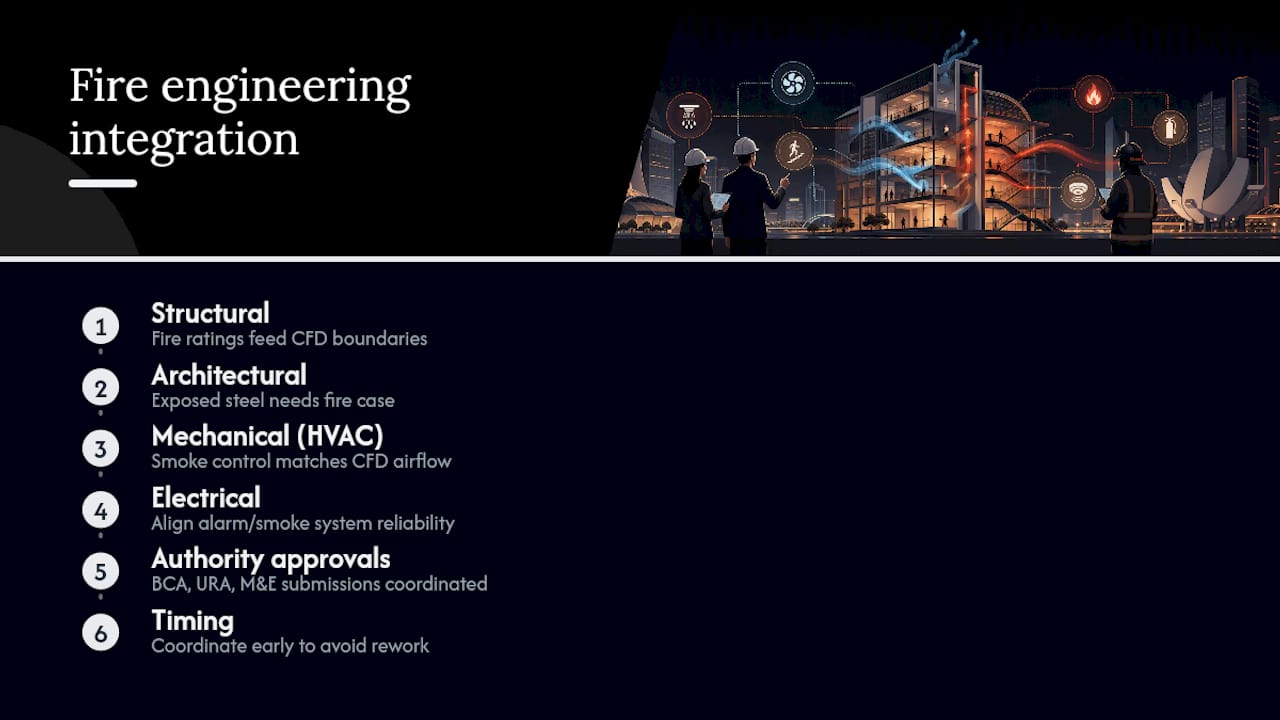
A PB fire strategy rarely stands alone. It reaches into structural, mechanical, electrical, and architectural decisions in ways a prescriptive design usually doesn’t, because the whole point of going performance-based is to tailor the solution to the building’s actual construction and systems.
Structural fire resistance ratings feed directly into CFD boundary conditions. Exposed steel that stays visible for architectural reasons needs a structural fire engineering case that ties back to the same ASET calculations used for egress. Mechanical ventilation design, particularly smoke control and pressurization systems, has to match the exact airflow assumptions used in the CFD model, or the as-built system won’t reproduce the modelled outcome. Electrical systems supporting fire alarm and smoke control need to be specified with the same reliability assumptions the fire engineer used to justify safety margins.
This is also where authority submissions intersect. A PB fire strategy interacts with BCA’s structural and accessibility requirements, URA’s planning parameters, and often M&E submissions to other agencies depending on the building’s systems. A change driven by the fire engineering analysis, say, a revised smoke shaft location, can ripple into structural submissions and building services coordination that need to be resubmitted in step.
Coordinating engineering workflows across disciplines early avoids the rework that comes from a fire strategy finalized in isolation. Some of the same coordination discipline applies across engineering fields generally, as covered in this overview of construction electrical workflow efficiency, which makes the case for locking down technical assumptions across trades before detailed design proceeds. For Singapore projects specifically, treating SCDF submissions as one thread in a broader authority approval sequence, rather than an isolated deliverable, keeps the schedule intact.
What Does a Fire Engineering Approach Cost to Budget For?
A PB submission costs more upfront than a prescriptive one, and the honest budgeting conversation starts there. You’re paying for CFD modelling time, evacuation simulation runs, an independent peer reviewer’s fee, and the extra design iterations that follow SCDF’s in-principle comments.
The scale of that premium depends heavily on project complexity. A single unusual feature, an atrium smoke exhaust strategy, say, requiring a handful of design fire scenarios costs meaningfully less than a full-building PB strategy for a mixed-use development with multiple occupancy types, each needing its own scenario set and sensitivity analysis.
Peer review is a fixed cost that a prescriptive design simply doesn’t carry, and it’s not one to shop down aggressively; a rushed or under-scoped peer review tends to surface as rework later in the SCDF cycle, which costs more than the review fee saved. Budget for at least one round of modelling revision after in-principle feedback, because scenario or methodology pushback from SCDF at that stage is common enough to plan for rather than treat as a contingency.
The upside that offsets the premium is real: a PB approach can right-size fire protection systems to actual risk rather than prescriptive defaults, which sometimes reduces sprinkler zoning, ductwork, or structural fire protection costs enough to partly offset the engineering fee. Whether that trade nets positive depends on the project, which is exactly why an early feasibility conversation with a fire safety engineer, before committing to the PB route, is worth the modest cost of that first consultation.
What Do Successful PB Submissions in Singapore Look Like?
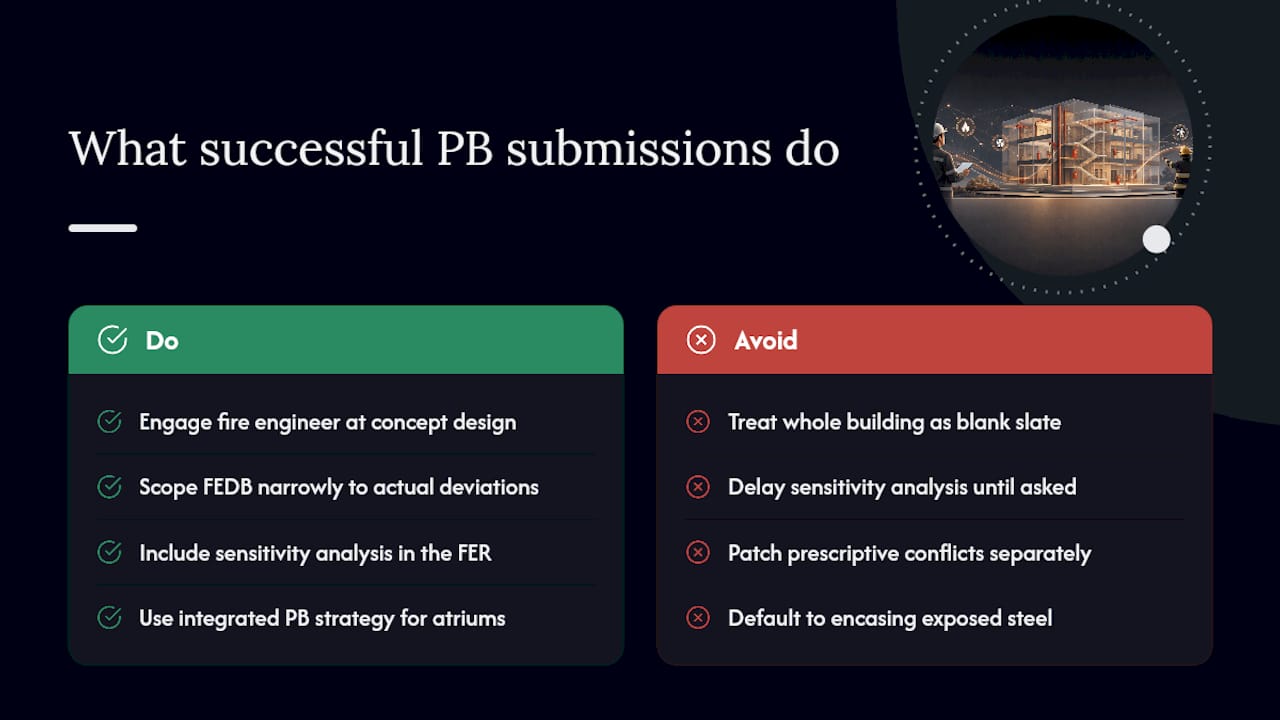
The PB submissions that move through SCDF review with the fewest cycles share a pattern more than a formula. They engage the fire safety engineer at concept design, they scope the FEDB narrowly around the actual points of deviation rather than treating the whole building as a blank slate, and they carry sensitivity analysis into the FER as a matter of course rather than an afterthought added when a reviewer asks for it.
Exposed structural steel projects are a common and instructive case. Where an architect wants steel members visible rather than encased in fire-rated board, a structural fire engineering analysis, tied to CFD-derived thermal exposure and validated fire resistance calculations, can demonstrate equivalent safety without full encasement. That kind of case is exactly where a performance-based approach to exposed structural design earns its cost: the architectural feature survives, and the fire safety case is built on calculation rather than a prescriptive default that would have forced encasement regardless of actual risk.
Mixed-use developments with atriums are another recurring pattern, where a single tall connected volume would trigger multiple deemed-to-satisfy conflicts (travel distance, compartmentation, smoke control) if treated prescriptively. A PB strategy addressing the atrium as an integrated smoke management and egress problem, rather than patching each prescriptive conflict separately, tends to produce a cleaner FER and a faster peer review, because the reviewer is following one coherent argument instead of several disconnected fixes.
What these cases have in common isn’t a shortcut. It’s disciplined scoping and documentation from the first FEDB draft onward.
How AECTechnicalSG Supports Performance-Based Fire Engineering Submissions
Aectechnicalsg works alongside project teams through the full PB workflow: FEDB preparation, coordination of CFD and evacuation modelling, liaison with independent peer reviewers, and O&M manual preparation for final SCDF approval. The firm’s role centers on early integration, bringing fire engineering input into the design before structural and M&E layouts are locked, and on managing the SCDF submission sequence alongside PE endorsement so the paperwork keeps pace with the design.
For developers and architects weighing whether a project needs a full PB strategy or a narrower waiver assessment, that early conversation is the practical next step. Aectechnicalsg also supports the broader authority submission process that a PB fire strategy inevitably touches, from BCA structural coordination to other agency filings.
The Real Gap in How Teams Approach Performance-Based Fire Engineering
The conventional advice on PB submissions focuses almost entirely on the technical modelling: get the CFD right, get the evacuation numbers right, and the submission follows. That advice isn’t wrong, but it skips the part that actually determines whether a project finishes on schedule: timing.
Every delay I’ve seen traced through SCDF’s PB process comes down to a decision made too late, not a calculation done wrong. A structural grid locked before anyone checked whether exposed steel needed a fire engineering case. An atrium smoke strategy bolted onto a finished architectural design instead of shaping it. The modelling itself, once scoped correctly, is usually the easy part. Getting scoped correctly, early enough that the answer can still change the building, is where most projects lose weeks they never get back.
There’s also a quieter misconception worth naming: that a waiver assessment and a full PB design are two sizes of the same thing, one just smaller. They’re not. A waiver addresses a specific, isolated gap. A PB design rebuilds the safety case for the whole affected area. Teams that scope a genuine PB problem as if it were a waiver end up resubmitting, and teams that over-scope a narrow deviation into a full PB exercise waste months and budget they didn’t need to spend. Getting that distinction right on the first FEDB draft is worth more than any modelling refinement that comes after.
— Aman
Get Support for Your SCDF Performance-Based Submission
This gives project teams a direct route to SCDF submission support without the back-and-forth of assembling a fire engineer, peer reviewer, and PE endorsement contact separately for every project. For developers and architects handling exposed structures, atriums, or mixed-use layouts that don’t fit deemed-to-satisfy defaults, that means one coordinated point of contact from FEDB drafting through final FER approval.
The firm’s engineering consultancy services cover the structural, M&E, and architectural coordination that a PB fire strategy inevitably touches, so the fire engineering case doesn’t get built in isolation from the disciplines it affects. If your project is at concept design and you’re weighing whether it needs a full PB submission or a narrower waiver route, reach out to Aectechnicalsg’s SCDF and FSSD submission team now, while the layout is still flexible enough for the answer to matter.
Sources
For direct reference when drafting an FEDB or FER, start with SCDF’s performance-based approach guidance and Fire Code 2023. The SFEG 2025 document and its waiver circular cover submission content and peer review expectations in detail, and both sit on SCDF’s own site rather than third-party summaries.