
Introduction
Deep basement excavation in Singapore’s Central Business District demands precise geotechnical engineering across 23 critical considerations spanning site investigation, design, construction, and monitoring. With deep basements routinely reaching depths of 12 m to 40 m beneath some of the world’s most densely built urban land area, every project must navigate complex soil conditions, stringent regulatory requirements, and the constant risk of damage to adjacent structures.
This article covers the full spectrum of geotechnical factors specific to CBD deep excavation projects-typically those exceeding 6 metres in excavation depth and requiring Earth Retaining and Stabilising Structures (ERSS). General construction management topics fall outside its scope. The content is written for property developers, consulting engineers, contractors, and building owners planning basement construction in Singapore’s CBD, where the stakes-financial, structural, and human-are exceptionally high.
Direct answer: The 23 geotechnical considerations encompass site investigation protocols (considerations 1–8), earth retaining systems and construction methodology design (considerations 9–18), and monitoring with risk management (considerations 19–23), all of which must be addressed to achieve safe, compliant, and cost-effective deep excavation in Singapore’s marine clay and reclaimed ground.
By reading this article, you will gain:
-
A structured understanding of all 23 key factors governing deep basement excavation in the CBD
-
Knowledge of Singapore’s regulatory framework including BCA, LTA, and Eurocode 7 requirements
-
Practical risk mitigation strategies drawn from real case studies including Marina Bay Sands and the Nicoll Highway collapse
-
Cost optimization approaches through construction methods selection and the Observational Method
-
Monitoring protocols that protect existing structures, MRT stations, and tunnels
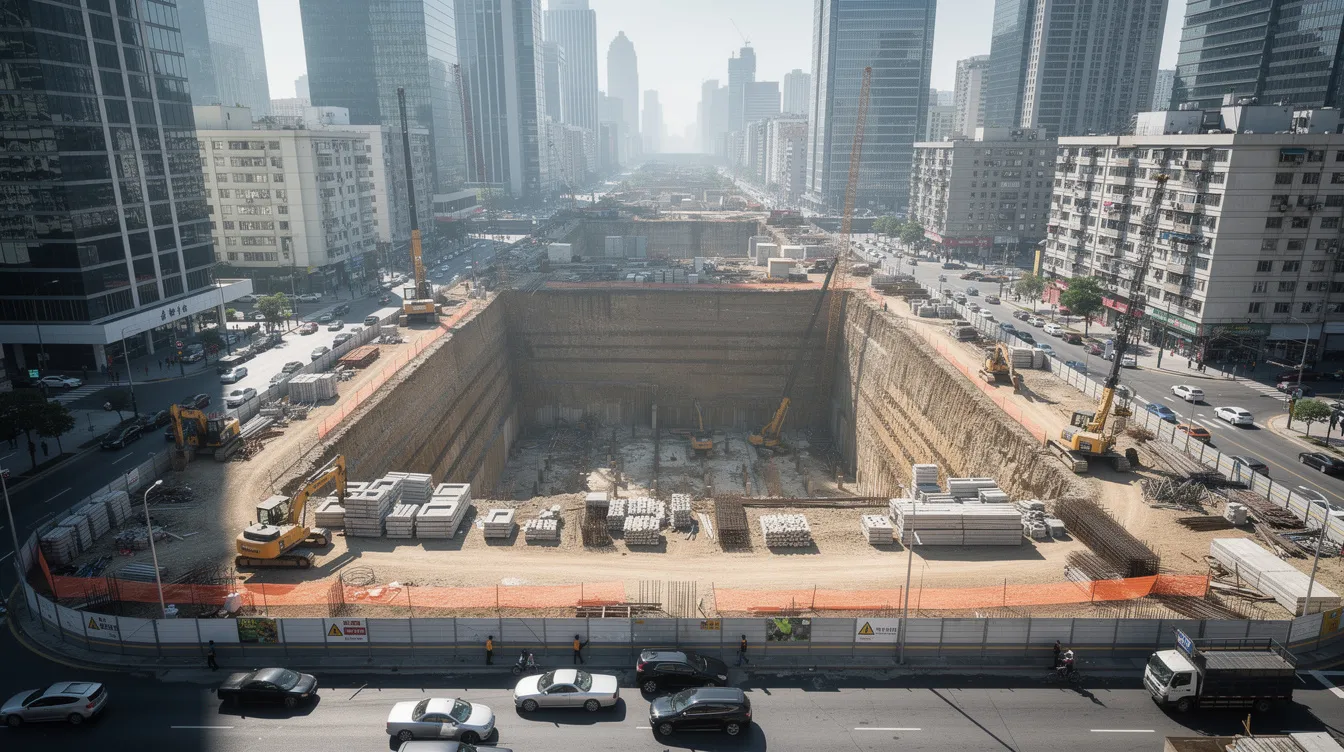
Understanding Geotechnical Engineering for Deep Basement Excavation in Singapore’s CBD
Deep basement excavation in Singapore is formally defined by the Building and Construction Authority (BCA) as excavations exceeding 6 metres below ground level that require ERSS. BCA requires PE endorsement for excavations deeper than 6 metres, and buildings taller than 30 storeys also need geotechnical PE endorsement. This process involves assessing ground conditions and risks, and a site investigation report is required for geotechnical PE endorsement.
CBD-specific challenges compound the technical difficulty. The district’s dense concentration of high rise buildings, underground carparks, mass rapid transit infrastructure, and deep foundation systems means that every excavation interacts with existing structures. Planning deep basement excavation in Singapore’s CBD requires navigating urban constraints and regulatory requirements simultaneously-a process that demands early engagement with qualified geotechnical professionals.
CBD Geological Context
Singapore’s CBD features variable geology including highly compressible marine clay and fluvial sands. The Kallang Formation marine clay dominates coastal CBD areas, with thicknesses that can exceed 30 to 40 metres in reclaimed zones. This marine clay has low shear strength, often less than 20 kPa, making it one of the most challenging soils for underground construction anywhere in the world.
Reclaimed land and hydraulic fill materials along the shoreline add further heterogeneity. These fill materials have variable density, potential weak layers, and may still be consolidating decades after placement. The transition zones between marine clay and underlying sands or Old Alluvium are critical for basal stability design, as they determine whether retaining wall toes can reach competent bearing strata.
Beyond the CBD’s coastal geology, Singapore’s broader geological landscape includes the Bukit Timah Granite-the oldest geological formation in Singapore-the Jurong Formation, which includes sedimentary units such as sandstone, and Old Alluvium deposits. Old Alluvium provides excellent bearing capacity and high skin friction values, making it a target stratum for wall embedment. The Jurong Formation’s bedding planes can dip at steep angles, and the bedding and hardness of these units can affect excavation stability and foundation behaviour, causing pile deflection-a concern for projects on the CBD fringe. Corestones in Bukit Timah Granite can cause catastrophic foundation failure if not identified during investigation, though this formation is more relevant to developments in central and northern Singapore than the coastal CBD.
Regulatory Framework for CBD Projects
BCA oversees the regulatory framework for deep excavation projects in Singapore. Excavations in Singapore often must comply with BCA and LTA regulations regarding nearby infrastructure. PE endorsement is required for excavations deeper than 6 metres, covering structural adequacy, ground movement prediction, and monitoring programme design.
Eurocode 7 replaced British Standard CP4 in Singapore’s regulations, and BCA mandates specific boreholes for site investigations under Eurocode 7. Deep basement projects in marine clay typically fall into Geotechnical Category 3-the highest risk classification-requiring the most rigorous design verification and third-party checking by Accredited Checkers.
The Land Transport Authority requires geotechnical assessment for works within 50 metres of MRT infrastructure. For projects adjacent to existing MRT stations or tunnels, LTA typically imposes movement limits (e.g., tunnel displacement below 15 mm and stress changes below 15 kPa). Excavations near MRT lines and heritage structures require strict control of movements to prevent damage.
Construction noise is regulated by the National Environment Agency, which imposes limits on activities such as driven piling. Driven piles are restricted to industrial zones due to noise regulations, pushing CBD projects toward quieter techniques like diaphragm wall construction or bored piles.
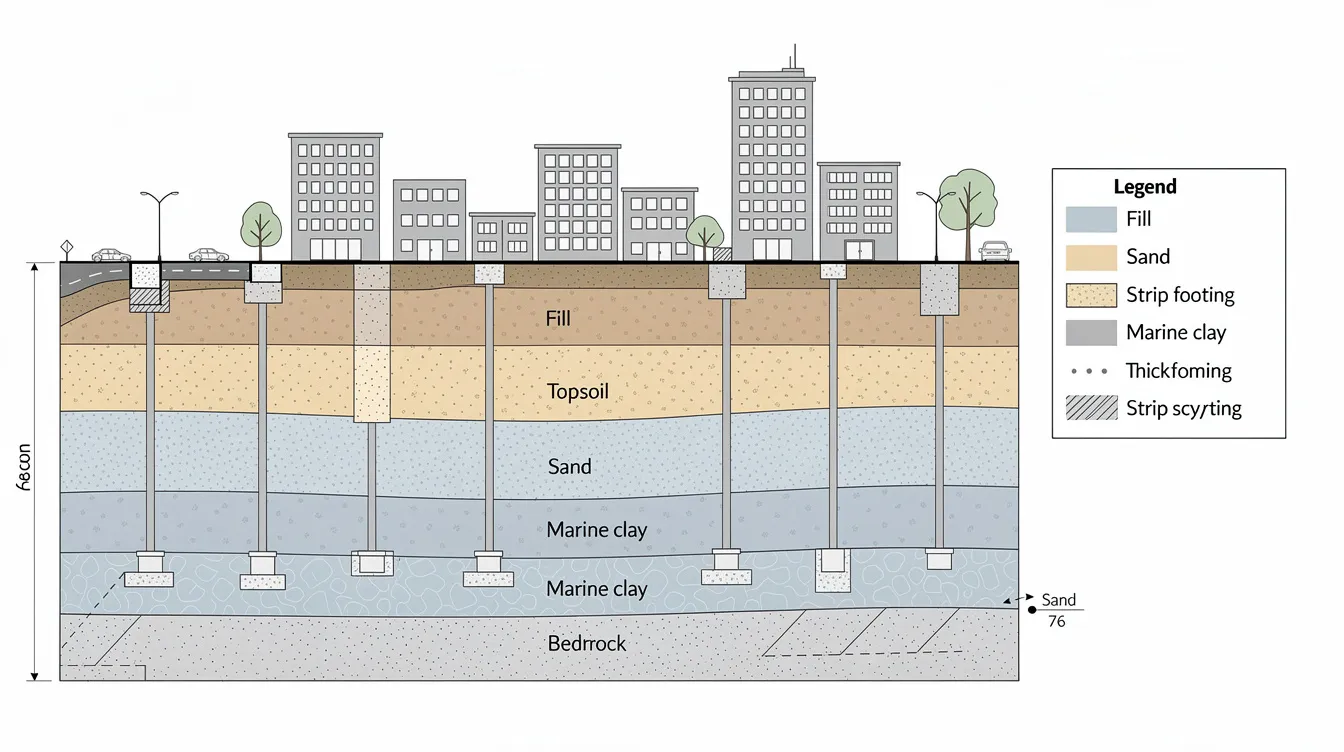
Critical Site Investigation Considerations (Considerations 1-8)
Proper site investigations are crucial for understanding subsurface conditions before deep excavations. The eight considerations below form the foundation of every successful CBD deep basement project, providing the soil data and environmental intelligence needed for safe design.
Ground Conditions Assessment
Consideration 1: Adequate borehole spacing and depth for deep excavations in heterogeneous CBD soils. Because the Kallang Formation is thick and heterogeneous, boreholes must penetrate through all soil strata to intersect underlying stiff layers such as Old Alluvium or weathered granite. For excavations exceeding 10 m, multiple boreholes across the plan area at 300–500 m spacing-supplemented by cone penetration tests (CPTs) and trial pits-are needed to verify stratigraphic consistency and ensure the assessment covered the full range of critical subsurface conditions relevant to design. Eurocode 7 guidance requires at least 10 samples per critical layer for strength characterisation and an equivalent number of in-situ stiffness tests. A thorough geotechnical investigation at this stage prevents costly surprises during excavation.
Consideration 2: Identification of marine clay layers and their consolidation characteristics. Marine clay is near-normally consolidated, with a high void ratio and time-dependent behaviour that can produce settlement months or years after construction. Soft marine clay can cause significant settlement during excavation if not properly managed and monitored. Consolidation testing (oedometer), undrained shear strength profiling (vane shear, CPT correlation), and permeability determination are essential. Marine clay requires deep foundations exceeding 30 metres to reach competent bearing strata beneath it-a fact that directly influences retaining wall embedment design.
Consideration 3: Assessment of existing fill materials and their engineering properties. In coastal CBD areas, various types of fill placed during reclamation-hydraulic sand, dredged material, or imported fill-often have variable density and may still be consolidating. Designers must sample and test fill for density, consolidation properties, and compaction state. Shallow foundation options are only feasible where suitable near-surface strata exist, so they are generally not appropriate for typical deep CBD basement conditions. At Marina Bay Sands, approximately 2.8 million m³ of fill and clay were excavated from a site underlain by deep reclamation and marine clay, illustrating the sheer volume of problematic material that must be characterised.
Consideration 4: Detection of underground obstructions and utilities in congested CBD areas. The CBD’s dense network of utility corridors, adjacent basements, MRT tunnels, and deep foundation systems creates a complex subsurface environment. Investigation must include geophysical surveys, ground-penetrating radar, and archival mapping to locate old foundations, buried structures, and live services. Existing building foundations influence the stability and deformation of earth retaining walls, making early detection of obstructions a critical risk-reduction measure.
Groundwater and Environmental Factors
Consideration 5: Comprehensive groundwater level monitoring and tidal influence assessment. High groundwater tables in Singapore pose risks of settlement and hydraulic uplift during deep excavations. The water table sits close to the surface across most of the CBD, and tidal influence adds diurnal variation in coastal zones. Pre-construction monitoring using standpipe piezometers, pumping tests, and tidal correlation analysis must establish baseline conditions. Acceleration of consolidation can occur due to sudden pressure drops from groundwater management, making controlled drawdown essential.
Consideration 6: Soil contamination evaluation in former industrial or reclaimed CBD sites. Many CBD sites sit over reclaimed or former industrial land where heavy metals, hydrocarbons, and elevated organic content may be present. Geo-environmental testing as part of the site investigation determines whether excavated soil can be reused, how dewatering discharge must be treated for PUB compliance, and what handling protocols apply under NEA regulations.
Consideration 7: Assessment of nearby basement structures affecting groundwater flow. Adjacent deep basements and underground structures can act as barriers or conduits to groundwater, altering local flow patterns and creating unexpected drawdown or flooding risks. Groundwater modelling must include existing structures as boundary conditions. Recharge wells, re-watering schemes, or cutoff wall extensions may be needed based on these interactions.
Consideration 8: Evaluation of artesian pressure conditions in deeper soil layers. Permeable sand or Old Alluvium layers beneath the marine clay may carry artesian pressure-groundwater head exceeding the excavation base level. If seepage paths exist through the retaining wall toe, through utility penetrations, or through soil fabric, piping and hydraulic uplift can develop rapidly. Early detection through piezometric monitoring and head-difference analysis is essential; design responses include extending wall embedment, grouting, impermeable membranes, and pressure relief drainage.
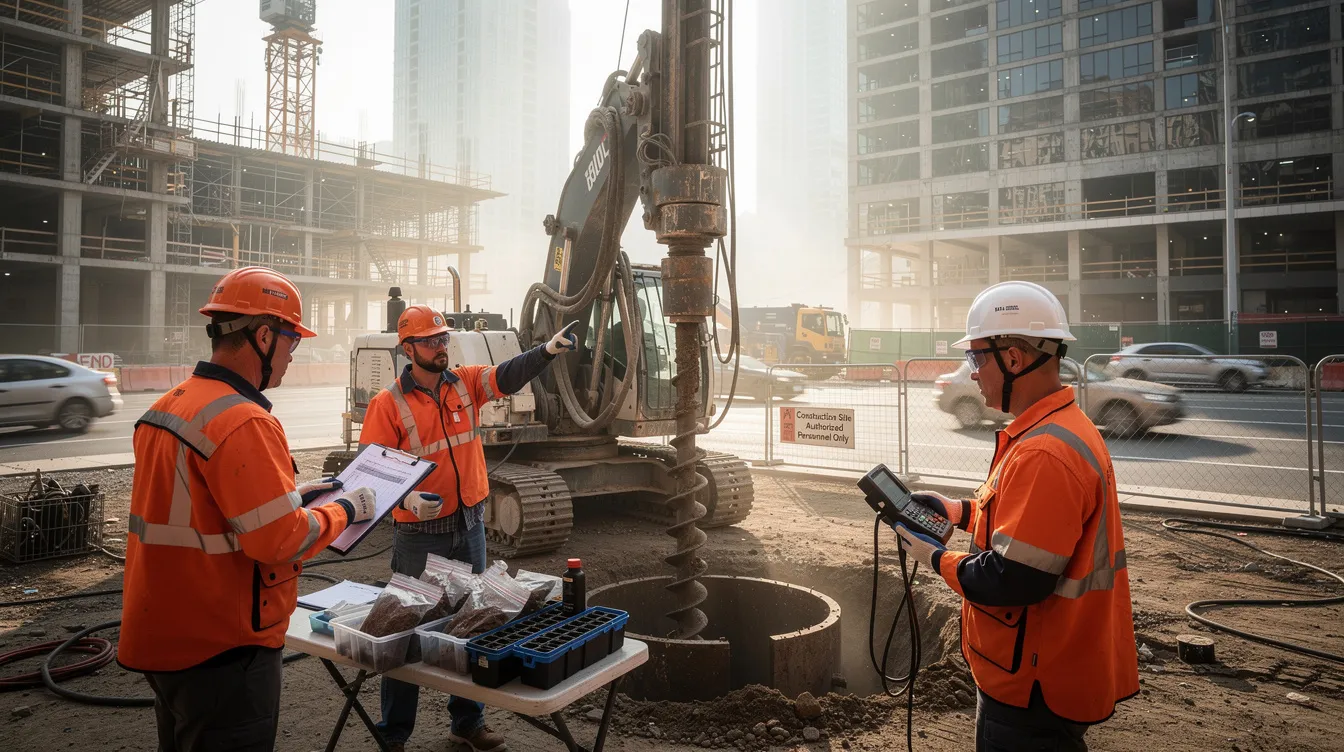
Design and Construction System Considerations (Considerations 9-18)
With site investigation findings in hand, the design phase must translate soil data into robust earth retaining systems and construction sequences that control ground movement, protect adjacent structures, and comply with Singapore’s regulatory framework.
Earth Retaining System Design
Consideration 9: Selection of appropriate retaining wall system. Diaphragm walls and secant pile walls are commonly used for deep excavations due to their stiffness and waterproofing capabilities. Diaphragm walls-typically 0.8 m to 1.5 m thick-dominate CBD deep basements because they can be keyed into hard strata and resist high bending moments. Contiguous bored pile walls offer an alternative where watertightness is less critical or where site access constraints limit panel excavation equipment. Where site constraints and adjacent property conditions permit, ground anchors may also supplement or replace some internal bracing. Sheet piles may serve shallower excavations or temporary works but exhibit greater deflection and leak potential. Bored piles are the predominant foundation type in Singapore for permanent works, and bored piles are standard for high-rise developments in Bukit Timah Granite zones. During installation, slurry performance matters because it forms a stabilising filter cake on the borehole wall. Residual silt at the pile base can reduce toe performance if desanding and base cleaning are inadequate. Barrettes provide a larger surface area for skin friction and are used where particularly high loads must be carried through soft ground. The choice depends on soil conditions, structural capacity requirements, expected wall deflection, and project economics. For a deeper comparison of structural versus geotechnical engineering considerations in this selection, early specialist input is invaluable.
Consideration 10: Design of strut and waler systems for multi-level basement excavations. Deep basements require multiple levels of internal bracing-steel struts and walers-to transfer horizontal earth and water pressures from the retaining wall. The Nicoll Highway collapse in 2004 demonstrated catastrophically what happens when waler connection details are inadequate: substitution of C-channel stiffeners for specified plate stiffeners led to structural failure, wall deflection exceeding 600 mm, and fatal consequences. Proper design of temporary works structures must address load paths, connection detailing, and redundancy.
Consideration 11: Assessment of wall embedment depth and base stability. Wall penetration into underlying competent strata is critical for resisting net active pressure and preventing undrained base heave. If walls do not reach hard supporting layers, the risk of basal failure increases sharply-particularly in marine clay where undrained shear strength is low. At UOB Plaza, diaphragm walls of 1.2 m thickness with embedment toward hard strata were used to manage these risks. Ground improvement techniques may be needed to address variability and compressibility of soils in the passive zone below formation level.
Consideration 12: Integration of permanent basement walls with temporary earth retaining systems. Where the permanent basement structure wall doubles as the temporary retaining wall, design must ensure compatibility of waterproofing, durability, load transfer, and construction sequence. Interface details-joint alignment, waterproof connectors, movement accommodation-require coordination between structural and geotechnical engineering disciplines from the earliest design stages.
Consideration 13: Waterproofing integration with earth retaining system design. Deep basements in the CBD will almost certainly require comprehensive waterproofing against hydrostatic pressures. This includes retaining wall tanking, base slab waterproofing, sealing around strut penetrations, drainage blankets, and sump pump systems. Waterproofing must be designed concurrently with the earth retaining system-not added as an afterthought-because it fundamentally affects wall detailing, construction sequence, and long-term serviceability.
Construction Methodology and Sequencing
Consideration 14: Top-down versus bottom-up construction methodology selection. Top-down construction methods, including the top-down construction method, are preferred in congested areas like the CBD to minimise ground movements and are often favoured near sensitive underground infrastructure such as MRT tunnels because of their movement control benefits. In this approach, basement floors are cast progressively as excavation proceeds downward, with the completed slabs acting as permanent lateral support. This reduces wall deflection compared to the bottom-up method, where the full excavation depth is reached before the base slab is placed. At City Square Mall-four basement levels reaching approximately 18 m depth in very soft marine clay-a semi-top-down construction approach combined with ground improvement controlled settlement far below initial predictions.
Consideration 15: Excavation staging and temporary works design for deep multi-level basements. Splitting excavation into controlled stages reduces surcharge, limits the unsupported height of retaining walls, and enables sequential installation of struts. The construction sequence must define when each strut level is installed, when soil berms can be removed, and when the base slab is cast. In MRT station deep excavations through marine clay, up to six levels of struts with jet-grouted base slabs have been used to protect against excessive wall deflection. Detailed temporary works design and approval processes are essential at this stage.
Consideration 16: Dewatering system design and groundwater control methodology. Groundwater control in deep excavations encompasses pumping wells, wellpoints, pressure relief wells, diaphragm walls as cutoffs, jet grouting for base sealing, and recharge wells to limit drawdown beyond the site boundary. Control of groundwater drawdown is critical in deep excavations to prevent damage to adjacent buildings through consolidation settlement. At Marina Bay Sands, observed drawdowns in marine clay zones contributed to long-term consolidation settlement even with recharge wells in operation, underscoring that groundwater control alone cannot eliminate all settlement risk.
Consideration 17: Noise and vibration control for CBD construction constraints. With the dense concentration of neighbours, heritage buildings, MRT infrastructure, and sensitive commercial operations in the CBD, noise and vibration from strut installation, piling, and jet grouting must be actively managed. Regulatory limits from MOM, NEA, and LTA govern permissible levels. Construction methods must be selected accordingly-diaphragm wall installation generates far less vibration than sheet pile driving, for example-and monitoring with real-time vibration sensors allows immediate response if limits are approached.
Consideration 18: Access and egress planning for deep excavation in constrained CBD sites. Tight CBD sites offer limited space for spoil removal, crane placement, material staging, and vehicle circulation without disrupting traffic. At Marina Bay Sands, spoil removal required approximately 800 trucks per day over two years. Logistics planning must consider temporary roads, hoisting arrangements, safety zones, and how temporary bracing can be installed without obstructing MRT corridors or public thoroughfares.
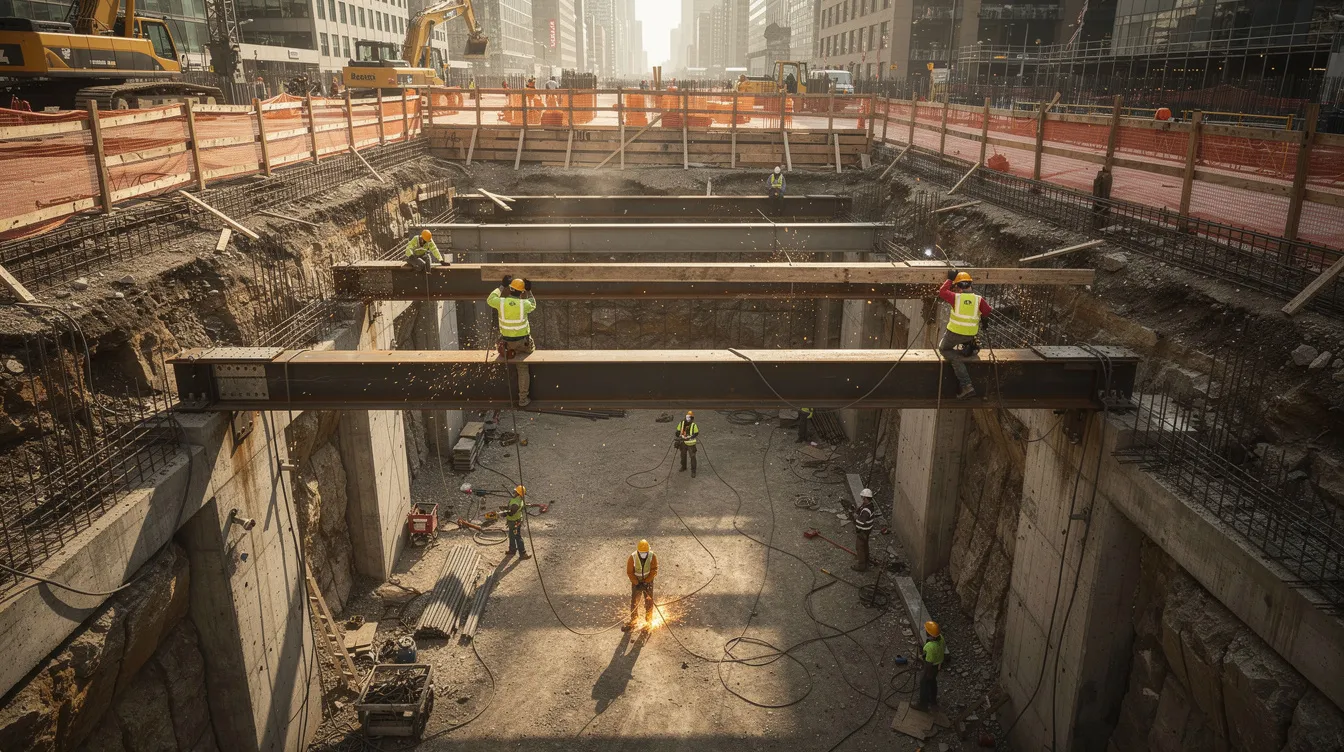
Monitoring and Risk Management Considerations (Considerations 19-23)
Real-time monitoring of ground and wall movements is essential during deep basement excavation in urban areas. The final five considerations address the instrumentation, protocols, and risk management structures that keep CBD deep excavation projects safe, compliant, and defensible.
Structural Monitoring Programs
Consideration 19: Real-time monitoring of adjacent buildings and infrastructure settlement. Inclinometers, settlement prisms, and tiltmeters installed on neighbouring buildings and infrastructure-including MRT tunnels-must continuously track movements against predefined trigger levels (green/amber/red). A 2026 case study documented settlements of up to 2.6% of the excavation depth at distances up to 11 times the excavation depth from the excavation edge, demonstrating how far the zone of influence extends. Monitoring limits set by regulatory authorities ensure minimal impact on adjacent infrastructure during excavation. Comprehensive geotechnical instrumentation programmes must be designed to match project-specific risk profiles.
Consideration 20: Earth retaining wall deflection and stress monitoring systems. Wall lateral deflection must be measured using embedded inclinometers, optical surveys, or laser scanning, while strut loads and waler forces are tracked with load cells and strain gauges. At City Square Mall, monitoring showed deflections significantly less than predicted after ground improvement and staging-but finite element models underpredicted the deflected wall shape due to neglecting 3-D effects. This highlights that monitoring serves both as a safety net and as a means to validate or challenge design assumptions. Ground movement during excavation poses risks to adjacent structures, making continuous comparison of measured versus predicted behaviour essential.
Consideration 21: Groundwater level monitoring and drawdown impact assessment. Continuous measurement of groundwater levels in observation wells inside and outside the excavation, plus pore pressure monitoring in critical soil strata below the base, provides early warning of unexpected drawdown or pressure build-up. Negative skin friction can significantly reduce pile capacity when drawdown causes consolidation around existing piled foundations. Recharge wells must be monitored and adjusted to maintain target groundwater levels outside the excavation perimeter.
Risk Mitigation Strategies
Consideration 22: Emergency response protocols for excavation-related incidents. Every deep excavation project must define what happens when an unexpected large movement, water inflow, strut overstress, or utility failure occurs. Protocols specify who has authority to stop work (the QP or site engineer), how to cordon off affected areas, when emergency dewatering or backfilling is triggered, and how stakeholders-including BCA, LTA, and adjacent property owners-are notified. These protocols must be documented in the ERSS submission and the site safety plan, not treated as informal arrangements. The common earthworks failure causes in Singapore reinforce why robust emergency planning is non-negotiable.
Consideration 23: Insurance and liability considerations for deep excavation risks in dense urban areas. Given the potential for catastrophic consequences-as demonstrated by the Nicoll Highway collapse, which caused fatalities and massive financial losses-projects must carry appropriate Professional Indemnity insurance, Contractor’s All Risk policies, and explicit contractual liability assignments covering settlement damage, utility strikes, and groundwater ingress. Compliance with BCA, LTA, and URA requirements is not only a legal obligation but a prerequisite for insurance validity and liability defence.
Common Challenges and Solutions
CBD deep excavation projects encounter recurring challenges that, if anticipated, can be managed effectively through proven techniques and proactive engagement.
Marine Clay Settlement Issues
Soft marine clay’s tendency toward long-term consolidation settlement is the single most common source of complications in CBD deep basements. Proven mitigation strategies include preloading to accelerate consolidation before excavation, jet grouting or lime column ground improvement to increase strength and stiffness, and installation of improved soil base layers (e.g., 3 m thick grouted improved soil, as used at City Square Mall); these measures should follow geotechnical science and project-specific test data. Understanding soil-structure interaction is fundamental to predicting and controlling settlement behaviour. Ground improvement techniques may be needed to address variability and compressibility of soils-particularly in river valleys and coastal reclamation zones where soil conditions are most challenging.
Adjacent Structure Protection
Minimising impact on neighbouring high rise buildings, MRT stations, tunnels, and utilities requires a combination of stiff retaining walls (diaphragm walls preferred), top down construction to limit wall deflection, and comprehensive monitoring with predefined intervention triggers. When monitoring detects amber-level movements, contingency measures such as additional strutting, localised ground treatment, or adjusted excavation sequences must be activated immediately. The Observational Method-formally accepted under BCA’s framework-allows designers to modify support levels in response to observed behaviour, optimising cost without compromising safety.
Regulatory Approval Delays
Strategies for streamlining BCA, LTA, and URA approval processes begin with early engagement. Submitting comprehensive ERSS designs, detailed instrumentation plans, and thorough geotechnical investigation reports at the pre-application consultation stage prevents rejection cycles. For projects near MRT infrastructure, the Land Transport Authority requires geotechnical assessments for works near MRT stations, and proactive coordination with LTA’s Rail Protection team-including preliminary movement analyses-can compress approval timelines by weeks. Ensuring that all authority approvals are mapped against the project programme prevents critical-path delays.
Conclusion and Next Steps
Successful deep basement excavation in Singapore’s CBD requires comprehensive consideration of all 23 geotechnical factors-from the first borehole to the final monitoring reading. No single consideration can be treated in isolation: site investigation informs design, design dictates construction methods, and monitoring validates everything. The consequences of omission are well documented in Singapore’s engineering history, from the Nicoll Highway collapse to settlement-induced damage in adjacent developments.
To move your project forward effectively:
-
Engage a qualified geotechnical engineer early in the feasibility stage to scope the site investigation and identify project-specific risks
-
Conduct comprehensive site investigation covering all eight ground and groundwater considerations, with sufficient boreholes, sampling, and testing to satisfy Eurocode 7 requirements
-
Develop an integrated design that addresses earth retaining system selection, construction sequence, waterproofing, and groundwater control as interdependent systems
-
Establish a monitoring plan with defined trigger levels, emergency protocols, and clear accountability before excavation begins
-
Secure appropriate insurance and contractual frameworks that reflect the actual risk profile of deep urban excavation
AEC Technical Advisory provides specialist geotechnical engineering and structural engineering services for CBD deep excavation projects, including PE endorsement, authority submissions, temporary works design, and instrumentation planning. For a consultation on your project’s specific geotechnical requirements, contact our team.
Additional Resources
-
BCA Code of Practice for Earth Retaining and Stabilising Structures (Advisory Note 1/09)
-
BCA Guidelines for Structural Plan Applications including ERSS
-
LTA Rail Protection Zone requirements for works near MRT infrastructure
-
AEC Technical Advisory geotechnical engineering services for Singapore CBD projects