
Navigating structural design approval in Singapore is one of the more demanding compliance challenges a project developer or construction firm will face. The CORENET X platform introduces a multi-gateway sequence that coordinates sign-offs from agencies including BCA, URA, LTA, NEA, PUB, SCDF, and NParks, each with distinct technical requirements and review timelines. Without a clear guide to structural design approval, teams frequently encounter costly redesigns, amendment cascades, and construction delays that erode both budget and schedule. This article breaks down every critical phase of the process, from gateway selection to amendment management, so your project moves forward with fewer surprises.
Table of Contents
- Understanding the CORENET X gateway approval process
- Preparation essentials for structural design approval submissions
- Step-by-step guide to submitting structural design approvals on CORENET X
- Managing structural design amendments effectively
- Final verification and practical tips for smooth structural design approval
- Why early design clarity and change control are your top defenses
- Streamline your structural design approval with expert advisory
- Frequently asked questions
Key Takeaways
| Point | Details |
|---|---|
| Multi-gateway process | Singapore’s CORENET X system requires approvals at Design, Piling (optional), and Construction Gateways for most projects. |
| Early preparation critical | Firming key design parameters early at the Design Gateway reduces the risk of costly amendments downstream. |
| Material vs immaterial changes | Only material changes trigger amendment submissions starting at relevant gateways; immaterial changes can wait for record plans. |
| Direct Submission Process | Simpler projects may be eligible for DSP, a streamlined single-stage approval process replacing multiple gateway submissions. |
| Change control discipline | Treat amendments as a formal change management process to minimize approval delays and rework risks. |
Understanding the CORENET X gateway approval process
The CORENET X platform structures the structural design process around three primary gateways, each serving a distinct purpose in the project lifecycle. Understanding when each gateway applies is the first step toward an efficient submission strategy.
The three core gateways are:
- Design Gateway (DG): Clears critical planning parameters including gross floor area, building height, use quantum, and key structural design intent. This is the earliest and most consequential gateway because approvals here anchor every downstream submission.
- Piling Gateway (PG): An optional gateway that addresses foundation and substructure design before piling commences. Teams can choose to invoke this gateway separately or bundle substructure elements into the Construction Gateway.
- Construction Gateway (CG): Finalizes detailed technical design approvals covering all structural, architectural, and M&E elements before construction start and, where applicable, before sales launch.
The design and build sequence within CORENET X is intentionally upstream/downstream. As the amendment submission guide confirms, the Design Gateway clears key planning parameters while later gateways handle detailed technical requirements. This separation prevents late-stage planning conflicts but also means that any material change to DG-cleared parameters requires a full return to that gateway.
For less complex building works, CORENET X provides an alternative path. The Direct Submission Process (DSP) bypasses the three-gateway sequence, consolidating approvals into a single-stage submission. DSP eligibility depends on project complexity and building use, and teams should confirm eligibility early rather than assuming it applies.
Gateway comparison at a glance:
| Gateway | Stage | Key approvals covered | Optional? |
|---|---|---|---|
| Design Gateway | Pre-design finalization | URA, BCA planning parameters, structural concept | No |
| Piling Gateway | Pre-piling | Foundation and substructure design clearance | Yes |
| Construction Gateway | Pre-construction/sales | Full structural, architectural, M&E detail | No |
| Direct Submission Process | Single stage | All approvals in one submission | Eligibility-based |
Now that you understand the overall multi-gateway structure, let’s explore the required preparations before submitting your structural design approvals.
Preparation essentials for structural design approval submissions
Preparation is where most projects either gain a significant advantage or begin accumulating problems that surface only at submission. The structural approval guidelines require that several foundational decisions are made before any submission package is assembled.
Core preparation steps include:
- Gateway path decision: Confirm early whether piling works will be submitted via the Piling Gateway or bundled into the Construction Gateway. This decision affects documentation sequencing and timeline planning.
- BIM model quality assurance: The BIM model must pass regulatory compliance and quality checks before submission. Poorly coordinated models create conflicts that agencies flag during review, triggering requests for additional information or resubmissions.
- Documentation assembly: Complete structural plans, design calculations, site formation plans, and piling layout plans must be in order. Incomplete packages are among the most common causes of initial submission failures.
- Team coordination: The Qualified Person (QP), project coordinator, and structural engineering team must align on submission content. Misalignment between the QP’s structural concept and the BIM data thread is a documented source of downstream errors.
The CORENET X RABW update is explicit on this point: structural teams should treat gateway alignment as a coordination problem between the PE/QP’s structural concept and the BIM data thread that flows downstream. In practice, this means holding a pre-submission coordination session where the QP, BIM coordinator, and project lead review every submission element against the gateway checklist before lodging.
Developers who invest in detailed structural engineering preparation, as outlined in the structural engineering guide for Singapore developers, consistently report fewer amendment applications and faster review cycles. Early design clearance reduces the risk of material amendments that force re-engagement with earlier gateways.
Understanding the building codes and regulations applicable to your project category is equally non-negotiable at this stage. Codes from BCA, URA, and other agencies set technical floors that submissions must meet without exception.
Pro Tip: Prepare a submission readiness checklist specific to each gateway before lodging. Include items such as BIM model version control, agency-specific drawing requirements, structural calculation sign-offs, and QP declaration status. Treat this checklist as a formal handoff document between your design team and the submitting QP.
With the proper preparation in place, let’s walk through the step-by-step structural design approval submission process.
Step-by-step guide to submitting structural design approvals on CORENET X
The submission sequence follows a logical progression, but the rules governing amendments at each stage require careful attention. Here is a structured walkthrough of the steps for structural engineering approvals across all three gateways.
Step 1: Prepare and lodge the Design Gateway submission
Assemble all planning and structural concept documents. This includes architectural plans, structural framing concept, site area calculations, and QP declarations. Submit via CORENET X and track agency-specific responses. Any change to key planning parameters cleared at this stage constitutes a material change requiring a fresh DG submission.

Step 2: Evaluate the Piling Gateway
Assess whether foundation design is sufficiently developed to warrant a separate Piling Gateway submission before piling starts. If piling is scheduled early in the construction sequence, early PG clearance avoids the risk of commencing piling without formal approval. If piling aligns with later construction stages, bundling into the Construction Gateway is a viable option.
Step 3: Develop and submit the Construction Gateway package
Finalize all structural, architectural, and M&E design elements. Ensure the BIM model is construction-ready and passes quality checks. Submit the complete CG package, coordinating responses from BCA, URA, LTA, SCDF, and other relevant agencies. CG clearance is a prerequisite for construction commencement and sales launch for applicable project types.
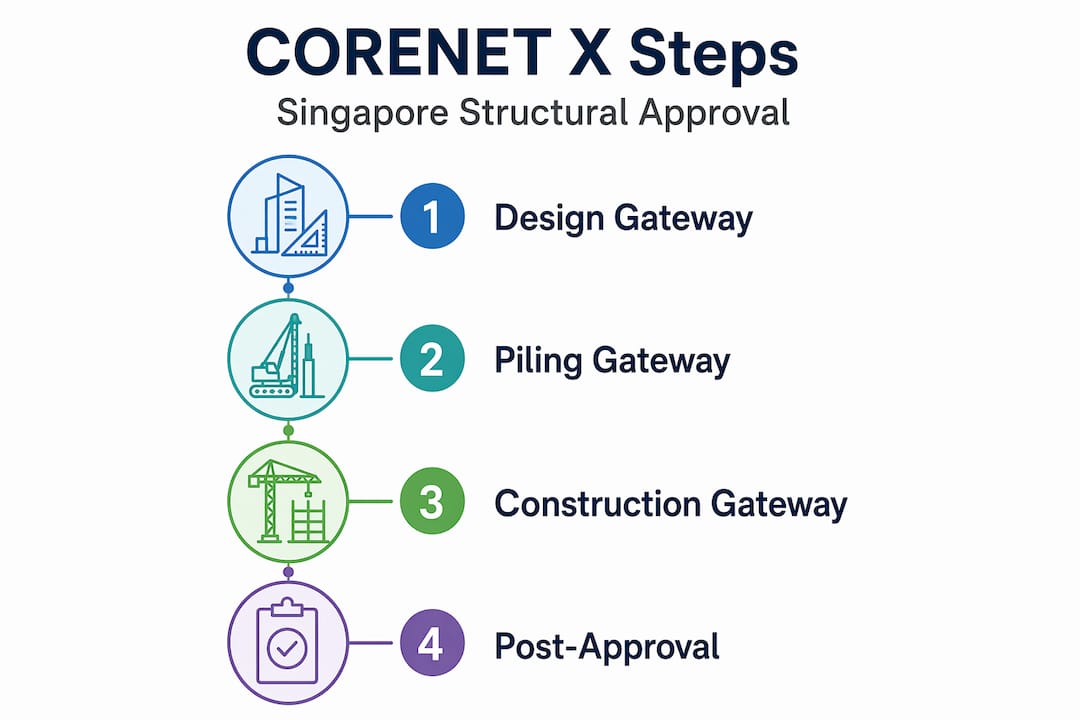
Step 4: Classify post-approval changes before acting on them
Every design change after initial approval must be classified as either material or immaterial. As the CORENET X amendment guidelines state, material changes affecting earlier approvals trigger amendment applications starting at the affected gateway, while immaterial changes may be incorporated as record or as-built plans. Acting on a change without this classification is where many projects begin accumulating avoidable resubmissions.
Material vs. immaterial changes by gateway:
| Change type | Example | Gateway impact | Submission required |
|---|---|---|---|
| Material | Increase in GFA or building height | Resubmit from Design Gateway | Amendment application |
| Material | Change in foundation system | Resubmit from Piling or CG | Amendment application |
| Immaterial | Minor slab thickness adjustment | No earlier gateway impact | Record or as-built plan |
| Immaterial | Cosmetic architectural revision | No earlier gateway impact | As-built plan at CG |
Refer to the BCA ST submission process for detailed requirements specific to structural plan submissions, and review common PE submission rejection reasons to anticipate and address likely review comments before they occur.
Pro Tip: Maintain a live change register from the moment DG clearance is obtained. Log every design deviation, its classification rationale, and the responsible QP sign-off. This register becomes your primary defense if an agency queries the basis for a record plan submission.
After submitting your design approvals, you need strategies to manage amendments efficiently to minimize delays and costs.
Managing structural design amendments effectively
Amendment management is where building design compliance efforts either hold together or unravel. The tendency to treat changes as informal drawing revisions, rather than formal engineering change orders, is one of the most consistent sources of regulatory problems on large Singapore construction projects.
Key practices for effective amendment management:
- Classify every change formally: Each design deviation should carry a written classification noting whether it affects earlier gateway approvals and referencing the technical basis for that determination.
- Maintain an audit trail: Document change requests, classification decisions, and QP endorsements. In multi-agency reviews, an undocumented change that surfaces during inspection can trigger investigations covering the entire submission history.
- Bundle immaterial changes strategically: Immaterial changes can be grouped into periodic amendment batches, reducing administrative overhead and keeping the submission record clean.
- Escalate ambiguous changes immediately: When the material or immaterial status of a change is uncertain, seek early consultation with the relevant authority rather than making an internal judgment that later proves incorrect.
As the amendment submission governance rules confirm, only material changes trigger amendment applications starting at the relevant earlier gateway. Managing change control as a documented process reduces the risk of re-triggering approvals unnecessarily.
Pro Tip: Early consultation with the relevant regulatory agency can clarify whether a proposed change is material before any redesign work is committed. A short pre-submission consultation saves far more time than a full amendment cycle triggered by an incorrect classification.
The practical structural engineering guide for Singapore provides additional frameworks for managing change on complex projects, and the fast project approval strategies resource covers coordination approaches that keep amendment volumes low.
“Treating amendment requests as quick drawing swaps rather than formal change orders is the single most reliable way to convert a manageable project issue into a regulatory crisis.”
Finally, let’s review how to verify approvals and ensure your project stays compliant during construction.
Final verification and practical tips for smooth structural design approval
Obtaining gateway clearances is not the end of the compliance obligation. Construction administration requires ongoing verification that the work in progress aligns with approved structural designs.
Key verification steps during construction administration:
- Confirm in writing that all required gateway clearances are received before issuing any notice to proceed.
- Distribute approved structural drawings to site supervisors and contractors with version control protocols to prevent use of superseded drawings.
- Establish a field change review protocol where any proposed site-level deviation is escalated to the QP for classification before implementation.
- Schedule periodic site audits comparing constructed elements against approved BIM models and structural drawings.
- Submit amendment or as-built plan applications for any approved field changes promptly, not at project completion.
- Coordinate between the PE, QP, and project coordinator at regular intervals to catch discrepancies early.
The CORENET X RABW documentation underscores that the Design Gateway anchors later documentation, and late structural changes are costly because they can force material amendments reversing approvals from the DG. That cascading effect is far more disruptive than the original change, which is why site-level discipline on change control is as important as the upfront submission quality.
For ongoing compliance considerations, the structural engineering compliance resource and the guidance on avoiding PE submission rejection are worth consulting as construction progresses.
Pro Tip: Use the BIM model as a single source of truth throughout construction. When contractors, supervisors, and QPs all reference the same BIM data, discrepancies between what is drawn and what is built become visible before they become compliance problems.
Having covered final verification, here is a unique expert perspective on navigating Singapore’s structural design approval process.
Why early design clarity and change control are your top defenses
There is a pattern that repeats itself across projects that encounter serious regulatory delays: the team treated gateway submissions as documentation exercises rather than design discipline checkpoints. The approvals were seen as forms to be filed, not as evidence that the structural concept was genuinely resolved.
The CORENET X system is architecturally intolerant of that approach. Because the Design Gateway clears parameters that all subsequent submissions depend on, any unresolved structural uncertainty at DG stage becomes a liability that compounds through every later submission. A structural concept that was “good enough to submit” at DG but not fully resolved creates pressure at the Construction Gateway, and that pressure often results in changes that are, by definition, material.
The second pattern is the informal change culture. On large projects involving multiple design consultants, contractors, and agency reviewers, design changes accumulate faster than documentation can track them. Teams that do not treat every change as a formal engineering change order, with classification, rationale, and QP endorsement, inevitably find themselves unable to reconstruct a coherent submission history when an agency requests clarification. The regulatory risk at that point is significant.
The practical guide for Singapore projects reflects this reality: the teams that consistently achieve efficient approval cycles are the ones that invest in design resolution and change documentation before they are required, not after a problem surfaces.
“Late changes are disproportionately costly since they can reset approvals starting at the Design Gateway, undoing months of coordinated submission work.”
The advice that consistently holds across project types and sizes is this: resolve your structural design to a sufficient level of completeness before the Design Gateway submission, establish formal change control from that point forward, and treat every field deviation as a potential amendment trigger until your QP confirms otherwise.
Streamline your structural design approval with expert advisory
Applying the steps in this guide requires not just process knowledge but deep familiarity with how Singapore’s regulatory agencies interpret and enforce their requirements at each gateway. Misjudging a single material change classification or submitting an incomplete BIM package can set a project back by months.
AEC Technical Advisory provides specialized consultancy for developers and construction firms navigating the full CORENET X gateway process. From design for safety requirements to amendment management and construction administration support, the team brings direct experience with BCA, URA, LTA, and multi-agency submissions. Whether your project involves a straightforward DSP submission or a complex three-gateway sequence, expert guidance reduces rejection risks and keeps approvals on schedule. Explore how the design and build advisory services and targeted support for avoiding PE submission rejection can be applied directly to your project’s approval timeline.
Frequently asked questions
What are the main gateways involved in Singapore’s structural design approval process?
The key CORENET X gateways are the Design Gateway, Piling Gateway (optional), and Construction Gateway, each covering progressively detailed technical requirements from planning parameters to full construction-ready design.
When is an amendment submission required after initial design approval?
An amendment submission is required whenever a post-approval change is classified as material, meaning it affects parameters cleared at an earlier gateway. Immaterial changes do not require amendment applications and can be captured in record or as-built plan submissions instead.
Can simpler projects use a streamlined approval process?
Yes. Eligible projects may use the Direct Submission Process, a single-stage alternative to the three-gateway system, provided the project meets the defined eligibility criteria for simplified building works.
How can I avoid costly redesigns during the approval process?
Resolve structural design parameters fully before the Design Gateway submission and maintain formal change control from that point. Investing early in design resolution at DG stage prevents material amendments that force re-clearance across subsequent gateways.
What is the role of BIM in structural design submissions?
BIM models must pass quality and regulatory compliance checks before submission and serve as the coordinating data thread linking the QP’s structural concept to all downstream gateway submissions, making model accuracy a direct factor in approval outcomes.