
Architectural design in Singapore is no longer a function confined to elevations, floor plans, and material palettes. For project developers and construction firms operating in one of the world’s most regulated built environments, architectural design has become the foundational mechanism through which regulatory approvals are secured, project timelines are protected, and construction costs are controlled. The shift is structural, not cosmetic, and understanding how design decisions at the earliest project stages cascade through every downstream workflow is now essential for anyone serious about delivering successful built outcomes in Singapore.
Table of Contents
- Why architectural design matters in Singapore’s project landscape
- How the CORENET X workflow reshapes project compliance
- Measuring performance: Architectural design’s impact on project success
- Integration versus separation: Delivery models and the design-compliance connection
- Smart compliance: BIM, analytics, and automation in architectural design
- The real game-changer: Why early design coordination is now non-negotiable
- Advance your next project with expert architectural and engineering guidance
- Frequently asked questions
Key Takeaways
| Point | Details |
|---|---|
| Regulatory compliance starts in design | Proactive architectural input now directly shapes regulatory results and project viability in Singapore. |
| Digital submission protocols matter | BIM/model-based regulatory workflows reduce late-stage errors and streamline approvals. |
| Early evaluation minimizes risk | Measuring design-phase performance exposes issues early, enabling smarter project decisions. |
| Delivery model influences success | Integrated design-build structures improve schedule outcomes but require strategic coordination of compliance. |
| Automation boosts compliance consistency | BIM analytics and model checking tools increase efficiency and accuracy for regulatory submissions. |
Why architectural design matters in Singapore’s project landscape
The persistent misconception that architectural design is primarily an aesthetic exercise continues to cost project teams time and money. In reality, architectural planning is the primary mechanism through which regulatory intent, spatial performance, and compliance data are first encoded into a project. Every design decision made at the concept stage carries forward implications for structural loading, fire egress, accessibility requirements, and agency approvals.
Singapore’s regulatory environment amplifies this truth considerably. The Building and Construction Authority (BCA), Urban Redevelopment Authority (URA), Singapore Civil Defence Force (SCDF), and Public Utilities Board (PUB) each impose overlapping technical standards that architectural design must satisfy before a project can advance. Getting these parameters right at the design stage is far less costly than resolving conflicts during construction.
“Architectural design quality in Singapore’s regulatory workflow is increasingly tied to BIM/model-based submission mechanics, which changes how architectural intent and compliance data are checked across disciplines.” (CORENET X Automated Model Checker)
The implications of this shift are significant. Design teams that treat their models as living compliance instruments, rather than static drawing deliverables, are gaining measurable advantages at every project gateway. The key areas where early architectural decisions now carry the most weight include:
- Regulatory pathway selection: The chosen use, density, and form directly determine which agencies must be consulted and in what sequence.
- BIM model integrity: Submission quality depends on how accurately the architectural model captures required compliance attributes from the start.
- Coordination readiness: Structural, M&E, and fire safety consultants can only work efficiently when the architectural frame is stable and code-compliant.
- Timeline certainty: Projects with well-resolved design submissions face fewer clarification rounds at BCA and URA review stages.
These are not abstract benefits. They are measurable outcomes that distinguish projects that complete on schedule from those that absorb months of remediation work after the first submission.
How the CORENET X workflow reshapes project compliance

Singapore’s BIM mandates have been evolving for over a decade, but the introduction of CORENET X represents the most decisive shift in how regulatory compliance is operationalized. The CORENET X workflow replaces the older, discipline-by-discipline submission model with an integrated, digital-first gateway system where model quality and compliance data are checked before formal agency review even begins.
QPs and submission coordinators are central to this system. Qualified Persons, licensed architects or engineers under Singapore law, bear legal responsibility for the accuracy and completeness of what is submitted. Submission Coordinators manage the digital logistics, ensuring that all disciplines upload their scopes to the correct gateway at the right time.
| CORENET X submission stage | Key responsibility | Primary actor |
|---|---|---|
| Concept/schematic stage | Establish architectural model and use parameters | Architect (QP) |
| Regulatory gateway submission | Confirm compliance data across all disciplines | Submission Coordinator |
| Automated model check | Rule-based checks against BCA/URA standards | CORENET X system |
| Agency review | Technical review of flagged items | BCA/URA reviewers |
| Permit issuance | Approval of confirmed compliant submission | Relevant authority |
The move from sequential to coordinated submission changes the timing of critical decisions in several ways:
- Earlier compliance locking: Architectural decisions on floor-to-floor heights, setbacks, and GFA (Gross Floor Area) calculations must be finalized before other disciplines can complete their scope.
- Simultaneous multi-discipline upload: All consultants submit to the same gateway, meaning unresolved clashes between architectural and structural or M&E models become visible before submission rather than after.
- Automated pre-checks: The CORENET X Automated Model Checker tests submitted models against coded regulatory rules, flagging non-compliance before a human reviewer sees the file.
- Reduced clarification cycles: Projects with well-prepared BIM models typically experience fewer requests for information from reviewing agencies, which directly accelerates approval timelines.
Pro Tip: Architectural teams should conduct internal BIM model quality audits against CORENET X checker criteria before every gateway submission. Addressing flagged items internally is significantly faster and less costly than receiving agency-level clarification requests.
Measuring performance: Architectural design’s impact on project success
Beyond compliance workflows, there is a growing body of evidence showing that structured design-phase evaluation directly improves project outcomes. Design-phase evaluation research published in 2025 confirms that performance measurement during the architectural design phase exposes cost and schedule gaps earlier than waiting for construction-phase measurement, when corrective action is far more expensive.
Key finding: Empirical research indicates that addressing performance gaps identified during design can reduce downstream rework costs significantly, with construction-stage corrections routinely costing 10 to 100 times more than design-stage corrections for equivalent scope changes.
The value of consultancy in this context is in enabling that early identification. Experienced consultants bring frameworks for evaluating design performance across dimensions that project teams without specialist support often miss.
| Performance dimension | Design-stage check | Construction-stage consequence if missed |
|---|---|---|
| Regulatory compliance | Model check against BCA/URA rules | Agency stop-work orders, redesign costs |
| Structural coordination | Load path review against architectural scheme | Major drawing revisions, foundation redesign |
| M&E spatial coordination | Coordination against ceiling and riser zones | Site clashes, remediation delays |
| Fire egress compliance | SCDF-required travel distance verification | Rejection of occupation permit application |
| Accessibility standards | Barrier-free path and facility checks | BCA non-compliance notices |
The key metrics that Singapore developers and construction firms should monitor at the design stage include:
- Regulatory compliance rate: The percentage of applicable code requirements that the architectural model already satisfies at first internal review, before external submission.
- Clash detection frequency: The number of coordination clashes between the architectural BIM model and other discipline models, identified and resolved before submission.
- Submission gateway pass rate: Whether the project passes the CORENET X automated model check on first attempt or requires resubmission.
- Design change velocity: The rate at which significant design changes occur after the architectural scheme has been formally issued, which is a leading indicator of downstream disruption.
Tracking these metrics at the architectural design stage gives project leaders actionable data. Teams that set explicit targets for these indicators consistently report fewer surprises during construction.
Integration versus separation: Delivery models and the design-compliance connection
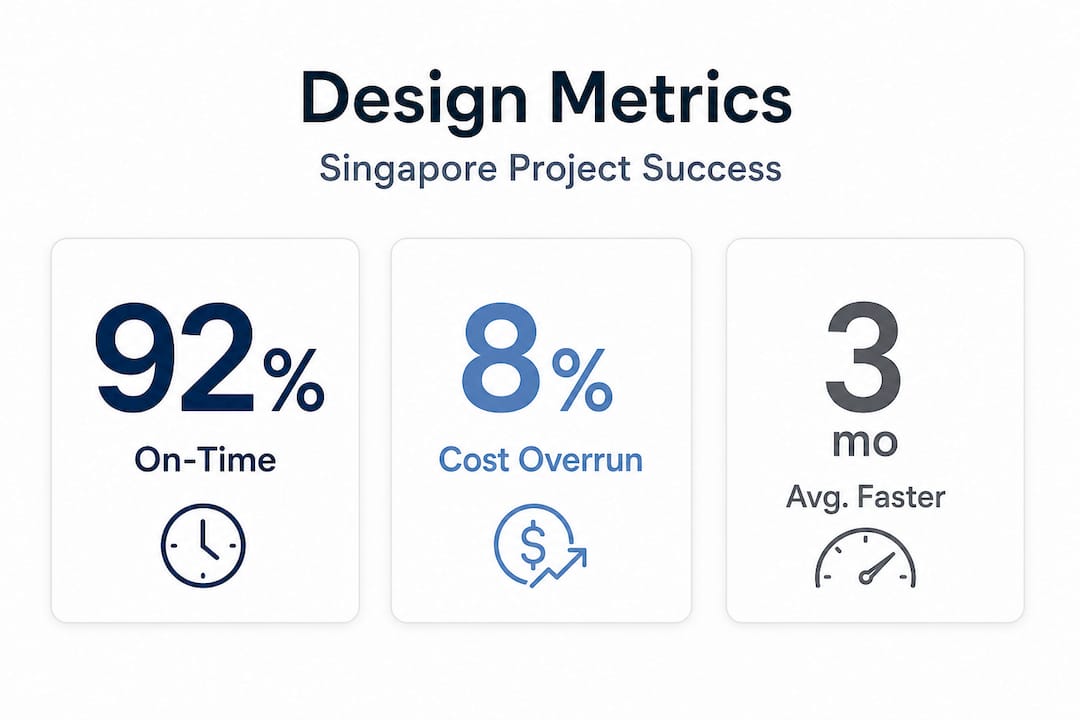
The choice of project delivery model has a direct bearing on how well architectural design and regulatory compliance are integrated. Design and build in Singapore has gained considerable traction because it creates contractual alignment between design intent and construction execution under a single responsibility framework.
Design-build outcomes research examining 183 projects in 2025 confirms that the design-build delivery structure produces measurable effects on schedule and cost performance. The mechanism is logical. When the team responsible for construction also controls design development, the incentive to identify and resolve compliance issues early is stronger. Construction managers who will be held accountable for schedule are unlikely to allow unresolved architectural compliance questions to persist until site work begins.
“Design-build delivery structure can affect schedule and cost outcomes; this is relevant for developers deciding how much of the architectural design-compliance workflow should be integrated with construction responsibilities.” (2025 study on 183 design-build projects)
The comparison between integrated and separated delivery modes in practice reveals several consistent patterns:
- Schedule performance: Integrated design-build projects tend to achieve tighter schedule adherence because design decisions and their compliance implications are resolved within a single team, rather than between separate contracting parties.
- Compliance continuity: When the architect and contractor share a delivery structure, BIM model updates triggered by construction logistics are more readily fed back into the compliance record.
- Cost risk allocation: In separated delivery models, unresolved design conflicts at the handover boundary frequently generate variation orders during construction, inflating final project costs.
- Agency submission coordination: Integrated teams are better positioned to coordinate multi-disciplinary submissions to BCA, URA, and SCDF, because the information flows within a unified project structure.
Pro Tip: For Singapore projects above a certain complexity threshold, particularly mixed-use developments or projects involving JTC or LTA submissions, developers should evaluate whether a design-build or design-build-manage framework would reduce the compliance coordination burden compared to a traditional separated model.
Smart compliance: BIM, analytics, and automation in architectural design
The most forward-looking architectural teams in Singapore are now treating compliance not as a checklist applied at the end of design, but as an active, automated function running throughout the design process. This shift is enabled by BIM-integrated rule-checking tools and analytics workflows that test design intent against regulatory criteria in near-real time.
BIM analytics for compliance research presented at CAADRIA 2025 proposes a workflow that integrates BIM, parametric algorithms, and regulatory rule mapping to automate compliance checking. The research demonstrates that a BIM compliance analytics approach reduces manual checking effort and increases consistency, because the rules are encoded and applied identically every time the model is updated.
Statistic to note: Automated compliance workflows consistently identify issues in architectural models that manual checking routinely misses, particularly where overlapping requirements from multiple agencies create complex intersecting constraints.
The implementation steps for bringing automated compliance into an architectural design workflow are practical and sequential:
- Establish the regulatory rule set: Map the specific BCA, URA, SCDF, and other agency requirements applicable to the project into a structured rule library, referenced against the relevant codes and circulars.
- Configure the BIM environment: Set up the authoring software so that model elements carry the correct data attributes that compliance rules will interrogate, including use classification, occupancy load, and fire zone boundaries.
- Integrate automated checking: Connect the BIM model to a rule-checking engine, whether CORENET X’s own checker or a purpose-configured tool, and run checks at each design milestone.
- Log and resolve flags: Every automated flag generates a traceable issue log. Resolving these systematically before submission builds an audit trail that supports both internal quality assurance and agency review.
- Align with fast project approval workflows: Compliance-ready models proceed through BCA review faster, reducing the time between submission and permit issuance.
The operational benefit for Singapore projects is not theoretical. Teams that implement this workflow report fewer agency clarification rounds, faster permit issuance, and stronger confidence in their submission quality at every gateway.
The real game-changer: Why early design coordination is now non-negotiable
The most costly delays in Singapore construction projects today are not primarily caused by contractor performance or material supply issues. They trace back to fragmented or late-stage architectural engagement, where design decisions that carry compliance implications are made without adequate cross-discipline input, then discovered as conflicts after formal submissions are filed.
This pattern is entirely avoidable. With CORENET X, architectural teams that treat BIM model coordination as integral to design delivery, rather than as a separate documentation task, experience significantly fewer late-discovery compliance issues. The automated model checker creates an objective standard against which design quality is measured, and teams that build toward that standard from concept stage consistently outperform those that retrofit compliance at submission time.
The insight that most project teams still underutilize is this: compliance coordination should begin at concept design, not after planning submission. The moment a use type, plot ratio, and building height are established, the compliance framework for that project is knowable. Engaging with it immediately, through structured architectural planning and BIM model setup, is the single highest-leverage action a project developer can take to protect the downstream schedule.
Firms that have adopted this posture consistently report that their submissions proceed with fewer stop-gap clarifications, their construction programs suffer fewer design-driven variations, and their relationships with reviewing agencies are more productive. Early coordination is not a process overhead. It is the primary risk management tool available at the architectural design stage.
Advance your next project with expert architectural and engineering guidance
Navigating Singapore’s regulatory landscape requires more than technical knowledge. It requires integrated consultancy that connects architectural design intent to BIM submission mechanics, agency requirements, and construction delivery realities from the very first project milestone.
AECTechnicalSG provides project developers and construction firms with precisely that capability. From engineering consultancy planning through to architectural planning solutions and PE endorsement and authority submissions to BCA, URA, SCDF, JTC, LTA, PUB, and NEA, the firm’s integrated approach ensures that compliance is embedded in the design process rather than appended to it. If your next project requires expert guidance on making architectural design a driver of regulatory certainty and delivery performance, AECTechnicalSG is equipped to support that outcome from concept to occupation permit.
Frequently asked questions
Why is BIM/model-based submission crucial for compliance in Singapore?
BIM model-based submission ensures that design details and compliance data are digitally checked for accuracy and consistency before formal agency review begins, reducing the risk of late-stage non-compliance discoveries that cause costly delays.
What are Qualified Persons (QPs) and why do they matter?
Qualified Persons are licensed architects or engineers who hold legal responsibility for the accuracy and completeness of regulatory submissions in Singapore, making their early engagement in design coordination essential for project compliance.
How does design-phase evaluation improve project outcomes?
Design-phase evaluation identifies cost and scheduling vulnerabilities while design changes are still low-cost to implement, allowing project owners to resolve issues that would otherwise generate expensive variations during construction.
Does integrating design and construction teams affect project schedules?
Design-build integration creates shared accountability for both design compliance and construction performance, which research shows contributes to stronger schedule adherence compared to fully separated delivery models.
How does automation support regulatory compliance?
Automated compliance workflows apply coded regulatory rules to BIM models consistently at every design milestone, reducing manual checking effort, flagging issues earlier, and generating documentation that supports transparent agency review.