
The infrastructure project lifecycle is defined as the complete sequence of structured phases governing an infrastructure asset from initial conception through decades of operation and maintenance. Unlike standard construction management, this lifecycle spans multiple generations of stakeholders, regulatory frameworks, and asset conditions. Understanding each phase is not optional for professionals in construction, engineering, and architecture. It is the foundation of every decision that determines whether a project delivers lasting value or accumulates costly failures.
What is the infrastructure project lifecycle, and why does it matter?
The infrastructure project lifecycle encompasses all stages from strategic planning through long-term operations, typically spanning 50 to 100 years in total duration. That figure is not theoretical. It reflects the physical reality that roads, bridges, water treatment plants, and transit systems must serve communities across multiple decades before replacement becomes viable.
What separates the infrastructure lifecycle from general construction management is scope and consequence. A commercial building project ends at handover. An infrastructure project’s most demanding work, in terms of cost and complexity, often begins after handover. The operations and maintenance phase carries financial obligations that dwarf the original construction budget when viewed across the full asset life.

Government bodies, regulatory agencies, and industry standards define the boundaries of each phase. In Singapore, authorities such as the Building and Construction Authority (BCA), the Land Transport Authority (LTA), the Public Utilities Board (PUB), and the Urban Redevelopment Authority (URA) each impose phase-specific compliance requirements that shape how projects progress. Professionals who treat these requirements as administrative checkboxes, rather than structural constraints, consistently encounter costly delays.
What are the typical phases of an infrastructure project lifecycle?
The lifecycle of construction projects at the infrastructure scale follows a phase-gated waterfall model, where each phase must satisfy defined quality and compliance gates before the next begins. This is not a stylistic choice. Physical and regulatory constraints make it impossible to reverse poor decisions made in earlier phases without disproportionate cost.
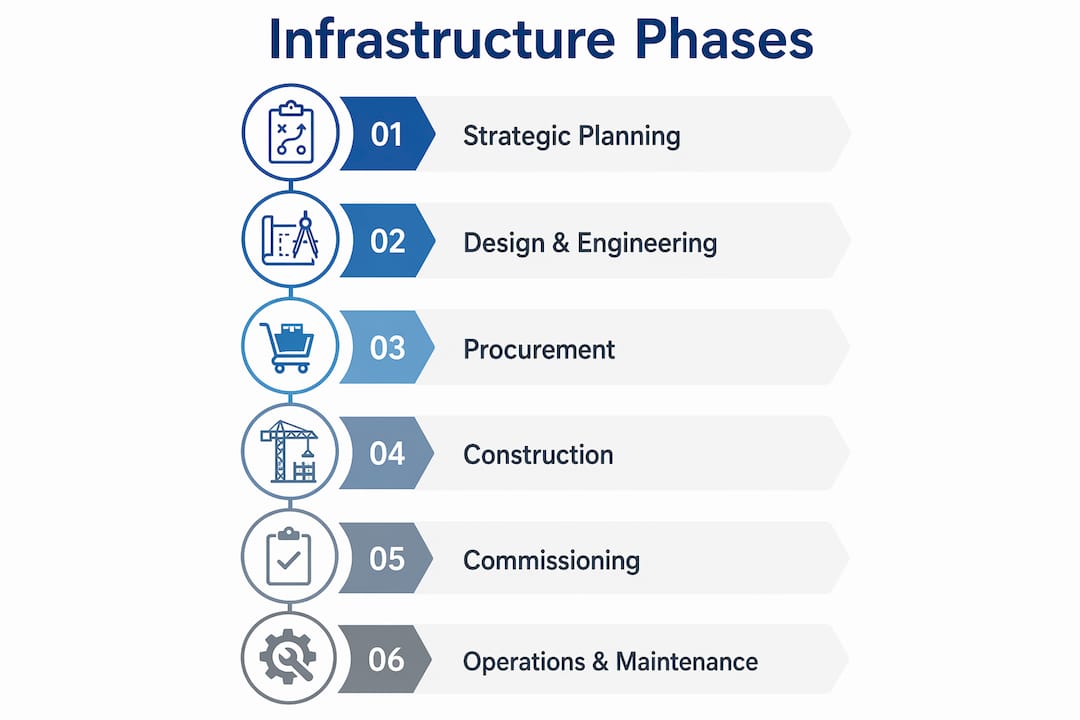
The standard phases and their typical durations are:
-
Strategic planning and needs assessment (1–3 years). This phase defines the project’s purpose, scope, and alignment with socio-economic objectives. Feasibility studies, environmental impact assessments, and funding approvals occur here. Errors at this stage propagate through every subsequent phase.
-
Design and engineering development (2–4 years). Concept design advances through schematic, detailed, and construction documentation stages. Structural, geotechnical, mechanical, and electrical engineering inputs are integrated. Regulatory submissions to relevant authorities begin during this phase.
-
Procurement and contract management. Tender documents are prepared, contractors are selected, and long-lead equipment orders are placed. This phase overlaps with late-stage design and early construction mobilization.
-
Construction and implementation (3–7 years). Physical works are executed on site. This is the most capital-intensive phase, requiring tight coordination between design teams, contractors, and regulatory inspectors.
-
Testing, commissioning, and handover. Systems are tested against design specifications. Defects are rectified. Regulatory sign-offs are obtained before the asset transfers to the operations team.
-
Operations and maintenance (50–100 years). The asset delivers its intended service. Preventive maintenance, periodic upgrades, and eventual repurposing or decommissioning occur within this phase.
| Phase | Typical Duration | Primary Focus |
|---|---|---|
| Strategic planning | 1–3 years | Feasibility, funding, socio-economic alignment |
| Design and engineering | 2–4 years | Technical development, regulatory submissions |
| Procurement | Overlapping | Contractor selection, long-lead equipment |
| Construction | 3–7 years | Physical delivery, quality assurance |
| Commissioning and handover | Variable | Testing, defect rectification, sign-off |
| Operations and maintenance | 50–100 years | Asset performance, preventive maintenance |
The infrastructure project workflow for each phase carries distinct documentation and approval requirements. Professionals who map these requirements at the outset avoid the schedule compression that plagues projects where regulatory submissions are treated as afterthoughts.

How does stakeholder and regulatory management shape the infrastructure project lifecycle?
Stakeholder and regulatory management is not a discrete task assigned to a project manager. It is a continuous discipline that runs in parallel with every technical phase of the lifecycle. Infrastructure projects involve governments, communities, private contractors, utility providers, and environmental agencies, each with distinct interests and legal standing.
The complexity compounds because regulatory requirements evolve over the life of a project. A framework that governs design approval in year one may be superseded by updated standards before construction completes in year seven. Project teams that do not build regulatory monitoring into their governance structure find themselves seeking retrospective approvals, which are consistently more expensive and time-consuming than proactive compliance.
Key dimensions of effective stakeholder and regulatory management include:
- Governance alignment. Project governance frameworks must align asset strategy with the socio-economic objectives of public agencies and funding bodies. Misalignment at the governance level produces scope disputes that stall projects for months.
- Community engagement. Infrastructure projects affect residents, businesses, and ecosystems. Structured community consultation, particularly during planning and design phases, reduces the risk of legal challenges that delay construction.
- Procurement transparency. Public infrastructure procurement carries legal obligations around competitive tendering and conflict-of-interest management. Failures here attract regulatory scrutiny and can void contracts.
- Regulatory submissions. In Singapore, submissions to BCA, LTA, PUB, NEA, and SCDF each follow prescribed formats and timelines. Missing a submission window can delay phase progression by months.
- Risk allocation. Contracts must clearly assign risk between public agencies and private contractors. Ambiguous risk allocation is the single most common source of construction-phase disputes.
Pro Tip: Build a regulatory submissions calendar at the start of the design phase. Map every required submission to its authority, format, and lead time. Review it quarterly and update it whenever regulations change.
Regulatory compliance for architects and engineers in Singapore requires active monitoring of updates from BCA and URA, not just adherence to the standards in force at project inception.
What are the unique challenges and best practices in the construction and implementation phase?
Construction is the phase where planning assumptions meet physical reality, and the gap between the two is almost always larger than anticipated. Effective change management during construction is the single most reliable predictor of whether a project finishes within budget and on schedule.
The construction phase presents several challenges that are specific to infrastructure scale:
- Long-lead procurement. Specialized equipment such as tunnel boring machines, high-voltage switchgear, and custom bridge bearings requires procurement lead times that can exceed 18 months. These items must be ordered before construction begins, based on design drawings that may still be evolving. A delay in confirming equipment specifications directly extends the project’s critical path.
- Site condition variability. Geotechnical surveys provide probabilistic data, not certainties. Unexpected soil conditions, buried utilities, and groundwater levels routinely require design modifications during construction. Teams without a formal change management protocol absorb these modifications as uncontrolled cost growth.
- Multi-contractor coordination. Large infrastructure sites operate with multiple prime contractors and dozens of subcontractors working in sequence and in parallel. Schedule integration across these parties requires a master program that is updated weekly, not monthly.
- Safety management. Infrastructure construction sites carry elevated risk profiles due to confined spaces, heavy plant, and work at height. Safety management systems aligned with Singapore’s Workplace Safety and Health Act are mandatory, not discretionary.
- Quality assurance protocols. Structural concrete, waterproofing membranes, and mechanical installations require inspection and testing at defined hold points. Skipping hold points to recover schedule creates defects that are exponentially more expensive to rectify after handover.
Pro Tip: Assign a dedicated change management engineer on any infrastructure project with a construction value above $50 million. Their sole function is to log, assess, and formally approve or reject every proposed change before work proceeds. This single role consistently prevents budget overruns that dwarf the cost of the position.
Risk assessment in construction must be treated as a living document, updated at every major milestone, not a one-time exercise completed at project kickoff.
Why is the operations and maintenance phase critical to lifecycle cost and asset optimization?
The operations and maintenance phase is the longest stage in the lifecycle of construction projects, spanning 50 to 100 years for most infrastructure assets. Its length alone makes it the dominant cost driver across the full asset life, yet it receives the least attention during early planning.
This imbalance has measurable consequences. Assets designed without explicit consideration of maintenance access, spare parts availability, and system redundancy consistently generate higher operating costs than those where maintainability was a design criterion from the outset. The operations and maintenance phase is critical but often overlooked during early project planning, which is why integrated lifecycle cost management must be embedded in the design brief, not added as a post-handover consideration.
Modern infrastructure governance is shifting toward a different priority. Infrastructure governance increasingly prioritizes enhancing and repurposing existing assets over new construction. This shift has direct implications for how needs assessments are conducted in the planning phase. The default answer to a capacity problem is no longer a new asset. It is an assessment of whether an existing asset can be upgraded, extended, or repurposed at lower lifecycle cost.
Key practices that define effective operations and maintenance management include:
- Digital performance monitoring. Sensor networks, building management systems, and asset management platforms provide real-time data on structural performance, equipment condition, and energy consumption. This data enables predictive maintenance, which reduces unplanned downtime and extends asset life.
- Preventive maintenance scheduling. Structured maintenance programs, aligned with manufacturer specifications and regulatory requirements, prevent the accelerated deterioration that results from reactive-only maintenance.
- Lifecycle cost modeling. Whole-life cost models, updated annually, allow asset owners to make informed decisions about repair versus replacement at each maintenance interval.
- Sustainability integration. Modern infrastructure assets are expected to meet evolving environmental standards throughout their operational life. Retrofitting for energy efficiency and reduced emissions is now a standard component of long-term asset management plans.
| Maintenance approach | Trigger | Cost profile |
|---|---|---|
| Reactive maintenance | Asset failure | High unit cost, unplanned downtime |
| Preventive maintenance | Time or usage interval | Moderate cost, planned downtime |
| Predictive maintenance | Sensor data and condition monitoring | Lower long-term cost, minimal downtime |
Lifecycle cost management and digital monitoring are no longer optional features of sophisticated projects. They are baseline requirements for any asset expected to perform reliably across a multi-decade operational life.
Key Takeaways
The infrastructure project lifecycle is a physics-constrained, phase-gated sequence where decisions made in early planning directly determine the cost and performance of an asset across 50 to 100 years of operation.
| Point | Details |
|---|---|
| Lifecycle spans decades | Infrastructure assets operate for 50–100 years, making early planning decisions the highest-leverage cost factor. |
| Phase gating is non-negotiable | Each phase must meet defined quality and compliance gates before progressing, as reversing poor decisions is disproportionately expensive. |
| Stakeholder management is continuous | Regulatory requirements and stakeholder interests evolve across all phases and require active, structured management throughout. |
| Construction demands change control | Formal change management during construction is the most reliable predictor of on-budget, on-schedule delivery. |
| Operations phase drives total cost | Maintenance and asset optimization across the operational life account for the majority of total lifecycle expenditure. |
Why lifecycle thinking separates good infrastructure projects from costly ones
Having worked across multiple infrastructure projects in Singapore and the broader Asia-Pacific region, the pattern I see most consistently is this: teams invest heavily in design and construction governance, then treat the operations phase as someone else’s problem. The handover package gets filed, the project team dissolves, and the asset owner inherits a system they do not fully understand.
The phase-gated waterfall model exists precisely because infrastructure is a physics-constrained sequence. You cannot pour a foundation twice. You cannot reroute a tunnel after it is bored. Every shortcut taken in requirements validation during planning shows up as a change order during construction, or worse, as a structural deficiency during operations.
What I find most encouraging is the shift toward repurposing existing assets. Governments and asset owners are finally recognizing that a well-maintained 40-year-old bridge or water treatment plant often delivers better value than a new one. That recognition changes how needs assessments are conducted and how early-phase budgets are allocated.
My practical advice for professionals managing long-duration infrastructure projects: build your operations and maintenance team into the design review process from the schematic phase onward. Their input on access panels, spare parts standardization, and system redundancy will save orders of magnitude more than their time costs. Lifecycle thinking is not a philosophy. It is an engineering discipline.
— Aman
How Aectechnicalsg supports infrastructure lifecycle projects
Infrastructure projects in Singapore require precise coordination across multiple regulatory authorities at every phase of the lifecycle. Aectechnicalsg provides engineering consultancy services covering structural and geotechnical engineering, architectural planning, and mechanical and electrical systems, with direct experience managing authority submissions to BCA, LTA, PUB, NEA, URA, and SCDF.
For developers and project teams navigating the design, procurement, and construction phases, Aectechnicalsg handles PE endorsement and authority submissions to keep projects compliant and on schedule. The team’s familiarity with Singapore’s regulatory environment means submission timelines are built into the project program from the outset, not managed reactively. Contact Aectechnicalsg to discuss lifecycle support for your infrastructure project.
FAQ
What is the infrastructure project lifecycle?
The infrastructure project lifecycle is the complete sequence of phases governing an asset from strategic planning through operations and maintenance, typically spanning 50 to 100 years in total duration.
What are the main infrastructure project phases?
The main phases are strategic planning, design and engineering, procurement, construction, commissioning and handover, and long-term operations and maintenance.
Why is the operations and maintenance phase often underfunded?
Operations and maintenance receives less attention during early planning despite being the longest and most cost-significant phase. Integrated lifecycle cost modeling from the design stage is the standard corrective practice.
What is a phase-gated waterfall model in infrastructure projects?
A phase-gated waterfall model is a sequential project management approach where each phase must meet defined quality and compliance criteria before the next phase begins. It is the standard framework for infrastructure projects because physical and regulatory constraints make phase reversal prohibitively expensive.
How does long-lead procurement affect infrastructure project timelines?
Long-lead procurement of specialized equipment can require lead times exceeding 18 months, directly affecting the project’s critical path. These orders must be placed during late design or early construction, based on drawings that may still be evolving, making early procurement planning a schedule-critical activity.