
Singapore requires SS 555, the code aligned with IEC 62305, as the deemed-approved standard for lightning protection, and the Building Control Regulations set a minimum Class III system for most buildings. Higher-risk structures need a formal risk assessment that may push the requirement to Class I or II. Every design must carry Professional Engineer endorsement, and installation and testing fall to a Licensed Electrical Worker before any building can pass its regulatory checks.
TL;DR:
- Most buildings default to Class III protection, which covers a rolling-sphere radius of about 45 meters, but higher-risk structures require a formal risk assessment that can elevate the class.
- A compliant external lightning protection system involves air terminals, dual down conductors, earth-termination systems, and equipotential bonding, with surge protection devices coordinated from the main service entry.
- Design approval must be signed by a Professional Engineer, and installation and testing are legally performed by a Licensed Electrical Worker, both of whom must be properly credentialed before work begins.
- Regular re-inspections every three to five years, along with post-incident checks, are essential to maintain system integrity against corrosion, vibration, and building modifications.
- Submission packages should include PE-endorsed drawings, SPD coordination calculations, earth resistance reports, and comprehensive maintenance plans to meet regulatory expectations.
Table of Contents
- What Are the Lightning Protection Requirements Under Singapore Law?
- Core Technical Design Requirements for a Compliant LPS
- Who Is Qualified to Design and Install Lightning Protection in Singapore?
- Inspection, Testing, and Maintenance: What Keeps an LPS Compliant Over Time
- What Documentation Do Authorities Expect in an LPS Submission?
- Practical Tips That Cut Down Submission Delays
- A Practical View on What Actually Gets Missed
- How Aectechnicalsg Supports Your Lightning Protection Compliance
- Sources
- FAQ
What Are the Lightning Protection Requirements Under Singapore Law?
The legal basis sits in the Building Control (Amendment) Regulations 2026, which requires a lightning protection system (LPS) capable of protecting a building’s structure and its occupants from physical damage caused by a strike. That clause does not specify the engineering detail. It points to a deemed-to-satisfy solution instead, and that solution is SS 555.
The Building and Construction Authority adopted SS 555 as the deemed-approved code, replacing the older CP 33 framework and aligning local practice with IEC 62305. The IES adoption circular confirms Class III as the baseline protection level for typical buildings, with higher classes reserved for higher-risk occupancies. SS 555 is published in four parts, and each governs a different stage of compliance:
- Part 1 covers general principles and defines the four protection classes.
- Part 2 sets out risk assessment procedures, weighing lightning flash density, structure characteristics, and potential consequential loss to determine the required class.
- Part 3 addresses physical damage and life-hazard protection, detailing external and internal LPS functions along with touch and step voltage control.
- Part 4 deals with protection of electrical and electronic systems inside the structure.
Class III applies by default for most commercial and residential developments. A hazardous storage facility, a hospital, or a building with sensitive electronic infrastructure typically triggers a risk assessment under SS 555 Part 2 that can raise the required class rather than defaulting to the baseline.
Core Technical Design Requirements for a Compliant LPS
Lightning protection classes run from I to IV, with Class I offering the tightest capture radius and Class III serving as the everyday baseline. In rolling-sphere terms, Class III corresponds to a sphere radius of roughly 45 meters. Anything that sphere can touch as it rolls across the roof and facade needs an air terminal, a down conductor, or a bonded structural element to intercept the strike before it reaches something vulnerable.
A compliant external system has four working parts:
- Air terminals placed at roof edges, parapets, and high points, sized and spaced to satisfy the rolling-sphere method for the assigned class.
- Down conductors, with a minimum of two independent paths routed on opposite sides of the structure, avoiding sharp bends and maintaining fixings at specified spacing intervals.
- Earth-termination systems, using electrodes, radials, or ring conductors sized to soil resistivity, with resistance values checked at commissioning rather than assumed from a table.
- Equipotential bonding, tying incoming metallic services, structural steel, and other conductive elements to a common earth reference to eliminate dangerous voltage differences during a strike.
Statistic Callout: The Class III Baseline
BCA’s adoption of SS 555 sets Class III, corresponding to an equivalent rolling-sphere radius near 45 meters, as the default protection level for typical Singapore buildings under the IES circular on SS 555 adoption.
Surge protection devices complete the system. Where an external LPS exists, IEC 62305 guidance calls for a Type 1 SPD at the main service entrance, with Type 2 and Type 3 devices coordinated further downstream to protect sensitive equipment and data lines. An external LPS installed without a properly coordinated Type 1 SPD leaves the system incomplete, no matter how well the air terminals and down conductors were designed. Field practice matters too: use copper or copper-clad conductors where long-term corrosion exposure is likely, and never let dissimilar metals sit in direct contact at a bonding point. Rooftop gardens and rooftop-mounted mechanical equipment need explicit coverage in the design; the same IES circular flags’ rooftop gardens as a specific area that gets overlooked during layout.
Who Is Qualified to Design and Install Lightning Protection in Singapore?
Design endorsement and installation sit with two distinct roles, and conflating them is a common source of rejected submissions.
- A Professional Engineer (PE) must review and endorse the LPS design, sign off on the risk assessment summary, and take responsibility for the submission package presented to the authority.
- A Licensed Electrical Worker (LEW), operating under the scope defined in the Electricity (Electrical Workers) Regulations, carries out the physical installation, bonding work, and the testing that proves the system performs as designed.
- International certification programs (UL-style listings, for example) can support product quality claims, but they do not substitute for local PE endorsement or LEW involvement on a Singapore project.
Procurement teams should confirm both credentials exist before work starts, not after the fact. A contractor with excellent international references but no LEW license on the electrical scope cannot legally sign off the testing an authority will ask for.
Inspection, Testing, and Maintenance: What Keeps an LPS Compliant Over Time
Commissioning is where most systems either prove themselves or reveal a shortcut taken during construction. The acceptance checklist typically covers:
- Continuity testing across every down-conductor path.
- Bonding verification at all equipotential connection points.
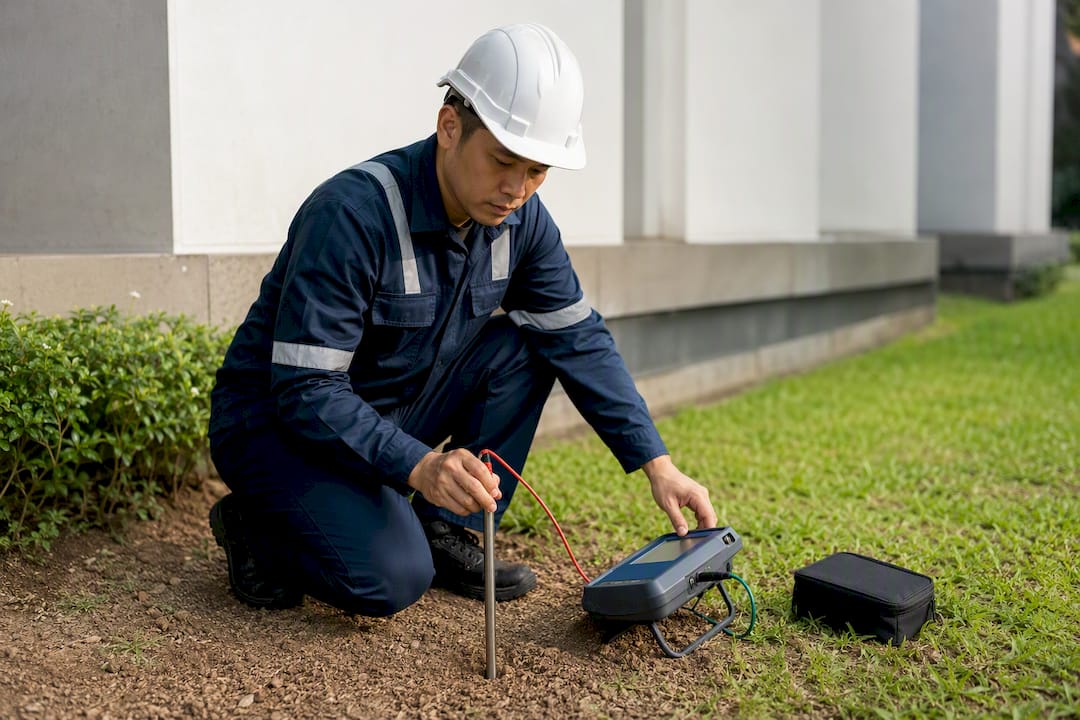
- Earth resistance measurement against the design’s target value.
- SPD coordination checks confirming Type 1, 2, and 3 devices work together rather than in isolation.
After commissioning, periodic re-inspection keeps the system honest against corrosion, vibration, and building alterations. Industry practice, echoed in maintenance guidance from GL Power’s inspection checklist, points to re-inspection roughly every three to five years, plus an unscheduled check after major roofing or facade works, or after a confirmed strike. Common findings include corroded fixings, loosened bonding clamps, and SPDs that have absorbed enough surge events to need replacement.
Pro Tip: Schedule your earth resistance retest for the dry season if possible. Soil moisture swings the reading enough that a passing result in November can look marginal by April, and you want your compliance file to reflect a conservative measurement, not a lucky one.
What Documentation Do Authorities Expect in an LPS Submission?
A submission package that mirrors what reviewers actually check moves faster than one built around what looks impressive. The core documents are:
- PE-endorsed LPS drawings showing air terminal layout, down-conductor routing, and a risk assessment summary consistent with SS 555 Part 2.
- SPD selection and coordination calculations, demonstrating that Type 1, 2, and 3 devices work as a matched system rather than isolated components.
- Earth resistance test reports and LEW installation and inspection certificates confirming the physical work matches the endorsed design.
- A handover pack combining as-built drawings, rolling-sphere coverage diagrams, and maintenance schedules for the building owner’s records.
Drawings that explicitly show rolling-sphere coverage and down-conductor paths, rather than leaving reviewers to infer coverage from a generic layout, tend to draw fewer clarification queries.
Practical Tips That Cut Down Submission Delays
Most rejected LPS submissions share the same handful of gaps. Coordinate earth-termination locations with the structural and civil packages before foundations are poured. Once concrete is placed, an electrode position that seemed convenient on paper can become inaccessible, forcing a redesign that a little early coordination would have prevented.
- Confirm rooftop garden and rooftop M&E equipment layouts against the LPS drawing before final submission.
- Include the PE endorsement note and LEW certificate in the same package, formatted consistently, rather than as separate late additions.
- Present earth resistance and SPD coordination test reports in a layout matching what SCDF and BCA reviewers have seen before.
- Cross-check bonding points against the M&E coordination package so structural steel and service earthing don’t conflict.
A Practical View on What Actually Gets Missed
Most compliance failures on Singapore projects trace back to timing, not technical ignorance. Earth-termination decisions get made too late, after foundations are poured and the cheapest electrode position is already covered in concrete. Get the PE and LEW talking to the structural team before that pour, and the rest of the submission tends to fall into place. If you check one thing before handover, check that bonding continuity and SPD coordination actually match the endorsed drawing, not just the design intent.
— Aman
How Aectechnicalsg Supports Your Lightning Protection Compliance
An engineering consultancy can provide a single point of accountability for lightning protection compliance instead of requiring separate consultants for design, PE endorsement, and authority liaison. They may handle the SS 555 risk assessment, prepare PE-endorsed drawings, coordinate with Licensed Electrical Workers on installation and testing, and assemble submission packages in formats expected by BCA and SCDF reviewers.
That combined approach matters most in the gap between design and site reality, where an unplanned earth electrode or an uncoordinated SPD schedule usually causes the resubmission cycle. Aectechnicalsg’s experience across building code submissions and M&E approvals means the templates for PE notes, LEW certificates, and test reports are already built around what reviewers ask for. If your project needs a lightning protection assessment or a submission-ready package, start with an assessment through the PE endorsement and authority submissions service and get a scoped quote before your next design milestone.
Sources
- Building Control (Amendment) Regulations 2026
- IES circular: Adoption of SS 555:2010 – Code of practice for protection against lightning
- SS 555: Part 2 – Risk management (Preview)
- IEC 62305-1:2024 — Protection against lightning — Part 1: General principles
FAQ
What Is the Singapore Standard for Lightning Protection?
SS 555, published in four parts and aligned with IEC 62305, is the deemed-approved standard adopted by BCA for lightning protection design and installation in Singapore.
What Is the Requirement for Lightning Protection Under Building Control Rules?
The Building Control (Amendment) Regulations 2026 require an LPS capable of protecting a building and its occupants from physical damage caused by lightning, with SS 555 setting a minimum Class III system as the default compliance path.
What Are the Main Standards Referenced for Lightning Protection Design?
SS 555 is the primary local standard, and it maps directly to IEC 62305, the international benchmark covering risk assessment, external and internal protection measures, and surge protective device coordination.
Do You Need to Be Certified to Install Lightning Protection in Singapore?
Yes. Design must carry Professional Engineer endorsement, and physical installation and testing must be carried out under a Licensed Electrical Worker per the Electricity (Electrical Workers) Regulations.
How Often Should a Lightning Protection System Be Inspected?
Industry practice recommends re-inspection roughly every three to five years, along with additional checks after major roofing or facade works or following a confirmed lightning strike.