Mechanical and electrical engineering is frequently misunderstood as a straightforward installation discipline. In Singapore’s construction environment, that assumption leads to costly project delays, failed authority submissions, and serious liability exposure. The real challenge is not installing equipment but navigating an interlocking framework of national standards, SCDF fire safety mandates, BCA submission protocols, and the professional accountability of Qualified Persons and Professional Engineers. This guide addresses each layer of that framework, offering developers and building owners a structured pathway from code familiarity to project completion.
Table of Contents
- Key codes and standards for mechanical and electrical engineering in Singapore
- Integrating fire safety requirements into M&E design
- Roles and responsibilities of Qualified Persons (QPs) and Professional Engineers (PEs)
- Advanced methodologies for M&E project success
- A fresh perspective on engineering consultancy: what really delivers value
- Find the right engineering consultancy partner for your project
- Frequently asked questions
Key Takeaways
| Point | Details |
|---|---|
| Codes drive compliance | Mechanical and electrical standards like SS 553 and SS 638 are essential for lawful, safe construction in Singapore. |
| Fire safety demands reliability | Singapore Fire Code requires N+1 redundancy and strict smoke control for system reliability and occupant safety. |
| Qualified experts matter | Only registered QPs and PEs can legally design, submit, and inspect M&E works for compliance. |
| Modern methodologies add value | BIM, energy modeling, and independent commissioning improve performance and reduce future risk. |
| Consultancy brings insight | Engaging expert consultants protects against hidden risks and unlocks long-term value beyond code compliance. |
Key codes and standards for mechanical and electrical engineering in Singapore
Every M&E engineering decision on a Singapore project traces back to specific codes and standards. Understanding which document governs which system prevents specification errors, authority rejections, and costly design revisions during construction.
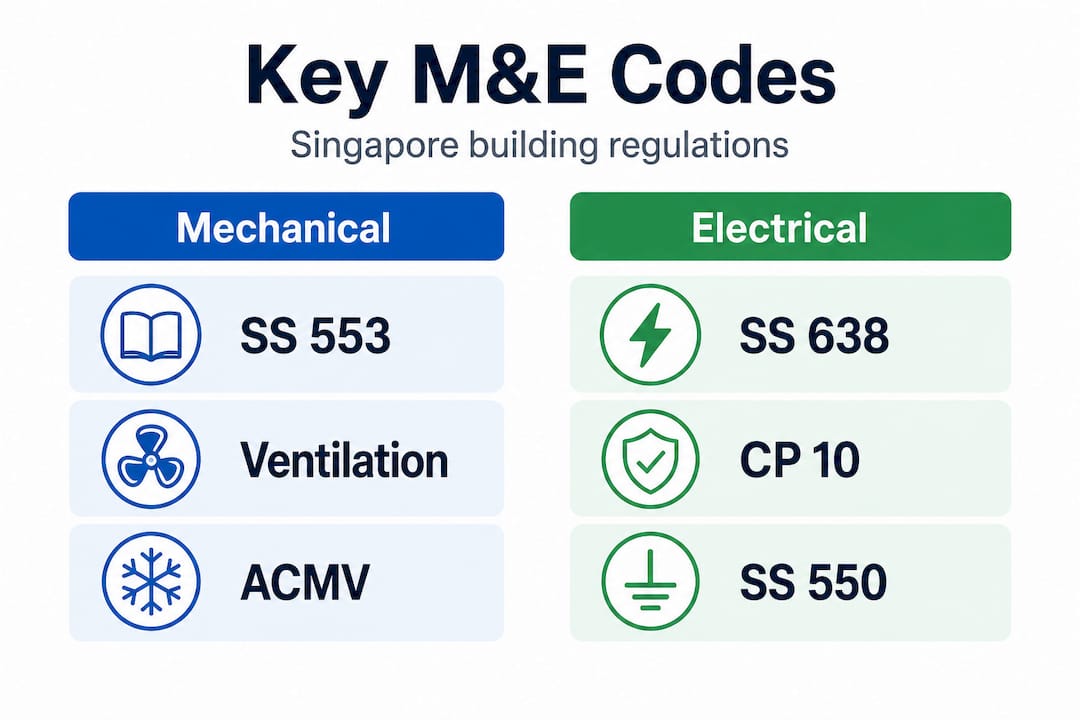
Mechanical systems: SS 553
SS 553 is the Code of Practice for Air-Conditioning and Mechanical Ventilation in Buildings (formerly CP 13), governing mechanical ventilation design and installation for all building types in Singapore. It covers system sizing, air distribution, ductwork design, and outdoor air requirements, and its provisions are referenced directly in BCA plan submissions. Engineers must apply its requirements from the earliest schematic design stage, not as an afterthought during detailed design.
Electrical systems: SS 638, CP 10, and SS 550
Electrical installations are governed by SS 638 (formerly CP 5 or CP 13 variants), which sets out the Singapore Code of Practice for Electrical Installations, including wiring methods, protection coordination, and earthing. SS CP 10 specifically addresses electrical fire alarm systems, covering detection, notification, and control panel requirements. SS 550 governs lifts and escalators, which fall under the M&E scope for most high-rise and commercial projects.
Comparing modern standards to legacy CP variants
Several developers and contractors still reference legacy CP documents from earlier decades, creating a dangerous gap between design intent and current compliance requirements. The transition from CP variants to SS-prefixed standards introduced more stringent technical requirements, updated safety margins, and alignment with international benchmarks such as IEC and ISO frameworks. Relying on outdated references during a 2026 submission is not just an administrative error; it can trigger plan rejection and force redesign at significant cost.
The table below summarizes key code references for quick orientation:
| Discipline | Current standard | Scope |
|---|---|---|
| Mechanical ventilation | SS 553 | ACMV design, ductwork, outdoor air |
| Electrical installation | SS 638 | Wiring, protection, earthing |
| Fire alarm (electrical) | SS CP 10 | Detection, panels, notification |
| Lifts and escalators | SS 550 | Vertical transportation systems |
Pro Tip: Always download standards directly from BCA and SCDF official portals rather than third-party summaries. Codes are revised periodically, and working from an outdated version is one of the most common causes of submission rejection.
The following systems are typically covered within the M&E scope of a Singapore building project:
- Air-conditioning and mechanical ventilation (ACMV)
- Electrical power distribution and lighting
- Fire detection and alarm systems
- Pressurization and smoke control
- Plumbing and sanitary systems
- Vertical transportation (lifts, escalators)
- Building automation systems (BAS)
Incorporating design for safety in engineering principles from the earliest design stage reduces the risk of safety-critical omissions and strengthens authority submission packages.
Integrating fire safety requirements into M&E design
Codes and standards shape the technical playing field, but fire safety demands add another layer of complexity to design and compliance. The Singapore Civil Defence Force (SCDF) Fire Code 2023 introduced updated M&E-specific requirements that affect nearly every building category above a certain occupancy and height threshold.
SCDF Fire Code 2023: key M&E impacts
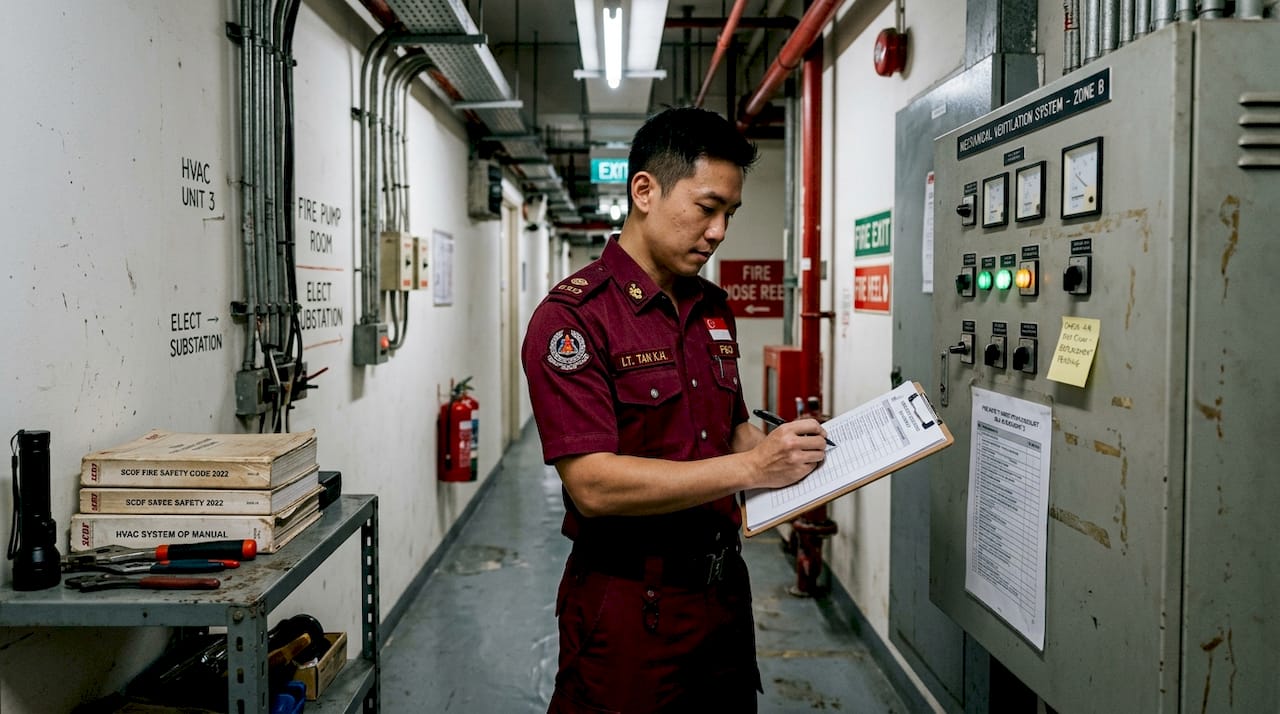
The SCDF Fire Code 2023 mandates specific M&E requirements for mechanical ventilation, smoke control, and pressurization systems in exit staircases and fire lobbies, with N+1 redundancy for critical fans and secondary power supplies. This is not a minor technical footnote. Smoke control systems that fail during a fire event can prevent safe evacuation and impede SCDF operations, creating both life-safety and legal consequences for the building owner.
Critical systems required under the Fire Code
The following systems must be designed and installed to Fire Code specifications on qualifying buildings:
- Pressurization systems for exit staircases and fire fighter lobbies
- Mechanical smoke exhaust systems for basements, atria, and car parks
- Smoke detection and alarm integration with building ventilation
- Emergency lighting and exit sign power circuits
- Secondary power supply for critical life-safety equipment
| System | Fire Code requirement | Consequence of non-compliance |
|---|---|---|
| Staircase pressurization | Minimum pressure differential per Fire Code 2023 | Building occupation permit withheld |
| Smoke exhaust | Dedicated fans with N+1 redundancy | SCDF rejection of fire safety submissions |
| Emergency power | Secondary supply for critical fans | Certificate of Statutory Completion blocked |
Understanding N+1 redundancy
N+1 redundancy means installing one additional unit beyond the minimum number needed to operate the system. If three fans are required to deliver the specified smoke exhaust volume, N+1 mandates four fans, so the system continues to perform correctly if any single fan fails. This requirement reflects a hard-learned lesson from fire incidents globally: systems that rely on minimum-spec equipment without backup fail at the worst possible moment.
“Critical fan systems serving life-safety functions must maintain full performance during equipment failure. N+1 redundancy is not an overdesign preference. It is a code obligation under SCDF Fire Code 2023.”
Some developers question the capital cost of N+1 redundancy during project budgeting. The counterargument is straightforward: the cost of replacing non-compliant equipment after construction, combined with the delay to obtaining a Certificate of Statutory Completion (CSC), consistently exceeds the original cost difference.
Independent RI(M&E) inspections
The Responsible Inspector for M&E, known as RI(M&E), is required to be independent from the design team. This separation exists to prevent self-certification bias, a condition where the engineer who designed the system also inspects it for compliance. For SCDF submission services, engaging a genuinely independent RI(M&E) is not optional. It is a safeguard that protects the developer from certification disputes and enforcement actions.
Pro Tip: Commission a mock SCDF fire safety inspection before the formal submission stage. Identifying pressurization shortfalls or smoke exhaust deficiencies before submission saves both time and authority fee resubmission costs.
Roles and responsibilities of Qualified Persons (QPs) and Professional Engineers (PEs)
Once fire safety requirements are integrated, building compliance hinges on professionals who manage submissions and ensure every technical detail is certified. Singapore’s regulatory framework assigns specific accountability to Qualified Persons and Professional Engineers, and the distinction between these roles has direct consequences for project delivery.
Qualifications and registration
A Qualified Person (QP) for M&E works must be a registered Professional Engineer (PE) with the Professional Engineers Board (PEB), holding a practicing certificate in a relevant mechanical or electrical engineering discipline. PEB and BCA registration are mandatory for both design authority submissions and site inspections. The BCA Directory lists all registered M&E contractors eligible to carry out licensed installation works, which developers must verify before appointment.
Step-by-step duties from design to completion
The sequence of professional responsibilities on a typical M&E project follows this order:
- Schematic design: QP/PE prepares design intent drawings and coordinates with architect and structural engineer on spatial and load requirements.
- Detailed design: Full M&E drawings, specifications, and calculations are produced to code requirements.
- Authority submission: Plans are submitted via CORENET, Singapore’s building plan submission platform. The QP/PE is the registered submitter and assumes liability for the submission.
- Construction supervision: The PE supervises or appoints a site supervisor to oversee installation to approved drawings.
- RI(M&E) inspection: An independent Responsible Inspector conducts staged and final inspections, certifying that installed systems match approved plans.
- Completion documentation: The PE submits completion certificates, test reports, and commissioning records to BCA and SCDF as required.
Understanding the role of professional engineers is essential for developers who want to set realistic timelines and avoid accountability gaps in their project teams.
CORENET and streamlined compliance
CORENET is the digital submission portal through which all building plans, including M&E, are submitted to BCA and other agencies. The system requires that submissions be made by a registered QP, and all associated documentation must meet current code requirements before submission. Developers who understand how CORENET works can better coordinate with their QP/PE to avoid the common reasons for rejection in PE submissions, which frequently include incomplete calculations, missing authority clearances, and non-compliant drawing formats.
Pro Tip: Engage your M&E QP/PE during the architectural concept stage, not after the layout is frozen. Late M&E coordination is the primary driver of costly design changes and submission delays. Reviewing the full range of engineering consultancy types available in Singapore helps developers select the right team structure for their project’s specific requirements.
For a structured overview of how M&E workflows are organized from inception to handover, the M&E workflow guide provides a practical framework for project planning.
Advanced methodologies for M&E project success
With qualified experts and the right submissions, advanced methodologies take engineering beyond basic compliance toward reliability and efficiency. Singapore’s more technically demanding projects, particularly high-rise commercial developments, industrial facilities, and healthcare buildings, require methodologies that deliver measurable performance outcomes, not just code-minimum installations.
BIM and energy modeling
Building Information Modeling (BIM) enables the M&E team to coordinate mechanical, electrical, and plumbing (MEP) systems in a shared three-dimensional model. BIM coordination identifies spatial clashes between ductwork, pipe runs, cable trays, and structural elements before construction begins, eliminating costly on-site rework. On larger commercial projects in Singapore, BIM submission to BCA is already mandatory above certain gross floor area thresholds.
Energy modeling complements BIM by simulating a building’s Energy Use Intensity (EUI) under various design scenarios. This allows engineers to optimize chiller plant configurations, air handling unit selections, and lighting power densities before finalizing specifications. Projects targeting Green Mark certification from BCA depend on energy modeling outputs to demonstrate compliance with efficiency benchmarks.
Post-construction commissioning
Commissioning is the process of verifying that all installed M&E systems perform to their design specifications under actual operating conditions. It involves balancing air flows, testing protection relay settings, verifying life-safety system response times, and documenting baseline performance data for facilities management. Many developers treat commissioning as a final checkbox. In practice, it is where design intent either gets confirmed or exposed as unrealized.
Commissioning failures discovered after handover are expensive to correct and can delay CSC issuance. A structured commissioning plan, developed alongside the design, reduces this risk substantially.
Retrofit considerations and long-term value
Buildings with aging M&E systems face a decision point between piecemeal maintenance and systematic upgrading to current standards. The Maintenance, Enhancement, and Improvement (MEI) framework that Singapore building owners increasingly work within places responsibility on owners to demonstrate ongoing building performance. Retrofit projects that align with current codes and modern efficiency standards generate long-term savings in energy costs, reduced maintenance downtime, and sustained asset value.
Inspections of the building envelope, including drone facade inspection methodologies, are increasingly integrated with M&E assessment programs to provide a complete picture of building performance and compliance status.
Why authoritative sources matter
Many developers rely on informal summaries or secondary website references when researching M&E requirements. This approach is unreliable. Singapore’s codes are updated on defined revision cycles, and technical requirements can change significantly between editions. BCA and SCDF primary documents are the only authoritative references for compliance decisions. Using secondary sources risks building a design on superseded or misinterpreted requirements.
A fresh perspective on engineering consultancy: what really delivers value
There is a persistent assumption in Singapore’s construction market that engaging the minimum required level of professional oversight protects the developer’s budget. Experienced consultants understand that this logic almost always reverses itself by the time a project reaches the inspection or handover stage.
Independent RI(M&E) inspections are the clearest example of this dynamic. Developers who appoint a single firm to both design and inspect their M&E systems save a modest fee at appointment but expose themselves to unchallenged design errors that pass through inspection without scrutiny. When a building operator reports a pressurization failure two years into occupancy, the accountability trail points directly back to a certification process that was never truly independent.
N+1 redundancy follows the same logic. The capital cost of one additional fan unit is often contested at the value engineering stage. Yet a single smoke exhaust system failure during an SCDF inspection means complete retesting, extended construction schedules, and in serious cases, redesign. The cost of that outcome far exceeds the avoided expenditure on the redundant fan.
The real value of consultancy firms in Singapore lies not in producing the minimum compliant documentation set. It lies in identifying what the minimum will miss and designing ahead of that risk. Modern methodologies like BIM coordination and energy modeling are not premiums for sophisticated clients. They are tools that prevent the expensive surprises that minimum-spec project delivery consistently produces.
Developers who invest in experienced, independent M&E consultancy from the project outset consistently achieve faster authority approvals, fewer construction variations, and more reliable building performance over the asset’s operating life.
Find the right engineering consultancy partner for your project
Applying the standards, fire safety requirements, and professional obligations covered in this guide requires a consultancy team with both technical depth and regulatory experience specific to Singapore’s authority submission processes.
AECTechnicalSG provides M&E engineering consultancy services aligned with Singapore’s current compliance framework, including design for safety consultancy and structured engineering consultancy options tailored to project scale and building type. For projects with complex fire safety requirements, the firm offers fire engineering solutions that address performance-based design requirements and SCDF submissions. Whether your project is a new development, a change-of-use submission, or a retrofit of existing M&E systems, engaging the right consultancy partner early in the process is the single most effective step a developer or building owner can take toward a successful outcome.
Frequently asked questions
What are the main mechanical and electrical standards for Singapore construction?
SS 553 governs mechanical ventilation design and installation, while SS 638, SS CP 10, and SS 550 are the key codes for electrical installations, fire alarm systems, and lifts respectively.
Who must carry out M&E submissions and inspections according to regulations?
Only Qualified Persons or Professional Engineers registered with PEB and listed in the BCA Directory can submit M&E designs via CORENET and carry out the required inspections for building compliance.
What is N+1 redundancy and why is it required?
N+1 means providing one additional unit beyond the minimum number needed for system operation. The SCDF Fire Code 2023 mandates N+1 redundancy for critical fans and secondary power supplies to ensure life-safety systems remain functional during equipment failure.
Why are independent inspections important for M&E compliance?
Independent RI(M&E) inspections prevent self-certification bias by separating the designer and reviewer roles, ensuring that installed systems are evaluated objectively against approved drawings and code requirements.
Where can I find official guidance and updates for Singapore M&E codes?
BCA and SCDF websites are the authoritative sources for all current codes, and building code resources such as official standards documents and BCA circulars provide the most reliable guidance for compliance decisions.
Recommended
- Streamline M&E engineering workflow in Singapore: full guide
- Performance-Based Seismic Design for Tall Buildings SG
- PE endorsement for renovation works in Singapore – AEC Technical Advisory Singapore Engineering Consultancy
- Understanding The Role Of Professional Engineers In Ensuring Building Safety And Compliance In Singapore – AEC Technical Advisory Singapore Engineering Consultancy