
M&E engineering submission steps are a phased, regulatory-driven process that every construction professional in Singapore must execute correctly to secure authority approvals. The process covers five distinct phases: schematic design, design development, construction documents, tender and procurement support, and construction administration. Regulatory bodies including BCA, SCDF, PUB, and NEA each impose specific documentation standards, and the CORENET e-submission platform governs how most filings reach the relevant authorities. Missing a single checklist item at any phase can trigger a rejection that delays the entire project program.
What are the M&E engineering submission steps in Singapore?
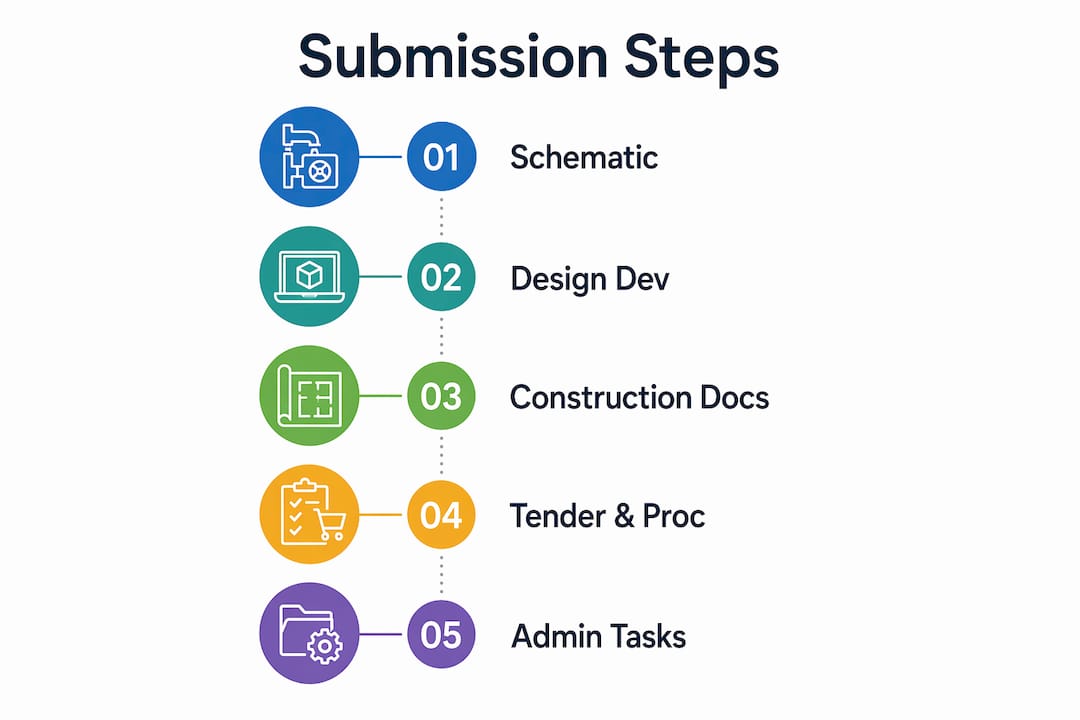
The M&E engineering submission process is defined by five sequential phases, each with distinct deliverables that build on the previous stage. Understanding this structure prevents teams from treating submission as a single event rather than a continuous workflow.
The five phases are:
- Schematic Design — Establishes the basis of design, confirms equipment locations, and defines system concepts for mechanical, electrical, and plumbing disciplines.
- Design Development — Advances system routing, resolves interdisciplinary clashes, and confirms spatial requirements with architectural and structural teams.
- Construction Documents — Produces permit-ready drawings, final engineering calculations, and full technical specifications for authority submission.
- Tender and Procurement Support — Prepares tender documentation, responds to contractor queries, and evaluates equipment submittals against the design intent.
- Construction Administration — Manages RFIs, reviews shop drawings, conducts site inspections, and verifies that installation matches the approved design.
According to the five-phase M&E workflow, site verification during construction administration is the final check that confirms design intent compliance before handover. That verification step is not optional. It is the mechanism that closes the loop between the approved submission package and what is physically built.
What prerequisites and quality checks are required before formal submission?

An internal quality control review is the single most important step before any formal submission package leaves the office. Skipping this review is the leading cause of plan check rejections in Singapore M&E projects.
The pre-submission checklist must cover:
- Drawing consistency — All plans, sections, and details must reference the same revision number and carry matching legends.
- Calculation verification — HVAC load calculations, electrical load schedules, and pipe sizing calculations must be checked against the final equipment selections.
- Equipment schedules — Every piece of equipment listed in the schedule must appear on the drawings with matching tag numbers and specifications.
- Emergency power definition — Critical circuits must be clearly identified, with transfer switch logic confirmed and documented.
- Labeling completeness — All systems, panels, and distribution boards must carry labels that match the single-line diagrams.
- Architectural and structural coordination — Ceiling heights, slab penetrations, and shaft allocations must be confirmed with the architectural and structural teams before submission.
Interdisciplinary coordination deserves particular attention. Vertical shaft and plenum space mismatches between M&E, architecture, and structure at the schematic stage produce expensive redesigns and construction delays. Catching these conflicts before submission costs a fraction of what they cost to resolve on site.
Pro Tip: Schedule a formal interdisciplinary coordination meeting at the end of design development, before construction documents begin. Require each discipline lead to sign off on the coordination matrix. That sign-off creates accountability and eliminates the “I didn’t know” problem during construction.
Verifying calculation accuracy for HVAC, electrical, and pipe sizing also supports insurance underwriting and client approval processes. Regulators and insurers both expect engineering proofs to accompany the submission package.
How does each submission phase work, from schematic design to construction administration?
Each phase of the M&E engineering process produces specific deliverables. The table below summarizes what each phase requires and who owns it.
| Phase | Key Deliverables | Responsible Role |
|---|---|---|
| Schematic Design | Basis of design report, system concept drawings, equipment location plans | Lead M&E Engineer |
| Design Development | Coordinated routing drawings, clash resolution reports, space allocation confirmation | M&E Coordinator |
| Construction Documents | Permit-ready drawings, final calculations, technical specifications, authority submission package | M&E Engineer + QC Reviewer |
| Tender and Procurement Support | Tender drawings, bill of quantities, contractor query responses, equipment submittal reviews | M&E Engineer + Project Manager |
| Construction Administration | RFI responses, shop drawing reviews, site inspection reports, as-built coordination | Site Inspector + M&E Engineer |
Schematic design outputs
The schematic design phase produces the basis of design document, which defines system types, capacities, and equipment locations. This document governs every downstream decision. Changing a fundamental system choice after schematic design is approved typically triggers a full redesign of the affected discipline.
Design development focus
Design development is where M&E engineering documentation becomes detailed enough to identify real clashes. The team confirms duct routing, pipe runs, cable tray paths, and vertical shaft allocations. Any conflict with structural beams or architectural ceiling heights must be resolved at this stage, not during construction.

Construction documents for authority submission
Construction documents are the permit-ready package submitted to BCA, SCDF, PUB, or NEA depending on the system type. These drawings must carry the Professional Engineer’s stamp, revision history, and all required legends. Technical specifications must reference the applicable Singapore Standards and code editions in force at the time of submission.
Pro Tip: Prepare a submission cover letter that lists every drawing number, calculation reference, and specification section included in the package. Reviewers at BCA and SCDF use this list to check completeness. A clear cover letter reduces back-and-forth queries by giving reviewers a structured index.
Tender and procurement support
During tendering, the M&E engineer responds to contractor queries and evaluates proposed equipment substitutions. Every substitution must be checked against the original design parameters before approval. Accepting an undersized chiller or a non-compliant switchboard at this stage creates a compliance problem that surfaces during commissioning.
Construction administration tasks
Construction administration is the most active phase for the M&E project review process. The engineer reviews shop drawings, responds to RFIs, and conducts periodic site inspections. Each inspection report must document observed conditions against the approved drawings and flag any deviations for immediate resolution.
How to manage coordination and version control during M&E submission
Coordination drawings and installation drawings serve different purposes and must never be confused. Coordination drawings function as contractual agreements between disciplines. Installation drawings are stripped of coordination markups and prepared for site use, with accurate centerline and grid alignment for the installation team.
The distinction matters because a site team working from a coordination drawing may encounter conflicting annotations that cause incorrect installation. Issuing clean installation drawings prevents that confusion.
Version control best practices include:
- Revision stamps on every sheet — Each drawing must carry a revision number, date, and description of changes made.
- Engineering review sign-offs — Every revision must carry the reviewing engineer’s signature before issue.
- Superseded drawing withdrawal — Outdated revisions must be formally withdrawn from circulation and marked “Superseded” in the document register.
- Single-source document register — All disciplines must reference one master register to prevent teams from working from different revision sets.
Version-stamping all submission documents with engineering review sign-offs reduces the risk of submission rejections and prevents operational confusion during the building’s life cycle. Regulators expect a clear document trail that shows how the design evolved from schematic to permit-ready.
Process layering with clear role assignment among designers, coordinators, and site inspectors reduces costly construction clashes. Design clashes that are not caught during coordination cost significantly more to fix during construction than during the design phase. Assigning explicit ownership of each coordination task to a named individual is the most reliable way to prevent gaps.
Pro Tip: Use a subcontractor reliability checklist to verify that each trade contractor has received and acknowledged the current revision of every drawing relevant to their scope. That acknowledgment becomes a contractual record if disputes arise later.
What are the common challenges during the M&E submission process?
Design conflicts between M&E disciplines and the architectural or structural design are the most frequent source of submission delays. These conflicts typically surface when coordination is deferred to the construction documents phase rather than resolved during design development.
Common challenges include:
- Inadequate internal QC — Submissions with calculation errors or missing equipment schedules are returned by BCA or SCDF with plan check comments that require formal resubmission.
- Interdisciplinary coordination failures — Unresolved clashes between ductwork and structural beams force costly redesigns and program delays.
- RFI backlog during construction — Poor construction documents generate high RFI volumes that slow site progress and increase the engineer’s workload.
- Commissioning failures at handover — Systems that were not tested against the Owner’s Project Requirements during design produce performance deficiencies that are expensive to correct after occupation.
Integrating commissioning from the design phase using the Owner’s Project Requirements is widely regarded as the most effective way to prevent performance failures at handover. Early commissioning involvement significantly reduces post-construction system performance issues and avoids costly post-occupancy corrections.
Resolving plan check comments efficiently requires a structured response matrix. Each comment must be addressed with a specific drawing revision or calculation update, not a general narrative. Regulators expect direct, traceable responses that link each comment to the corrected document.
Pro Tip: Engage your M&E consultant at the schematic design stage, not after architectural design is complete. Early engagement allows the consultant to flag spatial conflicts and regulatory requirements before they are locked into the design, which is the single most effective risk mitigation available to project developers.
Key Takeaways
A compliant M&E engineering submission requires a structured five-phase workflow, rigorous internal quality control, and clear role assignment across all disciplines from schematic design through construction administration.
| Point | Details |
|---|---|
| Five-phase structure | Every submission follows schematic design, design development, construction documents, tender support, and construction administration in sequence. |
| Pre-submission QC | Verify calculations, equipment schedules, labeling, and interdisciplinary coordination before any package leaves the office. |
| Coordination vs. installation drawings | Keep coordination drawings separate from installation drawings to prevent site confusion and incorrect installation. |
| Version control discipline | Stamp every revision, obtain sign-offs, and maintain a single-source document register across all disciplines. |
| Early commissioning integration | Integrate commissioning requirements from the design phase to prevent performance failures at handover. |
Why process ownership defines M&E submission outcomes
The most consistent mistake I see on Singapore M&E projects is treating submission as an administrative task rather than an engineering discipline. Teams rush to produce drawings without first confirming that the design is spatially coordinated, that calculations are complete, and that every regulatory requirement for the specific authority has been addressed. The result is a rejection letter that sets the program back by weeks.
What actually works is strict process ownership. Every phase needs a named engineer who is accountable for the deliverables, the quality check, and the coordination sign-off. When that accountability is diffuse, things fall through. When it is explicit, the submission package arrives at BCA or SCDF in a condition that reviewers can approve without extensive back-and-forth.
The regulatory environment in Singapore has also become more demanding. Authorities now expect digital submissions through CORENET with complete documentation packages, not partial sets with promises of follow-up. That shift rewards teams who invest in documentation discipline early and penalizes those who treat it as an afterthought.
The M&E compliance requirements for Singapore buildings are detailed and authority-specific. The teams that navigate them successfully are the ones who build the submission checklist into their project program from day one, not the ones who assemble it under deadline pressure.
— Aman
How Aectechnicalsg supports compliant M&E engineering submissions
Aectechnicalsg provides engineering consultancy services to project developers and construction firms across Singapore who need structured, authority-ready M&E submission packages.
The team at Aectechnicalsg manages the full submission workflow, from schematic design coordination through construction administration, with direct experience across BCA, SCDF, PUB, NEA, and JTC submissions. Every package is prepared against the current Singapore Standards and CORENET requirements, with internal QC reviews built into each phase. For developers who need a clear path through the project submission requirements or want to confirm their design for safety obligations, Aectechnicalsg offers consultancy engagements sized to the project scope.
FAQ
What are the five phases of M&E engineering submission?
The five phases are schematic design, design development, construction documents, tender and procurement support, and construction administration. Each phase produces specific deliverables that must be completed before the next phase begins.
Which Singapore authorities review M&E engineering submissions?
BCA, SCDF, PUB, NEA, and JTC each review M&E submissions depending on the system type and project location. Most submissions are filed through the CORENET e-submission platform.
What is the most common reason for M&E submission rejection?
Incomplete or inconsistent documentation is the most frequent cause of rejection. Missing calculation references, unresolved interdisciplinary clashes, and incorrect revision numbers all trigger plan check comments that require formal resubmission.
How early should commissioning be integrated into the M&E process?
Commissioning should be integrated from the schematic design phase using the Owner’s Project Requirements. Early integration significantly reduces performance failures at handover and avoids costly post-occupancy corrections.
What is the difference between coordination drawings and installation drawings?
Coordination drawings are interdisciplinary documents that resolve clashes between systems. Installation drawings are stripped of coordination markups and prepared for site use, with accurate grid alignment for the installation team.